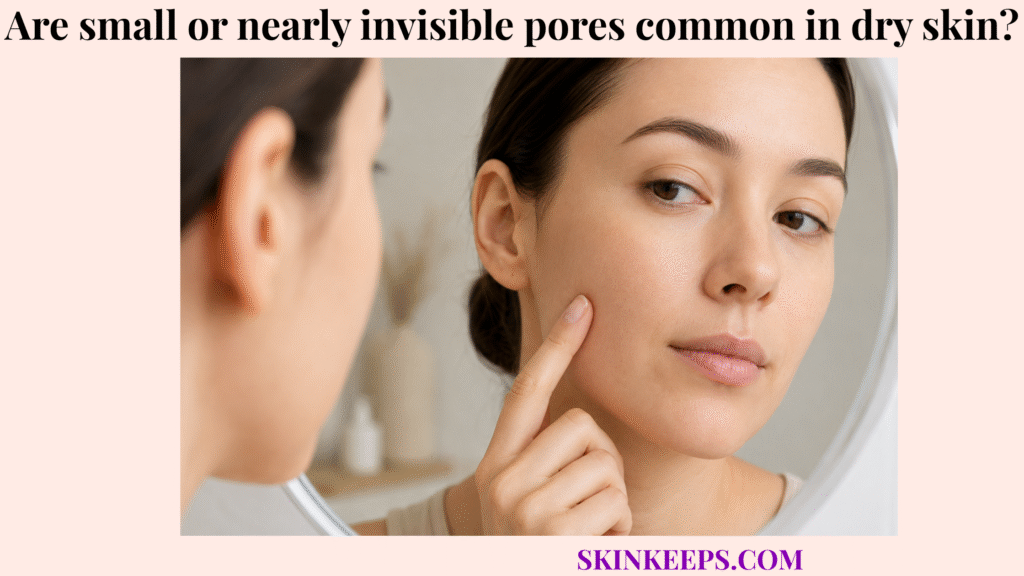
Yes, Small or nearly invisible pores are common in dry skin because lower sebum output gives pore openings less oily shine, congestion, and visual prominence. This reduced pore visibility can make dry skin look less pore-dense than oily skin, especially in areas that do not produce much surface oil.
This guideline explains why dry-skin pores may look small or nearly invisible, how pore visibility differs from skin texture, how dry-skin pores compare with oily-skin pores, which misconceptions to avoid, how to care for dry skin with small pores, and when dryness signs around small pores need professional attention.
Why are small or nearly invisible pores common in dry skin?
Small or nearly invisible pores are common in dry skin because lower oil flow makes pore openings less shiny, less filled, and less visually emphasized. This reduced sebum film means light does not highlight the pore openings as strongly. As a result, dry-skin pores can appear flatter or less noticeable.
This pore pattern is only one visual clue. Dry skin may have less prominent pores while still showing roughness, dullness, flakes, tightness, or irritation. Readers who need the broader pattern can compare this page with visible characteristics of dry skin.
How lower sebum output reduces visible pore prominence
Lower sebum output reduces visible pore prominence by giving the pore opening less oil, shine, and buildup to make it stand out. Sebum can act like a visual amplifier when it collects around pore openings. When that oil signal is lower, pores can look flatter or harder to see.
Why dry skin lacks the oily shine that makes pores stand out
Dry skin lacks the oily shine that makes pores stand out because its surface usually reflects less light from sebum-coated pore openings. Without that shiny film, pore borders may look less obvious. This does not mean dry skin has no pores or can never have buildup; it only means the pore pattern may be less visible.
| Dry-Skin Factor | What Happens | Visible Result |
|---|---|---|
| Lower sebum output | Less oil reaches the pore opening | Pores look less prominent |
| Less surface shine | Light does not highlight pore openings as much | Pores appear flatter |
| Less oil congestion | Pores are less likely to look filled or dark | Smaller-looking pore pattern |
| Surface dryness | Texture may look rough despite small pores | Small pores but uneven surface |
| Lower greasy film | Skin has less oily reflection | Pore borders look less obvious |
How is pore visibility different from skin texture?
Pore visibility is different from skin texture because pores describe how noticeable openings look, while texture describes whether the surface feels smooth, rough, flaky, tight, or uneven. A person can have small pores and still have rough dry skin. This distinction matters because pore size does not prove barrier comfort.
Dry skin may look low-pore but still feel uncomfortable. Roughness, dullness, flaking, and tightness can remain even when pores are nearly invisible. If the main issue is coarse or flat-looking skin, the page on dull or rough dry skin may better match the concern.
Why dry skin can have small pores but still feel rough
Dry skin can have small pores but still feel rough because low pore visibility does not prevent surface moisture loss or uneven dry texture. Pores may be hard to see while the surrounding surface feels coarse. The roughness belongs to the outer surface, not to pore size alone.
Why invisible pores do not cancel out flaking, scaling, or tightness
Invisible pores do not cancel out flaking, scaling, or tightness because those signs come from dry-surface barrier stress rather than pore prominence. A low-oil surface can still shed, sting, or feel tight. This is why skin comfort matters more than chasing less visible pore openings.
| Feature | Small Pores | Smooth Skin |
|---|---|---|
| Main meaning | Pores are not visually prominent | Surface texture is even and comfortable |
| Common in dry skin? | Yes | Not always |
| Can coexist with roughness? | Yes | No, roughness disrupts smoothness |
| Diagnostic value | Helps identify lower oiliness | Reflects better surface comfort |
| Main limitation | Does not prove healthy skin | Can change with dryness or irritation |
How do dry-skin pores differ from oily-skin pores?
Dry-skin pores differ from oily-skin pores because dry skin usually has lower sebum emphasis, while oily skin often has more visible, shiny, or congestion-prone pore openings. Less oil can make dry-skin pores appear smaller. More oil can make oily-skin pores look more prominent.
This comparison should stay focused on pore appearance. Dry skin is more likely to show roughness, flaking, tightness, and fine lines, while oily skin is more likely to show shine, blackheads, and congestion. If small pores appear with shallow visible lines, the guide on fine lines on dry skin can help explain that separate surface effect.
| Feature | Dry Skin | Oily Skin |
|---|---|---|
| Pore visibility | Often small or less noticeable | Often more visible or enlarged-looking |
| Sebum level | Lower | Higher |
| Surface shine | Usually lower | Usually higher |
| Texture concern | Roughness, flaking, fine lines | Shine, blackheads, congestion |
| Main care need | Moisture and barrier support | Oil control without stripping |
| Misreading risk | Small pores mistaken for healthy skin | Visible pores mistaken for dirt |
Can dry skin still look uneven even when pores are small?
Dry skin can still look uneven even when pores are small because roughness, flakes, dullness, and tightness come from surface dryness rather than pore size. The pores may be hard to see, but the surrounding surface can still look patchy or uncomfortable. This is why pore visibility should not be used as the only skin-health clue.
The care goal is not to make pores disappear. The care goal is to support barrier comfort, surface flexibility, and a smoother-looking dry skin surface. If small pores appear with loose dry pieces, the article on flaking and scaling in dry skin can help explain that visual shedding pattern.
| Visual Pattern | What It Means |
|---|---|
| Small pores with roughness | Texture dryness is still present |
| Small pores with dullness | Surface smoothness may be reduced |
| Small pores with flakes | Dry shedding is affecting the surface |
| Small pores with tightness | Barrier comfort may be low |
| Small pores with cracks | Dryness may be more advanced |
| Small pores with irritation | The issue is barrier stress, not pore size |
What misconceptions do people have about small pores and dry skin?
People often misunderstand small pores and dry skin by assuming that less visible pores automatically mean smooth, healthy, low-maintenance skin. This assumption ignores the surface dryness that can make the same skin feel rough, tight, or irritated. Small pores describe pore appearance, not total barrier health.
Another mistake is believing that pores can be permanently opened, closed, or erased. Pore appearance can look more or less noticeable, but pores remain normal skin structures. The better goal is comfortable dry skin, not artificial pore invisibility.
| Misconception | Better Explanation |
|---|---|
| Small pores mean perfect skin | Dry skin can still be rough, flaky, or irritated |
| Nearly invisible pores mean no skincare is needed | Dry skin often needs barrier support |
| Pores can permanently open or close | Pore appearance can change, but pores are normal structures |
| Dry skin never gets clogged pores | Dry skin can still get buildup, especially from heavy products |
| Small pores mean smooth texture | Texture and pore visibility are separate clues |
| Poreless skin is the goal | Comfortable barrier function is the better goal |
How should dry skin with small pores be cared for?
Dry skin with small pores should be cared for by focusing on gentle cleansing, consistent moisturizer, barrier support, and surface comfort rather than pore shrinking. Small pores do not remove the need for hydration and barrier care. The surface still needs support if it feels rough, tight, flaky, or irritated.
Care should stay gentle because dry skin can become more uncomfortable when over-scrubbed or over-exfoliated. Moisturizer after washing helps support the surface before tightness returns. If dry skin develops split-looking lines instead of only small pores, the guide on cracked riverbed appearance can help explain that more advanced pattern.
Why moisturizer matters even when pores are small
Moisturizer matters even when pores are small because dry skin can lack surface comfort and water support despite having low pore visibility. Small pore openings do not prevent tightness, roughness, or flaking. Moisturizer supports the dry surface rather than changing the normal structure of pores.
Why pore shrinking should not be the care goal
Pore shrinking should not be the care goal because dry skin with small pores usually needs barrier comfort, not smaller-looking openings. Pores are normal structures, and their appearance can vary with oil, light, buildup, and texture. The better goal is a calmer, smoother-feeling dry surface.
Why over-exfoliating small-pored dry skin can backfire
Over-exfoliating small-pored dry skin can backfire because friction and irritation can worsen roughness, tightness, and visible dryness. A low-pore surface can still become sensitive when the barrier is overworked. Gentle care