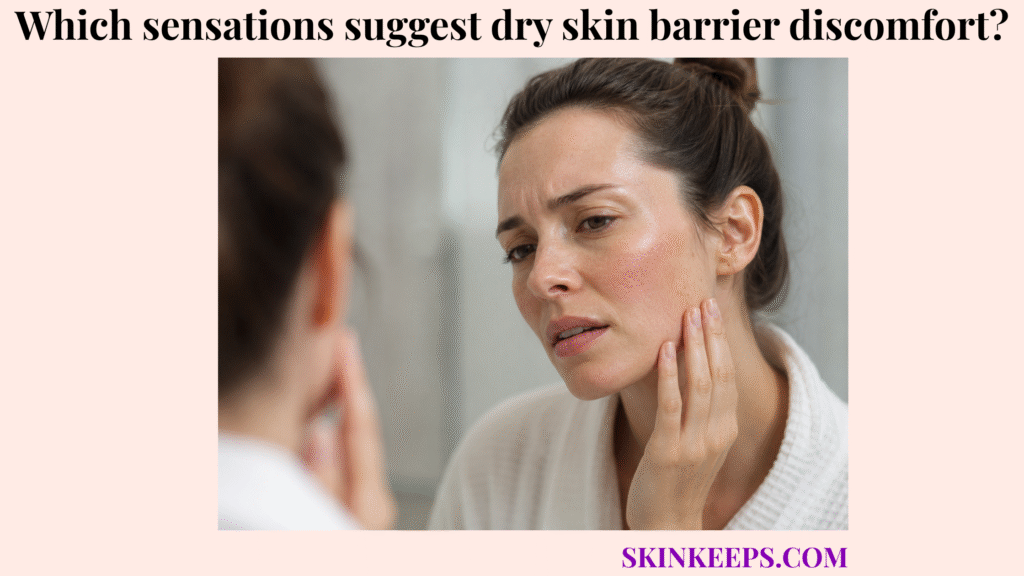
Dry skin barrier discomfort is commonly suggested by tightness, itching, stinging, burning, rough discomfort, soreness, or increased sensitivity after washing or applying products. These sensations usually point to a surface barrier that is dry, less flexible, or more reactive than usual.
This guideline explains what dry skin barrier discomfort feels like, why washing can trigger tightness, why itching, stinging, or burning can appear, how dry barrier discomfort differs from dermatitis or allergy-like reactions, which triggers worsen the sensations, how to calm the barrier, and when symptoms need professional evaluation.
What sensations most clearly suggest dry skin barrier discomfort?
The sensations that most clearly suggest dry skin barrier discomfort are tightness, itching, stinging, burning, rough discomfort, soreness, and increased sensitivity after cleansing or skincare use. These sensations usually come from an outer layer that has lost moisture support or has become irritated. The pattern is more meaningful when discomfort appears repeatedly after washing, weather exposure, or product use.
Not every dry-skin sensation has the same meaning. Mild tightness may suggest surface moisture loss, while burning, pain, swelling, or oozing can suggest stronger irritation or a condition that should be checked. If the discomfort appears with visible dryness, compare it with the guide on visible characteristics of dry skin.
Why tightness is one of the earliest dry-barrier sensations
Tightness is one of the earliest dry-barrier sensations because moisture loss reduces surface flexibility and makes the skin feel stretched after washing or exposure. This does not mean tightness confirms a disease. It usually means the surface is under-supported and less able to feel comfortable during normal facial movement, washing, or cold-weather exposure.
Why itching often appears when dry skin loses moisture
Itching often appears when dry skin loses moisture because the outer barrier becomes less comfortable and more reactive to friction, weather, and skincare contact. Itch can be part of ordinary dryness, but severe, persistent, or sleep-disrupting itch should be treated as a stronger warning pattern rather than a simple dryness signal.
| Sensation | What It May Suggest |
|---|---|
| Tightness | Moisture loss or reduced surface flexibility. |
| Itching | Dryness, irritation, or inflammation. |
| Stinging | Barrier sensitivity after washing or product use. |
| Burning | Stronger irritation or compromised barrier comfort. |
| Rough discomfort | Dry texture and low flexibility. |
| Soreness | More advanced dryness or irritation. |
| Pain | Cracking, inflammation, or a possible skin concern that needs review. |
| Product sensitivity | Reduced tolerance from barrier stress. |
Why does dry skin feel tight after washing?
Dry skin feels tight after washing because water, cleanser, and friction can temporarily remove surface comfort from an already moisture-poor barrier. This tight feeling means the surface is less flexible after cleansing. The solution is usually gentler cleansing and moisturizer, not more washing.
Tightness after washing becomes more meaningful when it happens every day. Hot water, harsh soap, and repeated washing can make the same sensation stronger. If this is the main pattern, the dedicated page on dry skin feels tight after washing can explain the cleansing-related mechanism in more detail.
How water, soap, and cleansing can remove surface comfort
Water, soap, and cleansing can remove surface comfort by washing away surface oils and exposing a dry barrier to faster moisture loss. This is why a face, hand, or body area may feel acceptable before washing but tight or stingy afterward. The sensation is especially likely when the cleanser is strong, the water is hot, or the skin is rubbed aggressively with a towel.
Why tightness means the barrier needs support, not more washing
Tightness means the barrier needs support, not more washing, because repeated cleansing can intensify dryness and make the surface feel more strained. When tightness improves after moisturizer, the pattern often points toward a surface that needs moisture support. When tightness appears with burning, swelling, or pain, the pattern should be interpreted more carefully.
| Pattern | Likely Meaning |
|---|---|
| Mild tightness after washing | The surface may be dry or under-supported. |
| Tightness after hot water | Heat may worsen dryness and discomfort. |
| Tightness after harsh soap | The cleanser may be too stripping for the current barrier state. |
| Tightness that improves with moisturizer | The barrier likely needs moisture support. |
| Tightness with burning or swelling | Stronger irritation may be present. |
| Tightness that never improves | Professional evaluation may be needed. |
Why does dry skin itch, sting, or burn?
Dry skin can itch, sting, or burn when the outer barrier becomes irritated enough that normal friction, cleanser contact, or skincare products feel uncomfortable. Itching can occur with ordinary dryness, but stinging and burning usually suggest a more reactive surface. The pattern should be judged by severity, duration, and whether visible inflammation appears.
Product-related discomfort should not be ignored if it repeats. A moisturizer that suddenly stings may be touching a barrier that is already irritated, while a cleanser that burns may be too harsh for the current skin state. If burning or stinging is the dominant symptom, the guide on dry skin stinging or burning can help interpret that specific discomfort.
| Sensation Pattern | Likely Meaning |
|---|---|
| Mild itch | A common dryness signal, especially when it comes and goes. |
| Itch with flakes | The dry outer layer may be shedding. |
| Stinging after moisturizer | The barrier may be irritated or the product may not suit the current skin state. |
| Burning after cleanser | The cleanser may be too harsh, or the skin may already be inflamed. |
| Pain with cracks | Dryness may be severe and should not be dismissed as ordinary tightness. |
| Burning with swelling | A stronger reaction may be present and evaluation is safer. |
| Persistent itch that disrupts sleep | Professional evaluation is safer. |
How is dry barrier discomfort different from dermatitis or allergy?
Dry barrier discomfort is different from dermatitis or allergy because ordinary dryness often causes tightness or mild itch, while inflammatory reactions may cause stronger burning, swelling, rash, blistering, oozing, or persistent symptoms. The difference is not always obvious from sensation alone. That is why severity, visible changes, and response to gentle care matter.
A dry barrier often improves with gentle cleansing and moisturizer. Dermatitis, allergy, or irritation may persist, spread, or worsen despite basic care. If discomfort appears with redness or inflammation, the page on dry skin redness and irritation can help connect the sensation with visible inflammatory clues.
| Feature | Dry Barrier Discomfort | Dermatitis or Allergic/Irritant Reaction |
|---|---|---|
| Main sensation | Tightness, mild itch, or rough discomfort. | Strong itching, burning, swelling, or rash-like discomfort. |
| Skin appearance | Dry, rough, flaky, or cracked. | Red, dark, purple-gray, blistered, oozing, or crusted. |
| Common trigger | Weather, hot water, harsh soap, or over-washing. | Irritant or allergen exposure. |
| Response to moisturizer | Often improves. | May persist or worsen. |
| Care level | Home care is often the first step when symptoms are mild. | Clinician evaluation may be needed if symptoms are severe or persistent. |
| Main warning clue | Discomfort keeps returning or worsens. | Severe, spreading, swollen, oozing, or painful symptoms appear. |
What commonly triggers dry skin barrier discomfort?
Dry skin barrier discomfort is commonly triggered by hot showers, harsh soaps, cold or dry weather, over-washing, fragrance, irritating products, over-exfoliation, and friction. These triggers reduce comfort or increase irritation at the outer surface. The result may feel like tightness, itch, sting, burn, roughness, or soreness.
The trigger pattern gives the best clue. Tightness after showering points toward water and cleanser exposure, while burning after an active product points toward irritation or low tolerance. If the skin mainly feels rough before it visibly flakes, the page on dry skin rough texture can help clarify that early texture-discomfort pattern.
| Trigger | Common Sensation |
|---|---|
| Hot showers | Tightness or stinging. |
| Harsh soaps | Burning or dryness after washing. |
| Cold or dry weather | Itching, tightness, or roughness. |
| Over-washing | A tight, stripped feeling. |
| Fragrance or irritating products | Stinging or burning. |
| Over-exfoliation | Sensitivity and soreness. |
| Friction from towels or clothing | Itching, soreness, or rough discomfort. |
| Dry indoor air | Tightness and itch. |
How should dry skin barrier discomfort be calmed?
Dry skin barrier discomfort should be calmed by using gentle cleansing, avoiding hot water, applying moisturizer after washing, pausing irritating products, and protecting the skin from cold air and friction. These steps reduce the repeated triggers that keep the barrier uncomfortable. The goal is comfort and tolerance, not aggressive exfoliation or stronger cleansing.
The care approach should match the sensation. Tight skin needs moisture support, stinging skin needs irritation reduction, and itchy skin may need less friction and more barrier protection. If symptoms keep returning despite consistent care, connect the pattern with the guide on persistent dry skin needs a dermatologist.
Why moisturizer should be applied after washing
Moisturizer should be applied after washing because the dry barrier needs support while the surface is still vulnerable to moisture loss. The aim is to reduce the tight after-washing feeling and help the surface feel more comfortable as it dries. This step is especially useful when the skin feels stretched soon after cleansing.
Why irritating products should be paused when dry skin burns or stings
Irritating products should be paused when dry skin burns or stings because repeated exposure can keep the barrier reactive and uncomfortable. Strong exfoliants, fragrance-heavy products, harsh scrubs, alcohol-heavy formulas, or active products may feel more intense when the surface is already sensitized. Reintroduction should be slow and based on comfort, not force.
Why gentle care matters more than aggressive correction
Gentle care matters more than aggressive correction because a dry, uncomfortable barrier usually needs stability before stronger products are reintroduced. Trying to scrub away roughness or wash away tightness can make discomfort worse. A calmer routine gives the barrier a chance to become less reactive.
Care Direction Checklist
When do dry skin sensations need professional evaluation?
Dry skin sensations need professional evaluation when itching, burning, pain, cracking, bleeding, swelling, oozing, crusting, open sores, sleep disruption, or persistent symptoms appear. These signs suggest the issue may be more than ordinary dryness. The safer approach is to seek evaluation without trying to self-diagnose the cause.
Repeated discomfort is especially important when the same area keeps returning. A dry barrier can improve with gentle care, but severe or persistent symptoms need a clinician’s assessment. Evaluation may be needed for possible eczema, dermatitis, psoriasis, infection, allergy, or another condition, but the visible pattern alone should not be treated as a diagnosis.
Dermatologist Warning Checklist
What should you remember about dry skin barrier discomfort?
The main point to remember is that dry skin barrier discomfort is usually felt as tightness, itching, stinging, burning, rough discomfort, soreness, or product sensitivity. Mild sensations may reflect moisture loss or surface reactivity, while severe, persistent, painful, swollen, oozing, or sleep-disrupting symptoms should be reviewed more carefully.
Final Takeaways
- Dry skin barrier discomfort is often felt before it becomes visually obvious.
- Tightness is often an early dry-barrier signal.
- Itching is common when dry skin loses moisture or becomes irritated.
- Stinging or burning suggests stronger barrier sensitivity or product irritation.
- Pain, cracks, bleeding, swelling, oozing, or sleep-disrupting itch should not be treated as ordinary dryness.
- Dry barrier discomfort often improves with gentle cleansing, immediate moisturizing, and avoiding harsh products.
- Persistent or severe sensations should be evaluated professionally.
FAQs
Which sensations suggest dry skin barrier discomfort?
Tightness, itching, stinging, burning, rough discomfort, soreness, and product sensitivity can suggest dry skin barrier discomfort, especially when they appear after washing, weather exposure, or skincare use.
Why does dry skin feel tight after washing?
Dry skin can feel tight after washing because cleanser, water, and friction can reduce surface comfort and make the barrier feel less flexible.
Is itching common with dry skin?
Yes, itching is common with dry skin, but severe, persistent, or sleep-disrupting itch should be evaluated professionally.
Why does moisturizer sting on dry skin?
Moisturizer may sting on dry skin when the barrier is already irritated, sensitized, or reacting to an ingredient in the product.
Is burning a normal dry skin sensation?
Burning can happen when dry skin is irritated, but strong, persistent, swollen, or rash-like burning should not be treated as simple dryness.
How can dry skin barrier discomfort be calmed?
Dry skin barrier discomfort can be calmed with gentle cleansing, immediate moisturizing, avoiding hot water, pausing irritating products, and protecting the skin from cold air and friction.
When should dry skin sensations need professional care?
Dry skin sensations need professional care when they involve severe itching, pain, swelling, cracks, bleeding, oozing, crusting, open sores, sleep disruption, or symptoms that do not improve.
Conclusion
Dry skin barrier discomfort is usually felt as tightness, itching, stinging, burning, rough discomfort, soreness, or increased sensitivity after washing or applying products. These sensations often mean the outer barrier needs gentler cleansing, better moisture support, and fewer irritating triggers.
Severe itching, pain, cracking, bleeding, swelling, oozing, crusting, or persistent symptoms should be evaluated professionally instead of being treated as ordinary dryness. The strongest takeaway is not to panic over every sensation, but also not to ignore patterns that intensify, return, spread, or interfere with daily comfort.