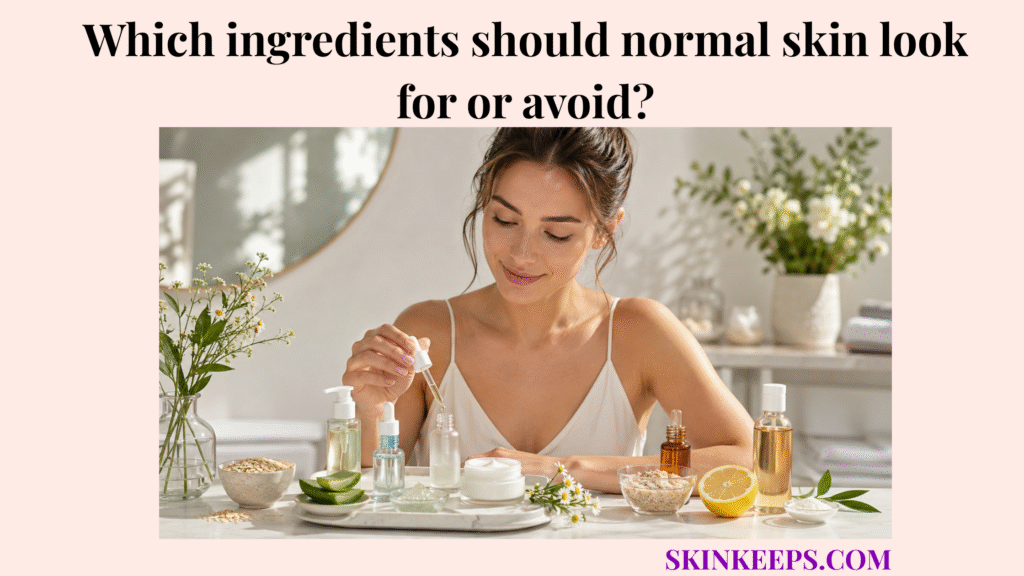
Normal skin should usually look for gentle hydrating, softening, barrier-supporting, non-comedogenic, and fragrance-free ingredients.
These ingredient styles help preserve comfort without making normal skin feel greasy, tight, irritated, or clogged. Normal skin should be careful with fragrance, harsh alcohols, strong exfoliating acids, aggressive scrubs, heavy occlusives, essential oils, and too many active ingredients at once. These ingredient types are not automatically bad, but they can disrupt normal skin balance if the skin does not need them.
Which ingredients normal skin should look for or avoid first?
Ingredients normal skin should look for first are gentle hydration and barrier-support ingredients, while ingredients normal skin should avoid first are repeated irritants, overly drying formulas, and textures that feel too heavy or clog-prone.
Normal skin needs supportive ingredients, not aggressive correction. The best first choices should keep the skin comfortable, smooth, and balanced.
This matters because different skin types do not need the same level of oil control, dryness support, or sensitivity avoidance.
| Look for | Avoid or limit |
|---|---|
| Glycerin | Fragrance-heavy formulas |
| Hyaluronic acid | Drying alcohol-heavy formulas |
| Ceramides | Harsh scrubs |
| Light emollients | Too many exfoliating acids |
| Non-comedogenic labels | Heavy oils if clogging occurs |
| Fragrance-free options | Essential oils if stinging occurs |
| Broad-spectrum sunscreen ingredients | Unneeded strong actives |
Normal skin needs supportive ingredients, not aggressive correction.
Which hydrating ingredients normal skin should look for or avoid?
Hydrating ingredients normal skin should look for include lightweight water-binding ingredients such as glycerin and hyaluronic acid, while excessive hydration layers should be limited if they feel sticky or overloaded.
Humectants can help normal skin feel comfortable without requiring a heavy cream. Normal skin usually needs light hydration, not many stacked hydration products.
| Hydrating ingredient style | Fit for normal skin |
|---|---|
| Glycerin | Good daily hydration support |
| Hyaluronic acid | Lightweight water-binding support |
| Panthenol | Can support comfort |
| Aloe-based formulas | May feel soothing for some skin |
| Heavy hydration layers | May feel sticky or excessive |
| Too many hydrating serums | Can cause product overload |
Normal skin usually needs light hydration, not many stacked hydration products.
Which barrier ingredients normal skin should look for or avoid?
Barrier ingredients normal skin should look for include ceramides, light emollients, and balanced moisturizer ingredients that keep the skin smooth and comfortable without a heavy seal.
Barrier support should feel comfortable. Normal skin does not usually need a thick full-face coating unless dry patches or weather stress make the skin feel under-supported.
Texture and weight also connect with choosing the moisturizer type that maintains normal skin balance.
| Barrier-support ingredient style | Fit for normal skin |
|---|---|
| Ceramides | Support skin barrier comfort |
| Light emollients | Soften without heavy coating |
| Squalane | May suit normal skin if not greasy |
| Dimethicone | Can reduce water loss and improve smooth feel |
| Petrolatum-heavy formulas | Useful for dry patches, often heavy for daily full face |
| Lanolin | Can irritate some people |
Normal skin barrier support should feel comfortable, not sealed under a heavy layer.
Which active ingredients normal skin should look for or avoid?
Active ingredients normal skin should look for or avoid should be chosen by real concern, because exfoliating acids, retinoids, acne ingredients, and strong brighteners can help some issues but irritate when overused.
Normal skin should use actives by purpose, not by trend. Strong or stacked actives can cause dryness, peeling, stinging, or redness.
This is especially important with exfoliation for normal skin, where acids should match dullness, roughness, or buildup rather than daily habit.
| Active ingredient | Use on normal skin |
|---|---|
| Mild exfoliating acids | Only for dullness or roughness |
| Retinoids | Introduce slowly if needed |
| Vitamin C | Use carefully if stinging occurs |
| Niacinamide | Often gentle, but still monitor |
| Benzoyl peroxide | Only for acne concerns |
| Salicylic acid | Only for clogged pores or acne patterns |
| Multiple actives together | Higher irritation risk |
| Daily strong exfoliation | Usually unnecessary |
Normal skin should use actives by purpose, not by trend.
Which irritating ingredients normal skin should look for or avoid?
Irritating ingredients normal skin should look for or avoid are best judged by repeated response, especially when fragrance, essential oils, drying alcohol-heavy formulas, dyes, harsh scrubs, or heavy oils cause symptoms.
Normal skin does not need to fear every ingredient. Repeated stinging, burning, dryness, clogged feel, redness, or rash-like changes are clearer stop signs.
| Ingredient or formula type | Why normal skin may avoid it |
|---|---|
| Added fragrance | Can trigger irritation or allergy |
| Essential oils | Can sting or irritate some skin |
| Drying alcohol-heavy formulas | May cause tightness |
| Dyes or colors | May irritate some people |
| Harsh scrubs | Friction can cause redness |
| Strong peeling products | May disrupt balance |
| Heavy oils | Can feel greasy or clog-prone |
| Too many products | Makes reactions harder to track |
Normal skin does not need to fear every ingredient, but repeated irritation is a clear stop sign.
How should ingredients normal skin should look for or avoid fit the routine?
Ingredients normal skin should look for or avoid should fit a simple routine built around gentle cleansing, lightweight moisturizer, daily sunscreen, and extras only when there is a real concern.
Ingredients should make the routine simpler, not more complicated. Add extras slowly, and keep the basic steps stable.
This structure fits care tips that preserve normal skin balance by limiting product overload.
- Cleanser: gentle, non-abrasive, non-stripping.
- Moisturizer: light, comfortable, non-greasy.
- Sunscreen: broad-spectrum SPF 30 or higher.
- Extras: only for real concerns.
- Actives: introduce one at a time.
- Fragrance: avoid if stinging, redness, or itching appears.
- Heavy textures: reduce if bumps or clogged feel appear.
Normal skin ingredients should make the routine simpler, not more complicated.
When should reactions to ingredients normal skin should look for or avoid need attention?
Reactions to ingredients normal skin should look for or avoid need attention when burning, stinging, rash-like redness, swelling, cracked patches, painful acne, severe itching, or changing lesions appear or repeat.
One ingredient mismatch can happen. Repeated or worsening reactions need review instead of constant product switching.
If reactions appear after new products, it helps to know why normal skin may tolerate new products more easily but still needs slow, traceable testing.
- Products repeatedly burn, sting, or cause rash-like redness.
- Skin reacts to many gentle formulas.
- Dry patches crack, bleed, burn, or spread.
- Breakouts become painful, deep, frequent, or scarring.
- Redness becomes warm, swollen, spreading, or persistent.
- Itching becomes intense or persistent.
- Swelling appears around the eyes, lips, or face.
- A mole, spot, or lesion changes color, shape, size, or behavior.
One ingredient mismatch can happen; repeated or worsening reactions need review.
What should you remember about ingredients normal skin should look for or avoid?
The key point is that ingredients normal skin should look for or avoid should preserve comfort, hydration, barrier support, low irritation, and low clogged-pore risk.
Normal skin usually does best with gentle hydration, ceramides, light emollients, non-comedogenic textures, fragrance-free options when irritated, and broad-spectrum sunscreen.
Broad-spectrum SPF belongs in the daytime routine because sunscreen is still essential for normal skin.
Frequently Asked Questions About Ingredients Normal Skin Should Look For or Avoid
Which ingredients should normal skin look for first?
Normal skin should usually look for glycerin, hyaluronic acid, ceramides, light emollients, non-comedogenic formulas, fragrance-free options, and broad-spectrum sunscreen.
Which ingredients should normal skin avoid first?
Normal skin should avoid or limit ingredients that repeatedly cause burning, stinging, redness, dryness, clogged pores, or rash-like irritation.
Does normal skin need active ingredients?
Not always. Normal skin should use active ingredients only when there is a real concern such as dullness, roughness, acne, or uneven tone.
Is fragrance bad for normal skin?
Not always, but fragrance can irritate some skin. If fragrance causes stinging, itching, redness, or rash-like changes, avoid it.
Can normal skin use exfoliating acids?
Yes, but gently and only when needed. Overuse can cause dryness, peeling, burning, and sensitivity.
Sources & Evidence About Ingredients Normal Skin Should Look For or Avoid
Cleveland Clinic skin-type guidance was used to ground normal, dry, oily, combination, and sensitive skin distinctions.
Peer-reviewed moisturizer review from NIH/PMC was used for humectants, emollients, occlusives, moisturizer function, hydration support, and barrier-support context.
American Academy of Dermatology dry-skin relief guidance was used for moisturizer support, dry patches, cracking, bleeding, burning, and itching boundaries.
American Academy of Dermatology acne moisturizer guidance was used for non-comedogenic, oil-free, and “won’t clog pores” product-label context.
American Academy of Dermatology acne treatment guidance was used for benzoyl peroxide, salicylic acid, acne-treatment context, painful acne, cystic acne, and scarring-acne referral boundaries.
American Academy of Dermatology exfoliation guidance was used for exfoliating acids, physical exfoliation, over-exfoliation, peeling, redness, and irritation risk.
American Academy of Dermatology product-testing guidance was used for repeated product reactions, irritation tracking, and patch-testing boundaries.
Peer-reviewed sensitive-skin review from NIH/PMC was used for burning, stinging, itching, redness, and reactive-skin symptom context.
American Academy of Dermatology sunscreen guidance was used for broad-spectrum sunscreen, SPF 30 or higher, and daytime protection boundaries.
American Academy of Dermatology melanoma signs guidance was used for changing moles, changing spots, lesion behavior, and referral boundaries.
Educational Disclaimer: This article is for general skin education only and does not diagnose, treat, or replace professional medical advice. If skincare ingredients cause repeated burning, swelling, rash-like redness, painful acne, cracked or bleeding patches, severe itching, spreading irritation, sudden unexplained changes, broader health symptoms, or changing moles or lesions, consult a qualified dermatologist or healthcare professional.