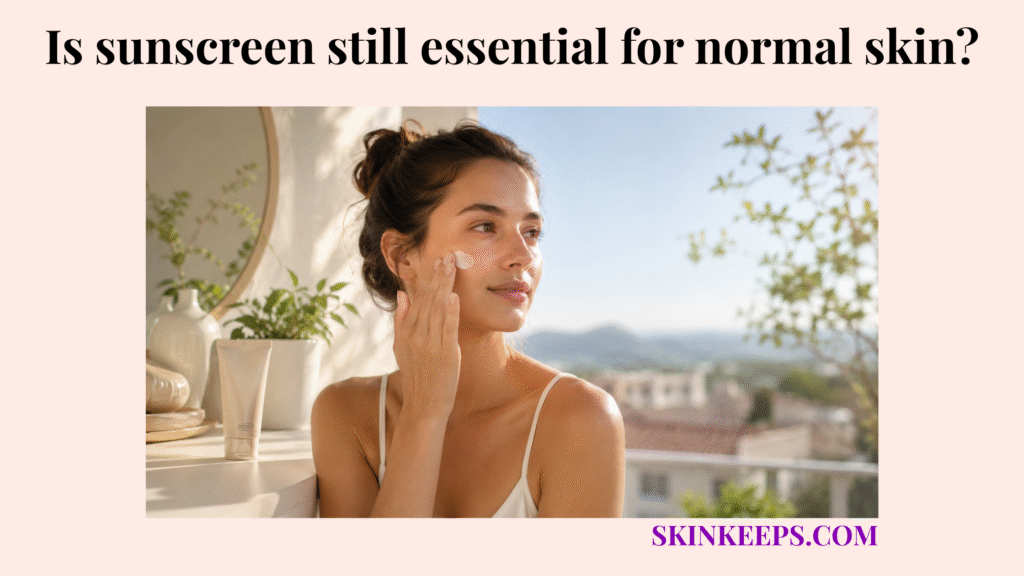
Yes, sunscreen is still essential for normal skin. Normal skin may feel balanced and comfortable, but it is not protected from UV rays. Sun exposure can still contribute to sunburn, redness, dryness, uneven tone, dark spots, premature aging signs, and skin cancer risk. Normal skin does not need sunscreen because it is “problem skin”; it needs sunscreen because all exposed skin can be affected by UV damage over time.
Why is sunscreen still essential for normal skin?
Sunscreen is still essential for normal skin because balanced skin is not UV-proof and can still burn, tan, darken, dry out, or develop long-term sun damage.
Normal skin can look calm and still be vulnerable to UV exposure. Balance describes oil, moisture, and comfort; it does not block UVA or UVB rays.
This is why sunscreen matters across different skin types, not only for skin that feels dry, oily, acne-prone, or sensitive.
| UV exposure effect | Why sunscreen still matters for normal skin |
|---|---|
| Sunburn | Normal skin can still redden, burn, or peel |
| Uneven tone | UV exposure can deepen spots and discoloration |
| Texture changes | Repeated exposure can roughen skin over time |
| Premature aging signs | Fine lines and wrinkles may appear earlier |
| Dryness | Sun exposure can make skin feel tight or rough |
| Sensitivity | Sun-stressed skin may sting with products |
| Skin cancer risk | UV damage is a long-term health concern |
Normal skin is balanced, not sun-resistant.
What sunscreen type is still essential for normal skin?
The sunscreen type still essential for normal skin is usually broad-spectrum sunscreen with SPF 30 or higher.
Broad-spectrum sunscreen helps cover UVA and UVB protection needs. Water resistance matters when normal skin is exposed to sweat, swimming, or longer outdoor time.
| Sunscreen feature | Why it matters for normal skin |
|---|---|
| Broad-spectrum | Helps protect from UVA and UVB rays |
| SPF 30 or higher | Common daily protection standard |
| Water-resistant | Useful for sweat or swimming |
| Comfortable texture | Makes daily use more realistic |
| Non-greasy finish | Helps preserve normal skin balance |
| Non-comedogenic option | Useful if bumps or clogged pores appear |
| Fragrance-free option | Useful if sunscreen stings or irritates |
The best sunscreen for normal skin is protective enough and comfortable enough to use consistently.
When is sunscreen still essential for normal skin daily?
Sunscreen is still essential for normal skin daily whenever exposed skin will meet daylight, not only during beach days or obvious heat.
Normal skin should not wait for sunburn before using sunscreen. Daylight exposure can happen during errands, driving, outdoor exercise, travel, or bright cloudy days.
- Morning daylight exposure.
- Driving or sitting near bright windows.
- Walking outside.
- Outdoor exercise.
- Beach, pool, or sports days.
- High-UV weather.
- Cloudy but bright days.
- Travel to sunny climates.
- Use of exfoliants or retinoids.
- Existing dark spots or uneven tone.
Normal skin should not wait for sunburn before using sunscreen.
How should sunscreen still essential for normal skin fit the routine?
Sunscreen still essential for normal skin should usually fit as the final morning skincare step before makeup.
If normal skin feels dry, a light moisturizer can go underneath. If sunscreen already feels moisturizing, a separate morning moisturizer may not always be needed.
This texture decision connects with choosing a moisturizer type that maintains normal skin balance before sunscreen.
| Routine situation | How sunscreen fits normal skin |
|---|---|
| Skin feels balanced | Sunscreen may be enough after cleansing |
| Skin feels tight | Light moisturizer before sunscreen |
| Wearing makeup | Sunscreen before makeup |
| Sweating outdoors | Use water-resistant sunscreen |
| Long outdoor exposure | Reapply as directed |
| Sunscreen feels greasy | Try lighter texture |
| Sunscreen stings | Try gentler/fragrance-free option |
Sunscreen should protect normal skin without making it feel heavy, greasy, or irritated.
Which myths make sunscreen still essential for normal skin seem optional?
Myths make sunscreen still essential for normal skin seem optional when they confuse balanced skin, cloudy weather, tanning, darker skin, makeup SPF, or indoor days with real UV protection.
UV exposure is not limited to obvious sunburn days. Skipping sunscreen because the skin looks balanced can still leave exposed skin unprotected.
| Myth | Better explanation |
|---|---|
| Normal skin does not need sunscreen | Normal skin can still get UV damage |
| Sunscreen is only for sunny days | UV exposure can still happen on cloudy days |
| Tanning means healthy skin | Tanning is a UV response |
| Darker skin never needs sunscreen | UV damage and pigmentation can still occur |
| Makeup SPF is always enough | Amount applied may be too low |
| Indoor days never need sunscreen | Window and incidental exposure may matter |
| Sunscreen causes all breakouts | Texture choice and removal matter |
| One morning layer lasts all day outdoors | Reapplication matters with time, sweat, and water |
Sunscreen is still essential for normal skin because UV exposure is not limited to obvious sunburn days.
What mistakes make sunscreen still essential for normal skin less protective?
Mistakes make sunscreen still essential for normal skin less protective when sunscreen is applied too thinly, skipped on exposed areas, not reapplied outdoors, expired, or removed poorly at night.
Normal skin needs sunscreen used correctly, not just owned. Texture discomfort should lead to a better fit, not skipping protection.
| Mistake | How it affects normal skin protection |
|---|---|
| Applying too little | Lowers real protection |
| Skipping ears, neck, lips, or hands | Leaves exposed areas unprotected |
| Forgetting reapplication outdoors | Protection decreases over time |
| Using expired sunscreen | Protection may be unreliable |
| Skipping sunscreen in winter | UV exposure still matters |
| Relying only on shade | Reflected and indirect UV can still reach skin |
| Not removing sunscreen at night | Residue may clog or irritate |
| Stopping because one sunscreen feels bad | A better texture may solve the issue |
Normal skin needs sunscreen used correctly, not just owned.
When do sun changes show sunscreen still essential for normal skin needs attention?
Sun changes show sunscreen still essential for normal skin needs attention when burns are severe, spots change, patches persist, pigmentation shifts suddenly, or sunscreen reactions repeat.
Sunscreen helps protect normal skin, but changing spots or severe sun reactions still need medical review. Do not treat changing lesions as routine sun marks.
- A mole, spot, or lesion changes color, shape, size, or behavior.
- A new spot grows, bleeds, crusts, or does not heal.
- Sunburn is severe, blistering, or very painful.
- A rough, scaly, persistent patch appears on sun-exposed skin.
- Pigmentation suddenly spreads, darkens, or changes.
- Redness becomes persistent, warm, swollen, or rash-like.
- Sunscreen repeatedly burns, stings, or causes swelling.
- Skin becomes unusually sun-sensitive after medication or illness.
Sunscreen helps protect normal skin, but changing spots or severe sun reactions still need medical review.
What should you remember about sunscreen still essential for normal skin?
The key point is that sunscreen is still essential for normal skin because normal skin is balanced, not UV-proof.
UV exposure can contribute to sunburn, dark spots, dryness, texture changes, premature aging signs, and long-term skin cancer risk. Sunscreen helps reduce risk, but it does not promise perfect skin.
Sun protection also supports normal skin even tone and texture by reducing avoidable UV stress.
Frequently Asked Questions About Sunscreen Still Essential for Normal Skin
Is sunscreen still essential for normal skin every day?
Yes. Sunscreen is still essential for normal skin during daylight exposure because UV damage can accumulate even when skin looks balanced.
Is SPF 30 enough for normal skin?
SPF 30 or higher is commonly recommended for daily broad-spectrum protection. Longer outdoor exposure, sweating, and swimming require correct application and reapplication.
Can normal skin skip sunscreen if it does not burn?
No. Not burning easily does not mean normal skin is protected from UV damage, pigmentation changes, premature aging signs, or skin cancer risk.
Can sunscreen clog normal skin?
Some heavy sunscreens can feel greasy or clog-prone, but a lighter or non-comedogenic texture may work better.
Does normal skin need sunscreen under makeup?
Yes. Makeup SPF may not be applied in enough quantity, so a dedicated sunscreen is often more reliable before makeup.
Sources & Evidence About Sunscreen Still Essential for Normal Skin
Cleveland Clinic skin-type guidance was used to ground normal, dry, oily, combination, and sensitive skin distinctions.
American Academy of Dermatology sunscreen guidance was used for broad-spectrum sunscreen, SPF 30 or higher, water resistance, daily use, shade, protective clothing, and reapplication boundaries.
American Academy of Dermatology sunburn guidance was used for sunburn, blistering, pain, and severe-burn caution boundaries.
American Academy of Dermatology tanning guidance was used for tanning as UV response, tanning-bed risk, and misinformation boundaries.
American Academy of Dermatology tanning-bed and skin-cancer risk guidance was used for UV exposure and skin-cancer prevention context.
Cleveland Clinic sun-damage guidance was used for photoaging, wrinkles, spots, roughness, and UVA/UVB exposure boundaries.
American Academy of Dermatology acne moisturizer guidance was used for non-comedogenic and “won’t clog pores” product-label context.
American Academy of Dermatology acne-and-makeup guidance was used for makeup, residue, clogged pores, and texture-removal boundaries.
American Academy of Dermatology melanoma signs guidance was used for changing moles, changing spots, bleeding lesions, non-healing areas, and referral boundaries.
American Academy of Dermatology ABCDE melanoma guidance was used for evolving spots, changing color, shape, or size, and lesion-check boundaries.
Educational Disclaimer: This article is for general skin education only and does not diagnose, treat, or replace professional medical advice. If sun-related skin changes include severe sunburn, blistering, swelling, persistent rough patches, bleeding or non-healing spots, sudden pigmentation changes, repeated sunscreen reactions, unusual medication-related sun sensitivity, or any mole, spot, or lesion that changes color, shape, size, or behavior, consult a qualified dermatologist or healthcare professional.