
Yes, hydration level can affect normal skin balance. When normal skin is well supported, it often feels comfortable, smooth, calm, and balanced. That steady feel can change when water support in the body or surface layers drops.
Low hydration can make normal skin feel tight, look dull, develop fine roughness, or react more easily than usual. These changes are clues, not automatic proof that the skin type has permanently changed.
Hydration is not only about drinking water. Normal skin balance depends on both internal hydration and surface moisture support. If the skin barrier loses too much water, normal skin can temporarily look dull, feel tight, show rough texture, or become more sensitive.
Why does hydration level matter for normal skin balance?
Hydration level matters for normal skin balance because water content helps the skin surface feel flexible, smooth, calm, and comfortable.
Normal skin may temporarily act drier, tighter, duller, or more reactive when hydration drops. This can happen without turning normal skin into dry skin overnight.
Hydration supports comfort and appearance, but it does not control every skin concern. Acne, pores, sensitivity, texture, and dullness can also be shaped by products, hormones, sleep, weather, irritation, and barrier stress.
Temporary hydration changes should be interpreted inside the wider skin-type pattern because one tight or dull day does not automatically move normal skin into another category among different skin types.
| Hydration-related factor | How it may affect normal skin | What it cannot guarantee |
|---|---|---|
| Good surface hydration | Skin feels smoother and more comfortable | Perfect texture |
| Low surface hydration | Tightness, dullness, roughness | Permanent skin-type change |
| Internal dehydration | Skin and lips may feel drier | Direct cure from water alone |
| Barrier water loss | More dryness or sensitivity | Automatic skin disease |
| Moisturizer support | Helps reduce surface dryness | Fixes every skin concern |
| Harsh cleansing | Can remove comfort and increase tightness | Always obvious immediately |
| Dry climate | Can pull comfort from skin | Permanent dryness |
Hydration supports normal skin balance, but it is one part of skin comfort — not the whole system.
How does internal hydration affect normal skin?
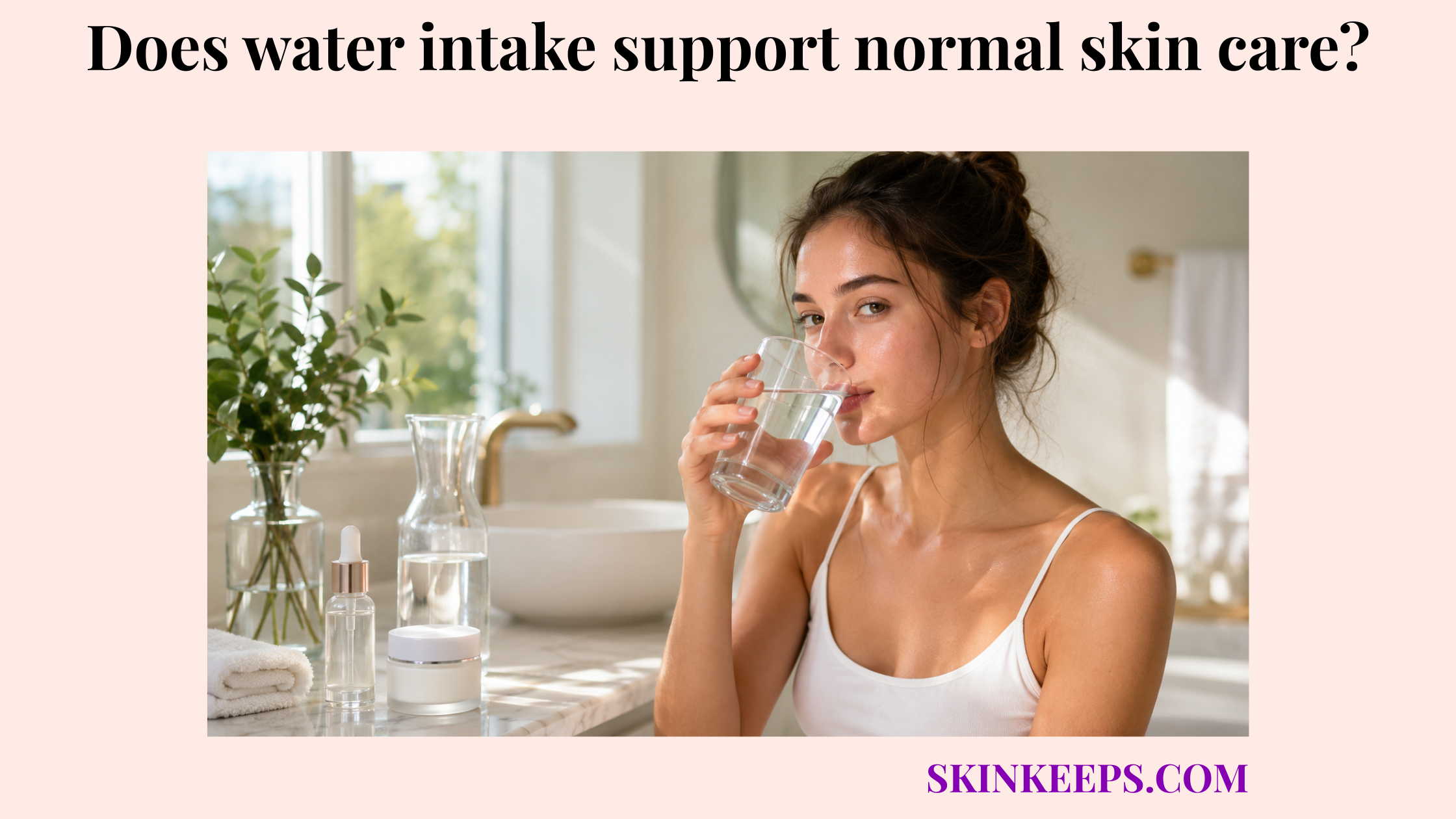
Internal hydration affects normal skin by supporting the body’s overall fluid balance, which can influence how comfortable or dull the skin appears.
Skin is part of the body, so under-hydration can coincide with dullness, dry lips, fatigue, or less comfortable skin. These clues matter more when they appear after heat, illness, sweating, travel, or poor sleep.
Drinking water alone does not automatically fix surface dryness, irritation, acne, or texture. Normal skin may still need surface moisture support when the outer barrier is losing water.
Internal hydration belongs with sleep, illness recovery, body fluid balance, and other internal factors that help maintain normal skin balance rather than isolated water-cure claims.
- Skin looks dull during dehydration.
- Lips feel dry at the same time.
- The body feels thirsty or fatigued.
- Dryness appears after illness, sweating, travel, or heat.
- Skin improves when overall hydration, sleep, and routine stabilize.
- Moisturizer is still needed for surface comfort.
Water supports normal skin from inside the body, but moisturizer supports the skin surface directly.
How does surface hydration affect normal skin?
Surface hydration affects normal skin by helping the outer skin layers hold enough water to feel smooth, flexible, and comfortable.
Surface hydration is separate from the myth that drinking more water instantly hydrates the face. The outer skin layers still need barrier support to keep water from escaping too quickly.
Normal skin can be internally hydrated but still surface-dry if the barrier is losing water. Harsh cleansers, dry air, hot water, over-exfoliation, and strong actives can all reduce surface comfort.
| Hydration type | What it means for normal skin | Main support |
|---|---|---|
| Internal hydration | Body fluid balance supports general wellness | Drinking enough fluids and overall health |
| Surface hydration | Water content in the outer skin layers | Humectants and moisturizer |
| Barrier moisture retention | Skin keeps water from escaping too quickly | Moisturizer, barrier support, gentle care |
| Temporary dehydration | Skin feels tight, dull, or rough | Restore comfort and reduce triggers |
| Product-related dryness | Skin loses comfort after harsh formulas | Switch to gentler products |
| Climate-related dryness | Air pulls moisture from skin | Moisturizer and environment adjustment |
Normal skin can be internally hydrated but still surface-dry if the barrier is losing water.
What signs show low hydration in normal skin?
Low hydration in normal skin can show as tightness, dullness, fine rough texture, makeup clinging, quick moisturizer absorption, or new stinging from products.
These signs should be read as clues, not instant proof that the skin type changed. A single tight morning or dull day may reflect surface water loss, cleanser strength, sleep, weather, or temporary barrier stress.
Each clue should be checked against related triggers. Cleanser strength, cold weather, hot water, sleep disruption, over-exfoliation, and barrier comfort often explain why normal skin briefly looks less balanced.
Tightness after cleansing should be judged against the usual baseline of whether normal skin feels comfortable and balanced across ordinary days.
| Sign in normal skin | Possible hydration meaning | What else to check |
|---|---|---|
| Tight feeling after cleansing | Surface hydration or barrier comfort may be low | Cleanser strength |
| Dull appearance | Hydration, sleep, or weather may be affecting glow | Stress and routine |
| Fine tight texture | Skin surface may need moisture support | Over-exfoliation |
| Makeup clings | Surface dryness may be present | Moisturizer and sunscreen texture |
| Skin feels rough | Water retention or barrier comfort may be reduced | Harsh products |
| Moisturizer absorbs quickly | Skin may need more support | Product amount |
| Stinging from products | Barrier may be stressed | Active overuse or irritation |
| Lips and skin both dry | Body hydration may also matter | Illness, heat, sweating |
Low hydration can make normal skin look less normal temporarily.
Can low hydration make normal skin feel dry?
Low hydration can make normal skin feel dry temporarily, especially when surface water loss, harsh cleansing, cold weather, indoor heat, or low moisture support is involved.
Normal skin can have dry-feeling days without becoming permanently dry skin. The sharper question is whether dryness is occasional and trigger-linked or repeated, flaky, burning, cracking, or bleeding.
Low hydration can make normal skin temporarily tight
Low hydration can make normal skin temporarily tight after cleansing, cold weather, indoor heat, travel, sweating, or insufficient moisture support.
Tightness is often a comfort signal. It usually points toward surface hydration and barrier comfort before it proves a permanent skin-type change.
Low hydration does not always mean normal skin has become dry skin
Low hydration does not always mean normal skin has become dry skin because occasional dryness can improve when triggers are reduced and moisture support returns.
Pattern matters more than one dry day. Repeated flakes, cracking, burning, or bleeding need closer attention because those signs move beyond simple normal-skin variation.
Normal skin can have dry-feeling days without permanently becoming dry skin.
Can low hydration make normal skin look dull?
Low hydration can make normal skin look dull because a tight, rough, or under-supported surface reflects light less evenly.
Dullness can be temporary when it appears after poor sleep, travel, cold weather, harsh cleansing, or low moisture support. The surface may look flatter because it is not as smooth or comfortable as usual.
Dullness does not automatically mean normal skin needs aggressive exfoliation. If the skin feels tight or rough, support and recovery usually come before stronger resurfacing.
Hydration-related dullness is easier to read when a healthy glow is separated from greasy shine, because normal skin can have a healthy glow without shine when surface comfort is supported.
- Skin looks less fresh than usual.
- The healthy glow looks flatter.
- Makeup looks patchier.
- Cheeks look less smooth.
- Skin feels tight but not necessarily flaky.
- Dullness appears after poor sleep, travel, cold weather, or harsh cleansing.
Dull normal skin often needs support and recovery, not aggressive exfoliation first.
Can hydration level affect normal skin texture?
Hydration level can affect normal skin texture by making the surface look smoother when supported and rougher, tighter, or more uneven when hydration drops.
Texture changes do not mean the skin should become poreless. Low hydration can make roughness, clinging makeup, visible pores, tight shine, flakes, or irritation more obvious without proving a permanent pore or skin-type change.
Hydration support should be considered before aggressive exfoliation. A tight surface often needs barrier comfort before it needs stronger actives.
Low surface hydration can make roughness look stronger, even when normal skin usually shows even tone and texture.
| Texture change in normal skin | Possible hydration link | Better interpretation |
|---|---|---|
| Fine roughness | Surface hydration may be low | Moisturize before exfoliating |
| Makeup clinging | Dry surface texture may be present | Support cheeks and dry zones |
| Pores look more noticeable | Surrounding skin may look less smooth | Not always enlarged pores |
| Tight shiny look | Skin may be dehydrated or over-cleansed | Avoid stripping |
| Flaky patches | Dryness or barrier stress may be present | Reduce harsh products |
| Bumps plus dryness | Irritation or product mismatch possible | Do not over-treat |
| Smooth after moisturizer | Hydration support likely helps | Continue gentle care |
Normal skin texture can look rougher when hydration drops, even if the skin type is still normal.
Can hydration level affect normal skin sensitivity?
Hydration level can affect normal skin sensitivity because low surface hydration and poor moisture retention can make the skin feel tighter, weaker, and more reactive.
Products that usually feel comfortable may sting, burn, or irritate when the barrier is stressed. This does not mean normal skin has become permanently sensitive, but it does mean the surface needs respect.
Hydration-stressed sensitivity often appears with tightness, redness, dryness, weather changes, or active overuse. The pattern should be watched closely if burning, swelling, or rash-like irritation persists.
Hydration-stressed stinging or redness can temporarily change the usual pattern of normal skin being less sensitive than reactive skin types.
- Moisturizer suddenly stings.
- Gentle cleanser feels drying.
- Skin feels tight and hot.
- Redness appears after products.
- Exfoliants feel stronger than usual.
- Dry patches appear after weather changes.
- Skin calms after simplifying and moisturizing.
Normal skin can feel sensitive when it is under-hydrated or barrier-stressed.
Which triggers reduce hydration balance in normal skin?
Triggers that reduce hydration balance in normal skin include harsh cleansing, hot water, dry air, cold weather, indoor heating, low humidity, over-exfoliation, sweat, illness, travel, and poor sleep.
Hydration balance can drop from routine habits, environment, and body stress at the same time. A person may blame water intake when the real trigger mix is hot water, dry air, over-cleansing, and low sleep.
Normal skin may feel tight, dull, rough, or reactive when several triggers overlap. The more triggers stack together, the more likely normal skin is to behave temporarily less balanced.
| Trigger | How it can affect normal skin |
|---|---|
| Harsh cleanser | Tightness and dryness after washing |
| Hot water | More surface dryness and discomfort |
| Cold weather | Dry cheeks, roughness, dullness |
| Indoor heating | Water loss and tightness |
| Air conditioning | Dry-feeling skin |
| Low humidity | Moisture evaporates more easily |
| Over-exfoliation | Barrier stress and stinging |
| Strong actives | Peeling, burning, tightness |
| Sweat and heat | Body hydration loss and irritation |
| Illness | Dryness or dullness during recovery |
| Travel | Climate shifts and dehydration |
| Poor sleep | Dullness and slower recovery |
Normal skin hydration balance can drop from routine habits, environment, and body stress at the same time.
How does moisturizer help hydration balance in normal skin?
Moisturizer helps hydration balance in normal skin by supporting surface comfort, water retention, smoother texture, and barrier recovery after dryness triggers.
Moisturizer is not only for dry skin. Normal skin may need it after cleansing, during dry weather, after travel, or when the surface feels tight, rough, or less comfortable than usual.
Moisturizer can support post-cleansing comfort, dry-weather adaptation, smoother sunscreen wear, and better makeup appearance. The goal is surface comfort, not turning hydration into a heavy routine.
| Moisturizer role | How it supports normal skin |
|---|---|
| Adds surface comfort | Reduces tightness and rough feel |
| Supports water retention | Helps skin stay comfortable longer |
| Smooths texture appearance | Helps makeup and sunscreen sit better |
| Reduces dryness after cleansing | Supports the barrier after washing |
| Helps tolerate actives | Reduces irritation risk when used properly |
| Supports dry-weather comfort | Helps normal skin adapt to climate |
| Maintains balance | Prevents normal skin from feeling stripped |
Moisturizer is not only for dry skin. Normal skin may need it when hydration comfort drops.
How should normal skin balance hydration without overloading the skin?
Normal skin should balance hydration without overloading the skin by adding enough moisture support to feel comfortable without creating a greasy, coated, or clogged feel.
The goal is comfort, not layering as many hydrating products as possible. Normal skin should feel supported rather than sticky, heavy, greasy, or coated.
Balanced hydration can come from gentle cleansing, lukewarm water, moisturizer when needed, sunscreen, lower exfoliation when tightness appears, and environmental adjustment during dry or air-conditioned conditions.
- Use a gentle cleanser.
- Avoid hot water and harsh scrubbing.
- Apply moisturizer when skin feels dry or tight.
- Apply moisturizer after washing when needed.
- Choose a texture that feels comfortable, not greasy.
- Use sunscreen daily.
- Reduce exfoliation if skin feels tight or stings.
- Adjust moisturizer in cold, dry, or air-conditioned environments.
- Drink enough fluids for overall health.
- Watch whether dullness, tightness, or roughness repeats.
Normal skin hydration should feel comfortable, not coated.
Can drinking more water alone balance normal skin?
Drinking more water alone cannot reliably balance normal skin because surface hydration depends on the outer skin barrier, moisturizer support, cleansing habits, weather, and irritation control.
Drinking enough water supports overall health and can help when the body is under-hydrated. That support is real, but it does not replace surface water retention.
Surface dryness often needs moisturizer, gentle cleansing, barrier support, and protection from harsh weather or irritating products. Water is supportive; the outer barrier still controls much of the skin-surface comfort.
| Myth | Better explanation for normal skin |
|---|---|
| Drinking water instantly hydrates the face | Surface hydration depends on the outer skin barrier too |
| Water replaces moisturizer | Moisturizer supports water retention on the skin surface |
| Dull skin always means dehydration | Sleep, stress, sun, products, and texture can also matter |
| Tight skin only needs more water | Harsh cleanser or barrier stress may be involved |
| Oily skin cannot be dehydrated | Skin can feel oily and tight at the same time |
| Hydration cures breakouts | Acne has many causes |
| More water means perfect skin | Skin balance is multifactorial |
Water is supportive. Moisture retention is the skin-surface job.
What mistakes happen when normal skin tries to improve hydration?
Mistakes happen when normal skin tries to improve hydration by relying only on water, skipping moisturizer, using heavy layers, over-exfoliating dullness, or cleansing until the skin feels squeaky.
Hydration improves best with support, not overload. Too little surface support can leave normal skin tight, while too much layering can make it sticky, coated, clogged, or irritated.
Common mistakes often stress the barrier. Squeaky cleansing, hot water, over-exfoliation, and ignoring stinging can make normal skin less comfortable instead of more balanced.
| Mistake | Why it hurts normal skin balance | Better move |
|---|---|---|
| Drinking water but skipping moisturizer | Surface dryness may remain | Support the barrier directly |
| Using heavy cream everywhere | Skin may feel greasy or clogged | Choose comfortable texture |
| Over-exfoliating dullness | Tightness and stinging may worsen | Moisturize first |
| Cleansing until squeaky | Barrier comfort drops | Use gentle cleansing |
| Hot-water washing | Dryness may increase | Use lukewarm water |
| Ignoring dry climate | Skin may stay tight | Adjust moisture support |
| Layering many hydrating products | Stickiness, pilling, or irritation may occur | Keep hydration simple |
| Ignoring stinging | Barrier stress may worsen | Stop and simplify |
Normal skin hydration improves best with support, not overload.
When should hydration problems in normal skin need professional attention?
Hydration problems in normal skin need professional attention when dryness, burning, bleeding, swelling, rash-like irritation, severe itching, painful acne, or sudden changes become persistent or unexplained.
Temporary hydration dips can happen, but certain signs should not be treated as routine dryness. Persistent cracking, burning, swelling, severe itching, painful acne, or spreading rash-like irritation deserves evaluation.
Referral signs do not diagnose the cause. They simply mark the point where a dermatologist or qualified clinician can check whether irritation, dermatitis, infection, medication effects, acne, allergy, or another skin concern is involved.
- Dryness becomes persistent despite gentle care.
- Skin cracks, bleeds, burns, or spreads with dry patches.
- Moisturizer repeatedly stings or burns.
- Redness, warmth, swelling, or rash-like patches appear.
- Itching becomes persistent or intense.
- Skin suddenly becomes very dry, oily, or reactive.
- Breakouts become painful, deep, frequent, or scarring.
- Peeling continues after stopping strong products.
- A mole, spot, or lesion changes color, shape, size, or behavior.
- Skin changes appear with illness, medication changes, or broader health symptoms.
Temporary hydration dips can happen in normal skin, but persistent, painful, bleeding, burning, swollen, or spreading symptoms need professional review.
What should you remember about hydration level and normal skin balance?
The key point is that hydration level can affect normal skin balance, but hydration support does not guarantee perfect skin or replace barrier care.
Normal skin may feel tight, dull, rough, or sensitive when hydration drops. These signs often reflect surface water loss, barrier stress, harsh cleansing, weather, sleep disruption, or temporary body-level stress.
Drinking water supports overall health, while moisturizer supports surface water retention. Normal skin balance improves most when both internal support and surface comfort are handled realistically.
Frequently Asked Questions About Hydration Level and Normal Skin
Can normal skin become dehydrated?
Yes. Normal skin can become temporarily dehydrated or surface-dry from weather, harsh cleansing, over-exfoliation, travel, illness, sweat, or low humidity.
Does drinking water fix normal skin dryness?
Not by itself. Drinking enough water supports overall health, but surface dryness usually also needs moisturizer, gentle cleansing, and barrier support.
Can normal skin feel oily and dehydrated?
Yes. Normal skin can sometimes feel shiny but tight if the surface is under-supported or over-cleansed.
Can low hydration make normal skin look dull?
Yes. Low surface hydration can make normal skin look less fresh, rougher, or duller, especially after poor sleep, travel, cold weather, or harsh products.
Should normal skin use moisturizer for hydration?
Yes, when needed. Normal skin can use moisturizer to support comfort, especially after cleansing, in dry weather, or when skin feels tight or rough.
Sources & Evidence About Hydration Level and Normal Skin
Cleveland Clinic skin-type guidance was used to ground the article’s normal, oily, dry, combination, and sensitive skin distinctions.
American Academy of Dermatology dry-skin relief guidance was used for moisturizer timing, gentle cleansing, dry-weather care, itching, cracking, bleeding, and dry-skin warning signs.
American Academy of Dermatology face-washing guidance was used for lukewarm water, gentle cleansing, and avoiding harsh scrubbing.
American Academy of Dermatology exfoliation guidance was used for irritation, redness, acne breakouts, and over-exfoliation caution.
American Academy of Dermatology contact-dermatitis symptom guidance was used for stinging, burning, itching, swelling, rash-like reactions, and product-reaction boundaries.
Peer-reviewed moisturizer review from NIH/PMC was used for stratum corneum hydration, transepidermal water loss, humectants, emollients, occlusives, and barrier-support mechanisms.
Peer-reviewed skin-barrier and moisturization review was used for skin-barrier function, moisturizer mechanisms, humectants, emollients, occlusives, and water-retention concepts.
American Academy of Dermatology acne treatment guidance was used for professional-care boundaries around painful, frequent, deep, or scarring acne.
American Academy of Dermatology melanoma signs guidance was used for changing mole, spot, and lesion referral boundaries.
Educational Disclaimer: This article is for general skin education only and does not diagnose, treat, or replace professional medical advice. If hydration-related skin changes include persistent dryness, cracked or bleeding patches, burning, swelling, spreading redness, rash-like irritation, painful acne, severe itching, sudden unexplained changes, broader health symptoms, or changing moles or lesions, consult a qualified dermatologist or healthcare professional.