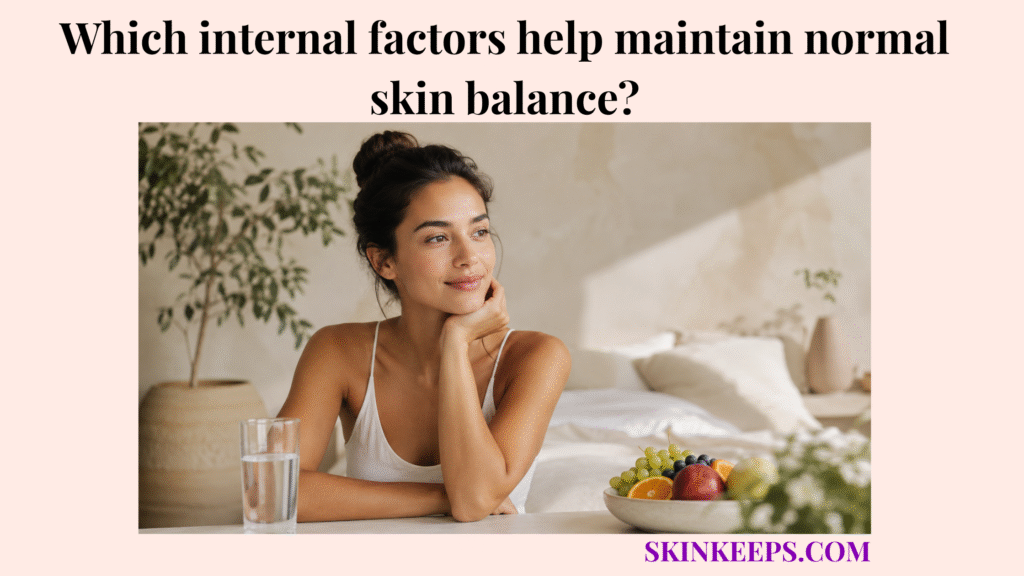
Internal factors that help maintain normal skin balance include genetics, steady hormone patterns, adequate hydration, balanced nutrition, good sleep, stress regulation, healthy barrier repair, and overall wellness.
These body-level factors can help normal skin stay comfortable, calm, and less dominated by oiliness, dryness, frequent breakouts, or sensitivity. That support matters because normal skin balance is a repeated pattern of steadiness, not a promise that the skin will look identical every day.
Even internally balanced normal skin can look dull, oily, dry, or blemish-prone during stress, poor sleep, hormonal shifts, illness, dehydration, diet changes, travel, or major routine disruption. Internal support therefore helps create steadiness, but it does not guarantee flawless skin or replace professional care when symptoms become sudden, painful, spreading, bleeding, or persistent.
Why does normal skin balance depend on internal stability?
Normal skin balance depends on internal stability because oil production, hydration, barrier repair, inflammation, and recovery are influenced by body-level conditions.
Normal skin looks and feels more balanced when internal and external pressures are not strongly disrupting the skin. That steadier state can support calmness, comfort, even-looking appearance, and lower visible reactivity, but it still depends on several systems working together rather than one isolated factor. This is why different skin types should be compared by repeated patterns rather than by one temporary skin day.
| Internal factor | How it may support normal skin balance | What it cannot guarantee |
|---|---|---|
| Genetics | Sets baseline oil, pore, and sensitivity tendencies | Perfect skin |
| Hormonal steadiness | Helps reduce sudden oil or breakout shifts | No breakouts ever |
| Hydration status | Supports overall body and skin comfort | Instant glow |
| Balanced nutrition | Supports repair and normal function | Cure for skin conditions |
| Sleep | Supports recovery and appearance | No dullness ever |
| Stress regulation | May reduce flare-like changes | Stress-proof skin |
| General health | Helps skin function normally | No skin changes |
| Barrier repair capacity | Supports comfort and low irritation | Invincible skin |
Practical rule: Normal skin balance is maintained by steady support, not by one internal factor alone.
How do genetics help maintain normal skin balance?
Genetics help maintain normal skin balance by setting the skin’s baseline tendencies for oil, pores, dryness, reactivity, and breakout frequency.
Genetics can give normal skin a more balanced starting point because inherited tendencies influence how much oil the skin produces, how visible pores tend to be, and how easily the skin becomes dry or reactive. That baseline also connects to how normal skin comfort and balance appear across ordinary days. That baseline is useful, but it is not destiny because habits, environment, health changes, and products still affect how normal skin behaves over time.
- How much oil the skin naturally produces.
- How visible pores tend to be.
- How easily the skin becomes dry or reactive.
- How often breakouts appear.
- How quickly the skin looks irritated after triggers.
- How the skin responds to hormones, weather, and products.
Practical rule: Genetics can help normal skin start from a balanced baseline, but habits, environment, health, and products still affect how the skin behaves.
How do hormones help maintain normal skin balance?
Hormones help maintain normal skin balance when their patterns stay steady enough that oiliness, dryness, breakouts, and sensitivity do not shift suddenly or severely.
Hormone patterns can influence oil production, congestion, dryness, pigmentation, and sensitivity, so normal skin may look steadier when those patterns are not strongly fluctuating. This does not mean hormones must be perfect; it means repeated severe shifts should be separated from ordinary mild variation.
Stable hormone patterns can support normal skin comfort
Stable hormone patterns can support normal skin comfort by reducing sudden changes in oiliness, congestion, or breakouts.
This support is about steadiness rather than perfection. Mild variation can still happen on normal skin, but it becomes easier to recognize when oiliness, breakouts, dryness, or sensitivity do not become a disruptive pattern.
Hormonal shifts can temporarily disturb normal skin balance
Hormonal shifts can temporarily disturb normal skin balance by changing oiliness, breakouts, dryness, pigmentation, or sensitivity.
Menstrual cycles, puberty, pregnancy, menopause, stress hormones, and medical conditions can all create temporary skin changes. Those changes should be tracked by timing and severity, because repeated painful, sudden, severe, or unexplained changes deserve professional attention instead of self-diagnosis.
| Hormonal pattern | Possible effect on normal skin | What to watch |
|---|---|---|
| Stable baseline | Balanced oil and comfort | Normal variation |
| Menstrual-cycle shifts | Chin or jawline pimples | Frequency and severity |
| Puberty | More oil or acne tendency | Persistent acne |
| Pregnancy-related changes | Pigmentation, sensitivity, oil, dryness | Sudden or severe changes |
| Menopause-related changes | Dryness or sensitivity | Persistent discomfort |
| Stress-related hormones | Oiliness, dullness, breakouts | Repeated flares |
| Medical hormone changes | New skin patterns | Professional evaluation |
Practical rule: Hormones can shift normal skin temporarily, but repeated painful, sudden, or severe changes should not be ignored.
How does hydration support normal skin balance?
Hydration supports normal skin balance by helping the body function well and by supporting a more comfortable skin appearance.
Hydration can support general comfort because the skin is part of a body that depends on fluid balance. That support has limits, however, because drinking water alone does not replace moisturizer, sunscreen, gentle care, or medical treatment when skin is dry, irritated, inflamed, or persistently uncomfortable. The surface still needs support when normal skin tone and texture look dull, tight, or temporarily uneven.
- The body is not dehydrated.
- The skin does not feel unusually tight.
- Lips and skin are not unusually dry from fluid loss.
- Sleep, climate, and diet are also stable.
- Moisturizer and sunscreen still support the surface barrier.
Practical rule: Hydration helps support normal skin, but water intake is not a standalone treatment for dryness, acne, or sensitivity.
How does nutrition help maintain normal skin balance?
Nutrition helps maintain normal skin balance by supporting normal body function, tissue repair, barrier-related processes, and overall wellness.
Balanced nutrition supports the body systems that normal skin depends on, including repair, immune function, and barrier-related processes. That does not mean one food, nutrient, or diet pattern can guarantee clear, glowing, or permanently balanced skin, so nutrition should be framed as support rather than a skin cure.
| Nutrition factor | How it may support normal skin | Safe wording |
|---|---|---|
| Protein | Supports tissue repair and normal function | “Supports,” not “rebuilds skin instantly” |
| Essential fatty acids | Support barrier-related processes | Not a cure for dryness |
| Vitamins and minerals | Support normal body and skin functions | Avoid mega-dose claims |
| Antioxidant-rich foods | Support general wellness | Not a sunscreen replacement |
| Low overall dietary imbalance | May reduce stress on health | Not a guarantee of clear skin |
| Consistent meals | Supports general stability | Not a direct skin cure |
| Excessive restriction | May affect health and appearance | Avoid extreme diets |
Practical rule: Balanced nutrition supports normal skin from inside the body, but no single food creates perfect skin balance.
How does sleep help maintain normal skin balance?
Sleep helps maintain normal skin balance by supporting recovery, steadier appearance, and the body’s ability to manage daily stress.
Sleep can affect how rested, dull, reactive, or stable normal skin may look because recovery processes occur across the body. That recovery link helps explain why normal skin healthy glow should be understood as balanced appearance, not a guaranteed result. This connection should be understood as support rather than a cure claim, since good sleep can help steadiness without guaranteeing that skin will never look tired, oily, dry, or blemish-prone.
- The body recover from daily stress.
- The skin appear less dull or tired.
- Barrier repair processes stay steady.
- Inflammation-related stress feel less dominant.
- Breakout triggers from stress and poor recovery reduce.
- Product tolerance feel more predictable.
- Overall wellness remain stable.
Practical rule: Normal skin often looks more balanced when the body is well-rested, but sleep is support, not a cure-all.
How does stress regulation support normal skin balance?
Stress regulation supports normal skin balance by helping reduce the internal and behavioral disruptions that can make skin look less predictable.
Stress should be discussed without blaming the reader because stress affects skin through many linked pathways and habits. It can influence sleep, touching, picking, sweat, hormonal shifts, skipped routines, appetite changes, and redness or breakouts, so the goal is to reduce repeat triggers rather than claim stress alone causes every skin issue. This is especially useful when reading normal skin breakouts as patterns rather than isolated blemishes.
| Stress-related change | How normal skin may respond | Better interpretation |
|---|---|---|
| Poor sleep during stress | Dullness or tired-looking skin | Recovery disruption |
| Increased touching or picking | More irritation or pimples | Behavior-linked trigger |
| Stress sweating | Congestion or irritation | Cleanse gently |
| Hormonal stress response | Oiliness or breakouts | Temporary flare possible |
| Skipped routine | Dryness or sunscreen inconsistency | Habit disruption |
| Appetite or diet changes | Skin may look less steady | Whole-body effect |
| Increased inflammation tendency | Redness or sensitivity may appear | Watch persistence |
Practical rule: Stress does not make skin “bad.” It can simply make normal skin less predictable for a while.
How does general health help maintain normal skin balance?
General health helps maintain normal skin balance because skin is connected to the body’s immune, barrier, circulatory, hormonal, and repair systems.
Normal skin can reflect broader body changes without revealing a single obvious cause. Illness, medication changes, nutritional problems, hormonal conditions, and inflammatory conditions can sometimes show through the skin, which is why sudden or persistent changes should be tracked rather than dismissed as ordinary imbalance.
- Sudden severe dryness.
- Sudden oiliness or acne.
- New sensitivity to many products.
- Rash-like redness.
- Persistent itch.
- Slow healing.
- Unexplained discoloration.
- Cracking, bleeding, or spreading patches.
- A sudden change from previously balanced skin.
Practical rule: Normal skin can change when the body changes. Sudden or persistent changes deserve attention.
How does the skin barrier help maintain normal skin balance?
The skin barrier helps maintain normal skin balance by keeping the surface comfortable, less reactive, and less prone to repeated tightness, roughness, or irritation.
The skin barrier is the outer protective system that helps the surface hold comfort and resist irritants. When it stays steady, normal skin is more likely to feel calm and smooth-feeling, but when it is stressed, normal skin can temporarily act dry, sensitive, or over-treated.
A stable barrier helps normal skin feel comfortable
A stable barrier helps normal skin feel comfortable because the surface is better able to stay calm, smooth-feeling, and less reactive.
Normal skin with a stable barrier is less likely to feel constantly tight, rough, itchy, or irritated. If those sensations repeat, they should be compared with normal skin sensitivity patterns rather than dismissed as ordinary variation. That quiet comfort helps the reader recognize normal skin balance without assuming the skin is invincible.
Barrier stress can make normal skin act sensitive or dry
Barrier stress can make normal skin act sensitive or dry when over-exfoliation, illness, dehydration, harsh products, weather, or inflammation disrupts comfort.
Barrier stress can be temporary when the trigger is removed and the skin is allowed to recover. It becomes more concerning when cracks, bleeding, spreading rash, or persistent burning appear, because those signs should not be treated as routine normal-skin variation.
| Barrier state in normal skin | How skin may feel | What it suggests |
|---|---|---|
| Stable barrier | Comfortable, calm, balanced | Normal skin pattern supported |
| Mild barrier stress | Tightness or dullness | Temporary disruption |
| Over-treated barrier | Stinging, peeling, shiny-tight feel | Routine or active overload |
| Dry barrier | Roughness, flakes, itch | More moisture support needed |
| Reactive barrier | Burning or redness | Irritation or sensitivity |
| Damaged barrier signs | Cracks, bleeding, spreading rash | Professional care needed |
Practical rule: Normal skin feels balanced when the barrier is quietly doing its job.
Which internal changes can temporarily disturb normal skin balance?
Internal changes can temporarily disturb normal skin balance when sleep, stress, hormones, hydration, nutrition, illness, medication, or major health shifts change how the skin behaves.
Temporary disruption should not reclassify normal skin too quickly because one difficult week can reflect a short-term internal or environmental pressure. The safer move is to track timing, severity, and persistence, then seek care if the change is sudden, painful, spreading, bleeding, changing, or linked with broader health symptoms.
| Internal change | Possible normal skin response | What to do conceptually |
|---|---|---|
| Poor sleep | Dullness, uneven appearance | Restore recovery patterns |
| High stress | Pimples, redness, oil changes | Reduce triggers and avoid picking |
| Hormonal shifts | Chin breakouts, oil changes | Track timing and severity |
| Dehydration | Tightness or dull look | Support hydration and surface moisture |
| Nutritional imbalance | Less steady appearance | Return to balanced intake |
| Illness | Dryness, sensitivity, dullness | Allow recovery |
| Medication change | Oil, dryness, sensitivity, acne | Ask clinician if persistent |
| Major weight or health change | Skin behavior shifts | Monitor and seek care if severe |
Practical rule: Temporary internal disruption can make normal skin look less normal for a while.
What mistakes should normal skin avoid when trying to support internal balance?
Normal skin should avoid internal-balance mistakes that overpromise one food, one supplement, one water habit, or one lifestyle change as a complete skin solution.
Internal balance supports skin, but it does not replace safe external protection or medical care when needed. That distinction matters because oversimplified claims, supplement misuse, skipped moisturizer, sunscreen neglect, and ignored sudden changes can make normal skin harder to understand and protect.
| Mistake | Why it can mislead normal skin care | Better move |
|---|---|---|
| Thinking one food fixes skin | Oversimplifies skin biology | Focus on balanced nutrition |
| Drinking water instead of moisturizing | Surface dryness may remain | Support both inside and outside |
| Ignoring sleep and stress | Triggers may repeat | Track lifestyle patterns |
| Taking random supplements | Can be unnecessary or risky | Ask a professional when needed |
| Blaming every breakout on diet | Misses products, hormones, sweat, friction | Track all triggers |
| Ignoring sudden skin changes | Delays care | Seek evaluation if persistent |
| Treating normal skin as invincible | Overuse can irritate it | Keep care gentle |
| Skipping sunscreen because balance is “internal” | UV exposure still affects skin | Use daily protection |
Practical rule: Internal balance supports normal skin, but it does not replace safe external protection or medical care when needed.
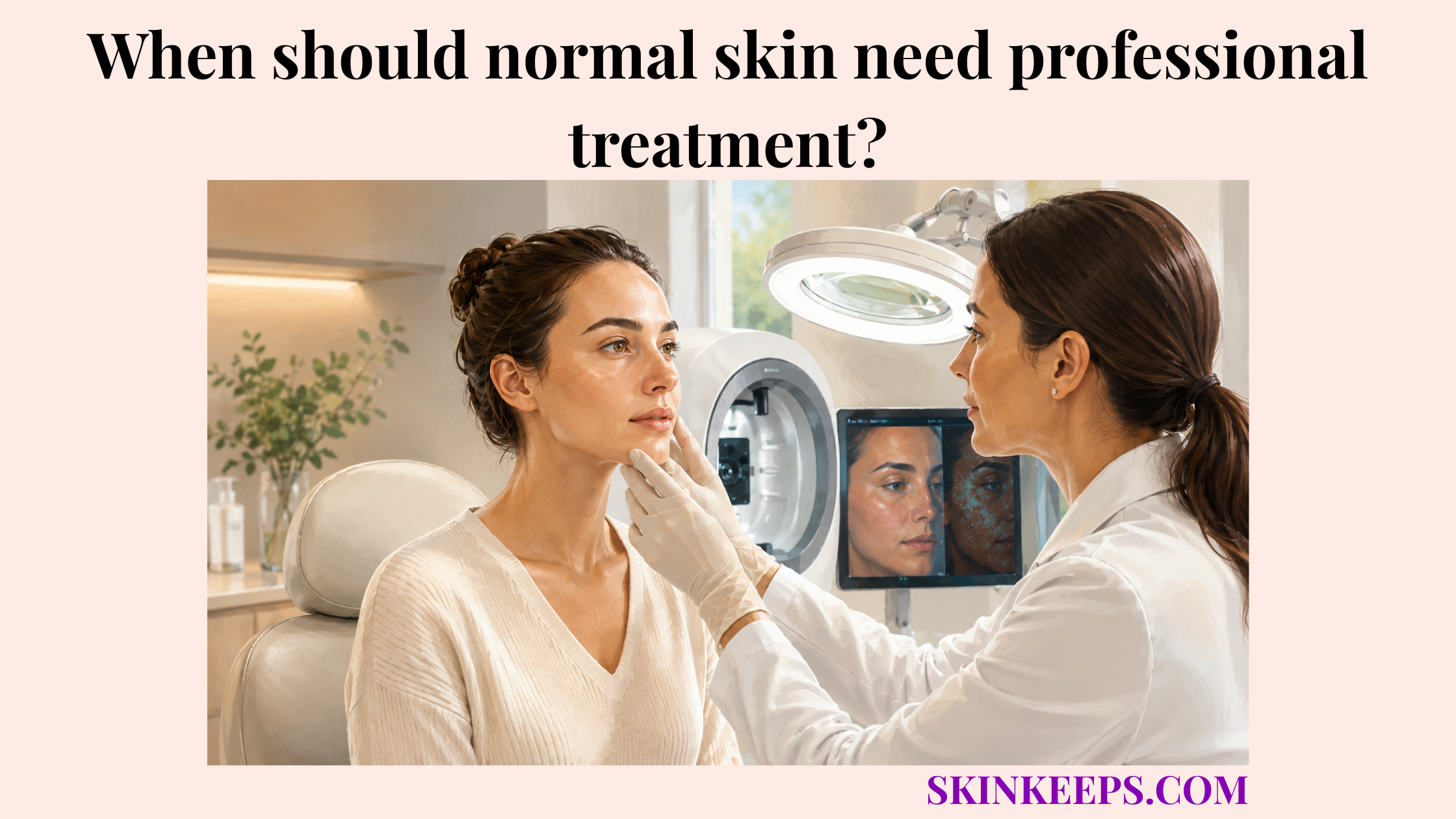
When should changes in normal skin balance need professional attention?
Changes in normal skin balance need professional attention when they are sudden, painful, spreading, bleeding, changing, persistent, or linked with broader health symptoms.
Normal skin can fluctuate, but certain changes should not be treated as ordinary imbalance. A dermatologist or qualified clinician can help when symptoms are severe, spreading, unexplained, linked with broader health changes, or not improving after obvious triggers are removed.
- Skin suddenly becomes very oily, very dry, or very reactive.
- Breakouts become painful, deep, cystic, frequent, or scarring.
- Dry patches crack, bleed, burn, or spread.
- Redness, warmth, swelling, or rash-like patches appear.
- Itching is persistent or intense.
- Products that used to work suddenly sting or burn.
- Skin reacts to many gentle products.
- Pigmentation appears suddenly, spreads, or changes.
- A mole, spot, or lesion changes color, shape, size, or behavior.
- Skin changes appear with broader health symptoms.
Practical rule: Normal skin balance can fluctuate, but sudden, painful, spreading, bleeding, changing, or persistent symptoms need professional review.
What should you remember about internal factors and normal skin balance?
The key point is that internal factors can support normal skin balance, but no single internal factor guarantees perfect skin.
Genetics, hormones, hydration, nutrition, sleep, stress regulation, general health, and barrier stability can all support normal skin balance from inside the body. Even so, temporary internal changes can still make normal skin look oily, dry, dull, reactive, or blemish-prone, so the goal is steady support rather than perfect control.
- Internal factors can help maintain normal skin balance.
- Genetics influence the baseline.
- Hormones can affect oil, dryness, and breakouts.
- Hydration supports overall comfort but does not replace moisturizer.
- Balanced nutrition supports normal body and skin function.
- Sleep supports recovery and appearance.
- Stress regulation can help reduce unpredictable skin changes.
- General health affects how skin behaves.
- A stable skin barrier helps normal skin feel comfortable.
- Temporary internal changes can make normal skin look oily, dry, dull, or reactive.
- No internal factor guarantees perfect skin.
- Avoid extreme diet, supplement, or skin detox claims.
- Seek help for sudden, painful, spreading, bleeding, persistent, or changing skin symptoms.
Frequently Asked Questions About Internal Factors and Normal Skin Balance
Can hormones affect normal skin balance?
Yes. Hormonal shifts can temporarily affect normal skin by increasing oiliness, breakouts, dryness, or sensitivity, especially if the pattern becomes repeated.
Does drinking water keep normal skin balanced?
Hydration supports overall health and comfort, but drinking water alone does not replace moisturizer, sunscreen, or treatment for persistent skin problems.
Can stress disturb normal skin balance?
Yes. Stress can affect sleep, habits, hormones, sweating, picking, and inflammation-related responses, which may make normal skin look less balanced temporarily.
Does diet affect normal skin balance?
Balanced nutrition supports normal body and skin function, but no single food guarantees clear, glowing, or perfectly balanced skin.
When is a change in normal skin balance concerning?
A change is more concerning when it is sudden, persistent, painful, scarring, spreading, bleeding, rash-like, swollen, or linked with changing spots or broader health symptoms.
Conclusion: How should normal skin internal balance be understood?
Normal skin balance is best understood as a steady pattern supported by both body-level factors and surface protection. Genetics, hormones, hydration, nutrition, sleep, stress regulation, general health, and barrier stability can help normal skin stay calm and comfortable, but each factor works as part of a broader system.
The safest takeaway is simple: support normal skin consistently, avoid extreme internal-balance claims, and do not ignore sudden or persistent changes. When normal skin becomes painful, spreading, bleeding, swollen, rash-like, intensely itchy, or linked with changing lesions or broader health symptoms, the concern moves beyond routine skin-type education.
Sources & Evidence About Normal Skin Internal Balance
Cleveland Clinic skin-type education was used to frame normal skin as one balanced skin type among oily, dry, combination, and sensitive patterns.
American Academy of Dermatology guidance on acne, oily skin, dry skin, sensitive skin, face washing, moisturizers, and sunscreen was used to keep claims realistic around breakouts, noncomedogenic support, barrier comfort, irritation, and protection.
DermNet and peer-reviewed dermatology reviews were used to support careful language around acne causes, hormones, stress, sleep, nutrition, and the skin barrier without making diet-cure, supplement, or hormone-diagnosis claims.
Professional-care boundaries were based on dermatology guidance for severe acne, bleeding or cracked skin, persistent rash-like symptoms, swelling, changing lesions, and broader unexplained skin changes.
- Cleveland Clinic: What Is My Skin Type and Why Does It Matter?
- American Academy of Dermatology: Adult acne
- American Academy of Dermatology: Skin care habits that can worsen acne
- American Academy of Dermatology: Dermatologists’ top tips for relieving dry skin
- Cleveland Clinic: Sensitive Skin
- DermNet: Acne
- PMC: Feeding the Skin Barrier
- Journal of Clinical and Aesthetic Dermatology: Skin Barrier Physiology
Educational Disclaimer: This article is for general skin education only and does not diagnose, treat, or replace professional medical advice. If skin balance changes include painful acne, scarring, cracked or bleeding patches, persistent burning, swelling, spreading redness, rash-like irritation, intense itching, sudden unexplained changes, broader health symptoms, or changing moles or lesions, consult a qualified dermatologist or healthcare professional.