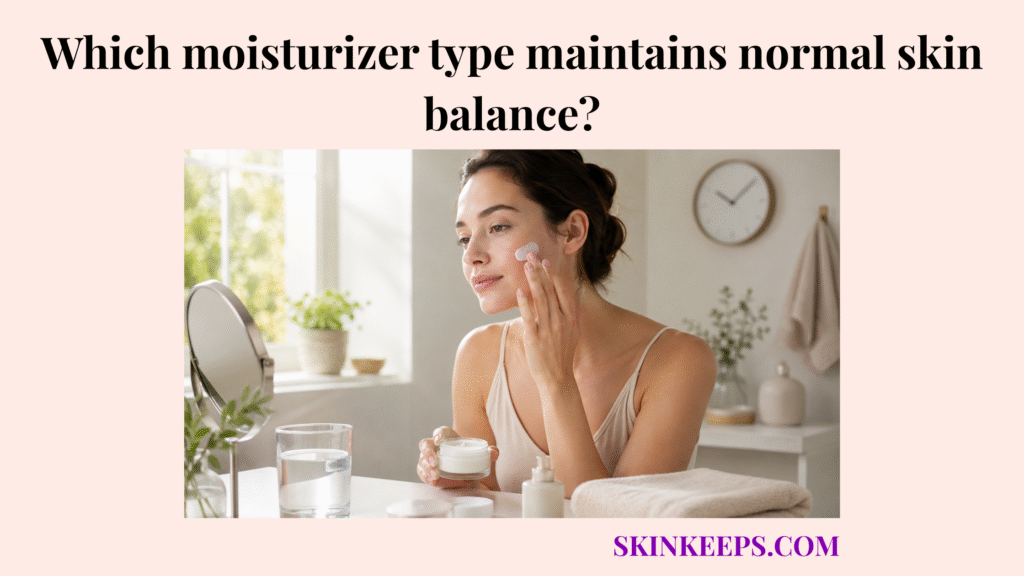
A lightweight, non-greasy, non-comedogenic moisturizer usually maintains normal skin balance best.
Normal skin often does well with a light lotion, light cream, or gel-cream that supports comfort without feeling heavy, oily, sticky, or pore-clogging. The right moisturizer should leave normal skin smooth and comfortable, not coated; a slightly richer texture may help if the skin feels tight or rough, while a lighter texture may work better if the skin feels shiny, clogged, or heavy.
What moisturizer type that maintains normal skin balance works best?
The moisturizer type that maintains normal skin balance is usually a light lotion, light cream, or gel-cream that hydrates without leaving shine, residue, or clogged-feeling areas.
Normal skin usually needs comfort and balance, not the richest formula available. The best moisturizer type gives enough support to reduce tightness without creating heaviness, shine, or bumps.
This texture-first choice fits how different skin types need different levels of oil, moisture, and product weight.
| Moisturizer type | Fit for normal skin balance |
|---|---|
| Light lotion | Often best for daily balance |
| Gel-cream | Good when skin dislikes heaviness |
| Light cream | Good when skin needs more comfort |
| Rich cream | Useful only when normal skin feels dry |
| Balm or ointment | Usually too heavy for full-face daily use |
| Oil-heavy moisturizer | May feel greasy or clog-prone |
| Fragranced moisturizer | May irritate some normal skin |
The best moisturizer type for normal skin balance gives comfort without heaviness.
How should moisturizer type that maintains normal skin balance feel?
A moisturizer type that maintains normal skin balance should feel comfortable, soft, absorbed, and supportive without feeling greasy, sticky, tight, coated, or clogging.
Judge moisturizer type by skin feel after it settles. If the moisturizer makes normal skin feel more balanced, the texture is probably right.
Texture and amount also connect with how often normal skin should be moisturized, because frequency and product weight should work together.
| Normal skin feel | Better moisturizer type |
|---|---|
| Comfortable and balanced | Light lotion |
| Slightly tight | Light cream |
| Dull or rough | Lotion or cream with more cushion |
| Shiny or heavy | Gel-cream or lighter lotion |
| Makeup pills | Use less or choose lighter texture |
| Sunscreen feels drying | Light moisturizer underneath |
| Cold-weather dryness | Slightly richer cream |
| Humid-weather heaviness | Lighter gel-cream |
If the moisturizer makes normal skin feel more balanced, the texture is probably right.
Which ingredient style supports moisturizer type that maintains normal skin balance?
The ingredient style that supports moisturizer type that maintains normal skin balance usually combines hydrating, softening, and barrier-supporting qualities without being overly rich.
Normal skin usually needs a balanced moisturizer formula, not the richest formula. Ingredient language should stay broad: hydration, softness, comfort, low residue, and lower clogged-pore risk matter more than trend claims.
| Ingredient style | Why it helps normal skin balance |
|---|---|
| Humectants | Help attract water to the skin surface |
| Light emollients | Help skin feel smoother |
| Barrier-support ingredients | Help comfort and moisture retention |
| Fragrance-free option | Useful if skin reacts easily |
| Non-comedogenic label | Helpful if bumps or clogged pores appear |
| SPF moisturizer | Useful in the morning if broad-spectrum protection is adequate |
Normal skin usually needs a balanced moisturizer formula, not the richest formula.
When should moisturizer type that maintains normal skin balance be richer?
Moisturizer type that maintains normal skin balance should be richer when normal skin feels tight, rough, flaky, dry, wind-stressed, cold-weather dry, or under-supported.
A richer texture helps only when normal skin actually feels dry or under-supported. Richness should be used as a comfort adjustment, not as a permanent rule for all normal skin.
Dry-feeling moments should be separated from long-term skin type because normal skin is often less prone to acne and dryness at baseline.
- Tightness after cleansing.
- Rough cheeks.
- Dry patches.
- Flaking.
- Cold-weather dryness.
- Wind-related tightness.
- Irritation after actives.
- Makeup clinging to dry areas.
- Sunscreen feeling drying.
A richer moisturizer type maintains normal skin balance only when normal skin actually feels dry or under-supported.
When should moisturizer type that maintains normal skin balance be lighter?
Moisturizer type that maintains normal skin balance should be lighter when normal skin feels greasy, shiny, coated, clogged, heavy, or poorly absorbed after moisturizing.
A lighter moisturizer can maintain balance when richer formulas feel heavy, shiny, or clogging. Gel-cream or lighter lotion may be more comfortable when humidity, sunscreen layers, or makeup make the skin feel overloaded.
- Greasy feel after moisturizing.
- Shiny T-zone.
- Makeup sliding.
- Sunscreen pilling.
- Small clogged bumps.
- Heavy coating sensation.
- Humid-weather discomfort.
- Product residue that does not absorb.
A lighter moisturizer type maintains normal skin balance when richer formulas feel heavy, shiny, or clogging.
Which moisturizer type can disrupt normal skin balance?
A moisturizer type can disrupt normal skin balance when it is too heavy, too fragranced, too oily, too light for dryness, layered too thickly, or changed too often to identify triggers.
The wrong moisturizer type can make normal skin feel less balanced, even if the product is marketed as gentle. Watch how the skin behaves after the product settles, during sunscreen layering, and under makeup.
Morning moisturizer choices still need sun protection support because normal skin still needs protection from sun damage.
| Moisturizer mistake | How it disrupts normal skin balance |
|---|---|
| Using heavy cream without dryness | Greasy feel or clogged pores |
| Using only gel when skin feels tight | Comfort may stay low |
| Choosing fragrance-heavy formulas | Stinging or redness may appear |
| Layering too much moisturizer | Pilling, shine, or heaviness |
| Using oil-heavy products for glow | Shine and bumps may increase |
| Skipping moisturizer when tight | Dryness may build |
| Changing moisturizer too often | Triggers become hard to track |
| Ignoring sunscreen | Balance is not protected from UV damage |
The wrong moisturizer type can make normal skin feel less balanced, even if the product is marketed as gentle.
When should reactions to moisturizer type that maintains normal skin balance need attention?
Reactions to moisturizer type that maintains normal skin balance need attention when burning, stinging, rash-like redness, swelling, severe itching, painful acne, cracked patches, or changing lesions appear or repeat.
Normal skin can dislike one moisturizer type, but repeated reactions need review. Persistent symptoms should not be handled by switching products over and over.
- Moisturizer repeatedly burns, stings, or causes rash-like redness.
- Skin reacts to many gentle moisturizers.
- Dry patches crack, bleed, burn, or spread.
- Breakouts become painful, deep, frequent, or scarring.
- Redness becomes warm, swollen, spreading, or persistent.
- Itching becomes intense or persistent.
- A mole, spot, or lesion changes color, shape, size, or behavior.
Normal skin can dislike one moisturizer type, but repeated reactions need review.
What should you remember about moisturizer type that maintains normal skin balance?
The key point is that the moisturizer type that maintains normal skin balance is usually lightweight, comfortable, non-greasy, and adjusted to the skin’s current feel.
Light lotion often works for daily balance, gel-cream can help when skin feels heavy or shiny, and light cream can help when skin feels slightly dry. The right choice is comfort-guided, not trend-guided.
Frequently Asked Questions About Moisturizer Type That Maintains Normal Skin Balance
Is lotion the best moisturizer type that maintains normal skin balance?
A light lotion is often a good daily option because it supports comfort without feeling heavy.
Is gel-cream a good moisturizer type that maintains normal skin balance?
Yes. Gel-cream can work well when normal skin feels shiny, heavy, or clogged with richer products.
Is rich cream a good moisturizer type that maintains normal skin balance?
Only when normal skin feels dry, tight, rough, or exposed to cold weather. Rich cream may be too heavy for everyday full-face use.
Is oil-free moisturizer always the best type for normal skin balance?
Not always. Normal skin mainly needs a comfortable, non-greasy texture. Oil-free may help if skin feels shiny or clogged.
Can the wrong moisturizer type disrupt normal skin balance?
Yes. A moisturizer that is too heavy, fragranced, drying, or poorly absorbed can make normal skin feel greasy, irritated, tight, or bump-prone.
Sources & Evidence About Moisturizer Type That Maintains Normal Skin Balance
Cleveland Clinic skin-type guidance was used to ground normal, dry, oily, combination, and sensitive skin distinctions.
American Academy of Dermatology dry-skin relief guidance was used for moisturizer support, applying moisturizer when skin feels dry, dry-weather dryness, cracked or bleeding skin, burning, and itching boundaries.
American Academy of Dermatology face-washing guidance was used for gentle cleansing and moisturizer support when skin feels dry or itchy after washing.
American Academy of Dermatology acne moisturizer guidance was used for non-comedogenic, oil-free, and “won’t clog pores” product-label context.
American Academy of Dermatology acne-and-makeup guidance was used for clogged pores, makeup residue, product buildup, and breakout-related boundaries.
American Academy of Dermatology sunscreen guidance was used for broad-spectrum sunscreen, SPF 30 or higher, and morning UV-protection boundaries.
Peer-reviewed moisturizer review from NIH/PMC was used for humectant, emollient, occlusive, and barrier-supporting moisturizer role context.
Peer-reviewed sensitive-skin review from NIH/PMC was used for burning, stinging, itching, and reactive-skin symptom context.
American Academy of Dermatology acne treatment guidance was used for painful, frequent, cystic, or scarring acne referral boundaries.
American Academy of Dermatology melanoma signs guidance was used for changing moles, changing spots, lesion behavior, and referral boundaries.
Educational Disclaimer: This article is for general skin education only and does not diagnose, treat, or replace professional medical advice. If moisturizer causes repeated burning, swelling, rash-like redness, painful acne, cracked or bleeding patches, severe itching, spreading irritation, sudden unexplained changes, broader health symptoms, or changing moles or lesions, consult a qualified dermatologist or healthcare professional.