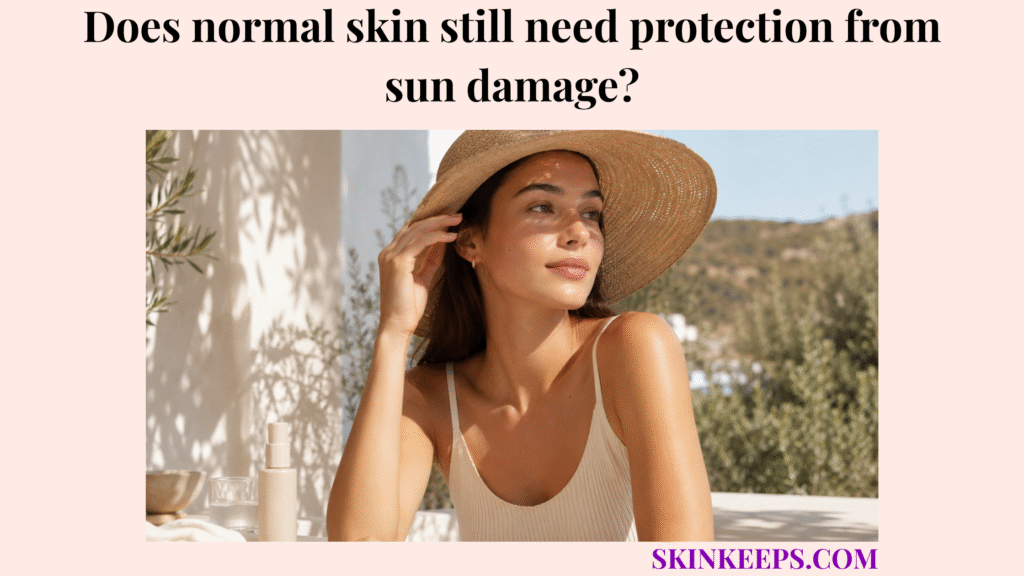
Yes, normal skin still needs protection from sun damage. Normal skin may feel balanced, smooth, and comfortable, but UV exposure can still cause sunburn, redness, dryness, uneven tone, dark spots, texture changes, premature aging signs, and skin cancer risk.
Normal skin is not immune just because it is not oily, dry, sensitive, or acne-prone. Sun protection is one of the most important daily habits for keeping normal skin healthy over time.
Why does normal skin still need sun protection?
Normal skin still needs sun protection because balanced skin is not UV-proof, and sun damage can build even when the skin looks healthy.
Sun damage does not always appear immediately. Normal skin can still burn, darken, dry out, redden, or become temporarily sensitive depending on skin tone, exposure level, UV intensity, and protection habits.
Sun protection belongs across different skin types because balanced skin feel does not prove the skin is protected from ultraviolet exposure.
Normal skin can look healthy while UV damage still accumulates
Normal skin can look healthy while UV damage still accumulates because repeated exposure may affect the skin before obvious changes appear.
Balanced skin feel does not prove the skin is protected. Repeated exposure can contribute to long-term tone, texture, and health concerns.
Normal skin can still burn, darken, or become irritated
Normal skin can still burn, darken, or become irritated when UV exposure exceeds the skin’s protection level.
The visible response can vary by skin tone, exposure time, UV intensity, and protection habits. Not every exposure causes immediate visible harm, but repeated exposure still matters.
| Sun exposure issue | How it can affect normal skin |
|---|---|
| UVA exposure | Premature aging signs and deeper skin damage |
| UVB exposure | Sunburn and surface damage |
| Repeated exposure | Cumulative skin damage |
| Tanning | Sign of UV response, not skin health |
| Sunburn | Redness, pain, peeling, irritation |
| Dark spots | Uneven tone and pigmentation changes |
| Texture changes | Roughness, fine lines, loss of smoothness |
| Skin cancer risk | Long-term medical concern |
Normal skin can be balanced and still vulnerable to UV damage.
How can sun damage affect normal skin in the short term?
Sun damage can affect normal skin in the short term by causing redness, warmth, tenderness, dryness, dullness, stinging, tanning, peeling, or blistering.
Short-term sun responses may appear the same day or after exposure. Heat, sweat, sunscreen residue, or outdoor friction may also contribute to irritation or breakout-like changes.
Post-sun stinging, burning, and redness can temporarily interrupt the usual pattern of normal skin being less sensitive than reactive skin types.
| Short-term response in normal skin | What it may look or feel like |
|---|---|
| Redness | Skin looks flushed or irritated |
| Warmth | Skin feels hot after exposure |
| Sunburn | Pain, tenderness, peeling, or blistering |
| Dryness | Skin feels tight or rough |
| Dullness | Skin looks less fresh after exposure |
| Stinging | Products may burn after sun exposure |
| Temporary darkening | Skin tone may deepen or tan |
| Breakout flare | Sweat, sunscreen, or heat may contribute |
If normal skin feels hot, sore, tight, or stinging after sun, it has been stressed.
How can sun damage affect normal skin over time?
Sun damage can affect normal skin over time by contributing to uneven tone, dark spots, rough texture, fine lines, premature aging signs, actinic damage, and skin cancer risk.
Long-term sun effects can build slowly, so they should be explained without fear-based language. Protection matters before tone, texture, or rough sun-exposed changes become obvious.
UV exposure, tone, texture, and premature aging signs overlap with how age changes normal skin over time.
Sun damage can change normal skin tone
Sun damage can change normal skin tone when repeated UV exposure contributes to freckles, dark spots, uneven tone, redness, or post-inflammatory marks becoming more noticeable.
Tone changes may build slowly. This section should help the reader recognize risk, not become a hyperpigmentation treatment plan.
Sun damage can change normal skin texture
Sun damage can change normal skin texture when repeated UV exposure contributes to roughness, fine lines, wrinkles, loss of firmness, or uneven surface texture.
Protection matters before texture changes become obvious. Sunscreen can help reduce risk, but it should not be framed as wrinkle reversal.
Sun damage can affect normal skin health
Sun damage can affect normal skin health because UV exposure is connected with skin cancer risk and suspicious lesion changes.
Sun protection is a health habit, not only a cosmetic step. Changing spots, rough persistent patches, and non-healing areas need evaluation.
| Long-term change | How normal skin may show it |
|---|---|
| Uneven tone | Spots, patchiness, discoloration |
| Freckles or sun spots | More visible pigmentation |
| Fine lines | Earlier visible aging signs |
| Rough texture | Less smooth surface |
| Redness | More persistent visible irritation |
| Fragility | Skin may recover more slowly |
| Actinic damage | Rough or scaly sun-related areas |
| Skin cancer risk | Changing or suspicious lesions may appear |
Sun protection helps preserve normal skin health before damage becomes obvious.
What type of sun protection does normal skin need?
Normal skin needs broad, consistent sun protection that includes broad-spectrum sunscreen, SPF 30 or higher, reapplication, shade, protective clothing, hats, sunglasses, and lip protection.
This guidance should stay general and brand-free. Sunscreen works best as part of a protection system, not as a one-time emergency step after the skin already feels hot or sore.
Sun protection is also one of the lifestyle choices that affect normal skin health because it lowers avoidable UV exposure across ordinary days.
| Protection step | Why it matters for normal skin |
|---|---|
| Broad-spectrum sunscreen | Helps protect against UVA and UVB rays |
| SPF 30 or higher | Common minimum recommendation for daily protection |
| Water-resistant sunscreen | Helpful for sweating or swimming |
| Reapplication | Protection wears off with time, sweat, and rubbing |
| Enough amount | Under-application reduces protection |
| Shade | Reduces direct UV exposure |
| Hats and clothing | Adds physical protection |
| Sunglasses | Protects eye-area skin and eyes |
| Lip protection | Lips can also burn |
| Daily consistency | UV exposure accumulates over time |
Normal skin needs consistent protection, not occasional emergency sunscreen.
Does normal skin need sunscreen every day?
Normal skin often needs sunscreen every day because ordinary daylight exposure can happen during commuting, errands, outdoor breaks, driving, sports, or time near bright windows.
Normal skin can receive UV exposure on ordinary days, and the skin does not need to feel damaged before protection matters. Repeated small exposure can add to cumulative risk.
UV exposure is one of the major environmental changes that normal skin responds to, even when the day is cool or the skin feels comfortable.
Normal skin can receive UV exposure on ordinary days
Normal skin can receive UV exposure on ordinary days during commuting, errands, outdoor breaks, driving, sports, or time near bright windows.
The skin does not need to feel hot or sore before protection matters. Repeated small exposure can still matter over time.
Normal skin still needs protection on cloudy or cool days
Normal skin still needs protection on cloudy or cool days because cooler weather and cloud cover do not automatically remove UV exposure.
Balanced comfort can be misleading. Consistent protection is safer than waiting for sunburn.
- You go outside during daylight.
- You drive or sit near windows often.
- You use exfoliants or retinoids.
- You have past sunburns or dark spots.
- You live in a sunny or high-UV area.
- You sweat or exercise outdoors.
- You want to reduce premature aging signs.
- You want to reduce sunburn and skin cancer risk.
Normal skin does not need to feel damaged before sunscreen matters.
Can normal skin skip sunscreen if it does not burn easily?
Normal skin should not skip sunscreen just because it does not burn easily, because UV damage can still occur without frequent sunburn.
Skin can still experience UV damage, tanning, pigmentation changes, premature aging signs, and skin cancer risk even when sunburn is rare. Low burn tendency is not the same as UV protection.
Not burning easily does not mean normal skin is protected.
Can normal skin tan safely?
Normal skin cannot treat UV tanning as risk-free because a tan is a sign that skin has responded to ultraviolet exposure.
A tan may happen without burning, but the exposure can still contribute to accumulated sun damage, uneven tone, texture changes, and long-term risk. Tanning should not be treated as a skin-health goal.
| Myth | Better explanation for normal skin |
|---|---|
| Normal skin does not need sunscreen | Balanced skin can still be sun-damaged |
| A tan means healthy skin | Tanning is a UV response |
| Darker skin never gets sun damage | Lower burn risk is not zero risk |
| Sunscreen is only for beach days | Daily exposure also accumulates |
| Clouds block all UV | UV can still reach skin |
| SPF in makeup is always enough | Amount used may be too low |
| Sunscreen prevents all damage | It reduces risk but needs correct use |
| One application lasts all day outdoors | Reapplication matters |
Normal skin glow should come from health and care, not intentional UV damage.
How should normal skin avoid irritation from sunscreen?
Normal skin can avoid sunscreen irritation by choosing a comfortable formula, supporting dryness when needed, avoiding repeated stinging, and removing sunscreen gently.
This solves a practical barrier without recommending brands. The best sunscreen is one that protects well and can be used consistently.
Sun-related uneven tone, dark spots, and texture changes can disrupt the usual pattern of normal skin having even tone and texture.
- Choose a texture that does not feel greasy or drying.
- Avoid formulas that repeatedly sting or burn.
- Moisturize first if sunscreen feels drying.
- Use a water-resistant option for sweat or swimming.
- Remove sunscreen gently at night.
- Avoid scrubbing to remove residue.
- Patch test if skin reacts easily.
- Ask a dermatologist if many sunscreens irritate the skin.
The best sunscreen for normal skin is one that protects well and can be used consistently.
What mistakes should normal skin avoid with sun protection?
Normal skin should avoid sun-protection mistakes such as skipping sunscreen, applying too little, forgetting reapplication, relying only on makeup SPF, tanning for glow, or ignoring changing spots.
Under-protection and overconfidence are common because normal skin may not feel immediately damaged. Small repeated gaps can matter more than one obvious sunburn.
| Mistake | Why it can harm normal skin | Better move |
|---|---|---|
| Skipping sunscreen because skin is normal | Normal skin is not UV-proof | Use daily protection |
| Applying too little sunscreen | Protection may be lower than expected | Use enough product |
| Forgetting reapplication outdoors | Protection wears down | Reapply as needed |
| Relying only on makeup SPF | Often not applied thickly enough | Use real sunscreen |
| Ignoring ears, lips, neck, and hands | These areas also get UV exposure | Protect exposed areas |
| Tanning for glow | UV damage accumulates | Use safer glow alternatives |
| Skipping sunscreen on cloudy days | UV still reaches skin | Protect consistently |
| Ignoring changing spots | Delays evaluation | Seek professional review |
Normal skin often gets sun damage from small repeated under-protection, not only from obvious sunburn.
When should sun-related changes in normal skin need professional attention?
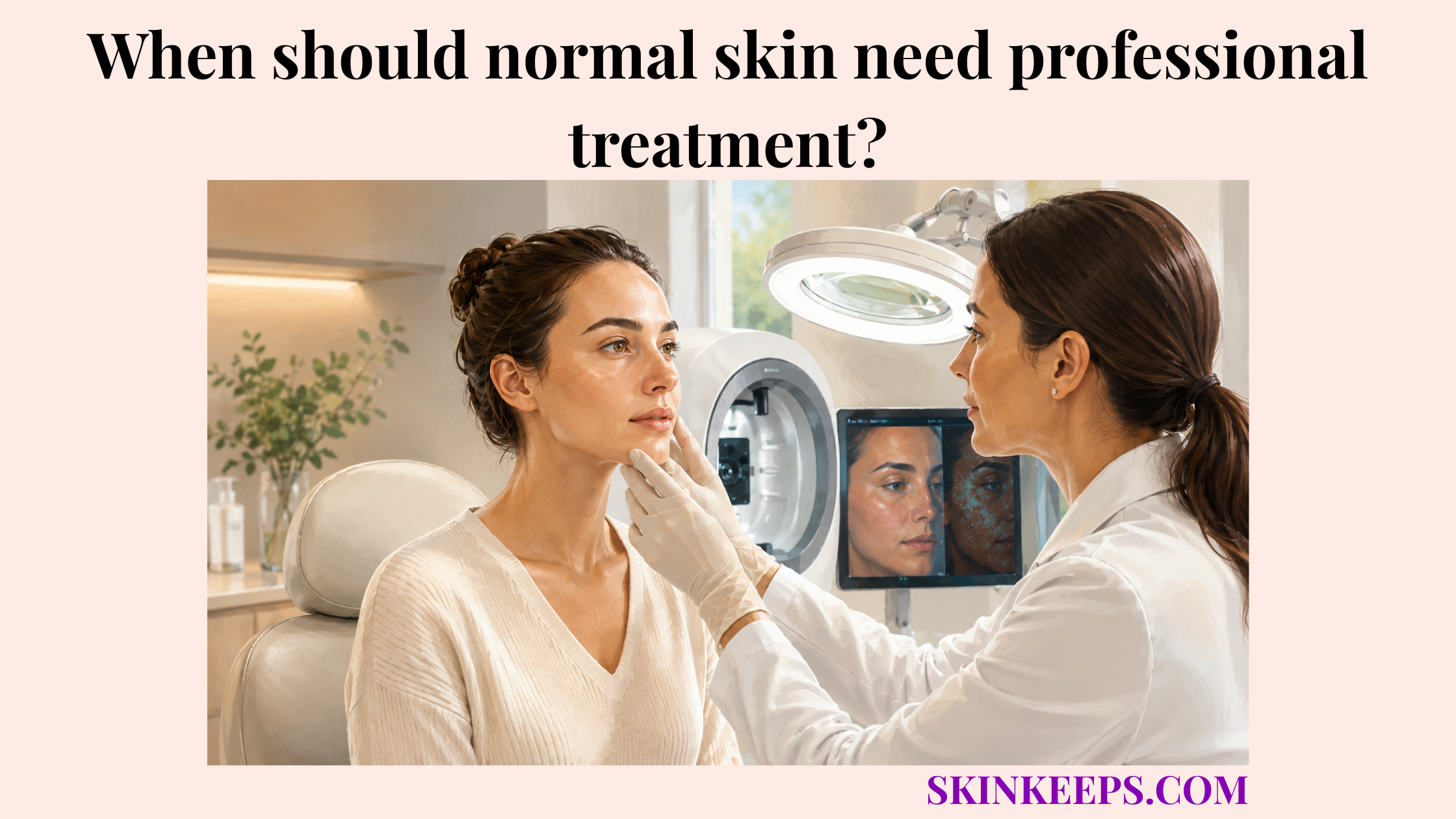
Sun-related changes in normal skin need professional attention when a mole, spot, lesion, burn, rough patch, pigmentation change, or non-healing area looks unusual, painful, severe, or persistent.
Sun-related changes should be watched carefully because some important damage is not only cosmetic. These signs do not diagnose the cause, but they do mark the need for professional review.
- A mole, spot, or lesion changes color, shape, size, or behavior.
- A new spot appears and grows, bleeds, crusts, or does not heal.
- Sunburn is severe, blistering, or very painful.
- Skin becomes swollen, infected-looking, or intensely painful after sun.
- A rough, scaly, persistent sun-exposed patch appears.
- Pigmentation appears suddenly, spreads, darkens, or changes.
- Redness becomes persistent, warm, swollen, or rash-like.
- Products sting or burn for days after sun exposure.
- You have repeated sunburns or a history of skin cancer.
- You are unsure whether a spot is harmless.
Sun-related changes should be watched carefully because some important damage is not just cosmetic.
What should you remember about normal skin and sun damage?
The key point is that normal skin still needs protection from sun damage because balanced skin is not UV-proof.
Sun exposure can affect short-term comfort, long-term tone, texture, aging signs, and skin cancer risk. Consistent protection helps reduce avoidable UV exposure over time.
Frequently Asked Questions About Normal Skin and Sun Damage
Does normal skin need sunscreen every day?
Yes. Normal skin still benefits from daily sun protection because UV exposure can accumulate even when the skin looks balanced.
Can normal skin get sun damage without burning?
Yes. Skin can tan, darken, develop spots, age prematurely, or accumulate UV damage even without frequent sunburn.
What SPF should normal skin use?
A broad-spectrum sunscreen with SPF 30 or higher is commonly recommended for daily protection.
Can normal skin tan safely?
No tan from UV exposure should be treated as risk-free. Tanning is a sign of UV response and can contribute to long-term damage.
When should sun damage on normal skin be checked?
A changing mole, growing spot, bleeding lesion, persistent rough patch, severe sunburn, blistering, or non-healing area should be checked by a qualified professional.
Sources & Evidence About Normal Skin and Sun Damage
Cleveland Clinic skin-type guidance was used to ground normal, dry, oily, combination, and sensitive skin distinctions.
American Academy of Dermatology sunscreen guidance was used for broad-spectrum sunscreen, water resistance, SPF 30 or higher, shade, protective clothing, hats, sunglasses, sunburn, premature aging, and skin cancer risk.
American Academy of Dermatology sunscreen application guidance was used for using enough sunscreen, face amount, full-body amount, and application boundaries.
American Academy of Dermatology sunburn treatment guidance was used for sunburn, blistering, second-degree sunburn, and when sunburn symptoms need extra care.
American Academy of Dermatology tanning and sunburn risk guidance was used for tanning, sunburn, cumulative damage, premature aging, age spots, wrinkles, and skin cancer risk.
American Academy of Dermatology tanning-myth guidance was used for the boundary that a tan is a sign of UV damage rather than a health goal.
American Academy of Dermatology indoor tanning guidance was used for UV radiation, melanoma risk, squamous cell carcinoma risk, and basal cell carcinoma risk.
Mayo Clinic sunburn symptoms guidance was used for short-term sunburn signs such as redness, pain, blisters, peeling, fever, nausea, and infection signs.
American Academy of Dermatology melanoma signs guidance was used for changing moles, changing spots, suspicious lesions, and referral boundaries.
Educational Disclaimer: This article is for general skin education only and does not diagnose, treat, or replace professional medical advice. If sun-related skin changes include severe sunburn, blistering, swelling, intense pain, infection signs, persistent rough patches, bleeding or non-healing sores, sudden pigmentation changes, broader health symptoms, or any mole, spot, or lesion that changes color, shape, size, or behavior, consult a qualified dermatologist or healthcare professional.