
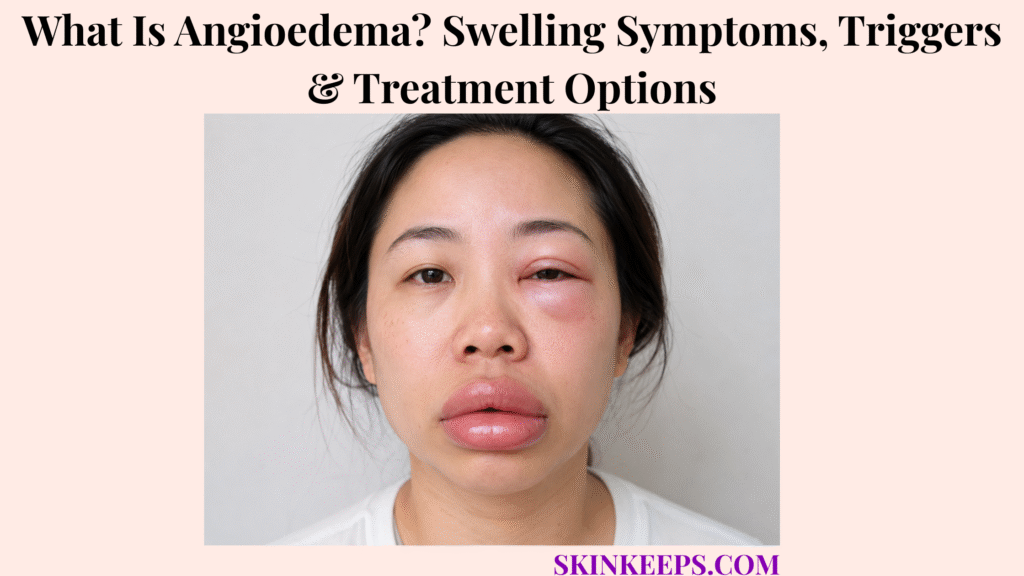
Angioedema is deeper swelling under the skin or mucous membranes that can affect the lips, eyelids, face, tongue, throat, hands, feet, genitals, or bowel. It should not be treated as ordinary puffiness when swelling is sudden, severe, recurrent, or near the airway.
This page covers swelling symptoms, trigger categories, emergency warning signs, diagnosis, treatment direction, prevention, and specialist evaluation. Tongue swelling, throat swelling, trouble breathing, trouble swallowing, fainting, confusion, or rapidly worsening swelling needs urgent or emergency care.
What Is Angioedema and How Does Swelling Start?
Angioedema is swelling in deeper tissue under the skin or mucous membranes, often affecting soft areas such as the lips, eyelids, tongue, throat, hands, feet, genitals, or bowel.
The swelling happens when blood vessels become more permeable and fluid leaks into deeper tissue. Depending on the type, this can involve mast cells and histamine, bradykinin, medication effects, complement-system problems, or no clear trigger.
Angioedema can occur with hives or without hives. The presence or absence of itching and surface welts can help clinicians decide whether histamine-mediated or non-histamine swelling is more likely.
Why Is Angioedema Deeper Than Ordinary Surface Swelling?
Angioedema is deeper than ordinary surface swelling because fluid collects below the skin surface or within mucous tissues rather than only producing a surface rash.
The area may feel tight, heavy, uncomfortable, pressure-like, or mildly painful. It may not look like a standard rash, especially when swelling involves the lips, eyelids, tongue, throat, hands, feet, genitals, or bowel.
Why Can Angioedema Be Dangerous?
Angioedema can be dangerous when swelling affects the tongue, throat, airway, breathing, swallowing, or blood-pressure symptoms such as dizziness or fainting.
Airway swelling can worsen quickly. Swelling that affects breathing, throat tightness, swallowing, alertness, color change, faintness, or collapse should be treated as an emergency rather than a skin problem.
Practical rule: Angioedema is not just cosmetic puffiness; airway, tongue, throat, breathing, swallowing, or fainting symptoms change the urgency.
What Angioedema Swelling Symptoms Can Appear?
Angioedema symptoms can include sudden or recurrent swelling of the face, lips, eyelids, tongue, throat, hands, feet, genitals, or abdomen, with or without hives.
Swelling may be one-sided or uneven. It may feel tight, heavy, uncomfortable, pressure-like, or mildly painful rather than itchy.
What Does Angioedema Swelling Look and Feel Like?
Angioedema swelling often looks like sudden, deeper, sometimes asymmetric enlargement and may feel tight, heavy, uncomfortable, mildly painful, or pressure-like.
Lips or eyelids may enlarge suddenly. Hands, feet, or genitals may feel tight or swollen. Bowel swelling can cause abdominal pain, nausea, vomiting, or diarrhea, especially when episodes recur.
Can Angioedema Happen With Hives?
Angioedema can happen with hives, especially in allergic or histamine-mediated swelling, but bradykinin-mediated angioedema often occurs without hives or itching.
Hives / urticaria are raised itchy surface welts. Angioedema is deeper swelling, and no-hives swelling can still be serious when it affects the airway or recurs without a clear trigger.
| Swelling Sign | Common Location | Possible Concern |
|---|---|---|
| Lip swelling | Lips or mouth | Can be allergic, medication-related, or hereditary |
| Eyelid swelling | Eyelids / face | May be soft-tissue angioedema or another facial swelling cause |
| Tongue swelling | Tongue / mouth | Emergency risk if breathing or swallowing is affected |
| Throat tightness | Throat / airway | Emergency warning sign |
| Hand or foot swelling | Hands / feet | Can occur in hereditary, idiopathic, or allergic forms |
| Genital swelling | Genitals | Needs medical evaluation if severe, painful, or recurrent |
| Abdominal pain | Bowel | Recurrent attacks may suggest hereditary or acquired angioedema |
| Hives with swelling | Skin surface + deeper tissue | More consistent with histamine-mediated reaction |
| Swelling without hives | Deeper tissue only | Can suggest bradykinin-mediated or non-histamine causes |
Where Does Angioedema Usually Affect the Body?
Angioedema commonly affects soft tissue areas such as the lips, eyelids, face, tongue, throat, hands, feet, genitals, and sometimes the bowel.
Tongue, throat, and airway swelling are the highest safety priority. Bowel swelling may cause stomach pain, nausea, vomiting, or diarrhea, and recurrent abdominal attacks deserve medical review.
Swelling location can guide trigger and mechanism review. Lip and facial swelling may point toward allergy, medication, or idiopathic causes, while recurrent hand, foot, genital, bowel, or no-hives swelling can raise concern for bradykinin-mediated disease.
| Area Affected | What the Reader May Notice | Safety Priority |
|---|---|---|
| Lips / mouth | Sudden swelling or tightness | Higher priority if worsening or paired with breathing symptoms |
| Tongue | Enlarged tongue, speech or swallowing difficulty | Emergency if airway or swallowing affected |
| Throat / airway | Tight throat, choking, wheezing, trouble breathing | Emergency |
| Eyelids / face | Soft facial swelling | Needs care if severe, recurrent, painful, or unclear |
| Hands / feet | Deep swelling, tight skin, pressure | Track recurrence and triggers |
| Genitals | Swelling, pressure, discomfort | Medical evaluation if severe or recurrent |
| Bowel | Abdominal pain, nausea, vomiting, diarrhea | Specialist evaluation if recurrent or paired with swelling episodes |
When Is Angioedema an Emergency?
Angioedema is an emergency when swelling affects the lips, mouth, tongue, throat, breathing, swallowing, alertness, or blood-pressure symptoms such as faintness or dizziness.
Emergency care is needed for tongue swelling, throat swelling, tight throat, trouble breathing, wheezing, choking, gasping, trouble swallowing, sudden weakness, confusion, drowsiness, dizziness, fainting, collapse, or rapidly worsening swelling.
Call emergency services if angioedema includes:
Practical rule: Do not wait with tongue, throat, breathing, swallowing, fainting, confusion, or color-change symptoms.
What Triggers Angioedema?
Angioedema triggers can include allergic reactions, medicines, ACE inhibitors, inherited C1-inhibitor problems, acquired C1-inhibitor problems, physical triggers, autoimmune or other health conditions, and idiopathic episodes with no clear cause.
Triggers should be organized by mechanism rather than guessed from swelling alone. Timing, hives, itching, medicine exposure, family history, abdominal attacks, and treatment response can help guide evaluation.
Which Allergy Triggers Can Cause Angioedema?
Allergy triggers can cause histamine-mediated angioedema after exposure to foods, medicines, latex, insect stings, or insect bites.
Allergic swelling often develops within minutes to a few hours and may occur with hives, itching, flushing, wheezing, or anaphylaxis-like symptoms. Latex allergy is one possible trigger category when swelling follows latex exposure.
Which Medicines Can Trigger Angioedema?
Medicines can trigger angioedema, especially ACE inhibitors, and medication-related swelling can appear even after a person has taken the medicine safely before.
ACE-inhibitor angioedema is reported in about 0.1% to 0.7% of ACE-inhibitor users. It can occur soon after starting therapy or years later, and a clinician should review medication changes and safer alternatives after dangerous swelling is addressed.
NSAIDs or aspirin can also be involved in some people. Do not restart a suspected medicine after swelling without clinician guidance.
Which Non-Allergic Triggers Can Cause Recurrent Angioedema?
Non-allergic recurrent angioedema can involve hereditary angioedema, acquired C1-inhibitor deficiency, idiopathic angioedema, physical triggers, stress, trauma, infection, dental work, or procedures.
Hereditary angioedema becomes more important when swelling recurs without hives, affects the abdomen, appears in families, or responds poorly to ordinary allergy medicines. Stress can be a trigger context for some people, but it should not be treated as the sole explanation.
| Trigger Category | Examples | Timing Clue | Hives Likely? |
|---|---|---|---|
| Allergic / histamine | Foods, latex, stings, drug allergy | Minutes to hours | Often yes |
| ACE inhibitor | Blood-pressure medicines in ACE-inhibitor class | Can occur early or years later | Usually no |
| NSAID-related | Aspirin or NSAIDs in susceptible people | Variable | May occur with or without hives |
| Hereditary / acquired C1-INH | C1-inhibitor deficiency or dysfunction | Recurrent attacks, often hours to days | Usually no |
| Physical triggers | Pressure, vibration, trauma, procedures | Trigger-linked recurrence | Variable |
| Idiopathic | No clear trigger found | Recurrent unexplained episodes | May or may not occur |
What Types of Angioedema Are Important to Know?
Angioedema treatment depends heavily on type because allergic or histamine-mediated swelling and bradykinin-mediated swelling do not respond to the same medicines.
This is why the same symptom word, swelling, can require very different medical decisions. Type clues include timing, hives, itching, medications, family history, abdominal attacks, and response to antihistamines.
What Is Allergic or Histamine-Mediated Angioedema?
Allergic or histamine-mediated angioedema is swelling driven by mast-cell mediators and often appears quickly with hives, itching, flushing, wheezing, or other allergic symptoms.
Foods, stings, latex, and drug allergy can fit this pattern. When swelling occurs with breathing trouble, throat symptoms, faintness, wheezing, or anaphylaxis-like symptoms, emergency treatment is needed.
What Is Bradykinin-Mediated Angioedema?
Bradykinin-mediated angioedema includes ACE-inhibitor angioedema, hereditary angioedema, and acquired C1-inhibitor deficiency, and it often causes swelling without hives or itching.
Bradykinin-mediated swelling may develop over hours to days. Antihistamines, corticosteroids, and epinephrine are not reliably effective for bradykinin-mediated angioedema, so airway management and type-specific medical care matter.
What Is Idiopathic Angioedema?
Idiopathic angioedema is recurrent swelling with no clear trigger after history, medicine review, and targeted evaluation.
Idiopathic does not mean imaginary or anxiety-driven. It means no clear cause has been identified yet, and the plan may involve trigger tracking, medication review, and specialist-guided symptom control.
| Type | Common Clues | Hives / Itching? | Treatment Direction |
|---|---|---|---|
| Allergic / histamine | Food, sting, latex, drug allergy, rapid onset | Often yes | Allergy/anaphylaxis pathway if severe |
| ACE-inhibitor | Face, lip, tongue, or airway swelling with ACE-inhibitor history | Usually no | Airway first; medication review and replacement by clinician |
| Hereditary / acquired C1-INH | Recurrent swelling, abdominal attacks, family history possible | Usually no | C4/C1-INH evaluation and HAE/AAE-specific treatment |
| Idiopathic | Recurrent swelling with no clear trigger | May or may not | Specialist evaluation and symptom-control plan |
How Is Angioedema Different From Hives, Allergy Rash, or Infection?
Angioedema affects deeper tissue swelling, while hives usually affect the skin surface as raised itchy welts, and infections often cause warmth, redness, pain, fever, or spreading tenderness.
These conditions can overlap or look confusing, so worsening, painful, airway-related, or unclear swelling should be assessed rather than self-diagnosed.
How Is Angioedema Different From Hives?
Angioedema is different from hives because angioedema causes deeper swelling, while hives cause raised itchy surface welts.
Angioedema can occur with hives, but swelling without hives can suggest non-histamine causes. No-hives swelling should not be considered safe if it affects the tongue, throat, breathing, swallowing, or recurs without explanation.
How Is Angioedema Different From Facial Infection or Cellulitis?
Angioedema is different from facial infection or cellulitis because infection often causes warmth, redness, spreading pain, tenderness, fever, or pus rather than soft recurrent swelling alone.
Cellulitis can also be serious, especially near the eyes or when fever and spreading redness occur. Unclear swelling needs medical assessment because treatment differs.
A delayed itchy rash after skin contact fits allergic contact dermatitis more than deep angioedema, while a medication-triggered skin eruption may fit a drug rash pattern rather than isolated deep swelling.
| Condition | Main Clue | Hives / Rash? | Emergency Concern |
|---|---|---|---|
| Angioedema | Deep swelling of lips, eyelids, face, tongue, throat, hands, feet, genitals, or bowel | May occur with or without hives | Airway, tongue, throat, breathing, faintness |
| Hives / urticaria | Raised itchy welts on skin surface | Yes, surface welts | Emergency if systemic allergic symptoms occur |
| Allergic contact dermatitis | Delayed itchy rash where allergen touched skin | Eczematous rash, not deep swelling | Emergency only if systemic swelling or breathing symptoms occur |
| Cellulitis | Warm, painful, red, spreading skin infection | Redness and tenderness, not usually hives | Urgent if spreading, feverish, or near eyes |
| Cosmetic puffiness | Mild bilateral puffiness, often around eyes | Usually no hives | Not typical emergency unless airway/systemic symptoms appear |
How Is Angioedema Diagnosed or Checked?
Angioedema is usually checked through symptom history, trigger review, medication review, physical examination, and targeted testing when swelling is recurrent, unexplained, or suspected to be hereditary or acquired.
Evaluation depends on whether the episode was single or recurrent, whether hives or itching occurred, whether the airway was involved, and whether medicines such as ACE inhibitors were being used.
What History Matters Most With Angioedema?
Angioedema history matters because swelling location, timing, triggers, hives, medicines, breathing symptoms, and recurrence help separate allergic, medication-related, hereditary, acquired, and idiopathic causes.
Important details include how fast swelling started, how long it lasted, whether hives or itching occurred, whether breathing or swallowing changed, and whether foods, stings, latex, medicines, NSAIDs, aspirin, procedures, infection, or trauma preceded it.
Family history, abdominal pain attacks, and previous response or poor response to antihistamines also matter.
Which Tests May Be Considered for Recurrent Angioedema?
Recurrent angioedema may need C4, C1-inhibitor level, C1-inhibitor function, allergy evaluation, medication review, or other tests when the pattern is unexplained or suggests hereditary or acquired disease.
A clinician may also consider infection, autoimmune, kidney, thyroid, or other conditions if the history points that way. A normal C4 level does not always exclude hereditary angioedema when clinical suspicion is strong, so specialist judgment matters.
- Take photos of swelling when safe.
- Record swelling location.
- Record start time and duration.
- Note whether hives or itching occurred.
- Note breathing, throat, tongue, swallowing, dizziness, or fainting symptoms.
- List recent foods, stings, latex, infections, stress, trauma, and procedures.
- List all medicines, especially ACE inhibitors, NSAIDs, aspirin, and new medicines.
- Record abdominal pain, vomiting, diarrhea, or bowel symptoms.
- Note family history of recurrent swelling.
- Record which treatments helped or failed.
What Treatment Options Are Used for Angioedema?
Angioedema treatment depends on whether the swelling is allergic or histamine-mediated, medication-related, bradykinin-mediated, hereditary, acquired, or idiopathic.
A generic treatment list can be unsafe because histamine-mediated and bradykinin-mediated angioedema do not respond the same way. Airway safety always comes first.
How Is Allergic or Histamine-Mediated Angioedema Treated?
Allergic or histamine-mediated angioedema is treated by removing the trigger, controlling histamine-driven symptoms, and using emergency treatment when airway or anaphylaxis-like signs appear.
Antihistamines may help appropriate histamine-mediated swelling. Corticosteroids may be used in some more severe cases under clinician guidance. Epinephrine is emergency-directed when anaphylaxis, airway symptoms, or blood-pressure symptoms are present.
Antihistamines should not be treated as enough for throat swelling, tongue swelling, breathing trouble, swallowing trouble, faintness, or collapse.
How Is ACE-Inhibitor or Bradykinin-Mediated Angioedema Treated?
ACE-inhibitor or bradykinin-mediated angioedema is treated with airway-first care, medication review, and targeted hospital-based therapies in severe or refractory cases rather than relying on ordinary allergy medicines.
ACE inhibitor review and replacement must be clinician-directed. Antihistamines, corticosteroids, and epinephrine are not reliably effective for bradykinin-mediated angioedema.
Severe or refractory hospital-managed cases may involve targeted options such as C1-inhibitor concentrate, icatibant, ecallantide, or fresh frozen plasma, depending on the setting and mechanism.
How Is Hereditary Angioedema Treated or Prevented?
Hereditary angioedema treatment may include on-demand attack therapy, short-term prevention before procedures, long-term prevention for frequent or severe attacks, and specialist management through allergy or immunology care.
On-demand treatment for HAE attacks may include icatibant, ecallantide, or intravenous C1-inhibitor therapy in appropriate settings. Short-term prevention can be discussed before dental or surgical procedures, and long-term prevention may be considered when attacks are frequent, severe, or high-impact.
| Angioedema Type | First Priority | Common Options | Key Caution |
|---|---|---|---|
| Allergic / histamine | Assess airway and allergic severity | Trigger removal, antihistamines, corticosteroids, epinephrine if severe or anaphylaxis-like | Do not delay emergency care for throat or breathing symptoms |
| ACE-inhibitor | Airway first, medicine review | Stop/switch ACE inhibitor under clinician direction; hospital care if severe | Can occur after months or years of use |
| Bradykinin-mediated | Airway first | C1-INH concentrate, icatibant, ecallantide, fresh frozen plasma in selected severe or refractory settings | Standard allergy medicines may not work |
| Hereditary angioedema | Specialist action plan | On-demand therapy, short-term prophylaxis, long-term prevention | Needs allergy/immunology care |
| Idiopathic recurrent | Pattern review and symptom control | Trigger diary, medication review, antihistamine strategies if histamine-responsive | Diagnosis requires excluding other causes |
How Can Angioedema Triggers Be Prevented or Tracked?
Angioedema prevention depends on identifying the trigger pattern, avoiding known triggers, reviewing medicines, and having an emergency plan when swelling has been severe or recurrent.
A swelling diary can track foods, medicines, ACE inhibitors, NSAIDs, aspirin, stings, latex, infections, stress, exercise, vibration, trauma, and procedures. Timing matters because minutes, hours, or days after exposure can suggest different mechanisms.
Track whether hives or itching occurred and which treatments helped or failed. Epinephrine should only be used when prescribed for allergic reactions, and an HAE action plan should be individualized after diagnosis.
| Date | Swelling Location | Timing | Suspected Trigger | Hives / Itching? | Breathing / Throat Symptoms? | Treatment Used | Duration |
|---|---|---|---|---|---|---|---|
| [blank] | [blank] | [minutes / hours / days] | [food / medicine / sting / latex / ACE inhibitor / procedure / unknown] | [yes/no] | [yes/no] | [blank] | [blank] |
What Angioedema Mistakes Should You Avoid?
The biggest angioedema mistake is treating throat, tongue, or breathing-related swelling as a wait-and-see skin problem.
Other unsafe mistakes include assuming swelling without hives is harmless, treating every type with antihistamines only, restarting a suspected medication without clinician guidance, missing recurrent abdominal attacks, and skipping specialist care for recurrent unexplained swelling.
| Mistake | Why It Is Risky | Better Action |
|---|---|---|
| Waiting with throat swelling | Airway swelling can worsen | Seek emergency care |
| Treating all angioedema with antihistamines only | Bradykinin types may not respond | Identify mechanism and type |
| Ignoring ACE-inhibitor history | Medication trigger may continue | Review medicines with a clinician |
| Missing recurrent abdominal attacks | Could suggest hereditary or acquired angioedema | Discuss C4/C1-INH testing |
| Assuming “no hives” means safe | No-hives swelling may still affect the airway | Treat airway symptoms as urgent |
| Skipping specialist care | Recurrent swelling remains unexplained | See allergy/immunology or appropriate specialist |
When Should Angioedema Be Checked by a Doctor or Specialist?
Angioedema should be checked by a healthcare professional when swelling is recurrent, unexplained, severe, medication-related, associated with abdominal pain, or affects the face, lips, tongue, throat, breathing, swallowing, or daily life.
Urgent care and specialist care are different decisions. Airway or systemic symptoms need urgent care now; recurrent unexplained swelling needs evaluation so the mechanism is not missed.
Which Angioedema Symptoms Need Urgent or Emergency Care?
Angioedema symptoms need urgent or emergency care when swelling affects the tongue, throat, breathing, swallowing, alertness, blood pressure, or rapidly worsens.
Emergency signs include tongue swelling, throat swelling or tightness, trouble breathing, trouble swallowing, faintness, dizziness, sudden weakness, confusion, collapse, severe vomiting or diarrhea with swelling, widespread severe swelling, or a child who is floppy, confused, or not responding normally.
Which Angioedema Patterns Need Specialist Evaluation?
Angioedema patterns need specialist evaluation when episodes repeat, lack a clear trigger, occur without hives, involve abdominal attacks, follow ACE-inhibitor exposure, respond poorly to antihistamines, or appear in families.
Allergy or immunology referral is especially important when hereditary or acquired angioedema is suspected. Readers should not self-diagnose HAE, but they should report recurrent no-hives swelling, family history, and abdominal attacks.
What Should You Remember About Angioedema?
The most important thing to remember about angioedema is that deeper swelling can be mild, recurrent, allergic, medication-related, hereditary, or life-threatening when it affects the airway.
Hives, timing, medicines, abdominal symptoms, family history, and treatment response help guide the likely mechanism. Treatment choice depends on the underlying type, not swelling alone.
Frequently Asked Questions About Angioedema
Is angioedema the same as hives?
No. Hives are raised itchy surface welts, while angioedema is deeper swelling under the skin or mucous tissues. They can happen together, especially in histamine-mediated reactions.
What causes angioedema?
Angioedema can be caused by allergic reactions, medicines such as ACE inhibitors, hereditary angioedema, acquired C1-inhibitor deficiency, physical triggers, autoimmune or other health conditions, and idiopathic cases.
Can angioedema be life-threatening?
Yes. Angioedema can be life-threatening when swelling affects the tongue, throat, airway, breathing, swallowing, alertness, or blood-pressure symptoms such as fainting or severe dizziness.
Does angioedema always come with itching or hives?
No. Allergic or histamine-mediated angioedema often comes with hives or itching, but bradykinin-mediated types often do not.
Can ACE inhibitors cause angioedema after years of use?
Yes. ACE-inhibitor angioedema can occur soon after starting therapy or years later, so medication history matters.
What is the best treatment for angioedema?
There is no single best treatment for every case. Treatment depends on whether swelling is allergic or histamine-mediated, ACE-inhibitor-related, bradykinin-mediated, hereditary, acquired, or idiopathic.
Why do antihistamines not work for every type of angioedema?
Antihistamines target histamine-mediated swelling. Bradykinin-mediated angioedema has a different mechanism and often needs different medical management.
When should angioedema need emergency care?
Emergency care is needed for tongue swelling, throat tightness, trouble breathing, trouble swallowing, fainting, severe dizziness, confusion, abnormal color change, severe vomiting or diarrhea with swelling, or rapidly worsening swelling.
Sources & Evidence About Angioedema
NHS — Angioedema was used for emergency warning signs, sudden swelling locations, bowel swelling, basic treatment categories, and urgent treatment guidance for lips, tongue, throat, breathing, swallowing, color change, confusion, dizziness, fainting, and abnormal child responsiveness.
Cleveland Clinic — Angioedema was used for patient-friendly definition, common body areas, trigger categories, severe airway swelling or low blood-pressure danger, and repeated swelling advice.
MSD / Merck Manual Professional — Angioedema was used for deeper swelling mechanism, mast-cell versus bradykinin mechanisms, symptoms, chronic/recurrent evaluation, C4/C1-inhibitor testing, and treatment differences.
DermNet — ACE Inhibitor-Induced Angioedema was used for ACE-inhibitor incidence context, delayed onset, medication-trigger framing, and bradykinin-related mechanism context.
WAO/EAACI Guideline — Hereditary Angioedema 2021 Revision and Update was used for hereditary angioedema specialist-management logic, early treatment, 28 recommendations, and on-demand treatment options such as icatibant, ecallantide, and intravenous C1-inhibitor therapy.
World Allergy Organization Journal — 2025 HAE Guideline Source was used for updated hereditary angioedema classification, diagnosis, treatment framing, and rare-disease prevalence context.
AAAAI — Understanding Hereditary Angioedema was used for hereditary angioedema distinction from allergic angioedema, C1-inhibitor context, and allergy/immunology care framing.
Educational Disclaimer: This SkinKeeps article is for educational purposes only and does not diagnose or replace medical care. Sudden swelling of the lips, mouth, tongue, throat, or face; trouble breathing; trouble swallowing; fainting; severe dizziness; confusion; collapse; or rapidly worsening swelling should be treated as urgent or emergency symptoms.