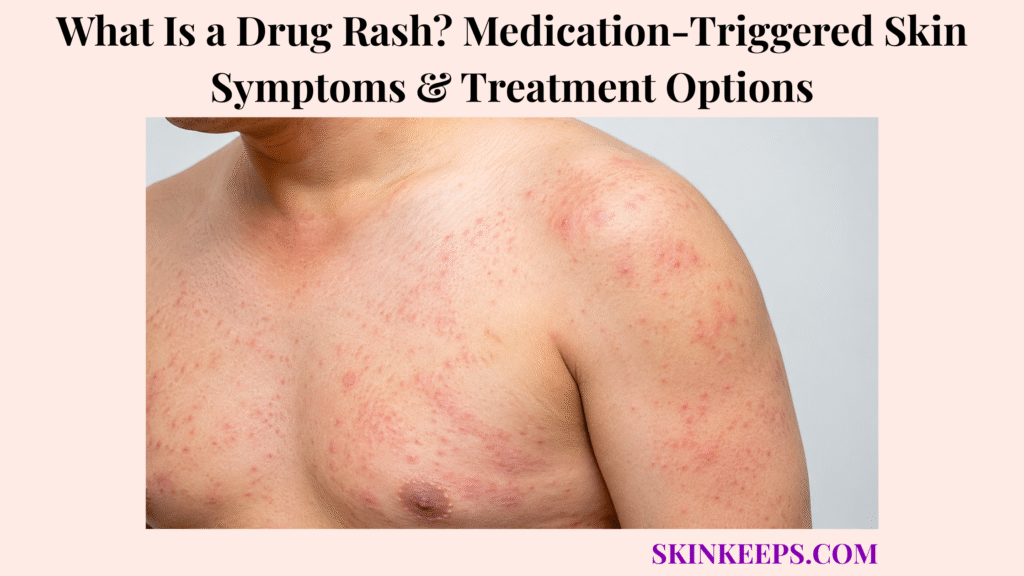
A drug rash is a skin reaction that appears after taking, applying, injecting, or being exposed to a medication.
Drug rash is not always a true allergy, and severe symptoms need urgent care. This page covers symptoms, timing, rash types, common triggers, diagnosis, treatment, emergency signs, what to do now, prevention, documentation, mistakes, and doctor-warning signs.
What Is a Drug Rash and How Can Medication Trigger Skin Symptoms?
A drug rash is a skin reaction that appears after taking, applying, injecting, or being exposed to a medication.
The medical term is drug eruption or cutaneous adverse drug reaction. Exposure can include prescription medicines, over-the-counter medicines, topical creams, eye drops, injections, contrast agents, herbal products, and supplements.
Not every drug rash is a true allergy, and not every rash that appears while taking medicine is caused by the medicine. Timing, rash pattern, severity, infection symptoms, dose changes, and medication importance all matter.
Why Is Drug Rash Also Called a Drug Eruption?
Drug rash is also called a drug eruption because the skin can break out in spots, bumps, hives, swelling, blisters, peeling, pustules, or other visible changes after medicine exposure.
Some reactions are immune-mediated. Others may relate to photosensitivity, irritation, toxicity, side effects, or non-allergic pathways.
Severity can range from mild to life-threatening, so the first task is not choosing a cream; it is checking severity and building a medication timeline.
Why Does Timing Matter?
Timing matters because different drug reactions can appear within minutes, hours, days, or weeks after a medicine is started, restarted, increased, or combined with another exposure.
Immediate reactions may appear quickly with hives, swelling, breathing symptoms, or dizziness. Delayed reactions can appear after days or weeks, and some severe delayed reactions may follow longer exposure or a dose increase.
A rash can also happen faster after re-exposure to a medicine that previously caused a reaction.
Practical rule: Do not restart a suspected medicine at home to “test” the rash. Re-exposure can be dangerous, especially after severe symptoms.
What Medication-Triggered Skin Symptoms Can a Drug Rash Cause?
A drug rash can cause red, pink, purple, brown, or darker spots, itchy bumps, hives, swelling, peeling, blisters, pustules, or widespread inflamed skin depending on the reaction type and severity.
Mild and severe drug reactions can look similar early, so symptoms such as fever, skin pain, blisters, peeling, swelling, mucosal sores, breathing symptoms, or organ symptoms must be checked early.
What Does a Mild Drug Rash Look Like?
A mild drug rash may appear as small flat or raised spots that are itchy and widespread but not painful, blistering, peeling, or linked with mouth sores or fever.
On lighter skin, it may look pink-red. On darker skin, it may look purple-brown, darker, or less obviously red.
A common mild pattern is called morbilliform or maculopapular drug eruption, but even a widespread spotty rash should be monitored for red flags.
What Do Hives and Swelling Suggest?
Hives and swelling can suggest an immediate drug allergy pattern, especially when raised itchy welts appear with lip, eyelid, tongue, face, or throat swelling.
Hives can move from one body area to another and may appear quickly after medication exposure.
Lip, eyelid, tongue, face, or throat swelling may suggest angioedema; breathing difficulty, throat tightness, wheezing, dizziness, or fainting is an emergency.
What Symptoms Suggest a Severe Drug Reaction?
Fever, skin pain, blisters, peeling, mouth sores, eye pain, genital sores, facial swelling, swollen lymph nodes, pustules, purple spots, breathing symptoms, dizziness, dark urine, or jaundice can suggest a severe drug reaction.
These warning signs can point toward severe cutaneous adverse reactions such as SJS/TEN, DRESS/DIHS, AGEP, severe blistering eruptions, exfoliative dermatitis, vasculitic reactions, anaphylaxis, or organ involvement.
Severe symptoms should not be covered up with leftover creams, antibiotics, or steroids.
| Symptom Pattern | Possible Meaning | Safety Level |
|---|---|---|
| Mild widespread spots | Morbilliform drug rash. | Call clinician soon. |
| Hives | Immediate allergy possible. | Urgent if swelling or breathing symptoms occur. |
| Lip, tongue, or throat swelling | Angioedema/anaphylaxis concern. | Emergency. |
| Facial swelling + fever | DRESS concern. | Urgent same-day care. |
| Painful rash + blisters | SJS/TEN concern. | Emergency. |
| Pustules + fever | AGEP concern. | Urgent care. |
| Rash + organ symptoms | Severe systemic reaction. | Emergency or specialist care. |
How Soon Can a Drug Rash Appear After Taking Medicine?
A drug rash can appear within minutes, hours, days, or weeks, so timing must be matched to the reaction type and medication history.
Timing alone does not prove the cause, because infections, multiple medicines, dose changes, supplements, topical products, and medication restarts can confuse the timeline.
A full timeline is one of the most useful tools a clinician has when deciding whether a medicine is likely responsible.
| Timing After Medication | Rash Pattern to Consider | Safety Note |
|---|---|---|
| Minutes to hours | Hives, angioedema, anaphylaxis. | Breathing/throat symptoms = emergency. |
| Days to weeks | Morbilliform rash. | Contact prescriber. |
| Weeks after start or dose increase | DRESS or delayed eruption. | Fever, facial swelling, organs = urgent. |
| After sun exposure | Photosensitivity. | Check medicine + UV pattern. |
| Same spot after re-use | Fixed drug eruption. | Avoid re-exposure until reviewed. |
What Types of Drug Rashes Are Important to Know?
Drug rashes come in several patterns, and the pattern helps clinicians decide whether the reaction is mild, urgent, allergic, photosensitive, or potentially life-threatening.
Knowing the pattern does not replace medical assessment, but it helps the reader recognize why some symptoms need same-day or emergency care.
What Is a Morbilliform or Maculopapular Drug Rash?
A morbilliform or maculopapular drug rash is a measles-like pattern of small spots or bumps that often starts on the trunk and spreads symmetrically.
It is often itchy and may be confused with a viral rash.
It is usually less concerning when there is no fever, skin pain, blisters, peeling, facial swelling, mucosal sores, or organ symptoms, but a clinician should still review the medication timeline.
What Is Drug-Induced Urticaria?
Drug-induced urticaria means medicine-triggered hives that appear as itchy raised welts and may move from one body area to another.
Hives may happen quickly and can appear with swelling.
Breathing difficulty, throat tightness, dizziness, fainting, or swelling of the lips, tongue, face, or throat needs urgent care.
What Is a Fixed Drug Eruption?
A fixed drug eruption is a drug reaction that tends to return to the same skin or mucosal spot when the same medicine is taken again.
The spot can be round, dusky, red-purple, brown, blistered, painful, or darker after healing.
The repeated same-site pattern is a key clue, but home rechallenge should not be used to prove it.
What Is a Photosensitive Drug Rash?
A photosensitive drug rash happens when a medicine makes skin react abnormally after ultraviolet exposure.
It may look like sunburn, eczema-like rash, or a photoallergic reaction on sun-exposed skin.
Sunscreen, clothing, shade, and medication review matter; do not assume it is ordinary sunburn if it starts after a new medicine.
What Are Severe Cutaneous Adverse Reactions?
Severe cutaneous adverse reactions are serious drug reactions such as SJS/TEN, DRESS/DIHS, AGEP, severe blistering reactions, exfoliative dermatitis, or drug-induced vasculitis.
These reactions require urgent evaluation and often hospital or specialist care.
Fever, facial swelling, swollen lymph nodes, skin pain, blisters, peeling, pustules, purple spots, mucosal sores, dark urine, jaundice, or severe weakness should not be treated as routine itch.
| Type | Main Clue | Urgency |
|---|---|---|
| Morbilliform | Widespread small spots or bumps. | Call clinician. |
| Urticaria | Moving itchy welts. | Urgent if swelling or breathing symptoms occur. |
| Fixed drug eruption | Same spot repeats after same drug. | Medication review. |
| Photosensitivity | Sun-exposed rash after medicine. | Drug + UV review. |
| DRESS | Fever, facial swelling, nodes, organ signs. | Urgent. |
| SJS/TEN | Skin pain, blisters, mucosal sores, peeling. | Emergency. |
| AGEP | Sudden pustules + fever. | Urgent. |
Which Medications Commonly Cause Drug Rashes?
Many medications can cause rashes, but common trigger histories include antibiotics, anti-seizure medicines, NSAIDs, allopurinol, some antivirals, contrast agents, topical medicines, and newer cancer or immune therapies.
A common-trigger list does not prove causation. It only tells the clinician which exposures need careful timeline review.
Which Drug Groups Often Appear in Medication-Rash Histories?
Drug-rash histories often include antibiotics, anti-seizure medicines, NSAIDs, allopurinol, contrast agents, topical products, supplements, or newer immune and cancer therapies.
Examples include penicillins, cephalosporins, sulfonamides, carbamazepine, phenytoin, lamotrigine, ibuprofen, naproxen, allopurinol, antiretrovirals, contrast agents, immunotherapy, targeted cancer medicines, topical antibiotics, topical antiseptics, herbal products, and supplements.
Do not label yourself allergic to an entire drug family unless a clinician confirms that this is appropriate.
Why Do Common-Trigger Lists Not Prove Causation?
Common-trigger lists do not prove causation because infection, multiple medicines, dose changes, restarts, supplements, vaccines, or timing overlap can confuse the rash history.
The newest medicine is not always the cause, and infection itself can cause a rash.
Stopping an essential medicine without advice can be risky, so clinician review balances rash risk against the reason the medicine is needed.
| Question | Why It Matters |
|---|---|
| What medicines started recently? | Delayed reactions are possible. |
| Any dose increases? | DRESS and delayed reactions can follow dose changes. |
| Any restarted old medicine? | Re-exposure may react faster. |
| Any OTC medicines? | Often forgotten. |
| Any supplements or herbal products? | Can also trigger reactions. |
| Any topical creams or eye drops? | Local reactions may mimic contact dermatitis. |
| Any infection symptoms? | Viral rash can mimic drug rash. |
| Any previous allergy label? | Avoid dangerous re-exposure. |
How Is a Drug Rash Different From Other Rashes?
A drug rash can look like viral rash, eczema, hives, contact dermatitis, scabies, cellulitis, measles-like rash, autoimmune rash, or skin infection, so timing and whole-body symptoms matter.
The goal is to avoid two errors: blaming every rash on medicine, or missing a serious medication reaction because the rash looks familiar.
How Is a Drug Rash Different From a Viral Rash?
A viral rash often appears with infection symptoms, while a drug rash is suspected when the pattern fits a medication start, restart, or dose-change timeline.
Fever, sore throat, cough, diarrhea, or viral illness can point toward infection, but antibiotics are often started during infections, which can confuse the cause.
Clinicians may need follow-up, labs, or medication review when the timeline is unclear.
How Is a Drug Rash Different From Eczema or Contact Dermatitis?
Dermatitis or eczema often recurs in familiar areas, while contact dermatitis usually matches a direct exposure site and drug rash is often more widespread or symmetric.
A local rash from a topical antibiotic, adhesive, cream, or eye drop may fit allergic contact dermatitis more than a widespread medication eruption.
Product history and medication history both matter.
How Is a Drug Rash Different From Cellulitis?
Cellulitis is usually painful, warm, swollen, and often one-sided, while many drug rashes are widespread, symmetric, and itchy.
Fever can happen in both, so clinical exam matters.
Spreading painful redness, warmth, swelling, or a person feeling ill needs urgent assessment.
How Is a Drug Rash Different From Scabies?
Scabies often causes severe night itch and may affect close contacts, while drug rash suspicion depends more on the medication timeline.
Burrows may appear between fingers, wrists, waistline, or genitals.
Both can be itchy, so distribution, contact history, and medication exposure must be reviewed together.
| Condition | Main Clue | Why Confusion Happens | Safer Next Step |
|---|---|---|---|
| Drug rash | New/restarted medicine timeline. | Looks like viral rash. | Medication timeline review. |
| Viral rash | Infection symptoms. | Antibiotic timing overlap. | Clinician review. |
| Eczema | Chronic itchy pattern. | Itch/scale overlap. | Check distribution and history. |
| Contact dermatitis | Exposure-site rash. | Topical drug reactions. | Product review. |
| Cellulitis | Painful warm swelling. | Red skin overlap. | Urgent if spreading or painful. |
| Scabies | Night itch + close contacts. | Severe itch overlap. | Check contacts and burrows. |
Autoimmune rashes, including lupus erythematosus, can also mimic medication rashes when photosensitivity, mouth sores, joint symptoms, or systemic features are present.
How Is a Drug Rash Diagnosed?
A drug rash is diagnosed by reviewing medication timing, rash pattern, symptoms, past reactions, medical history, and whether red flags suggest a severe cutaneous adverse reaction.
The diagnosis often depends more on the medication timeline than on one photo.
What Does a Clinician Check First?
A clinician first checks every medication exposure, the rash timeline, the rash pattern, and symptoms that suggest a severe reaction.
This includes prescription medicines, OTC medicines, supplements, herbal products, topical creams, eye drops, injections, contrast agents, start dates, stop dates, dose changes, prior exposure, past allergy labels, and infection symptoms.
They also check for fever, facial swelling, swollen lymph nodes, mucosal sores, skin pain, blisters, peeling, breathing symptoms, and organ symptoms.
What Tests May Be Used?
Tests may be used when the rash is severe, unclear, blistering, vasculitic, systemic, infected-looking, or linked with possible drug allergy.
Testing may include CBC with differential, liver and kidney function tests, urinalysis, skin biopsy, cultures if infection is suspected, and allergy testing in selected drug-allergy situations.
Dermatology or allergy/immunology referral may be needed for severe, recurrent, uncertain, blistering, mucosal, or high-risk reactions.
Why Can Rechallenge Be Dangerous?
Rechallenge can be dangerous because taking the suspected drug again may trigger a faster or more severe reaction.
Rechallenge is unsafe after severe reactions and should not be done at home.
Specialist-supervised drug challenge may be considered only in selected situations where benefits, alternatives, and risk are carefully reviewed.
- Photos of the rash in good lighting.
- List of all prescription medicines.
- List of OTC medicines, painkillers, cold medicines, and supplements.
- Topical creams, eye drops, injections, or contrast exposure.
- Start dates, stop dates, and dose changes.
- Any restarted old medicine.
- Previous reaction to the same or similar medicine.
- Infection symptoms before the rash.
- Fever, swelling, lymph nodes, skin pain, blisters, peeling, mouth/eye/genital sores.
- Breathing trouble, dizziness, fainting, dark urine, jaundice, abdominal pain, or severe weakness.
- Which medicines are essential and should not be stopped casually.
- Any hospital visit or treatment already received.
What Treatment Options Help a Drug Rash?
Drug rash treatment depends on severity, but the key step is usually identifying and stopping the suspected medicine when it is medically safe to do so.
Essential medicines such as seizure, heart, transplant, HIV, TB, anticoagulant, or cancer medicines should not be stopped casually without prescriber guidance unless emergency symptoms require immediate care.
When Should the Suspected Medication Be Stopped or Changed?
The suspected medication may need to be stopped or changed, but essential medicines should be handled with urgent prescriber guidance unless emergency symptoms are present.
A prescriber may switch to a safer alternative or decide whether close monitoring is safer than stopping immediately.
Never restart a suspected severe-reaction medicine without specialist guidance.
What Can Help Mild Itching or Rash Symptoms?
Mild drug rash symptoms may be supported with gentle skin care and clinician-approved medicines while the rash is monitored for progression.
Cool compresses, fragrance-free moisturizer, gentle cleanser, and avoiding scratching may reduce irritation.
Oral antihistamines may help hives or itch when appropriate, and topical corticosteroids may be used for selected inflamed itchy areas under clinician guidance.
How Are Severe Drug Reactions Treated?
Severe drug reactions require urgent medical evaluation, immediate culprit-drug review, supportive care, and specialist-directed treatment.
Hospital care may include skin support, fluid support, pain control, infection monitoring, eye care, mucosal care, and organ monitoring depending on reaction type.
Systemic corticosteroids, IVIG, cyclosporine, biologics, or other therapies may be considered by specialists, but dosing and protocols should not be self-managed.
| Reaction Pattern | Treatment Direction | Key Caution |
|---|---|---|
| Mild morbilliform rash | Stop/switch if safe + symptom care. | Monitor for red flags. |
| Hives | Antihistamine + allergy review when appropriate. | Breathing/throat symptoms are emergency. |
| Fixed drug eruption | Avoid culprit after confirmation. | Repeats with re-exposure. |
| Photosensitivity | UV protection + medication review. | Avoid burns. |
| DRESS | Hospital or specialist evaluation. | Organ involvement possible. |
| SJS/TEN | Emergency hospital care. | Life-threatening. |
| AGEP | Stop culprit + medical care. | Fever/pustules need review. |
When Is a Drug Rash an Emergency?
A drug rash is an emergency when it appears with breathing difficulty, throat swelling, dizziness, skin pain, blisters, peeling, mouth or eye sores, fever, facial swelling, or signs of organ involvement.
Emergency signs should be checked before routine rash advice because early severe reactions can worsen quickly.
Which Symptoms Suggest Anaphylaxis or Angioedema?
Trouble breathing, throat tightness, tongue or lip swelling, wheezing, dizziness, fainting, weak pulse, or widespread hives with systemic symptoms can suggest anaphylaxis or angioedema.
Vomiting or abdominal cramping with allergic symptoms can also occur.
Emergency care is needed when breathing, throat, circulation, or widespread systemic symptoms appear.
Which Symptoms Suggest SJS/TEN?
Flu-like symptoms followed by skin pain, spreading red or purple rash, blisters, peeling, and mouth, eye, or genital sores can suggest SJS/TEN.
Eye pain, eye redness, mouth ulcers, genital erosions, and painful spreading rash should not wait.
SJS/TEN is a medical emergency and often needs hospital-level care.
Which Symptoms Suggest DRESS?
Fever, widespread rash, facial swelling, swollen lymph nodes, abnormal blood counts, or liver, kidney, lung, heart, or other organ symptoms can suggest DRESS.
DRESS may be delayed and can involve organs beyond the skin.
Dark urine, jaundice, severe abdominal pain, shortness of breath, chest symptoms, confusion, or severe weakness should be treated as urgent warning signs.
Emergency red flags:
| Emergency Clue | Why It Matters |
|---|---|
| Breathing trouble or throat swelling | Anaphylaxis / angioedema concern. |
| Skin pain + blisters | SJS/TEN concern. |
| Mouth, eye, or genital sores | Severe mucosal involvement. |
| Fever + facial swelling | DRESS concern. |
| Pustules + fever | AGEP concern. |
| Dark urine or jaundice | Possible organ involvement. |
| Dizziness or fainting | Systemic allergic reaction. |
| Confusion or severe weakness | Severe systemic reaction. |
What Should You Do If You Suspect a Drug Rash?
If you suspect a drug rash, write down every medicine and start date, take clear photos, check for emergency symptoms, and contact the prescriber before stopping essential medication unless severe symptoms are present.
Keep the medication container, label, dose, and name available for clinicians.
Seek emergency care for severe symptoms and do not restart the suspected medicine without medical guidance.
- Take clear photos.
- Write a full medication timeline.
- Include OTC medicines, supplements, topical medicines, injections, and contrast exposure.
- Check for fever, swelling, skin pain, blisters, peeling, mucosal sores, breathing symptoms, dizziness, or organ symptoms.
- Contact the prescriber before stopping essential medication unless emergency symptoms are present.
- Seek emergency care for red flags.
- Do not restart the suspected medication without medical guidance.
- Document the reaction clearly.
How Can Future Drug Rashes Be Prevented?
Future drug rashes can sometimes be prevented by documenting the reaction clearly, avoiding confirmed culprit medicines, and using allergy or dermatology evaluation when the medication history is uncertain.
Good documentation is more useful than a vague “allergy” label with no details.
What Should Be Added to a Medication Allergy Record?
A useful medication allergy record should include the drug name, reaction date, rash type, timing, severity, treatment, and whether the allergy was confirmed or suspected.
Photos, hospital records, and the exact medicine name can help future clinicians avoid unsafe re-exposure.
Do not label broad drug families as allergies unless a clinician advises that this is needed.
When Is Allergy Testing or Specialist Review Useful?
Allergy testing or specialist review may be useful when an important medication is needed, the allergy label is uncertain, the reaction was severe, or multiple drug allergy labels create treatment problems.
Specialist review may be especially useful for uncertain antibiotic allergy labels, hives or anaphylaxis history, multiple drug allergy labels, essential medication need, or unclear severe reactions.
Drug challenge or desensitization should happen only in specialist-supervised settings when appropriate.
| Field | What to Record |
|---|---|
| Suspected drug | Exact name and dose if known. |
| Reaction date | When symptoms began. |
| Timing | Minutes, hours, days, or weeks after exposure. |
| Rash pattern | Spots, hives, swelling, blisters, peeling, pustules, fixed spot. |
| Severe symptoms | Fever, skin pain, mucosal sores, breathing symptoms, organ symptoms. |
| Treatment | Stopped drug, antihistamine, steroid, emergency care, hospital care. |
| Confirmation status | Suspected, confirmed, or needs specialist review. |
| Future plan | Avoid, specialist review, or safe alternative list. |
What Drug Rash Mistakes Should You Avoid?
The biggest drug rash mistake is ignoring severe warning signs or restarting the same medication without medical guidance.
Do not assume all drug rashes are mild, and do not stop essential medicines such as seizure, heart, transplant, HIV, TB, anticoagulant, or cancer medicines without urgent medical advice unless emergency symptoms require immediate care.
Do not hide OTC medicines or supplements from clinicians, use leftover steroids or antibiotics to cover the rash, or create vague allergy labels that confuse future prescribing.
| Mistake | Why It Is Risky | Better Action |
|---|---|---|
| Rechallenge at home | Reaction may be worse. | Specialist guidance only. |
| Ignoring fever or blisters | Severe reaction risk. | Urgent care. |
| Stopping essential medicine alone | The treated disease may worsen. | Call prescriber urgently. |
| Vague allergy label | Causes future prescribing confusion. | Record reaction details. |
| Random creams or antibiotics | Delays diagnosis. | Severity-based evaluation. |
| Hiding supplements | Misses possible trigger. | List every exposure. |
| Ignoring mucosal sores | SJS/TEN concern. | Emergency review. |
When Should a Medication Rash Be Checked by a Doctor?
A medication rash should be checked by a doctor when it is widespread, worsening, itchy, painful, blistering, peeling, associated with fever, linked to swelling, or appears after starting, restarting, or increasing a medication.
Same-day advice is safer when multiple medicines, pregnancy, children, immune suppression, liver disease, kidney disease, or high-risk medicines are involved.
Which Rash Signs Need Same-Day Medical Advice?
Same-day medical advice is needed for widespread rash, fever, facial swelling, swollen lymph nodes, hives, lip or eyelid swelling, purple spots, pustules, high-risk medicine exposure, pregnancy, babies, immune suppression, liver/kidney disease, or multiple medications.
Same-day care is also reasonable when the rash is worsening, very itchy, painful, or hard to connect to one clear medicine.
Bring a medication list and rash photos to the visit if possible.
Which Signs Need Emergency Care?
Emergency care is needed for trouble breathing, throat or tongue swelling, dizziness, fainting, skin pain, blisters, peeling, mouth/eye/genital sores, confusion, severe weakness, dark urine, jaundice, severe abdominal pain, or rapidly worsening rash.
Do not wait for the rash to “prove itself” when severe warning signs are present.
Tell emergency clinicians about every medicine, supplement, topical product, injection, contrast exposure, and recent dose change.
Seek medical review if there is:
- New, restarted, or dose-increased medicine.
- Widespread rash.
- Worsening rash.
- Fever.
- Hives.
- Lip, eyelid, face, tongue, or throat swelling.
- Skin pain.
- Blisters.
- Peeling.
- Mouth, eye, or genital sores.
- Facial swelling or swollen lymph nodes.
- Purple spots, bruising, or pustules.
- Trouble breathing, dizziness, or fainting.
- Dark urine, jaundice, abdominal pain, confusion, or severe weakness.
- Pregnancy, child, immune suppression, liver/kidney disease, or multiple medicines.
What Should You Remember About a Drug Rash?
A drug rash is a medication-triggered skin reaction, so the safest approach is to match the rash to the medication timeline, check severity, and get medical guidance before stopping or restarting important medicines.
Clear documentation protects future care because it helps clinicians avoid dangerous re-exposure without creating vague allergy labels.
- Drug rash can happen after prescription, OTC, topical, injected, contrast-agent, or supplement exposure.
- Not every drug rash is a true allergy.
- Not every rash while taking medicine is caused by the medicine.
- Morbilliform rash is common and often mild.
- Hives and swelling may suggest immediate allergy.
- SJS/TEN, DRESS, AGEP, and anaphylaxis are severe reactions.
- Timing can range from minutes to weeks.
- Treatment usually begins with identifying and stopping the culprit medicine when safe.
- Essential medicines should not be stopped casually without prescriber guidance unless emergency symptoms require immediate care.
- Do not rechallenge yourself.
- Severe symptoms need urgent or emergency care.
- Document the drug, timing, rash type, severity, and treatment.
Frequently Asked Questions About Drug Rashes
What does a drug rash look like?
A drug rash may look like small flat or raised spots, hives, itching, swelling, peeling, blisters, pustules, or red, purple, brown, or darker patches depending on reaction type and skin tone.
How long after starting medicine can a drug rash appear?
Timing varies. Immediate reactions can appear within minutes or hours, while delayed reactions may appear after days or weeks. Some severe delayed reactions can happen after longer exposure or after a dose increase.
What medicines commonly cause drug rashes?
Drug-rash histories can include antibiotics, anti-seizure medicines, NSAIDs, allopurinol, contrast agents, antivirals, targeted cancer therapies, topical medicines, and supplements, but timing and clinician review are needed to identify the likely culprit.
Should I stop the medicine if I get a rash?
Contact the prescriber urgently, especially if the medicine is important. Seek urgent or emergency care if there are severe symptoms such as breathing trouble, swelling, skin pain, blisters, peeling, mucosal sores, fever, or organ symptoms.
Is a drug rash always an allergy?
No. Some drug rashes are allergic, while others are non-allergic side effects, photosensitivity, irritation, toxicity, or immune-mediated reactions.
When is a drug rash dangerous?
A drug rash is dangerous when it appears with breathing trouble, throat swelling, dizziness, fainting, skin pain, blisters, peeling, mouth, eye, or genital sores, fever, facial swelling, swollen lymph nodes, dark urine, jaundice, severe weakness, or organ symptoms.
How is a drug rash diagnosed?
Diagnosis uses the medication timeline, rash exam, severity screen, past reactions, lab tests if systemic signs exist, skin biopsy for severe or unclear eruptions, and specialist allergy or dermatology review in selected cases.
Can I take the same medicine again after a drug rash?
Not without medical advice. Rechallenge can be dangerous, especially after severe reactions, and should only happen in specialist-supervised settings when appropriate.
Sources & Evidence About Drug Rashes
DermNet — Drug Eruptions was used for drug eruptions ranging from mild to life-threatening, medication-history review, drug-eruption categories, and treatment framing around identifying and stopping the responsible drug when possible.
DermNet — Morbilliform Drug Reaction was used for morbilliform or maculopapular drug eruption as a common drug-rash pattern and for identifying and stopping the causative medicine when possible.
DermNet — Severe Cutaneous Adverse Reaction was used for SCAR categories including SJS/TEN, DRESS/DIHS, and AGEP, and for history/exam, blood-test, biopsy, culprit-drug, and supportive-care framing.
DermNet — DRESS / Drug Hypersensitivity Syndrome was used for fever, widespread rash, facial swelling, swollen lymph nodes, blood abnormalities, organ involvement, and urgent blood-test context in DRESS/DIHS.
Mayo Clinic — Drug Allergy was used for hives, rash, fever, swelling, wheezing, anaphylaxis, and drug-allergy symptom framing.
Mayo Clinic — Stevens-Johnson Syndrome was used for flu-like symptoms followed by painful spreading rash, blisters, skin shedding, and medical-emergency framing.
Merck Manual Professional — Drug Eruptions and Reactions was used for medication-pattern review, DRESS timing context, photosensitivity reactions, suspected-drug management, and rechallenge caution.
Merck Manual Consumer — Drug Rashes was used for patient-facing drug-rash framing, medication stopping/symptom treatment context, photosensitivity, and life-sustaining medication caution.
Educational Disclaimer: This SkinKeeps article is for educational purposes only and does not diagnose or replace medical care. A rash that appears after a new, restarted, increased, injected, topical, over-the-counter, supplement, herbal, contrast-agent, antibiotic, anti-seizure, NSAID, allopurinol, cancer-therapy, immune-therapy, or essential medication should be reviewed with a qualified healthcare professional, especially when it is widespread, worsening, painful, blistering, peeling, swollen, fever-associated, facial-swelling-associated, lymph-node-associated, mucosal, purple-spotted, pustular, organ-symptom-associated, or unclear. Seek emergency care for trouble breathing, throat or tongue swelling, dizziness, fainting, skin pain, blisters, peeling, mouth/eye/genital sores, confusion, severe weakness, dark urine, yellow eyes or skin, severe abdominal pain, or rapidly worsening rash. Do not stop essential medicines, restart suspected medicines, test a drug again, use leftover prescriptions, or label entire drug families as allergies without appropriate medical guidance unless emergency symptoms require immediate care.