Aquagenic urticaria is a rare chronic inducible urticaria where contact with water triggers visible hives or wheals on the skin. It is different from ordinary dry-skin itch after showering and different from aquagenic pruritus, which causes water-triggered itch without visible hives.
This page explains symptoms, water triggers, body areas, similar conditions, proposed mechanisms, diagnosis, treatment options, daily management, mistakes, and urgent signs. It does not diagnose the reader or reduce the condition to a simple “water allergy” label.
What Is Aquagenic Urticaria and Why Does Water Trigger Hives?
Aquagenic urticaria is a rare chronic inducible urticaria where water contact triggers visible hives or wheals on the skin.
A wheal is a raised hive-like bump caused by temporary swelling in the upper skin. Aquagenic urticaria belongs within hives / urticaria, but the trigger pattern is unusual because the reaction follows water contact rather than a food, drug, or ordinary irritant pattern.
The exact mechanism is not fully settled. Water appears to interact with skin in a way that can trigger mast-cell mediator release, including histamine-linked wheals, itching, burning, or prickling in susceptible people.
Why Is Aquagenic Urticaria Not Ordinary Dry Skin After Showering?
Aquagenic urticaria is not ordinary dry skin after showering because it causes visible wheals or hives after water contact, not just tightness or itch from dryness.
Dry-skin itch after bathing may cause tightness, flaking, or irritation without raised wheals. Aquagenic urticaria needs visible water-triggered hives, timing after water exposure, and clinician-led confirmation.
Why Is Aquagenic Urticaria Rare and Often Misrecognized?
Aquagenic urticaria is rare and often misrecognized because water exposure is common, symptoms can resemble other inducible urticarias, and many people first describe the problem as ordinary shower itch.
A systematic review summarized by AAAAI included 77 patients across 59 studies, showing that the evidence base is limited and mostly built from case reports and case series. That rarity is why diagnosis should be careful rather than assumed from itching alone.
Practical rule: Aquagenic urticaria requires visible water-triggered hives, not just shower itch.
What Aquagenic Urticaria Symptoms Appear After Water Contact?
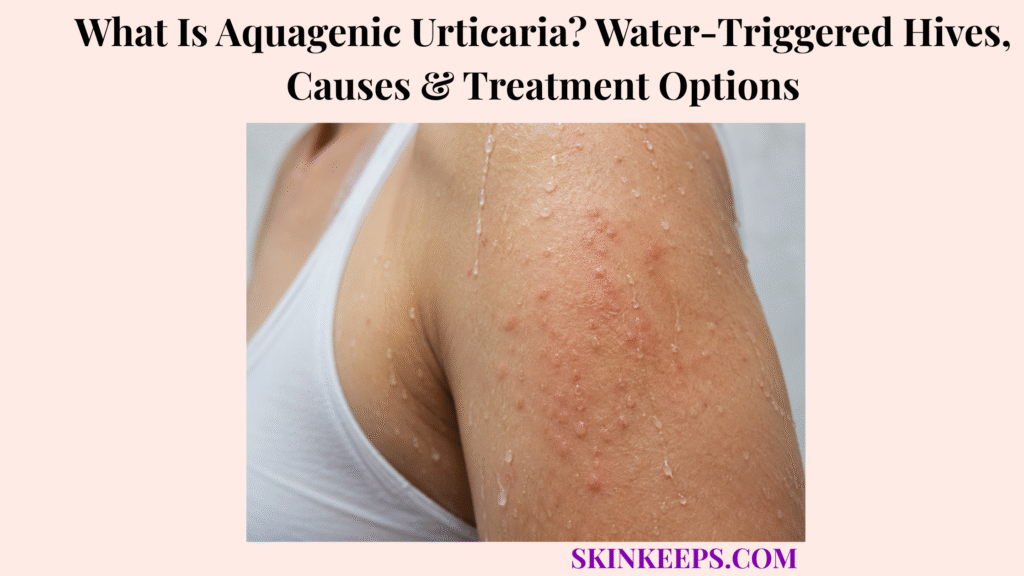
Aquagenic urticaria usually causes small follicle-centered wheals with surrounding redness or discoloration, often with itching, burning, or prickling after water touches the skin.
DermNet describes typical wheals as 1–3 mm folliculocentric bumps with 1–3 cm surrounding flares. Lesion size can support clinical recognition, but it should not be used as a self-diagnosis rule.
What Do Water-Triggered Hives Look Like?
Water-triggered hives in aquagenic urticaria often look like small raised wheals with surrounding flares, especially on the trunk or upper arms.
The surrounding flare may look red, pink, darker, or close to the person’s skin color depending on skin tone. Palms and soles are usually spared, but individual patterns can vary.
What Do Aquagenic Urticaria Symptoms Feel Like?
Aquagenic urticaria symptoms can feel itchy, burning, prickling, stinging, or distressing after water touches the skin.
The symptoms can make showering, bathing, swimming, rain exposure, sweating, or crying stressful. The impact can be practical and emotional, not merely cosmetic.
How Long Do Aquagenic Urticaria Hives Last?
Aquagenic urticaria hives often appear within 20–30 minutes after water contact and usually fade within 30–120 minutes after the water exposure stops.
Timing can vary. Lesions that persist, bruise, become painful, leave marks, or do not fade like hives should be evaluated for other causes.
| Symptom | What the Reader May Notice | Why It Matters |
|---|---|---|
| Small wheals | Tiny raised bumps after water contact | Supports water-triggered urticaria pattern |
| Surrounding flare | Red, pink, darker, or skin-colored halo | Common hive reaction pattern |
| Itching | Itchy skin after water exposure | Needs visible hives to support AquaU |
| Burning / prickling | Stinging or prickly sensation | Common associated sensation |
| Rapid timing | Symptoms within 20–30 minutes | Helps separate from delayed dermatitis |
| Short duration | Fades after exposure stops | Fits urticaria more than eczema |
| Wheezing or shortness of breath | Breathing symptoms with skin flare | Urgent medical attention |
What Water Triggers Can Cause Aquagenic Urticaria?
Aquagenic urticaria can be triggered by water contact from sources such as fresh water, seawater, sweat, or tears, and it can occur regardless of water temperature, saltiness, or pH.
Water sources may include showering, bathing, swimming, rain, handwashing, sweat, tears, and sometimes other water-containing body fluids. Not every patient reacts to every source equally.
Temperature-independent symptoms still need careful evaluation because cold urticaria, heat urticaria, and cholinergic urticaria can mimic the pattern. Testing should control water temperature rather than using very hot or cold water.
| Water Exposure | Common Scenario | Tracking Note |
|---|---|---|
| Shower | Hives after bathing | Record temperature, timing, body area, and duration |
| Bath | Longer water contact | Note whether longer contact worsens flares |
| Swimming | Pool, lake, ocean | Record fresh water vs seawater and exertion |
| Rain | Outdoor exposure | Note clothing coverage and timing |
| Handwashing | Local hand or forearm exposure | Record whether hives are limited or spread |
| Sweat | Exercise, heat, humidity | Separate water/sweat trigger from core-temperature trigger |
| Tears | Crying or eye-area exposure | Track if wheals appear where tears touch |
Where Does Aquagenic Urticaria Usually Affect the Skin?
Aquagenic urticaria mainly affects the trunk and upper arms, although the rash may spread beyond areas that directly touched water.
Common areas include the chest, back, abdomen, and upper arms. Areas directly touched by water may flare first, but hives may extend beyond the exact contact site.
Palms and soles are typically spared. If palms, soles, or unusual locations dominate, a clinician may consider another or overlapping inducible urticaria.
| Area | Commonity Clue | Diagnostic Value |
|---|---|---|
| Chest / trunk | Common site | Fits typical AquaU pattern |
| Back | Common after showers or bathing | Useful photo area if safe |
| Abdomen | Trunk involvement | Supports water-contact distribution |
| Upper arms | Common site | Helps pattern recognition |
| Palms / soles | Usually spared | Involvement may suggest another or overlapping condition |
| Beyond contact area | Rash may spread | Still needs clinician interpretation |
How Is Aquagenic Urticaria Different From Other Water-Related Skin Problems?
Aquagenic urticaria must be separated from aquagenic pruritus, cholinergic urticaria, cold urticaria, heat urticaria, solar urticaria, contact dermatitis, and ordinary dry-skin itching after bathing.
The deciding clue is not water discomfort alone. Visible wheals after water contact matter because itch-only water symptoms, dry skin, cleanser irritation, and temperature-triggered hives need different evaluation.
How Is Aquagenic Urticaria Different From Aquagenic Pruritus?
Aquagenic urticaria causes visible hives after water contact, while aquagenic pruritus causes water-triggered itching, burning, stinging, or tingling without hives or rash.
Aquagenic pruritus may last from about 10 minutes to two hours, and it can sometimes be associated with conditions such as polycythemia vera. Itch-only water symptoms should not be dismissed, but they are not the same as visible water-triggered hives.
How Is Aquagenic Urticaria Different From Cholinergic Urticaria?
Aquagenic urticaria is triggered by water contact, while cholinergic urticaria is triggered by increased core body temperature from heat, exercise, stress, or sweating.
Both can produce small wheals, so clinicians may ask whether flares happen with exercise, hot environments, emotional stress, or sweat without direct water exposure.
How Is Aquagenic Urticaria Different From Cold or Heat Urticaria?
Aquagenic urticaria can occur regardless of water temperature, while cold urticaria is triggered by cold exposure and heat urticaria is triggered by local heat.
Cold water or very hot water can confuse the pattern. A clinician-led test uses controlled water temperature to reduce confusion with cold-triggered or heat-triggered urticaria.
| Condition | Main Trigger | Hives Visible? | Key Distinction |
|---|---|---|---|
| Aquagenic urticaria | Water contact | Yes | Water triggers wheals |
| Aquagenic pruritus | Water contact | No | Itch, burning, stinging, or tingling without rash |
| Cholinergic urticaria | Heat, exercise, or core-temperature rise | Yes | Body-temperature trigger |
| Cold urticaria | Cold exposure | Yes | Cold-specific trigger |
| Heat urticaria | Local heat exposure | Yes | Heat-specific trigger |
| Contact dermatitis | Irritant or allergen exposure | Eczema-like rash | Usually delayed dermatitis pattern, not short-lived wheals |
| Dry skin after shower | Hot water, cleanser, barrier dryness | Usually no wheals | Tightness, flaking, or itch without urticarial wheals |
What Causes Aquagenic Urticaria Beneath the Skin Surface?
The exact cause of aquagenic urticaria is not fully understood, but proposed mechanisms involve water interacting with unknown skin components and triggering mast-cell mediator release that produces hives.
Mast cells are immune cells in the skin that can release mediators such as histamine. Histamine can contribute to wheals, itching, burning, and flare reactions, which is why antihistamines may help some people.
Why Is Aquagenic Urticaria Not Always a Simple “Water Allergy”?
Aquagenic urticaria should not be simplified as a literal water allergy because the trigger is water contact, but the biological mechanism is still not fully settled.
The safer wording is water-triggered inducible urticaria. Water is the exposure that starts symptoms, but current explanations focus on skin interaction and mast-cell mediator response rather than a simple allergy to water itself.
Why Can Sweat and Tears Matter in Aquagenic Urticaria?
Sweat and tears can matter in aquagenic urticaria because they may act as water-containing body-fluid triggers in some patients.
This can affect exercise, humidity, emotional crying, swimming, and daily hygiene. Not every person reacts to every body fluid, so source-specific tracking matters.
How Is Aquagenic Urticaria Diagnosed or Checked?
Aquagenic urticaria is suspected from a history of visible hives after water exposure, but diagnosis should be confirmed with a water provocation test and by excluding other inducible urticarias.
Photos of visible hives can help, but diagnosis should remain clinician-led because several physical urticarias and contact reactions can mimic water-triggered symptoms.
What Happens During a Water Provocation Test?
During a water provocation test, room-temperature or skin-temperature water is applied to a cloth, placed on upper trunk skin, and checked for an urticarial reaction.
DermNet describes a method using a wet cloth applied to the upper trunk for 30 minutes. Room-temperature or skin-temperature water helps avoid confusing aquagenic urticaria with cold or heat urticaria.
Home testing should not replace medical evaluation, especially if symptoms have ever included breathing problems, swelling, dizziness, fainting, or severe widespread hives.
What Other Conditions Should Be Excluded?
Other conditions should be excluded because heat, cold, pressure, sunlight, exercise, contact allergens, and itch-only water reactions can mimic or confuse aquagenic urticaria.
Clinicians may consider cholinergic urticaria, cold urticaria, heat urticaria, pressure urticaria, solar urticaria, aquagenic pruritus, dermatographism, and contact reactions.
A delayed itchy rash after cleanser, fragrance, topical medicine, or product exposure may fit allergic contact dermatitis more than short-lived water-triggered wheals.
- Visible hives appear after water contact.
- Timing after exposure is recorded.
- Water source is recorded.
- Water temperature is noted.
- Hives are photographed when safe.
- Water provocation testing is discussed.
- Heat, cold, exercise, pressure, sunlight, and contact reactions are excluded.
- Itch-only symptoms are separated from hives.
What Treatment Options Are Used for Aquagenic Urticaria?
Aquagenic urticaria treatment aims to prevent or reduce symptoms because complete avoidance of water is not realistic.
Treatment is symptom-control focused. The plan should match confirmed diagnosis, flare severity, daily-life impact, and response to first-line therapy.
How Do Antihistamines Help Aquagenic Urticaria?
Second-generation H1 antihistamines can help aquagenic urticaria by reducing histamine-linked wheals, itching, burning, and prickling in some patients.
Daily non-sedating second-generation H1 antihistamines are commonly used as first-line therapy. Cetirizine, loratadine, and fexofenadine are examples, but dose choice and adjustment should be clinician-guided.
Response should be tracked objectively through timing, water source, body area, wheal duration, symptom severity, and treatment timing.
Which Options May Be Considered for Refractory Aquagenic Urticaria?
Refractory aquagenic urticaria may need specialist-directed options such as adjusted second-generation H1 antihistamines, omalizumab, phototherapy, or barrier strategies when standard treatment is not enough.
Updosed second-generation H1 antihistamines, omalizumab, phototherapy, H2 antihistamines, first-generation antihistamines, and petrolatum-type barrier approaches have been discussed in reports or reviews, but these are not routine first-line choices for everyone.
Why Should Aquagenic Urticaria Treatment Be Clinician-Guided?
Aquagenic urticaria treatment should be clinician-guided because the condition is rare, diagnosis needs confirmation, and similar inducible urticarias require different management.
Random long-term medication stacking can hide the real trigger pattern, increase side effects, and delay the correct diagnosis. Total water avoidance is not a realistic treatment plan.
| Treatment Option | Best-Fit Situation | Goal | Key Caution |
|---|---|---|---|
| Second-generation H1 antihistamines | First-line symptom prevention | Reduce wheals, itch, burning, prickling | Response varies; dose changes need guidance |
| Updosed second-generation H1 antihistamines | Symptoms uncontrolled on standard dosing | Improve symptom control | Clinician-directed only |
| Omalizumab | Selected refractory cases | Reduce uncontrolled urticaria symptoms | Specialist-led biologic treatment |
| Phototherapy | Refractory cases in specialist care | Reduce skin reactivity in some patients | Not first-line for everyone |
| Petrolatum coating | Reported barrier approach | Reduce water-skin contact | Evidence is limited or controversial |
| Trigger management | Daily living support | Reduce unnecessary exposure and document patterns | Total water avoidance is unrealistic |
How Can Daily Water Exposure Be Managed With Aquagenic Urticaria?
Daily management of aquagenic urticaria focuses on reducing unnecessary water exposure, shortening contact time, protecting the skin barrier, and following the treatment plan from a dermatologist or allergist.
Shorter showers, avoiding unnecessarily long baths, and patting skin dry instead of rubbing may reduce friction and contact time. Exercise planning can help when sweat is a trigger.
Barrier ointments should be discussed with a clinician rather than used as the whole plan. Fear of bathing, swimming, rain, sweat, or tears can create real psychological stress, so uncontrolled symptoms deserve follow-up.
- Keep water contact as short as practical.
- Avoid unnecessarily long baths or showers.
- Pat skin dry instead of rubbing.
- Track shower, rain, swimming, sweat, and tear triggers.
- Record timing and duration of wheals.
- Follow the antihistamine or treatment plan as prescribed.
- Discuss barrier strategies before relying on them.
- Avoid total water avoidance.
- Seek help if bathing fear or daily-life stress becomes significant.
What Aquagenic Urticaria Mistakes Should You Avoid?
The biggest aquagenic urticaria mistake is assuming every itch after water is the same condition, because aquagenic pruritus, dry skin, temperature urticarias, and contact reactions need different evaluation.
Visible wheals, timing, water source, and temperature control matter. Testing with very hot or cold water can confuse the pattern and should not replace clinician-led provocation testing.
| Mistake | Why It Fails | Better Action |
|---|---|---|
| Calling any shower itch aquagenic urticaria | It may be pruritus, dry skin, heat, or irritation | Check for visible hives and timing |
| Ignoring whether wheals appear | AquaU requires visible hives/wheals | Photograph visible lesions when safe |
| Testing with hot or cold water | Confuses heat or cold urticaria | Use clinician-guided provocation testing |
| Avoiding all water | Unrealistic and psychologically stressful | Minimize symptoms safely |
| Using random treatments | Diagnosis may be wrong | Confirm with a dermatologist or allergist |
| Ignoring breathing symptoms | Rare systemic symptoms can occur | Seek urgent care for wheezing or shortness of breath |
When Should Aquagenic Urticaria Be Checked by a Doctor?
Aquagenic urticaria should be checked by a dermatologist or allergist when water repeatedly triggers visible hives, symptoms affect bathing or daily life, the diagnosis is unclear, or standard treatment does not control symptoms.
Medical review is also important when symptoms follow swimming, heavy sweating, or water exposure and feel systemic rather than limited to short-lived skin wheals.
Which Water-Triggered Symptoms Need Faster Care?
Water-triggered symptoms need faster care when hives are severe or widespread, or when wheezing, shortness of breath, throat tightness, facial swelling, lip swelling, tongue swelling, dizziness, or fainting occurs.
Deep lip, tongue, facial, or throat swelling may fit an angioedema pattern and should not be treated as an ordinary skin flare, especially with breathing or throat symptoms.
What Should You Bring to an Aquagenic Urticaria Appointment?
A useful aquagenic urticaria appointment starts with photos, timing, water source, water temperature, symptom duration, visible hives, systemic symptoms, and treatments already tried.
Do not provoke dangerous symptoms at home for proof. Bring safe observations, photos when possible, and details about heat, cold, exercise, pressure, sunlight, products, sweat, and tears.
What Should You Remember About Aquagenic Urticaria?
The most important thing to remember about aquagenic urticaria is that it is a rare water-triggered hive disorder, not just ordinary shower itch.
Visible hives, timing after water contact, controlled provocation testing, exclusion of similar conditions, and clinician-guided treatment are the main anchors.
Frequently Asked Questions About Aquagenic Urticaria
Is aquagenic urticaria a real water allergy?
Aquagenic urticaria is a real rare water-triggered inducible urticaria, but the mechanism is not fully understood, so it should not be reduced to a simple literal “water allergy.”
What does aquagenic urticaria look like?
Aquagenic urticaria often causes small follicle-centered hives or wheals with surrounding flares, often on the trunk or upper arms, after water contact.
How fast do aquagenic urticaria symptoms appear?
Symptoms often appear within 20–30 minutes after water touches the skin and usually fade within 30–120 minutes after exposure stops, although timing can vary.
Is aquagenic urticaria the same as aquagenic pruritus?
No. Aquagenic urticaria causes visible hives, while aquagenic pruritus causes itching, burning, stinging, or tingling after water exposure without hives or rash.
Can sweat or tears trigger aquagenic urticaria?
Yes. Sweat and tears have been reported as triggers in some patients, but not every patient reacts to every body fluid.
How is aquagenic urticaria diagnosed?
Diagnosis uses water-trigger history, visible hives, water provocation testing, and exclusion of cold, heat, exercise, pressure, sunlight, and contact-triggered conditions.
What is the best treatment for aquagenic urticaria?
There is no one best treatment for everyone. Second-generation H1 antihistamines are commonly recommended first-line, while refractory symptoms may need specialist-directed options such as dose adjustment, omalizumab, phototherapy, or selected barrier approaches.
When should water-triggered hives need urgent care?
Urgent care is needed for wheezing, shortness of breath, throat tightness, lip swelling, tongue swelling, facial swelling, dizziness, fainting, or severe widespread symptoms.
Sources & Evidence About Aquagenic Urticaria
DermNet — Aquagenic Urticaria was used for definition, rarity, symptoms, 1–3 mm wheals, 20–30 minute onset, 30–120 minute resolution, triggers, locations, water provocation test, differentials, treatment options, psychological stress, and unknown remission framing.
AAAAI — Aquagenic Urticaria Subgroups and Treatment Options was used for the 77-patient systematic review context, 59-study evidence base, familial/acquired subgroups, tap water and body-fluid triggers, first-line second-generation H1 antihistamines, updosing, omalizumab, and phototherapy.
PubMed — Systematic Review of Aquagenic Urticaria was used for peer-reviewed evidence-base context, first-line second-generation H1 antihistamine recommendation, and rarity framing.
Cleveland Clinic — Aquagenic Pruritus was used for the difference between water-triggered itching without hives or rash and aquagenic urticaria, 10-minute to two-hour itch duration, possible polycythemia vera association, and provider-evaluation advice.
DermNet — Aquagenic Pruritus was used for water-triggered severe itch or prickling without visible lesions.
DermNet — Cold Urticaria was used for cold-contact wheal trigger distinction and the need to avoid confusing cold-water reactions with water-triggered reactions.
DermNet — Heat Urticaria was used for heat-triggered urticaria distinction and provocation-test context for heat-related mimics.
PMC Case Review — Aquagenic Urticaria Diagnosed by Water Provocation Test was used for rare presentation, water provocation testing, symptoms after handwashing, showering, rain exposure, and antihistamine response context.
Educational Disclaimer: This SkinKeeps article is for educational purposes only and does not diagnose or replace medical care. Water-triggered hives with wheezing, shortness of breath, throat tightness, lip swelling, tongue swelling, facial swelling, dizziness, fainting, or severe widespread symptoms should be checked urgently by a qualified healthcare professional.