
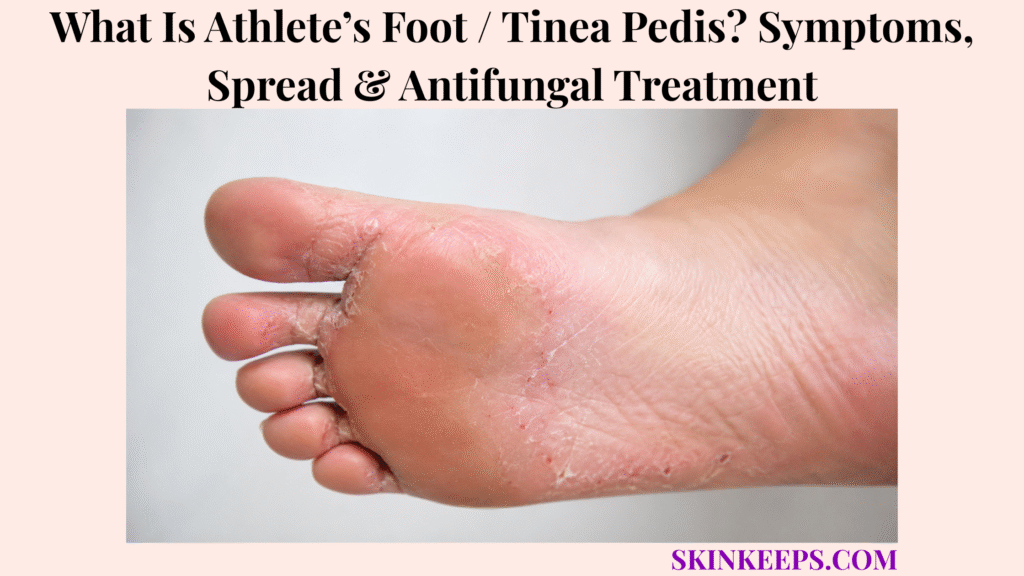
Athlete’s foot, medically called tinea pedis, is a contagious fungal infection of the foot skin that often affects the spaces between the toes. It can also involve the soles, sides of the feet, instep, and sometimes the top of the foot.
This page explains symptoms, foot locations, spread, causes, diagnosis, antifungal treatment, prevention, mistakes, and when to seek care. Athlete’s foot is not ordinary dry feet or foot odor; treatment usually needs antifungal therapy plus moisture and reinfection control.
What Is Athlete’s Foot and Why Is It Called Tinea Pedis?
Athlete’s foot, medically called tinea pedis, is a fungal infection of the skin on the feet, especially the moist spaces between the toes.
The infection is caused by dermatophyte fungi, a group of fungi that can live on keratin-rich skin, nails, and hair. On the feet, these fungi often grow where warmth, sweat, tight footwear, and trapped toe-web moisture create a favorable environment.
The name “athlete’s foot” is common because the infection can spread in damp shared places such as locker rooms, public showers, pool decks, and gym floors. The medical name “tinea pedis” means a dermatophyte infection of the foot.
Why Does Athlete’s Foot Grow Well in Warm, Moist Foot Areas?
Athlete’s foot grows well in warm, moist foot areas because dermatophyte fungi thrive where sweat, occlusive footwear, and trapped toe-web moisture create a favorable environment.
Sweaty socks, tight shoes, non-breathable footwear, heavy boots, damp toe webs, and reusing shoes before they dry can keep the skin warm and moist. That environment allows fungi to persist and spread.
Public showers, locker rooms, pool decks, and shared wet floors increase exposure risk, especially when a person walks barefoot and then puts damp feet back into closed shoes.
Why Is Athlete’s Foot Not Just Dry Skin?
Athlete’s foot is not ordinary dry skin because it is an infectious fungal condition that can itch, burn, peel, crack, blister, spread, and recur when the foot environment stays damp.
Moisturizer may soften rough feet, but it does not clear fungal infection. Athlete’s foot usually needs antifungal treatment, drying between toes, clean socks, dry shoes, and reinfection prevention.
The infection may spread from foot skin to toenails, hands, groin, shoes, socks, towels, floors, or other people. Recurrent foot fungus should prompt nail and shoe-environment review.
Practical rule: Athlete’s foot care needs antifungal treatment plus moisture control; lotion alone does not kill dermatophyte fungi.
What Athlete’s Foot Symptoms Appear on the Feet?
Athlete’s foot symptoms can include itching, burning, stinging, peeling, scaling, cracking, redness or darker discoloration, soggy white skin between toes, blisters, odor, and dry thickened skin on the soles.
The appearance can vary by pattern. Some cases mainly affect the toe webs, some create dry scaling across the soles and sides, and some flare with small blisters on the instep or sole.
What Does Athlete’s Foot Between the Toes Look Like?
Athlete’s foot between the toes often looks like peeling, cracking, scaling, or white soggy skin in the toe webs, especially between the fourth and fifth toes.
This interdigital pattern may itch, burn, sting, split, or smell unpleasant. Odor alone does not diagnose athlete’s foot, but odor plus macerated toe webs, peeling, fissures, and recurrence in damp shoes supports fungal suspicion.
What Does Athlete’s Foot on the Soles Look Like?
Athlete’s foot on the soles may appear as dry scaling, thickened skin, or a moccasin-like pattern around the sole and sides of the foot.
Moccasin-type tinea pedis can be chronic and recurrent. Because it can look like dry skin, eczema, or psoriasis, persistent sole scaling may need fungal testing before stronger prescription treatment.
What Does Blistering Athlete’s Foot Look Like?
Blistering athlete’s foot can cause small vesicles or blisters, often on the instep or sole, with itching, burning, or sudden flare symptoms.
Do not pop blisters. Blistering foot rash can be confused with dyshidrotic eczema, allergic contact dermatitis, friction blisters, or bacterial infection, especially when pain, swelling, pus, or spreading redness appears.
| Foot Sign | What the Reader May Notice | Possible Tinea Pedis Pattern |
|---|---|---|
| Toe-web peeling | Skin flakes or lifts between toes | Interdigital type |
| White soggy skin | Macerated skin between toes | Moist toe-web infection |
| Cracks / fissures | Painful splits between toes or soles | Interdigital or severe scaling pattern |
| Itching / burning | Itchy, hot, or stinging feet | Common fungal symptom |
| Dry scaly soles | Rough scale on bottom of foot | Moccasin-type tinea pedis |
| Thickened sole skin | Hyperkeratotic scaling | Chronic moccasin pattern |
| Blisters | Small vesicles or bullae | Vesiculobullous pattern |
| Pus, warmth, fever | Infection signs | Needs clinician review |
Where Does Athlete’s Foot Usually Appear?
Athlete’s foot most often appears between the toes, but it can also affect the soles, sides of the feet, heels, instep, and sometimes the top of the foot.
The fourth and fifth toe web is a classic site because moisture can stay trapped there. One foot or both feet may be involved.
Toenails should be checked when athlete’s foot keeps returning because thick, yellow, crumbly, or lifted nails may act as a fungal reservoir that reinfects the foot skin.
| Location | Common Symptom | What Else to Check |
|---|---|---|
| Between toes | Peeling, cracks, white soggy skin | Moisture, odor, fissures |
| Fourth/fifth toe web | Classic toe-web involvement | Maceration and splitting |
| Soles | Dry scaling, thickened skin | Moccasin pattern or psoriasis mimic |
| Sides of feet | Scaling around edges | Moccasin distribution |
| Instep | Blisters or vesicles | Dyshidrotic eczema mimic |
| Toenails | Thick, yellow, crumbly, lifted nails | Possible nail reservoir |
How Does Athlete’s Foot Spread?
Athlete’s foot spreads when fungi from infected skin, contaminated surfaces, socks, shoes, towels, or damp shared areas contact skin that can support fungal growth.
Fungal skin scales can survive in damp environments and on personal items. Spread is more likely when feet are wet, sweaty, cracked, macerated, or enclosed in shoes that do not dry well.
How Does Athlete’s Foot Spread Between People?
Athlete’s foot can spread between people through infected skin scales, damp shared floors, locker rooms, public showers, pool areas, towels, socks, or shoes.
Walking barefoot in damp communal spaces increases exposure risk. Shower shoes, flip-flops, or sandals in pools, gyms, shower areas, locker rooms, and hotel bathrooms reduce direct floor contact.
Do not share towels, socks, or shoes during an active infection. Wash socks and towels regularly, and let shoes dry fully before wearing them again.
How Can Athlete’s Foot Spread on the Same Person?
Athlete’s foot can spread on the same person when fungus moves from foot skin to toenails, hands, groin, or shoes that later reinfect the feet.
Scratching or applying products with bare hands can transfer fungus to the hand. Towels or clothing can move fungus from the feet to the groin, where a related tinea infection may develop.
Toenail fungus is not the same as athlete’s foot, but untreated nail involvement can contribute to recurrence because nails can hold fungal organisms longer than skin.
What Causes Athlete’s Foot and Who Is More Likely to Get It?
Athlete’s foot is caused by dermatophyte fungi that grow best when feet stay warm, sweaty, enclosed, and exposed to contaminated surfaces.
Anyone can develop tinea pedis. Risk rises with sweaty feet, tight or non-breathable shoes, heavy boots, damp socks, public wet-floor exposure, previous athlete’s foot, minor skin breaks, macerated toe webs, and recurrent toenail fungus.
People with diabetes, poor circulation, immune suppression, lymphoedema, or foot wounds should seek care earlier because cracks and fungal infection can be complicated by bacterial infection.
| Risk Factor | Why It Helps Fungus | Prevention Action |
|---|---|---|
| Sweaty feet | Moisture supports fungal growth | Change socks and dry feet |
| Tight shoes | Trap heat and moisture | Use breathable footwear |
| Damp socks | Keep toe webs wet | Change socks when sweaty |
| Public wet floors | Increase exposure | Wear shower shoes |
| Shared towels/shoes | Transfer infected skin scales | Do not share personal items |
| Nail fungus | May reinfect foot skin | Check nails if recurrent |
| Diabetes / immune risk | Infection complications can be higher | Seek care earlier |
How Is Athlete’s Foot Different From Dry Skin, Eczema, Psoriasis, or Bacterial Infection?
Athlete’s foot can resemble dry skin, eczema, psoriasis, or bacterial infection, but fungal clues include toe-web scaling, peeling, maceration, itch, recurrence in sweaty shoes, and spread to nails or other body areas.
Correct identification matters because moisturizer-only care may miss fungus, while steroid-only creams can mask or worsen tinea infection.
How Is Athlete’s Foot Different From Ordinary Dry Cracked Feet?
Athlete’s foot is different from ordinary dry cracked feet because it is contagious and often affects toe webs or active scaling edges, while dry feet usually do not spread through towels, shoes, or floors.
Dry skin / xerosis may improve with moisturizer, but fungus can persist unless antifungal treatment and moisture control are used. Toe-web maceration and recurrence from shoes are stronger fungal clues.
How Is Athlete’s Foot Different From Eczema or Psoriasis?
Athlete’s foot is different from eczema or psoriasis because tinea pedis is fungal, while eczema is usually barrier/inflammation-related and psoriasis often forms thicker plaques or nail changes.
Atopic dermatitis can involve chronic itchy eczema patterns, and psoriasis can cause thick sole plaques or nail pitting. Moccasin-type tinea can mimic both, so testing may be useful when the pattern is unclear.
Shoe materials, adhesives, rubber, leather dyes, or topical products may point toward allergic contact dermatitis rather than fungal infection.
How Is Athlete’s Foot Different From Bacterial Infection?
Athlete’s foot is different from bacterial infection because fungal symptoms often involve itch, scale, peeling, and maceration, while bacterial infection may cause spreading redness, warmth, swelling, pus, severe pain, fever, or rapid worsening.
Cracked tinea pedis can allow bacteria to enter. Spreading warmth, swelling, pus, fever, or severe pain may suggest cellulitis or another bacterial infection, especially in people with diabetes, poor circulation, immune suppression, or foot wounds.
| Condition | Key Clue | Common Location | Why It Matters |
|---|---|---|---|
| Athlete’s foot | Itchy scaling, toe-web cracking, peeling, maceration | Toe webs, soles, sides | Needs antifungal treatment |
| Dry skin | General roughness or flaking | Heels, soles, wider dry areas | Moisturizer may help if no fungus |
| Eczema | Itch plus irritant/allergen/barrier pattern | Variable; may affect hands/feet | Barrier + anti-inflammatory care |
| Psoriasis | Thick plaques, sharper scale, nail pitting | Soles, elbows, knees, scalp, nails | Different treatment path |
| Contact dermatitis | Shoe/product exposure pattern | Contact area | Trigger avoidance or patch testing |
| Bacterial infection | Pain, warmth, pus, fever, spreading redness | Cracks/wounds | Needs urgent medical review |
How Is Athlete’s Foot Diagnosed or Checked?
Athlete’s foot is often recognized by foot examination, but skin scraping, potassium hydroxide microscopy, or fungal culture may be used when the diagnosis is unclear, recurrent, severe, or not responding to treatment.
A clinician may also check the toenails, hands, and groin because related dermatophyte infections can support the diagnosis or explain recurrence.
What Does a Clinician Look for With Athlete’s Foot?
A clinician looks for athlete’s foot signs such as toe-web peeling, cracking, macerated white skin, scaling on the soles or sides, blisters, nail fungus signs, spread to other body areas, and bacterial infection signs.
The exam may include diabetes, circulation, immune-risk, foot-wound, shoe, sock, sweating, public-floor exposure, and treatment-history questions. Photos can help track changes, but photos alone should not be the diagnostic standard.
When Might Athlete’s Foot Need Fungal Testing?
Athlete’s foot may need fungal testing when symptoms are recurrent, severe, moccasin-like, blistering, unclear, not improving after antifungal treatment, or could be eczema, psoriasis, contact dermatitis, or bacterial infection.
A skin scraping can be checked with potassium hydroxide microscopy to look for fungal elements. Fungal culture may be used when diagnosis is uncertain, when treatment fails, or before oral antifungal therapy is considered.
Nail testing may be needed if toenail thickening, yellowing, crumbling, or lifting suggests toenail fungus that may keep reinfecting the foot skin.
- Photos of affected foot areas.
- Duration and recurrence.
- Toe-web, sole, side, heel, or blister pattern.
- Products used and how long.
- Antifungals tried and whether the full course was completed.
- Steroid creams used.
- Shoe and sock routine.
- Sweating pattern.
- Locker room, pool, gym, or hotel shower exposure.
- Nail thickening, yellowing, crumbling, or lifting.
- Diabetes, poor circulation, immune suppression, or foot wounds.
- Pus, warmth, swelling, fever, or spreading redness.
What Antifungal Treatment Helps Athlete’s Foot?
Athlete’s foot treatment usually starts with topical antifungal medicine plus keeping feet dry, while severe, extensive, recurrent, or treatment-resistant cases may need prescription or oral antifungal treatment.
The treatment goal is to clear the foot-skin infection and reduce recurrence from damp toe webs, shoes, socks, towels, floors, or nail reservoirs.
Which Over-the-Counter Antifungals Are Commonly Used for Athlete’s Foot?
Over-the-counter antifungals commonly used for athlete’s foot include terbinafine, clotrimazole, miconazole, tolnaftate, and butenafine in cream, gel, spray, or powder forms.
Apply the medicine to the affected area and slightly beyond the visible rash, following the label or clinician plan. Typical topical courses can last 2 to 4 weeks, depending on the product and pattern.
Do not stop early only because itching improves. Fungus may persist under scale or in damp toe webs, and recurrence becomes more likely when treatment is incomplete.
When Are Prescription or Oral Antifungals Considered?
Prescription or oral antifungals may be considered when athlete’s foot is severe, extensive, moccasin-type, recurrent, not improving with topical treatment, nail-involved, or occurring in an immunocompromised person.
Oral antifungals require clinician review because correct diagnosis, medication interactions, liver-risk considerations, pregnancy context, and other health factors matter.
Why Must Antifungal Treatment Be Paired With Moisture Control?
Antifungal treatment must be paired with moisture control because fungus can persist or recur when feet stay damp and shoes or socks remain contaminated.
Dry carefully between toes after bathing, change socks when sweaty, rotate shoes, let shoes dry fully, and use breathable footwear when possible. Cream alone may fail if the same damp shoe environment keeps reinfecting the skin.
| Pattern | First-Line Direction | Duration Clue | When to Escalate |
|---|---|---|---|
| Mild toe-web athlete’s foot | Topical antifungal + dry toe webs | Follow label; many courses last weeks | No improvement or recurrent symptoms |
| Moccasin-type scaling | Topical antifungal; sometimes keratolytic support | Often longer course | Extensive thick scaling or failed topical care |
| Blistering pattern | Antifungal treatment after correct diagnosis | Depends on severity | Painful, severe, unclear, or infected-looking blisters |
| Recurrent athlete’s foot | Treat skin + shoes/socks + nail reservoir check | Complete full course | Repeated recurrence or nail involvement |
| Severe/extensive disease | Clinician-guided prescription therapy | Clinician-directed | Diabetes, immune suppression, poor circulation, wounds |
| Secondary bacterial infection signs | Medical evaluation | Not OTC-only | Pus, fever, spreading warmth/redness, severe pain |
How Can You Stop Athlete’s Foot From Spreading or Coming Back?
Preventing athlete’s foot recurrence means keeping feet dry, reducing fungal exposure, treating shoes and socks as part of the environment, and avoiding barefoot contact with damp shared surfaces.
Dry between toes after bathing. Change socks daily or whenever sweaty. Rotate shoes and let each pair dry fully before wearing them again.
Use breathable shoes when possible. Wear shower shoes in gyms, pools, locker rooms, public showers, and hotel bathrooms. Do not share towels, socks, or shoes.
Active athlete’s foot still needs antifungal treatment; prevention steps help reduce spread and recurrence but should not replace treatment when infection is present.
- Dry carefully between toes after bathing.
- Change socks daily or whenever sweaty.
- Rotate shoes and let each pair dry.
- Choose breathable shoes when possible.
- Use shower shoes in public wet areas.
- Avoid sharing towels, socks, or shoes.
- Wash towels and socks regularly.
- Use antifungal or drying powder if advised.
- Check toenails if athlete’s foot keeps returning.
- Complete the full antifungal course.
What Athlete’s Foot Mistakes Should You Avoid?
The biggest athlete’s foot mistake is treating the rash for a few days, stopping when itch improves, and then putting the feet back into the same damp shoes that caused reinfection.
Other common mistakes include steroid-only cream on suspected fungus, moisturizer-only care, barefoot locker rooms, sweaty socks all day, ignoring infected cracks, sharing towels or shoes, and forgetting to dry between toes.
Toenail fungus should also be checked when athlete’s foot keeps returning because nails can act as a reservoir even after the foot skin briefly improves.
| Mistake | Why It Fails | Better Action |
|---|---|---|
| Stopping treatment early | Fungus may remain | Complete the full course |
| Steroid-only cream | Can mask or worsen tinea | Confirm and use antifungal treatment |
| Moisturizer only | Softens skin but does not kill fungus | Use antifungal therapy when tinea is likely |
| Damp shoes daily | Reinfection risk stays high | Rotate and dry shoes |
| Barefoot locker rooms | New fungal exposure | Wear shower shoes |
| Ignoring nail fungus | Nails can act as a reservoir | Ask about nail evaluation |
| Ignoring infection signs | Cracks can allow bacteria in | Seek care if pain, pus, redness, warmth, or fever appears |
When Should Athlete’s Foot Be Checked by a Doctor?
Athlete’s foot should be checked by a clinician when symptoms are severe, spreading, recurrent, not improving with antifungal treatment, affecting the nails, or showing signs of bacterial infection.
Medical review is especially important for people with diabetes, poor circulation, immune suppression, lymphoedema, or foot wounds because infection complications can be more serious.
Which Athlete’s Foot Symptoms Need Medical Review?
Athlete’s foot symptoms need medical review when there is no improvement after appropriate antifungal use, repeated recurrence, widespread moccasin scaling, painful cracks, bleeding fissures, nail changes, or bacterial infection signs.
Seek care for pus, honey-colored crust, swelling, warmth, spreading redness, fever, feeling unwell, severe pain, toenail thickening, toenail yellowing, crumbling nails, lifted nails, or infected-looking cracks.
What Should You Bring to an Athlete’s Foot Appointment?
A helpful athlete’s foot appointment starts with photos, timeline, treatment history, shoe and sock routine, public wet-area exposure, nail changes, and diabetes or immune-risk history.
Bring the names of antifungal products used, how long they were used, whether the full course was completed, any steroid creams used, sweat patterns, footwear details, and symptoms such as pus, warmth, swelling, fever, or spreading redness.
Seek medical review if athlete’s foot is:
What Should You Remember About Athlete’s Foot?
The most important thing to remember about athlete’s foot is that it is a fungal foot infection, so clearing it requires antifungal treatment, dry feet, shoe hygiene, and prevention of reinfection.
Toe-web peeling, maceration, cracked skin between toes, dry scaling soles, blisters, and recurrence in damp shoes should not be managed as odor or dryness only.
Frequently Asked Questions About Athlete’s Foot
Is athlete’s foot the same as tinea pedis?
Yes. Athlete’s foot is the common name; tinea pedis is the medical name for dermatophyte fungal infection of foot skin.
What does athlete’s foot look like?
Athlete’s foot may cause peeling, scaling, cracking, macerated white skin between toes, itchy or burning skin, blisters, and dry scaling on the soles.
Is athlete’s foot contagious?
Yes. Athlete’s foot can spread through infected skin scales, contaminated floors, towels, shoes, socks, and damp shared spaces.
What is the best antifungal treatment for athlete’s foot?
There is no one best treatment for every case. Many skin-limited cases respond to topical antifungals such as terbinafine, clotrimazole, miconazole, tolnaftate, or butenafine, but severe, recurrent, extensive, nail-involved, or nonresponsive cases may need clinician-guided treatment.
How long does athlete’s foot treatment take?
Duration depends on the medicine and pattern. Typical topical courses may last 2 to 4 weeks, while some product labels or clinician plans may differ. The full label or clinician-directed course should be completed.
Can athlete’s foot spread to toenails or groin?
Yes. Dermatophyte infections can affect foot skin, toenails, hands, groin, or body skin, especially through scratching, towels, shoes, clothing, and untreated infection.
Can steroid cream make athlete’s foot worse?
Steroid-only treatment can mask or worsen fungal infection, so suspected athlete’s foot should not be treated as eczema without considering fungus.
When should athlete’s foot need medical care?
Medical care is needed for severe symptoms, recurrent infection, no response to appropriate antifungal treatment, nail involvement, diabetes, poor circulation, immune suppression, pus, swelling, spreading redness, warmth, fever, or painful cracks.
Sources & Evidence About Athlete’s Foot
CDC — Healthy Habits: Foot Hygiene was used for tinea pedis as a fungal infection of skin and feet, toe-web involvement, warm/dark/moist fungal growth, clean and dry feet, and regular shoe and sock changes.
DermNet — Tinea Pedis was used for dermatophyte causes, interdigital, moccasin, blistering and ulcerative patterns, toe-web clinical features, KOH/culture testing, topical antifungal classes, oral options, keratolytic support, and recurrence prevention.
Mayo Clinic — Athlete’s Foot Symptoms and Causes was used for definition, between-toes onset, itchy scaly rash, floors/towels/shoes spread, symptoms across skin tones, diabetes warning, infection signs, and prevention guidance.
Mayo Clinic — Athlete’s Foot Diagnosis and Treatment was used for diagnosis by appearance, lab sample when needed, antifungal products, washing and drying feet, sock changes, breathable footwear, and shoe rotation.
MSD Manual Professional — Tinea Pedis was used for adult prevalence context, clinical forms, moccasin distribution, KOH testing when unclear, bacterial complications, topical and oral antifungals, moisture reduction, and drying agents.
American Academy of Dermatology — How to Prevent Athlete’s Foot was used for shower shoes, flip-flops, or sandals in pools, gyms, showers, locker areas, and hotel rooms, plus keeping feet dry, changing socks, alternating shoes, and avoiding shared towels or shoes.
Educational Disclaimer: This SkinKeeps article is for educational purposes only and does not diagnose or replace medical care. Severe, spreading, recurrent, nail-involved, diabetic, immune-risk, poor-circulation, pus-filled, swollen, warm, painful, bleeding, fever-associated, or non-improving foot symptoms should be checked by a qualified healthcare professional.