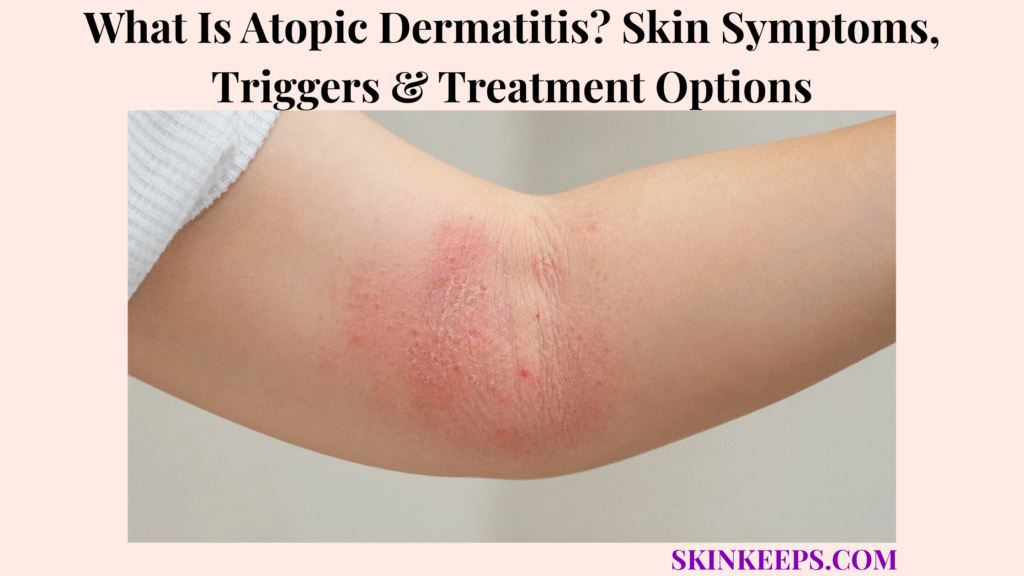
Atopic dermatitis is a chronic inflammatory eczema condition that causes dry, itchy, inflamed, flare-prone skin. It can improve, return, persist, or change location over time.
This page explains symptoms, age-location patterns, causes, triggers, diagnosis, treatment options, daily care, mistakes, and when to seek care. Atopic dermatitis is not contagious, not caused by dirty skin, and not the same as every other eczema type.
What Is Atopic Dermatitis and Why Does It Cause Itchy Skin?
Atopic dermatitis is a common chronic inflammatory skin condition that causes dry, itchy, inflamed, and flare-prone skin.
Atopic dermatitis is also called atopic eczema. Eczema is a broader umbrella term for several itchy, dry, inflamed skin conditions, while atopic dermatitis is the chronic atopic type linked with barrier weakness, immune inflammation, and personal trigger sensitivity.
A flare is a period when symptoms become more active. Remission means symptoms are calmer, but the skin may still be sensitive and prone to future flares.
Why Is Atopic Dermatitis More Than Ordinary Dry Skin?
Atopic dermatitis is more than ordinary dry skin because barrier weakness, immune inflammation, itch, scratching, and repeated flares keep the skin cycling between irritation and repair.
The outer barrier loses moisture more easily and lets irritants, allergens, and germs interact with the skin more readily. That creates dryness, itch, inflammation, cracks, and flare-prone sensitivity.
Itch can affect sleep, concentration, work, school, and quality of life. Scratching may give short relief, but it damages the barrier and makes the next flare easier to trigger.
Why Is Atopic Dermatitis Not Contagious?
Atopic dermatitis is not contagious, so it does not spread from person to person through touch, shared spaces, or casual contact.
It is not caused by poor hygiene. Scratching can worsen eczema by breaking the barrier, but scratching does not make atopic dermatitis infectious by itself.
Broken eczema skin can become secondarily infected. Infected eczema needs medical attention, but that is different from saying atopic dermatitis itself is contagious.
Practical rule: Atopic dermatitis control usually needs daily barrier care plus the right flare treatment level when inflammation is active.
What Atopic Dermatitis Symptoms Appear on Skin?
Atopic dermatitis symptoms can include intense itch, dry skin, inflamed patches, scaling, cracking, oozing, crusting, thickened skin, sleep disruption, and color changes that vary by skin tone.
On lighter skin, inflammation may look red or pink. On darker skin, it may look brown, purple, gray, darker than nearby skin, or less visibly red even when itch and inflammation are severe.
What Does an Atopic Dermatitis Flare Look Like?
An atopic dermatitis flare can look red, pink, brown, purple, gray, or darker depending on skin tone, often with dry scale, scratch marks, swelling, oozing, crusting, burning, stinging, or tenderness.
Acute flares may feel hot, tender, wet, or very itchy. Scratching can create excoriations, which are scratch marks or small open areas caused by rubbing or scratching.
Oozing or crusting can happen in active eczema, but honey-colored crust, pus, worsening pain, spreading warmth, or fever should raise concern for infection.
What Does Chronic Atopic Dermatitis Look Like?
Chronic atopic dermatitis can cause thickened, leathery, darker or lighter, persistently dry, cracked, or itchy skin because repeated scratching and inflammation change the skin over time.
Lichenification means skin thickening from repeated rubbing or scratching. Chronic areas may also show post-inflammatory hyperpigmentation or hypopigmentation, especially after repeated flares.
These marks do not always mean permanent damage, but persistent scratching and uncontrolled inflammation can make the skin harder to calm.
| Skin Sign | What the Reader May Notice | Why It Matters |
|---|---|---|
| Intense itch | Strong urge to scratch, often worse at night | Central AD symptom |
| Dryness | Rough, tight, flaky skin | Barrier dysfunction clue |
| Inflamed patches | Red, pink, brown, purple, gray, or darker areas | Skin-tone-aware description |
| Oozing / crusting | Wet or crusted flare surface | Acute flare or infection concern |
| Cracks / fissures | Painful splits in hands, folds, or dry areas | Barrier breakdown |
| Thickened skin | Leathery plaques from scratching | Chronic itch-scratch cycle |
| Sleep disruption | Itch keeps person awake | Severity and care threshold |
| Honey crust / pus | Yellow crust, drainage, pain, warmth | Possible infection |
Where Does Atopic Dermatitis Usually Appear by Age?
Atopic dermatitis location often changes with age, so infant, child, and adult patterns should be described separately rather than treated as one universal rash.
Location patterns help recognition, but they do not diagnose every rash. The strongest pattern combines itch, dryness, recurrence, flare-remission history, age-related location, and exclusion of mimics.
Where Does Atopic Dermatitis Appear in Babies?
In babies, atopic dermatitis often appears on the cheeks, scalp, trunk, and outer arms or legs, and it may look bumpy, weepy, crusted, or very dry.
The diaper area is often less typical for atopic dermatitis than diaper dermatitis because the diaper environment is different. A baby cheek rash should not be assumed to be atopic dermatitis without considering saliva irritation, seborrheic dermatitis, infection, and other causes.
Where Does Atopic Dermatitis Appear in Children?
In children, atopic dermatitis often appears in skin folds such as elbow creases, knee creases, wrists, ankles, neck, and hands.
This flexural pattern can become thickened and very itchy from scratching. Some children also have face, extensor, trunk, or hand involvement, so the pattern should be interpreted with age and history.
Where Does Atopic Dermatitis Appear in Adults?
In adults, atopic dermatitis may affect the hands, eyelids, face, neck, flexures, nipples, feet, ankles, or chronically thickened areas exposed to work or routine triggers.
Adult hand eczema may relate to wet work, detergents, gloves, sanitizers, chemicals, caregiving, health work, cleaning work, hair work, or other repeated exposures. Eyelid eczema may overlap with contact allergy, cosmetics, fragrances, or eye products.
| Age Group | Common Sites | Useful Clue |
|---|---|---|
| Babies | Cheeks, scalp, trunk, outer arms/legs | May look bumpy, weepy, crusted, or very dry |
| Children | Elbow folds, knee folds, wrists, ankles, neck, hands | Flexural itch and scratching |
| Adults | Hands, eyelids, face/neck, flexures, nipples, feet/ankles | Chronic thickened or occupationally triggered eczema |
What Causes Atopic Dermatitis Beneath the Skin Surface?
Atopic dermatitis develops from a mix of skin-barrier dysfunction, immune inflammation, genetics, environmental exposure, and individual trigger sensitivity.
It should not be reduced to one allergy, one food, one product, or one hygiene issue. Several forces can combine to make the skin dry, itchy, inflamed, and reactive.
How Does Skin-Barrier Weakness Contribute to Atopic Dermatitis?
Skin-barrier weakness contributes to atopic dermatitis by allowing too much moisture to escape and making it easier for irritants, allergens, and germs to interact with the skin.
The stratum corneum is the outer skin layer. When its barrier function is weakened, the skin becomes drier and more easily irritated.
Moisturizing is therefore treatment logic, not cosmetic advice. It helps support the barrier so the skin loses less water and tolerates everyday exposure better.
How Does Immune Inflammation Contribute to Atopic Dermatitis?
Immune inflammation contributes to atopic dermatitis by driving redness or discoloration, itch signaling, swelling, scaling, and repeated flare reactions after triggers.
This is why some flares need anti-inflammatory treatment beyond moisturizer. Barrier care supports the skin, while flare medicines help calm active inflammation.
How Do Genetics and the Atopic Tendency Fit Atopic Dermatitis?
Genetics and atopic tendency can increase the chance of atopic dermatitis, especially when eczema, asthma, hay fever, or other allergic disease runs in the family.
Family history can matter, but atopic dermatitis is not caused by one specific allergy in most people. Food allergy may matter in selected cases, especially some children, but broad food avoidance can create nutrition and growth risks if done without medical guidance.
The atopic march describes the way some people develop eczema, asthma, hay fever, or food allergy over time. Not everyone with atopic dermatitis develops these conditions.
What Triggers Can Make Atopic Dermatitis Flare?
Atopic dermatitis triggers vary by person, and anything that repeatedly irritates or inflames a person’s eczema-prone skin can become a flare trigger.
Some people identify clear triggers. Others flare without a single obvious cause. Trigger tracking should reduce avoidable irritation, not create fear of every product, food, fabric, or environment.
Which Irritants Commonly Trigger Atopic Dermatitis?
Common irritant triggers for atopic dermatitis include harsh soaps, fragrances, detergents, wool, rough fabrics, sweat, saliva, frequent washing, hand sanitizer, hot water, and occupational wet work.
These triggers are not universal. A product or routine becomes suspicious when the same exposure repeatedly worsens the same areas or when symptoms improve after simplifying the routine.
Which Environmental Factors Can Trigger Atopic Dermatitis?
Environmental triggers for atopic dermatitis can include cold dry weather, heat, sweating, low humidity, dust mites, pollen, pets, climate shifts, and air pollution in selected patients.
Heat and sweat can sting inflamed skin. Cold dry air and indoor heating can increase dryness. Low humidity may require more frequent moisturizer use.
Which Allergy-Related Triggers May Matter in Selected Cases?
Allergy-related triggers may matter in selected atopic dermatitis cases, but AD should not be reduced to food allergy or treated with broad elimination diets without medical guidance.
Contact allergens such as fragrance, preservatives, metals, topical medicines, or cosmetic ingredients may worsen eczema in some people. Patch testing may be considered when allergic contact dermatitis is suspected.
Food allergy evaluation should be targeted to a consistent history, especially in children. Broad elimination diets can create nutrition and growth concerns if used without clinician guidance.
| Trigger Category | Examples | Flare Clue | Prevention Step |
|---|---|---|---|
| Irritants | Soap, detergent, fragrance, sanitizer | Stinging, dryness, flare after contact | Simplify and choose gentle products |
| Fabrics | Wool, rough clothing, tight friction | Itchy areas under fabric | Use soft breathable fabrics |
| Weather | Cold dry air, heat, sweating, low humidity | Seasonal or heat-linked flares | Adjust clothing, cooling, moisturizer frequency |
| Occupational | Wet work, gloves, chemicals | Hand flares at work or school | Barrier plan and exposure review |
| Contact allergy | Nickel, fragrance, preservatives, topical products | Same-site recurring rash | Consider patch testing |
| Food allergy | Selected cases only | Immediate or consistent food-linked symptoms | Clinician-guided evaluation only |
How Is Atopic Dermatitis Different From Other Skin Rashes?
Atopic dermatitis can resemble contact dermatitis, psoriasis, seborrheic dermatitis, fungal rash, hives, scabies, or infection, but AD is usually chronic, itchy, barrier-related, and flare-prone.
Wrong identification can lead to wrong treatment. Steroid-only use can worsen some fungal rashes, while infection signs should not be treated as ordinary eczema flares.
How Is Atopic Dermatitis Different From Contact Dermatitis?
Atopic dermatitis is usually chronic and barrier-immune driven, while contact dermatitis follows irritant or allergen exposure to a specific substance or surface.
Both can overlap. A same-site rash after fragrance, nickel, preservative, rubber, dye, glove, cosmetic, or topical medicine exposure may need patch testing if allergic contact dermatitis is suspected.
How Is Atopic Dermatitis Different From Psoriasis?
Atopic dermatitis is often intensely itchy and flexural, while psoriasis often forms thicker, sharper plaques on areas such as elbows, knees, scalp, or nails.
Psoriasis can have nail pitting, scalp plaques, and sharper borders. Atopic dermatitis more often centers on itch, dryness, flexural eczema, and barrier sensitivity.
How Is Atopic Dermatitis Different From Fungal Rash or Infection?
Atopic dermatitis is different from fungal rash or infection because fungal rashes may have a ring-shaped edge or one-sided scaling pattern, while infection may cause pain, pus, crusting, fever, warmth, or rapid worsening.
A ring-shaped scaling edge may suggest ringworm / tinea corporis rather than eczema. Steroid-only cream can hide or worsen fungal infection.
Spreading warmth, swelling, pain, fever, or rapidly worsening broken skin may suggest cellulitis or another infection and should be checked promptly.
| Condition | Main Clue | Common Pattern | Why It Matters |
|---|---|---|---|
| Atopic dermatitis | Chronic itch + dry inflamed skin | Flexures, hands, face/neck, age-dependent | Barrier repair + anti-inflammatory care |
| Contact dermatitis | Exposure-linked rash | Contact site | Trigger identification and patch testing if allergic |
| Psoriasis | Thick plaques, sharp borders, nail/scalp clues | Elbows, knees, scalp, nails | Different immune pathway and treatment plan |
| Seborrheic dermatitis | Greasy scale in oily areas | Scalp, eyebrows, nose folds, chest | Different yeast/oil-area management |
| Fungal rash | Ring/edge scale or foot/groin pattern | Variable; often active border | Antifungal treatment may be needed |
| Hives / urticaria | Transient raised welts | Comes and goes quickly | Different trigger and treatment logic |
| Infection | Pain, pus, honey crust, fever, warmth | Broken eczema skin | Medical care may be needed |
How Is Atopic Dermatitis Diagnosed or Checked?
Atopic dermatitis is usually diagnosed from the rash pattern, itch history, chronic or recurrent course, age-related distribution, personal or family atopic history, and exclusion of similar conditions.
Diagnosis is usually clinical. Visual appearance alone is not enough because skin tone, scratching, infection, contact allergy, fungal rash, and psoriasis can change how the rash looks.
What Does a Clinician Check With Atopic Dermatitis?
A clinician checks atopic dermatitis by reviewing itch severity, rash location, age at onset, flare-remission pattern, sleep disruption, trigger history, infection signs, and personal or family allergy history.
The visit may include questions about eczema, asthma, allergic rhinitis, food allergy, products, detergents, fragrances, bathing routine, moisturizer use, work or school exposures, and treatments already tried.
When Might Tests Be Useful for Atopic Dermatitis?
Tests may be useful for atopic dermatitis when the diagnosis is unclear, infection is suspected, allergic contact dermatitis is possible, fungal rash is a mimic, or allergy history suggests a targeted evaluation.
Patch testing may help when contact allergy is suspected. A swab or culture may be used when infection is suspected. A KOH or fungal test may be used when tinea is possible.
Allergy testing is not automatic for every child or adult with atopic dermatitis. Biopsy is reserved for unclear, atypical, or treatment-resistant cases where another diagnosis needs exclusion.
- Photos during flares.
- Age at first symptoms.
- Body areas affected.
- Itch severity.
- Sleep impact.
- Flare-remission pattern.
- Bathing and moisturizer routine.
- Products, detergents, fragrances, and topical medicines used.
- Trigger diary.
- Food concerns, if any.
- Personal or family eczema, asthma, hay fever, or allergy history.
- Treatments tried and response.
- Oozing, crusting, pain, warmth, fever, or infection signs.
What Treatment Options Help Atopic Dermatitis?
Atopic dermatitis treatment usually combines daily skin-barrier care, trigger reduction, flare medicines, itch control, infection management when needed, and advanced therapies for moderate-to-severe or treatment-resistant disease.
No one plan fits every patient. Treatment depends on age, body site, skin thickness, severity, infection risk, trigger pattern, previous response, pregnancy context, other medical conditions, and access to specialist care.
How Do Moisturizers and Emollients Help Atopic Dermatitis?
Moisturizers and emollients help atopic dermatitis by supporting the skin barrier, reducing dryness, lowering itch, and making the skin less vulnerable to irritation.
Fragrance-free thick creams or ointments are often preferred when tolerated. Apply after bathing while the skin is still slightly damp, and continue even when the rash improves.
Moisturizer is foundational care, not cosmetic care. It may not be enough for every active flare, but stopping it between flares keeps the barrier more vulnerable.
When Are Topical Corticosteroids Used for Atopic Dermatitis?
Topical corticosteroids are used for active atopic dermatitis flares when skin is inflamed, itchy, swollen, cracked, or not controlled by barrier care alone.
Strength and duration should match the body site, age, and severity. Lower-potency treatment is often used on thinner areas such as face, eyelids, folds, and in children.
Fear of all steroid use can leave inflammation undertreated, while overuse without guidance can increase side effects. A clear flare plan is safer than random use.
Which Non-Steroid Topical Treatments May Help Atopic Dermatitis?
Non-steroid topical treatments for atopic dermatitis may include topical calcineurin inhibitors, crisaborole, roflumilast, ruxolitinib, tapinarof, or other region-approved options when they fit the patient’s age, body site, severity, and safety profile.
Topical calcineurin inhibitors include tacrolimus and pimecrolimus. They may be considered for sensitive sites or steroid-sparing plans.
Newer non-steroid medicines may not be approved in every country or for every age group. They should be selected with clinician guidance rather than used as a casual product switch.
When Are Phototherapy, Biologics, or JAK Inhibitors Considered?
Phototherapy, biologics, or JAK inhibitors may be considered when atopic dermatitis is moderate-to-severe, widespread, sleep-disrupting, quality-of-life limiting, or poorly controlled despite optimized topical care.
Phototherapy uses controlled medical light, not tanning beds. When prescribed, it often requires repeated visits, commonly two to three times weekly for a period set by the dermatologist.
Specialist-led biologic examples include dupilumab, tralokinumab, lebrikizumab, or nemolizumab in eligible patients. Specialist-led oral JAK inhibitor examples include abrocitinib or upadacitinib where approved. These options require eligibility review, safety discussion, and monitoring.
| Treatment Level | Best-Fit Situation | Goal | Key Caution |
|---|---|---|---|
| Moisturizers/emollients | All severity levels as foundation | Barrier support and dryness control | Not enough for every active flare |
| Trigger reduction | Recurrent or exposure-linked flares | Reduce avoidable inflammation | Triggers vary by person |
| Topical corticosteroids | Active inflamed flares | Calm inflammation quickly | Match potency to site, age, and duration |
| Topical calcineurin inhibitors | Sensitive sites or steroid-sparing plan | Control inflammation without steroid use | Clinician-guided |
| Crisaborole / newer non-steroid topicals | Mild-to-moderate or selected cases | Reduce inflammation or itch | Region and age approval matter |
| Wet wraps | Severe flares or intense itch when advised | Hydrate and reduce scratching | Must be taught properly |
| Phototherapy | Persistent moderate-to-severe disease | Reduce inflammation | Requires scheduled treatments; avoid tanning beds |
| Biologics | Moderate-to-severe uncontrolled AD | Target immune inflammation | Specialist-led eligibility and monitoring |
| JAK inhibitors | Selected moderate-to-severe cases | Reduce inflammatory signaling | Safety screening and risk discussion required |
| Infection treatment | Pus, honey crust, pain, fever, warmth | Treat secondary infection | Antimicrobials do not treat AD itself |
How Can Daily Skin Care Reduce Atopic Dermatitis Flares?
Daily skin care for atopic dermatitis should protect the skin barrier every day, not only when the rash is severe.
Use lukewarm, short baths or showers. Use gentle fragrance-free cleanser. Pat dry instead of scrubbing, then apply moisturizer while the skin is still slightly damp.
Moisturize at least daily, and often more during flares or dry weather. Wear soft breathable fabrics, keep nails short, rinse sweat gently when needed, and moisturize again after washing or sweating.
Track personal triggers instead of guessing. A written flare plan can help families and adults know when to moisturize, when to use prescribed flare medicine, and when to seek care.
- Use lukewarm water.
- Use gentle fragrance-free cleanser.
- Pat dry instead of scrubbing.
- Apply moisturizer after bathing.
- Moisturize daily, even between flares.
- Avoid fragrance-heavy or irritating products.
- Wear soft breathable fabrics.
- Keep nails short.
- Manage sweat gently.
- Track personal triggers.
- Follow a written flare plan if flares recur.
What Atopic Dermatitis Mistakes Should You Avoid?
The biggest atopic dermatitis mistake is treating only the visible rash while ignoring daily barrier repair, triggers, scratching, and infection risk.
Stopping moisturizer when the rash improves can leave the barrier weak. Harsh soap and scrubbing can worsen water loss. Adding many new products during a flare can make trigger detection harder.
Steroid fear can undertreat active inflammation, while steroid overuse without a body-site plan can increase side effects. Broad food elimination without guidance can create nutrition and growth risks, especially in children.
| Mistake | Why It Fails | Better Action |
|---|---|---|
| Moisturizing only during flares | Barrier stays weak between flares | Use daily maintenance care |
| Harsh soap or scrubbing | More irritation and water loss | Use gentle cleanser and pat dry |
| Random product stacking | More possible triggers | Simplify routine |
| Steroid fear | Active inflammation may remain undertreated | Use a clear clinician-guided flare plan |
| Steroid overuse | Side effects increase when strength, site, or duration are wrong | Match potency and duration to body site |
| Food elimination without guidance | Nutrition and growth risks, especially in children | Test only when history supports it |
| Ignoring infection | Eczema may worsen or spread | Seek care for crust, pus, pain, warmth, or fever |
When Should Atopic Dermatitis Be Checked by a Doctor?
Atopic dermatitis should be checked by a clinician when itch is severe, sleep is affected, flares are frequent, the rash is infected-looking, the diagnosis is unclear, or symptoms do not improve with consistent skin care and appropriate treatment.
Medical review is also important when eczema affects eyelids, hands, school, work, feeding, sleep, growth, mental well-being, or daily function.
Which Atopic Dermatitis Symptoms Need Medical Review?
Atopic dermatitis symptoms need medical review when itch is severe, sleep is disrupted, flares are frequent, eczema is widespread, cracks are painful, infection signs appear, or eyelids, hands, school, work, or daily life are affected.
Seek care for oozing, pus, honey-colored crust, increasing pain, warmth, swelling, fever, rapidly worsening eczema, painful cracks, eyelid symptoms, hand eczema that affects work or school, poor treatment response, or repeated need for stronger flare medicine.
Children with food restriction, poor growth, or nutrition concerns should be assessed rather than placed on broad elimination diets at home.
What Should You Bring to an Atopic Dermatitis Appointment?
A useful atopic dermatitis appointment starts with photos during flares, itch and sleep scores, product list, bathing routine, trigger diary, medicines tried, family history, and infection signs.
Bring names of cleansers, moisturizers, fragrances, detergents, topical medicines, supplements, and alternative products. Mention work, school, glove, sanitizer, wet-work, food, pet, dust, weather, sweat, and stress patterns if they seem connected.
Seek medical review if atopic dermatitis has:
What Should You Remember About Atopic Dermatitis?
The most important thing to remember about atopic dermatitis is that it is a chronic itchy eczema condition where long-term control depends on barrier repair, trigger management, and the right flare treatment level.
Atopic dermatitis is not contagious and not caused by dirty skin. It can look different across skin tones, change by age, and require more than moisturizer when active inflammation, infection, or moderate-to-severe disease is present.
Frequently Asked Questions About Atopic Dermatitis
Is atopic dermatitis the same as eczema?
Atopic dermatitis is one type of eczema. Eczema is a broader term for several itchy, dry, inflamed skin conditions, while atopic dermatitis is the chronic atopic type.
Is atopic dermatitis contagious?
No. Atopic dermatitis is not contagious and cannot spread from person to person through touch, shared spaces, or casual contact.
What does atopic dermatitis look like?
Atopic dermatitis can look like dry, itchy, inflamed patches that may appear red, pink, brown, purple, gray, or darker depending on skin tone, with scale, scratch marks, oozing, crusting, cracking, or thickened skin.
What triggers atopic dermatitis?
Triggers vary by person and may include harsh soaps, fragrance, detergents, wool, sweat, heat, cold dry weather, low humidity, stress, contact allergens, and allergy-related triggers in selected cases.
Is atopic dermatitis caused by food allergy?
Not usually as a single cause. Food allergy can matter in selected patients, especially some children, but broad food elimination should not be done without medical guidance.
What is the best treatment for atopic dermatitis?
The best plan depends on age, severity, body site, infection risk, trigger pattern, previous response, and whether disease is mild, moderate, severe, or treatment-resistant.
Can atopic dermatitis go away?
Atopic dermatitis can improve, flare, remit, or persist. Some children improve with age, while some people continue to have eczema into adolescence or adulthood.
When should atopic dermatitis need stronger treatment?
Stronger treatment may be needed for severe itch, poor sleep, frequent flares, widespread disease, infection, eyelid or hand involvement, poor response to topical care, or major quality-of-life impact.
Sources & Evidence About Atopic Dermatitis
American Academy of Dermatology — Atopic Dermatitis Overview was used for definition, itchy/dry/inflamed skin, non-contagious nature, eczema as a broader umbrella term, skin-tone variation in babies, chronic course, moisturizer role, and early-life onset context.
American Academy of Dermatology — Atopic Dermatitis Causes was used for skin-barrier gaps, moisture loss, irritant entry, germ entry, genes, immune system, environmental exposure, family allergy history, and atopic march context.
American Academy of Dermatology — Atopic Dermatitis Diagnosis and Treatment was used for clinical diagnosis, biopsy when needed, treatment goals, moisturizer, bathing, gentle skin care, wet wraps, trigger management, topical corticosteroids, topical calcineurin inhibitors, crisaborole, roflumilast, ruxolitinib, tapinarof, phototherapy, biologics, JAK inhibitors, and infection management.
DermNet — Atopic Dermatitis was used for age patterns, adult forms, nipple and hand involvement, lichenification, skin-of-colour variation, post-inflammatory pigment changes, clinical diagnosis, patch-testing context, complications, differential diagnosis, and prevalence context.
National Eczema Association — Atopic Dermatitis was used as patient-friendly context for atopic dermatitis as a common eczema type, chronic itch, flare behavior, trigger awareness, and treatment-plan framing.
NHS — Atopic Eczema was used for practical patient-care context around emollients, topical corticosteroids, flare control, trigger management, and when symptoms need clinical review.
Educational Disclaimer: This SkinKeeps article is for educational purposes only and does not diagnose or replace medical care. Severe itch, sleep disruption, frequent flares, widespread eczema, painful cracks, pus, honey-colored crust, warmth, swelling, fever, eye or eyelid involvement, hand eczema affecting daily function, poor treatment response, or child growth/nutrition concerns should be checked by a qualified healthcare professional.