
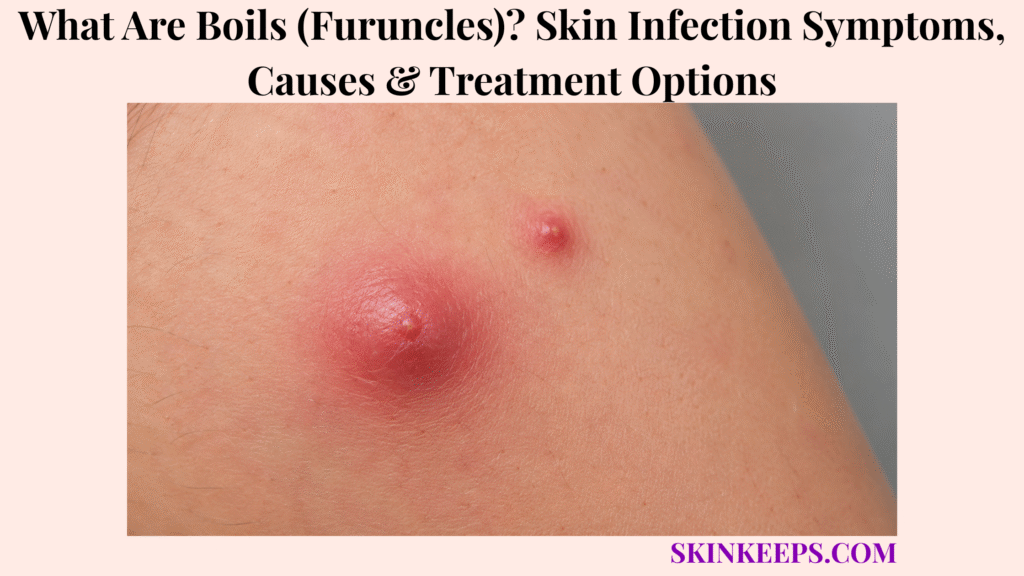
Boils, medically called furuncles, are deep bacterial infections of hair follicles that form tender, swollen, pus-filled lumps under the skin.
They are not ordinary pimples, and squeezing or cutting them at home can spread infection. This page explains symptoms, causes, spread, risk factors, diagnosis, warm-compress care, drainage, antibiotics when needed, recurrence prevention, mistakes, and urgent signs.
What Are Boils and Why Are They Called Furuncles?
Boils, medically called furuncles, are deep bacterial infections of hair follicles that form tender, swollen, pus-filled lumps under the skin.
A hair follicle is the small skin structure that grows a hair. When bacteria infect deeper parts of that follicle, swelling, pain, inflammation, and pus can build under the skin.
A large pus pocket can become a skin abscess. A carbuncle is a cluster of connected boils that forms a larger infected area under the skin.
Why Does a Boil Start in a Hair Follicle?
A boil starts when bacteria infect a hair follicle and the immune response creates swelling, pain, inflammation, and pus.
The follicle may become infected after shaving irritation, small cuts, friction, sweat, insect bites, or damaged skin. As the immune system responds, pus can collect and create a firm or soft painful lump.
The lump may enlarge, soften, drain, crust, or spread into surrounding skin. A boil should not be squeezed to bring pus out.
Why Is a Carbuncle More Serious Than a Single Boil?
A carbuncle is more serious than a single boil because it is a cluster of connected boils that creates a larger and deeper area of infection.
Carbuncles can be more painful, deeper, and more likely to drain from several points. They may also be more likely to cause fever, illness, or scarring.
A carbuncle should usually be checked by a clinician because treatment may require drainage, culture, wound care, or antibiotics when indicated.
Practical rule: Treat a boil as a bacterial infection, not a routine acne bump. Small uncomplicated boils may be protected with warm compresses, but large, spreading, recurrent, high-risk, or face/nose-area boils need medical review.
What Boil Symptoms Appear on Skin?
Boils usually begin as tender red, pink, purple, brown, or darker swollen bumps that become more painful as pus builds up under the skin.
Color can look different across skin tones. On lighter skin, surrounding inflammation may look red or pink. On brown or black skin, it may look purple, darker brown, grayish, or simply more swollen and shiny than nearby skin.
What Does an Early Boil Look and Feel Like?
An early boil may feel like a tender, warm, firm, swollen lump before pus comes to the surface.
It may hurt, throb, itch, or feel tight. Pressing hard to test it is not recommended because pressure can worsen pain and spread inflammation.
What Does a Mature Boil Look Like?
A mature boil may become larger, softer, more painful, and develop a white or yellow pus center that can drain or crust.
The center may feel soft or fluctuant, meaning fluid or pus may be under pressure. Drainage can leak onto clothing, towels, bedding, or hands, so the area should be covered.
After healing, some boils can leave dark marks or scars, especially if squeezed, cut, repeatedly irritated, or deeply inflamed.
What Symptoms Suggest the Infection Is Spreading?
A boil may be spreading when fever, chills, expanding warmth, spreading redness or color change, red streaks, swollen lymph nodes, multiple boils, or feeling unwell appear.
Spreading infection around a boil can resemble cellulitis, especially when the surrounding skin becomes increasingly warm, swollen, painful, and discolored.
Multiple connected boils suggest a carbuncle and should be checked.
| Skin Sign | What the Reader May Notice | Severity Meaning |
|---|---|---|
| Tender firm lump | Painful swollen bump near a hair follicle | Early boil pattern |
| Warmth and swelling | Inflamed skin around the lump | Infection activity |
| Red, pink, purple, brown, or darker color | Skin-tone-dependent inflammation | Track spread or deepening color |
| White or yellow center | Pus coming toward the surface | Mature boil |
| Soft or fluctuant center | Pus pocket may be present | May need drainage if large or painful |
| Draining pus | Fluid leaking from the sore | Cover and prevent spread |
| Fever or chills | Systemic symptoms | Medical care |
| Red streaks or swollen nodes | Possible spreading infection | Urgent review |
| Multiple connected boils | Carbuncle pattern | Medical evaluation |
Where Do Boils Usually Appear?
Boils commonly appear in hair-bearing, sweaty, rubbed, or occluded areas such as the face, neck, armpits, thighs, buttocks, groin, and back.
They may occur around the beard area after shaving, near waistbands or sports gear, on the back of the neck under collars, in armpits, in groin folds, on inner thighs, on the buttocks, or on the back.
Boils on the face, near the nose, near the spine, near the genitals, or next to a wound or medical device should be checked sooner. Location alone does not prove the diagnosis.
| Location | Common Trigger | Safety Caution |
|---|---|---|
| Face / nose area | Shaving, follicle irritation, staph carriage | Lower threshold for care; do not squeeze |
| Back of neck | Sweat, collars, friction | Carbuncle risk if clustered |
| Armpits | Sweat, shaving, friction | Recurrent lesions may suggest hidradenitis-like disease |
| Groin / inner thighs | Friction, sweat, occlusion | Recurrent deep lumps need evaluation |
| Buttocks | Sitting, friction, bacterial spread | Cover drainage; prevent spread |
| Back | Sweat, clothing, friction | Large carbuncles may occur |
| Beard area | Shaving irritation, follicle infection | Avoid shaving over active infection |
| Waistband / equipment zones | Tight clothing, sports gear | Reduce pressure and rubbing |
What Causes Boils?
Boils are usually caused by bacteria, especially Staphylococcus aureus, infecting a hair follicle and creating a deeper pus-filled infection.
Staph bacteria can live on the skin or in the nose without causing symptoms. A boil can form when bacteria enter a follicle through irritated, rubbed, shaved, bitten, scratched, or damaged skin.
How Does Staph Bacteria Cause a Boil?
Staph bacteria can cause a boil when they enter a follicle through damaged or irritated skin and trigger a pus-forming immune response.
Some boils may involve MRSA, a type of staph that is resistant to some antibiotics. MRSA cannot be assumed from appearance alone, so culture and clinician judgment matter.
Why Can Shaving, Friction, and Sweat Trigger Boils?
Shaving, friction, and sweat can trigger boils by irritating hair follicles and weakening the skin barrier where bacteria can enter.
Small shaving cuts, tight clothing, waistbands, sports equipment, sweat, and skin folds can create irritation and moisture. Avoid shaving, waxing, or picking over active infection.
Why Do Some People Get Recurrent Boils?
Recurrent boils can happen when staph carriage, household spread, skin-barrier problems, diabetes, immune suppression, friction, or a hidradenitis-like condition keeps triggering new infections.
Skin-barrier disease such as atopic dermatitis can make bacterial entry easier when the skin is cracked, scratched, or inflamed.
Repeated armpit, groin, buttock, or under-fold painful lumps should not always be treated as simple boils. A clinician may consider hidradenitis suppurativa or another recurring condition.
| Cause Factor | Follicle / Skin Effect | Prevention / Treatment Implication |
|---|---|---|
| Staphylococcus aureus | Infects a hair follicle | Culture if recurrent or nonresponsive |
| Small cuts / shaving | Opens entry point for bacteria | Avoid shaving over active infection |
| Friction / tight clothing | Irritates follicles | Reduce rubbing and occlusion |
| Sweat / skin folds | Moist environment and irritation | Keep areas clean and dry |
| Damaged skin barrier | Easier bacterial entry | Manage eczema or skin irritation |
| Staph carriage | Repeated re-seeding | Clinician-led recurrence plan |
| Diabetes / immune suppression | Harder infection control | Lower threshold for care |
| Household spread | Shared bacterial exposure | Cover drainage and avoid sharing items |
How Do Boils Spread or Come Back?
Boils can spread when pus or contaminated skin contact transfers bacteria to nearby skin, towels, clothing, razors, bedding, gym equipment, or other people.
Touching a draining boil and then touching other skin can move bacteria. Reusing dressings, sharing towels or razors, or letting drainage contact clothing and bedding can also spread bacteria.
Recurrent boils may involve staph carriage on the skin or in the nose, household exposure, untreated close-contact spread, friction, diabetes, immune risk, or an underlying skin condition.
Who Is More Likely to Get Boils?
Boils are more likely when skin is damaged, follicles are irritated, bacteria spread easily, or the immune system has a harder time controlling infection.
Risk factors are not a shame issue. Many people with boils have normal hygiene, but repeated friction, sweating, skin-barrier injury, close contact, and health conditions can raise risk.
How Are Boils Different From Pimples, Cysts, Folliculitis, Carbuncles, and Cellulitis?
Boils can look like pimples or cysts, but a boil is a deeper painful bacterial hair-follicle infection that may need drainage if it becomes large, soft, fluctuant, or spreading.
Wrong labeling can lead to squeezing, acne-only treatment, delayed drainage, or missed spreading infection.
How Is a Boil Different From a Pimple?
A boil is different from a pimple because a boil is usually deeper, more painful, infection-driven, and more likely to enlarge into a pus-filled abscess.
Acne pimples are usually part of an acne pattern. Boils are bacterial follicle infections, and squeezing can spread infection.
How Is a Boil Different From an Epidermoid Cyst?
A boil is different from an epidermoid cyst because cysts may grow slowly and remain noninfected at first, while boils are active bacterial infections.
An infected cyst can mimic a boil. Diagnosis changes management because cysts may recur unless the cyst wall is addressed, while a boil centers on infection, drainage, and spread control.
How Is a Boil Different From Folliculitis or a Carbuncle?
Folliculitis is usually more superficial, a boil is deeper, and a carbuncle is a cluster of connected boils under the skin.
Superficial folliculitis may appear as small follicular pustules. A boil is usually more painful and deeper. A carbuncle creates a larger connected infection and may cause fever or scarring.
How Is a Boil Different From Cellulitis?
A boil is a localized pus-filled infection, while cellulitis is a spreading infection of deeper skin layers that may not have one central drainable pus pocket.
Cellulitis causes spreading warmth, swelling, pain, and redness or darker color change. It can occur around a boil and may need antibiotics or urgent care.
| Condition | Main Clue | Usual Treatment Direction | Safety Caution |
|---|---|---|---|
| Boil / furuncle | Painful pus-filled follicle lump | Warm compress if small; drainage if large | Do not squeeze |
| Pimple | Acne bump or pustule | Acne treatment | Not usually deep abscess |
| Epidermoid cyst | Slow lump, may inflame | Cyst-specific care if recurrent | Infected cyst can mimic boil |
| Folliculitis | Small superficial follicle pustules | Hygiene, topical, or clinician care | Can progress deeper |
| Carbuncle | Cluster of connected boils | Medical evaluation or drainage | Fever and scarring risk |
| Cellulitis | Spreading warmth, redness, or darker color change | Medical care; antibiotics may be needed | Can become serious |
| Impetigo | Superficial bacterial crusting or blisters | Cause-specific infection care | Can spread through contact |
| Hidradenitis-like disease | Recurrent painful armpit, groin, fold, or buttock nodules | Dermatology care | Do not treat as repeated simple boils only |
How Are Boils Diagnosed or Checked?
Boils are often diagnosed by skin exam, but culture or further evaluation may be needed when boils are recurrent, severe, spreading, treatment-resistant, or MRSA is suspected.
A clinician checks whether the lump is firm or soft, whether there is a drainable pus pocket, whether surrounding infection is spreading, and whether the person has risk factors that make infection more dangerous.
What Does a Clinician Check With a Boil?
A clinician checks a boil by assessing its size, location, pain, softness, drainage, surrounding infection, fever, recurrence, and patient risk factors.
Face, nose, spine, genital, wound-adjacent, or device-adjacent boils may need more caution. Diabetes, immune suppression, poor circulation, MRSA history, severe pain, or multiple boils also changes the care threshold.
When Might a Boil Need Culture or Lab Testing?
A boil may need culture or lab testing when infection is recurrent, severe, spreading, not responding to treatment, linked with MRSA concern, or occurring in a high-risk person.
A pus sample can help identify the bacteria and guide antibiotic choice when antibiotics are needed. Culture is especially useful for recurrent boils, household outbreaks, severe infection, failed treatment, or immune-risk situations.
What Home Care Helps a Small Boil Safely?
A small uncomplicated boil may improve with warm compresses, gentle cleaning, covering drainage, and avoiding squeezing.
Home care is only for small, uncomplicated boils in people without high-risk features. It is not enough for fever, spreading infection, severe pain, carbuncles, face/nose/spine/genital location, diabetes, immune suppression, poor circulation, recurrent boils, or worsening drainage.
How Should Warm Compresses Be Used for a Boil?
Warm compresses can help a small boil by easing pain and encouraging natural drainage without squeezing.
Use a clean warm, moist cloth. Apply it gently several times daily, keeping the temperature warm rather than hot enough to burn.
Wash cloths and towels after use, especially if drainage touches them.
How Should a Draining Boil Be Covered?
A draining boil should be gently cleaned, covered with a clean dressing, and handled with careful hand hygiene to reduce bacterial spread.
Wash hands before and after care. Cover the draining area with a clean dry dressing and change it when wet or dirty.
Do not reuse contaminated dressings. Launder towels, clothing, and bedding that touch drainage.
Why Should You Not Squeeze a Boil?
You should not squeeze a boil because pressure can push infection deeper, spread bacteria to nearby skin, and increase pain, inflammation, and scarring.
Face and nose-area boils are especially unsafe to squeeze. Clinician drainage is different from home squeezing because it uses sterile technique, wound assessment, and follow-up when needed.
What Medical Treatment Options Are Used for Boils?
Medical treatment for boils may include incision and drainage, wound care, culture, and antibiotics when infection is severe, spreading, recurrent, high-risk, or linked to MRSA concern.
Not every boil needs antibiotics, and not every boil can heal with warm compresses alone. Treatment depends on size, softness, drainage, spread, recurrence, location, and health risk.
When Does a Boil Need Incision and Drainage?
A boil may need incision and drainage when it is large, very painful, soft or fluctuant, part of a carbuncle, not draining naturally, or located in a high-risk area.
Incision and drainage should be performed by a clinician, not attempted with a needle, razor, blade, or fingernails at home.
When Are Antibiotics Used for Boils?
Antibiotics may be used for boils when infection is spreading, systemic symptoms are present, boils are recurrent or multiple, the person is high-risk, or MRSA is suspected.
Antibiotics may be considered with fever, spreading cellulitis, carbuncle, multiple boils, immune compromise, diabetes, poor circulation, severe infection, or clinician concern.
Specific antibiotic choice should be guided by clinician assessment, culture when needed, and local resistance patterns.
Why Might Antibiotics Alone Not Cure a Large Boil?
Antibiotics alone may not cure a large boil because a closed pus pocket often needs drainage before the infection can fully resolve.
A large abscess cavity can limit how well medication reaches the center. Drainage plus wound care may be central, while antibiotics are added when spread, systemic symptoms, recurrence, MRSA concern, or high-risk status makes them necessary.
| Boil Situation | Likely Treatment Direction | Key Caution |
|---|---|---|
| Small early boil | Warm compress, cover, monitor | Do not squeeze |
| Draining small boil | Clean, cover, hand hygiene | Prevent spread through drainage |
| Large painful boil | Clinician evaluation and possible drainage | Do not cut at home |
| Carbuncle | Medical evaluation or drainage | Higher systemic and scar risk |
| Spreading warmth or fever | Antibiotics may be needed | Urgent care if worsening |
| Recurrent boils | Culture and risk review | Consider staph carriage, household spread, HS mimic |
| Diabetes / immune suppression / poor circulation | Lower threshold for care | Avoid delay |
| MRSA concern | Culture or susceptibility-guided plan | Do not self-select antibiotics |
How Can Boils Be Prevented From Spreading or Coming Back?
Preventing boils from spreading or returning means reducing skin injury, covering drainage, cleaning hands and shared items, and addressing recurrent staph or medical risk factors when present.
Keep draining boils covered until healed. Do not share towels, razors, clothing, bedding, or sports gear. Wash items that touch drainage.
For recurrent boils, a clinician may review staph carriage, household spread, diabetes, immune risk, skin-barrier disease, friction, and hidradenitis-like patterns. Decolonization steps should be clinician-directed, not started as DIY treatment.
What Boil Mistakes Should You Avoid?
The biggest boil mistake is squeezing, cutting, or trying to drain it at home, because that can spread infection and worsen tissue damage.
Do not share towels or razors. Do not ignore fever, red streaks, severe pain, or spreading warmth and color change.
Do not keep applying steroid cream to a suspected infection unless a clinician directs it. Do not treat recurrent armpit or groin lesions as repeated simple boils without evaluation.
| Mistake | Why It Is Risky | Better Action |
|---|---|---|
| Squeezing a boil | Spreads infection and deepens inflammation | Warm compress, cover, monitor |
| DIY cutting or lancing | Bleeding, scarring, severe infection risk | Clinician drainage if needed |
| Sharing towels or razors | Spreads staph bacteria | Separate and wash items |
| Ignoring fever | Possible systemic infection | Urgent medical review |
| Steroid cream on infection | May mask or worsen infection | Get diagnosis if unsure |
| Recurrent “boils” in groin/armpit | Could be hidradenitis-like disease | Dermatology review |
| Stopping prescribed antibiotics early | Treatment failure or resistance risk | Follow prescription instructions |
| Reusing dressings | Recontamination risk | Use clean dressings |
When Should Boils Be Checked by a Doctor?
A boil should be checked by a clinician if it is large, very painful, on the face or near the nose or spine, part of a carbuncle, not improving, recurrent, associated with fever, spreading warmth or color change, or occurring in someone with diabetes, immune suppression, or poor circulation.
High-risk people should not wait long because infection can spread faster or heal poorly.
Which Boil Symptoms Need Faster Medical Care?
Faster medical care is needed when a boil causes fever, chills, rapidly spreading warmth or color change, severe pain, red streaks, swollen lymph nodes, multiple boils, carbuncle, or worsening drainage.
A boil that keeps getting bigger despite self-care, does not improve after several days of warm compresses, or does not heal as expected should be checked. Confusion or sudden weakness in a frail or older person is also concerning.
Which People Should Not Wait With Boils?
People with diabetes, immune suppression, poor circulation, organ transplant history, chemotherapy, dialysis, significant immune compromise, infants, or recurrent furunculosis should not wait long with a boil.
People with MRSA history, wounds, medical devices, chronic kidney disease, or poor healing risk should also use a lower threshold for care.
Seek medical care if a boil is:
What Should You Remember About Boils?
The most important thing to remember about boils is that they are painful bacterial hair-follicle infections, so safe care depends on controlling drainage, avoiding squeezing, and getting medical treatment when infection is large, spreading, recurrent, or high-risk.
Small uncomplicated boils may be protected with warm compresses and clean dressings, but large, soft, carbuncle-like, spreading, recurrent, or high-risk boils need clinician evaluation.
Frequently Asked Questions About Boils
Are boils and furuncles the same thing?
Yes. Furuncle is the medical term for a boil, which is a deep bacterial infection of a hair follicle.
What causes boils?
Boils are usually caused by bacteria, especially Staphylococcus aureus, entering or infecting a hair follicle through irritated, damaged, rubbed, shaved, or broken skin.
Should you pop a boil?
No. Squeezing or popping can spread infection, worsen inflammation, and increase scarring risk. Warm compresses are safer for small uncomplicated boils.
When does a boil need drainage?
Large, painful, soft or fluctuant, non-draining boils or carbuncles may need clinician-performed incision and drainage. Do not cut or lance a boil at home.
Do boils need antibiotics?
Not always. Some small boils improve with warm compresses and drainage, while antibiotics may be needed for spreading infection, fever, recurrent boils, MRSA concern, carbuncles, immune compromise, diabetes, or other high-risk situations.
Are boils contagious?
The boil is localized, but bacteria in pus or drainage can spread to nearby skin or other people through direct contact, towels, razors, clothing, bedding, or shared sports items.
Why do I keep getting boils?
Recurrent boils can be linked with staph carriage, household spread, skin friction, shaving, diabetes, immune suppression, skin-barrier disease, and possible hidradenitis-like disease if lesions recur in armpits, groin, buttocks, or under skin folds.
When should a boil need urgent care?
A boil needs urgent care when there is fever, chills, spreading warmth or color change, red streaks, severe pain, face/nose/spine location, carbuncle, multiple boils, diabetes, immune suppression, poor circulation, or no improvement.
Sources & Evidence About Boils
Mayo Clinic — Boils and Carbuncles: Symptoms & Causes was used for boil and carbuncle definitions, symptoms, common locations, and when to seek care.
Mayo Clinic — Boils and Carbuncles: Diagnosis & Treatment was used for warm compresses, no squeezing or lancing, culture for recurrent or nonresponsive infection, and antibiotics for severe or recurrent infections.
DermNet — Boils / Furunculosis was used for boil as deep bacterial folliculitis, Staphylococcus aureus culture, carbuncle, abscess, cellulitis, staph carriage, and follicle-centered presentation.
DermNet — Folliculitis and Furunculosis was used for superficial versus deep follicular infection, contagiousness, hygiene, large furuncle or abscess incision and drainage, and recurrent-case swabs.
DermNet — Cutaneous Abscess was used for abscess causes, Staphylococcus aureus, MRSA, diabetes and abscess context, bacterial abscess framework, and hygiene prevention.
Cleveland Clinic — Boils and Carbuncles was used for patient-friendly overview, symptoms, risk factors, warm compresses, “never squeeze/prick,” and provider thresholds for high-risk patients.
Merck Manual Professional — Furuncles and Carbuncles was used for incision and drainage as central treatment for large furuncles and carbuncles, warm compress support for smaller furuncles, and antibiotics in selected systemic or high-risk contexts.
Recurrent Furunculosis: Challenges and Management Review was used for recurrent boils, culture, hygiene optimization, household transmission, staph carriage, and clinician-directed recurrence-management context.
Educational Disclaimer: This SkinKeeps article is for educational purposes only and does not diagnose or replace medical care. A large, very painful, rapidly worsening, spreading, fever-associated, red-streaked, recurrent, carbuncle-like, face/nose/spine/genital, diabetic, poor-circulation, immune-risk, medical-device-adjacent, or non-improving boil should be checked by a qualified healthcare professional. Do not squeeze, cut, lance, or drain boils at home.