
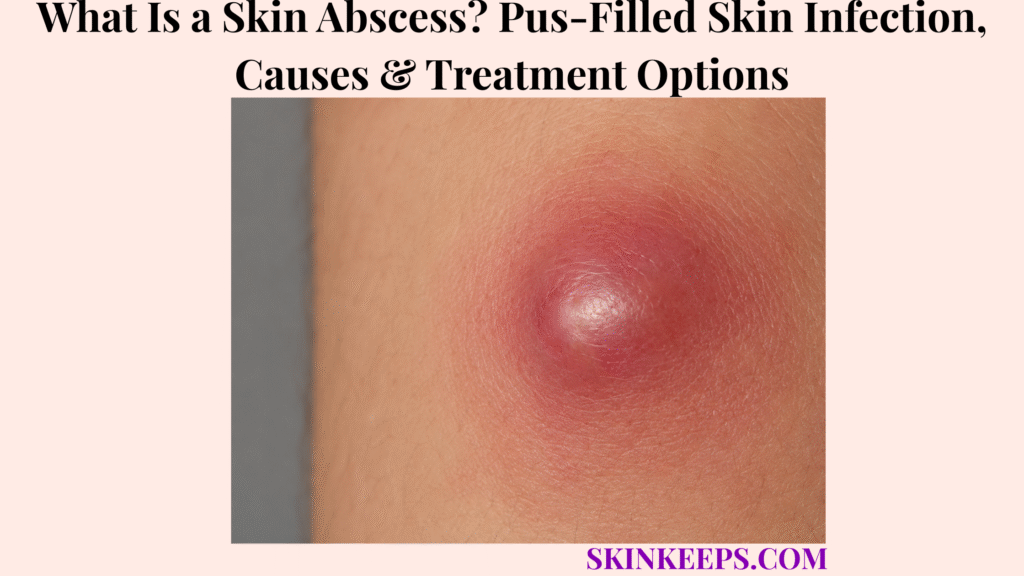
A skin abscess is a localized pocket of pus that forms within the skin or deeper soft tissue and usually creates a painful, swollen, warm and tender lump. As inflammatory cells and damaged tissue collect inside the cavity, pressure builds; the center may become soft or fluctuant and sometimes drains pus.
A true abscess is different from diffuse cellulitis or a ruptured epidermoid cyst, even though all three can look red and painful. When a drainable pus collection is present, evacuation is usually the central treatment step; antibiotics are added according to severity and patient risk, while recurrence or systemic spread changes the diagnostic and treatment plan.
This article is for educational purposes only. Rapidly worsening, recurrent, very painful or fever-associated skin abscesses should be medically evaluated.
What Is a Skin Abscess and What Does It Look and Feel Like?
A skin abscess is a localized cavity filled with pus that typically causes a raised, painful, warm and tender lump with surrounding inflammation.
How Does a Pus-Filled Skin Abscess Form?
A skin abscess forms when microorganisms and tissue injury trigger a local immune response that produces inflammatory cells, damaged tissue and pus inside a confined cavity.
The useful sequence is barrier disruption or local microbial entry → immune response → pus and tissue debris → cavity formation → rising pressure. Staphylococcus aureus is an important cause, but abscesses can contain other organisms depending on location and clinical context.
Why Does a Skin Abscess Become Painful and Swollen?
Skin-abscess pain and swelling develop because inflammation and accumulating pus stretch and irritate tissue around the cavity.
This can produce warmth, tenderness, throbbing, swelling and redness or another visible color change from the surrounding baseline skin. The intensity of color is not the defining feature; the localized painful swelling and evidence of a pus collection matter more.
What Are the Typical Signs of a Skin Abscess?
Typical skin abscesses are painful raised lumps that may feel softer or fluctuant in the center and may contain or release visible pus.
Some lesions have surrounding firmness or inflammation, a small pustular point or spontaneous drainage, while others are deeper and do not show obvious pus at the surface. Not every feature is present in every abscess, so a painful red lump should not be self-labeled from appearance alone.
Can a Skin Abscess Burst or Drain on Its Own?
Yes; some skin abscesses open and release pus spontaneously, but spontaneous drainage does not prove that the cavity has emptied completely or that no further treatment is needed.
Persistent swelling, pain, continued drainage, surrounding inflammation or systemic symptoms after spontaneous rupture can indicate that infection remains active or has extended beyond the original pocket.
Figure 1. A skin abscess behaves differently from a simple inflamed bump because pus is confined within a cavity, creating pressure as well as inflammation.
What Causes Skin Abscesses and Why Do Some Keep Coming Back?
Skin abscesses often develop after bacteria gain access through a disrupted skin barrier, while recurrent abscesses may reflect persistent organisms, repeated local injury, a local structural problem or another diagnosis.
How Does Staphylococcus aureus Cause Skin Abscesses?
Staphylococcus aureus is an important cause of skin abscesses because it can enter damaged skin, produce localized infection and contribute to a pus-filled inflammatory cavity.
The pathway is barrier break → bacterial entry → localized inflammation → pus accumulation. Because staphylococci can also colonize healthy skin or the nose without causing illness, the presence of a familiar skin bacterium does not by itself explain every recurrent lesion.
What Is the Role of MRSA in Skin Abscesses?
MRSA is an antibiotic-resistant form of S. aureus that can cause skin abscesses, but MRSA cannot be reliably identified from the way a lesion looks.
A fluctuant or draining lesion may be compatible with S. aureus, including MRSA, yet laboratory culture is what identifies the organism. Susceptibility testing can then help guide antibiotic selection when antibiotics are clinically needed.
How Can Skin Damage Increase Abscess Risk?
Cuts, abrasions, shaving injuries, scratching and puncture wounds can disrupt the skin barrier and create an entry route for bacteria.
Repeated friction or trauma can also keep the same area vulnerable. This is different from blaming abscesses on “poor hygiene”; recurrent disease deserves a search for the specific entry pathway, organism or local condition rather than a stigmatizing assumption.
Can Follicular Infection Develop Into a Skin Abscess?
Yes; infection beginning around a hair follicle can extend deeper and form a furuncle or small abscess.
More superficial folliculitis remains centered around the follicle, while a furuncle represents deeper follicular infection with a small abscess. Carbuncles are clusters of connected furuncles and belong to the same purulent spectrum without replacing the broader skin-abscess diagnosis.
Why Do Some Skin Abscesses Keep Coming Back?
Repeated skin abscesses should prompt reassessment for persistent bacterial colonization, repeated local injury, foreign material, a local anatomical problem or a different recurrent inflammatory disorder.
The useful sequence is verify that the lesion is truly an abscess → drain and culture when appropriate → look for a local source → reconsider the diagnosis if the same regions repeatedly develop boil-like lesions. Recurrent disease should not automatically be labeled antibiotic resistance or poor hygiene.
Figure 2. Recurrent abscesses are evaluated by confirming the lesion, identifying organisms when useful and looking for a local source or alternative diagnosis rather than assuming poor hygiene.
How Is a Skin Abscess Diagnosed and Distinguished From Similar Skin Lumps?
A skin abscess is usually diagnosed from a painful, tender lesion with pus, drainage or fluctuance, but the key diagnostic task is distinguishing a true drainable cavity from inflamed cysts, cellulitis and other abscess-like disorders.
How Does a Clinician Diagnose a Skin Abscess?
A clinician evaluates the lesion’s location, pain, swelling, warmth, fluctuance, drainage and surrounding inflammation to determine whether a drainable abscess is present.
History and examination also establish severity: the clinician looks for systemic symptoms, multiple lesions, immune compromise, treatment failure and surrounding infection. When the central question remains “is there a fluid collection?”, bedside imaging may sometimes be used, but classic superficial abscesses are often recognized clinically.
When Is Pus Sent for Culture?
Abscess pus may be cultured to identify the organism and guide therapy, especially in recurrent, severe, complicated or treatment-resistant disease.
Culture is not an absolute prerequisite before every uncomplicated abscess is treated. Its value rises when the result could change antibiotic selection, when MRSA or another resistant organism is a concern, or when the same problem keeps returning.
How Is an Inflamed Epidermoid Cyst Different From a Skin Abscess?
An inflamed epidermoid cyst can become red, swollen and painful after rupture even when the dominant inflammation is caused by released keratin rather than a bacterial pus-filled infection.
An epidermal cyst is an enclosed keratin-containing structure; when its wall ruptures, keratin can trigger intense sterile inflammation. A true abscess is defined by a localized collection of pus, so the two conditions should not be treated as automatic synonyms.
How Is Cellulitis Different From a Skin Abscess?
Cellulitis is a spreading skin and soft-tissue infection that causes warmth, tenderness and inflammation without necessarily forming a localized drainable pus pocket.
That structural difference is why cellulitis and abscess management diverge: cellulitis is primarily a spreading tissue infection, whereas a drainable abscess has a focal cavity that may need to be evacuated. The two can also coexist around the same lesion.
What Other Conditions Can Resemble Recurrent Abscesses?
Repeated boil-like lesions in the same anatomical regions can signal another chronic follicular or inflammatory disorder rather than a series of unrelated skin abscesses.
Clusters in the armpits, groin, beneath the breasts or around the buttocks, especially with tunnels, scarring or repeated same-site drainage, should prompt reconsideration of the diagnosis. Recurrent disease may also reflect a pilonidal process, foreign material or another local structural source.
Figure 3. The central diagnostic fork is whether a localized pus pocket actually exists; diffuse cellulitis and ruptured cyst inflammation can look similar without representing the same structure.
How Is a Skin Abscess Treated?
A drainable skin abscess is usually treated by evacuating the pus, while antibiotics are added selectively according to severity, surrounding infection, systemic illness, immune status and treatment response.
Why Is Incision and Drainage Often the Main Treatment?
Incision and drainage address the central mechanical problem by opening a clinically confirmed abscess cavity, evacuating pus and debris and relieving pressure.
Antibiotics can treat susceptible bacteria, but they do not physically empty a closed pus cavity. This is why management of a true drainable abscess begins with deciding whether evacuation is needed rather than assuming that a prescription alone will solve every painful red lump.
Does Every Skin Abscess Need Antibiotics?
No; antibiotics are not automatically required for every uncomplicated drained abscess and are added according to systemic symptoms, surrounding cellulitis, host defenses, lesion burden and response to drainage.
Fever or systemic illness, extensive surrounding infection, multiple lesions, markedly impaired host defenses, poor response to initial management and other clinical risk factors can shift the balance toward adjunct antibiotic treatment. The decision belongs to the clinical context, not the redness of the lump alone.
When Are MRSA-Active Antibiotics Considered?
MRSA-active antibiotics may be considered when resistant S. aureus is confirmed or clinically important MRSA risk is present, particularly in severe, systemic, recurrent or poorly responding disease.
Because MRSA cannot be diagnosed from appearance, culture and susceptibility results are particularly useful when treatment has failed, disease is recurrent or the patient is seriously ill. Antibiotic choice, dose and duration should remain clinician-directed.
Can Warm Compresses Help a Small Purulent Lesion?
Warm moist compresses may help selected small boils or superficial purulent lesions drain, but they should not replace evaluation of a large, worsening, deep or very painful abscess.
This supportive approach is most appropriate at the small boil-like end of the spectrum. A clearly fluctuant cavity, major surrounding inflammation, fever, rapid progression or high-risk medical context requires assessment rather than repeated home attempts to “bring it to a head.”
Why Should a Skin Abscess Not Be Squeezed or Pierced?
Squeezing or piercing a skin abscess can traumatize surrounding tissue and potentially spread infection rather than safely emptying the cavity.
Disrupted or draining skin can also develop superficial bacterial crusting; impetigo is a different superficial infection pattern and should not be confused with the deeper localized pus cavity of an abscess. Home cutting, needle drainage or forceful expression is not a safe substitute for professional drainage.
Figure 4. Drainage is placed at the center of management for a true drainable abscess, while antibiotics, cultures and escalation are added according to severity, risk and response.
How Should a Skin Abscess Be Cared for After Drainage, and When Is Reassessment Urgent?
After drainage, the wound should be kept clean and appropriately covered while healing is monitored, and recurrent or systemically worsening infection should trigger further medical assessment.
How Should an Abscess Wound Be Protected After Drainage?
A drained abscess is generally protected with an appropriate clean dressing and clinician-directed wound care while drainage, pain and surrounding inflammation are monitored.
Avoid manipulating the wound, follow the specific post-procedure instructions provided and seek reassessment if drainage increases, pain worsens or surrounding inflammation spreads. Packing is not a universal requirement for every abscess, so aftercare should follow the actual procedure and wound characteristics.
How Can Spread to Other People Be Reduced?
Keeping draining wounds covered, washing hands after wound care and avoiding shared contaminated personal items can reduce transmission of organisms such as S. aureus.
Towels, razors and other items that contact drainage can transmit staphylococci, including MRSA. Transmission prevention is about containing wound drainage and hand contamination rather than assuming every household contact will develop an abscess.
What Should Be Done When Skin Abscesses Keep Returning?
Recurrent skin abscesses should be drained and cultured when appropriate and investigated for a persistent organism, local structural cause or alternative diagnosis.
A same-site recurrence should raise questions about foreign material, a pilonidal source or another local problem; repeated lesions in characteristic fold areas may point toward chronic inflammatory disease. The purpose of culture is to identify the organism when that result can guide targeted treatment—not to label every recurrence as MRSA.
Is MRSA Decolonization Needed After Every Abscess?
No; MRSA or S. aureus decolonization is not a routine requirement after every isolated skin abscess and may be considered selectively for recurrent staphylococcal infections.
Because decolonization strategies have context-dependent evidence and require coordinated household and skin measures, they should be clinician-directed rather than improvised from a generic recipe after one abscess.
When Does a Skin Abscess Need Prompt or Urgent Medical Care?
Prompt assessment is needed when a skin abscess rapidly enlarges, becomes increasingly painful, has spreading inflammation, fails treatment, repeatedly recurs or is accompanied by fever or systemic illness.
Fever, chills, marked weakness, low blood pressure, rapidly spreading swelling, severe pain or rapid systemic deterioration suggest that infection may no longer be confined to one localized pus pocket. Medically vulnerable patients and people with multiple lesions also deserve a lower threshold for reassessment.
Severe pain, rapidly progressive swelling or systemic toxicity out of proportion to a routine abscess warrants urgent evaluation for a deeper aggressive infection such as necrotizing fasciitis. A localized pus pocket is different from rapidly spreading tissue infection; worsening beyond the abscess changes the urgency.
What Should You Remember About Skin Abscesses?
A skin abscess is a localized pus collection, and the key management question is whether the lesion needs drainage rather than assuming antibiotics alone will resolve every painful red lump.
- A skin abscess is a localized collection of pus within skin or deeper soft tissue.
- Pain, tenderness, warmth and swelling are common; fluctuance can suggest a drainable cavity.
- Spontaneous drainage can occur but may be incomplete.
- Staphylococcus aureus is an important cause, and MRSA is one resistant form.
- MRSA cannot be diagnosed reliably from appearance alone.
- Skin-barrier damage and deeper follicular infection can provide entry pathways.
- Recurrent abscesses should not automatically be blamed on poor hygiene.
- Diagnosis is primarily clinical, with culture used selectively and more strongly in recurrent or complicated disease.
- An inflamed epidermoid cyst can mimic an abscess without representing the same pus-filled process.
- Cellulitis is spreading skin infection and may occur without a drainable cavity.
- Incision and drainage is central treatment for a clinically drainable abscess.
- Antibiotics are added according to systemic illness, surrounding infection, host risk, lesion burden and treatment response.
- Warm compresses are supportive only for selected small boil-like lesions.
- Squeezing, piercing and home cutting are unsafe substitutes for professional drainage.
- After drainage, the wound should be kept clean, covered as directed and monitored.
- Hand hygiene and covering drainage help reduce spread of staphylococci.
- Recurrent disease may require culture and evaluation for a local source or different diagnosis.
- Decolonization is selective, not automatic after every abscess.
- Fever, spreading inflammation, severe pain or systemic deterioration increase urgency.
Core pathway: Painful swollen lump → determine whether a pus cavity is present → drain when clinically indicated → add antibiotics according to risk → protect the wound → culture/reassess recurrence → urgently escalate spreading or systemic infection.
Frequently Asked Questions About Skin Abscesses
The main skin-abscess questions concern boils, spontaneous healing, antibiotics, recurrence and whether an abscess should be squeezed or popped.
Is a Skin Abscess the Same as a Boil?
A boil is a type of follicle-centered infection that forms a small abscess, while skin abscess is the broader term for a localized pus collection in the skin or soft tissue.
Can a Skin Abscess Heal Without Being Drained?
Some small lesions can drain or improve spontaneously, but larger or clearly drainable abscesses often require clinician-directed drainage.
Does Every Skin Abscess Need Antibiotics?
No; drainage is often the central treatment for a localized drainable abscess, while antibiotics are added according to severity, surrounding infection, systemic illness, host risk and treatment response.
Why Do Skin Abscesses Keep Coming Back?
Recurrent abscesses may reflect persistent bacteria, repeated skin injury, a local structural cause or another chronic inflammatory condition and therefore deserve reassessment.
Should You Squeeze or Pop a Skin Abscess?
No; squeezing or puncturing an abscess can damage tissue and spread infection and is not a safe substitute for medical drainage.
Which Sources Support This Skin Abscess Guidance?
Infectious Diseases Society of America — Skin and Soft Tissue Infection Guideline — Used for cutaneous-abscess definition, incision-and-drainage priority, selective culture, adjunct-antibiotic principles, inflamed epidermoid-cyst distinction, recurrent-abscess evaluation and selective decolonization.
CDC — Clinical Overview of MRSA — Used for MRSA skin-infection features, laboratory confirmation, culture/susceptibility guidance, drainage-centered MRSA skin-infection treatment and escalation context.
CDC — Preventing MRSA — Used for covering wounds, hand hygiene and avoiding shared contaminated personal items.
MedlinePlus — Skin Abscess — Used for pain, swelling, warmth, pus drainage, clinical diagnosis, spontaneous drainage, medical treatment and systemic-spread warnings.
American Academy of Dermatology — How to Treat Boils and Styes — Used for warm-compress support in selected boil-like lesions and the warning not to squeeze or pierce purulent lesions.