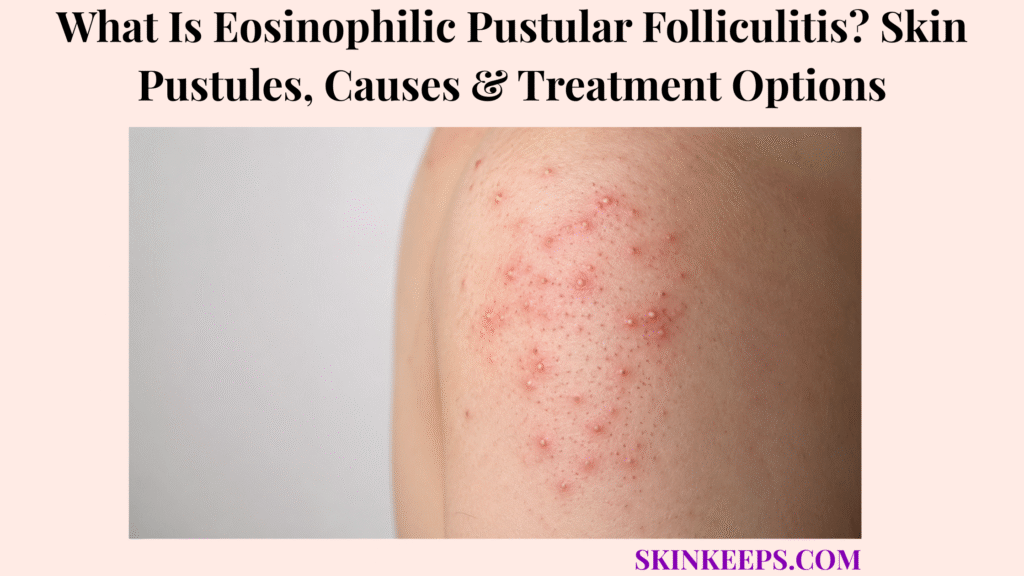
Eosinophilic pustular folliculitis is a rare recurrent inflammatory skin condition that causes itchy bumps and pustules around hair follicles.
It is also called eosinophilic folliculitis, EPF, EF, or Ofuji disease. EPF is not ordinary acne or bacterial folliculitis by default, so persistent itchy pustules often need dermatology review, infection rule-out, biopsy consideration, immune-context review, and subtype-led treatment.
What Is Eosinophilic Pustular Folliculitis and Why Does It Cause Skin Pustules?
Eosinophilic pustular folliculitis is a rare recurrent inflammatory skin condition that causes itchy bumps and pustules around hair follicles.
The condition centers on inflammation around hair follicles rather than ordinary bacterial pus infection in most cases.
Because acne, bacterial folliculitis, fungal folliculitis, scabies, medication reactions, and impetigo can look similar, EPF should not be self-diagnosed from bumps alone.
Why Do Eosinophils Matter in EPF?
Eosinophils matter in EPF because biopsy often shows these immune cells collecting around hair follicles and nearby sebaceous structures.
Eosinophils are immune cells involved in some allergic, inflammatory, and immune-response patterns.
EPF pustules are usually described as sterile or noninfectious, but bacterial, fungal, viral, and parasite-related mimics still need to be ruled out when the pattern is unclear.
Why Is EPF Also Called Ofuji Disease?
Ofuji disease is another name often used for classic eosinophilic pustular folliculitis.
Eosinophilic folliculitis is another common synonym, while infantile cases may also be called eosinophilic pustular folliculitis of infancy.
The names overlap, but not every EPF case is classic adult Ofuji disease because infantile and immunosuppression-associated variants have different workup and care needs.
Practical rule: Do not squeeze EPF-like pustules. Recurrent itchy pustules need diagnosis-led care, not repeated acne or antibiotic treatment without reassessment.
What Eosinophilic Pustular Folliculitis Symptoms Appear on Skin?
Eosinophilic pustular folliculitis usually causes itchy red, skin-colored, brown, purple-brown, or darker bumps and pustules that may come back in flares.
The bumps can look acne-like or folliculitis-like, which is why the pattern is often confusing at first.
What Do EPF Bumps and Pustules Look Like?
EPF bumps often look like itchy dome-shaped papules or small pustules around hair follicles.
They may appear in recurrent crops and may be scratched open because itch is often a major symptom.
Long-standing scratching can cause crusting, excoriations, thickened itchy skin, dark marks, or post-inflammatory hyperpigmentation, especially in darker skin tones.
What Symptoms Suggest Infection or Another Diagnosis?
Fever, painful spreading redness, warmth, worsening tenderness, abscesses, honey-colored crust, red streaking, swollen lymph nodes, blisters, ulcers, or severe illness suggest infection or another diagnosis rather than uncomplicated EPF.
A rash after a new medicine may also need medication-reaction review.
An infant with pustules plus fever, poor feeding, low energy, or widespread illness should be checked urgently rather than treated as harmless infant EPF.
| Symptom | EPF Clue | When to Check Urgently |
|---|---|---|
| Itchy papules | Common EPF feature. | Severe widespread itch with systemic symptoms. |
| Pustules | Follicular sterile pustules possible. | Painful pus, abscess, or fever. |
| Recurrent flares | EPF pattern. | Rapid spreading rash. |
| Acne-like bumps | Can mimic acne. | Treatment-resistant or unusual distribution. |
| Scratching marks | Itch-driven damage. | Infection signs. |
| Thickened itchy skin | Chronic rubbing or scratching. | Non-healing lesions. |
| Honey crust / warmth | Infection clue. | Same-day medical review. |
Where Does Eosinophilic Pustular Folliculitis Usually Appear?
Eosinophilic pustular folliculitis often appears on follicle-rich areas such as the face, scalp, neck, trunk, upper chest, back, and sometimes arms or legs.
Infantile EPF often favors the scalp, but infant pustules should still be evaluated carefully because infections and other infant pustular conditions can look similar.
Palms and soles can rarely show similar pustular lesions, but true folliculitis wording is limited because palms and soles do not have hair follicles.
| Site | EPF Clue | Mimic to Rule Out |
|---|---|---|
| Face | Itchy dome-shaped papules or pustules. | Acne, rosacea, drug eruption. |
| Scalp | Recurrent itchy pustules; infantile subtype may favor scalp. | Bacterial folliculitis, tinea, impetigo. |
| Neck | Itchy follicular papules. | Folliculitis, shaving irritation, contact dermatitis. |
| Upper chest | Itchy follicular bumps. | Malassezia folliculitis, acne. |
| Back | Recurrent follicular pustules. | Acne, fungal folliculitis. |
| Shoulders | Acne-like recurrent bumps. | Acneiform drug eruption. |
| Arms / legs | Less classic but possible. | Folliculitis, eczema, scabies, drug rash. |
What Types of Eosinophilic Pustular Folliculitis Are Important to Know?
EPF has different subtypes, and the subtype matters because causes, prognosis, workup, and treatment choices are not the same for infants, healthy adults, and immunosuppressed patients.
Using the same treatment plan for every EPF-like rash can delay care, especially when an infant, transplant patient, cancer patient, or immune-suppressed person is involved.
| EPF Type | Typical Context | Key Care Implication |
|---|---|---|
| Classic adult EPF | Recurrent itchy follicular papules/pustules. | Dermatology diagnosis; indomethacin often considered. |
| Infantile EPF | Babies or young children, often scalp. | Usually benign/self-limited, but infection must be ruled out. |
| HIV-associated EPF | Advanced HIV or immune-suppression context. | HIV care, ART, and immune recovery may matter. |
| Transplant/immunosuppression-associated EPF | After transplant or immune suppression. | Review immune status and medications. |
| Cancer-associated EPF | Hematologic or other cancer contexts. | Coordinate with oncology/dermatology. |
| Medication-associated EPF | After certain medicine exposures. | Medication timeline review. |
What Causes Eosinophilic Pustular Folliculitis?
The exact cause of eosinophilic pustular folliculitis is not fully known, but immune dysregulation, eosinophilic inflammation, microbiome factors, medications, and immunosuppression may play roles.
The cause may differ by subtype, which is why classic adult EPF, infantile EPF, HIV-associated EPF, transplant-associated EPF, cancer-associated EPF, and medication-associated EPF should not be treated as one identical disease pattern.
Why Is EPF Considered Inflammatory Rather Than Ordinary Infection?
EPF is considered inflammatory because eosinophils collect around follicles and the pustules are usually sterile rather than driven by ordinary bacterial infection.
Antibiotics alone may not fix EPF if bacteria are not the driver.
Infection mimics still need to be ruled out through exam, culture, fungal testing, or biopsy when the rash is unclear.
How Does Immune Suppression Fit?
Immune suppression matters because EPF can appear in HIV, transplant, cancer, or other immune-altered contexts.
Immune-context review should be medical, respectful, and based on the person’s history, symptoms, risk context, and consent.
EPF should not be used as a stigmatizing label or as an automatic assumption about HIV status.
Can Medications Trigger EPF?
Medication-associated EPF has been reported, so a medication timeline matters when itchy follicular pustules start after a new or changed medicine.
A medication timeline can help separate EPF from drug rash, acneiform eruption, bacterial folliculitis, or fungal folliculitis.
Do not stop essential medicines without prescriber guidance unless emergency symptoms require urgent care.
| Cause / Context | How It May Relate | Care Implication |
|---|---|---|
| Unknown immune trigger | Eosinophilic follicular inflammation. | Biopsy/dermatology workup. |
| HIV / immunodeficiency | Immune dysregulation. | Immune-status review when appropriate. |
| Transplant / immunosuppression | Altered immune function. | Coordinate care. |
| Infancy | Benign recurrent infant subtype. | Rule out infection first. |
| Medication | Timeline-linked eruption. | Medication review. |
| Microbiome theories | Malassezia/Demodex proposed in some cases. | Avoid assuming infection without evidence. |
Who Is More Likely to Get Eosinophilic Pustular Folliculitis?
EPF can affect infants, otherwise healthy adults, and people with immune suppression, but the pattern and workup depend on the patient context.
Risk context is not a diagnosis. It helps decide whether dermatology, biopsy, culture, KOH testing, medication review, immune evaluation, oncology coordination, or infant safety review is needed.
- Infant with recurrent scalp or face pustules.
- Adult with recurrent intensely itchy follicular pustules.
- Acne-like rash without typical comedones.
- Folliculitis not responding as expected to antibiotics.
- HIV or immune-suppression context, when clinically relevant.
- Transplant or bone marrow transplant history.
- Cancer or hematologic disease context.
- New medication or dose-change timeline.
- Recurrent flares with scratching marks or dark marks.
How Is Eosinophilic Pustular Folliculitis Different From Other Pustular Skin Conditions?
EPF can look like acne, bacterial folliculitis, Malassezia folliculitis, rosacea, scabies, impetigo, drug rash, or eczema with scratching, so diagnosis should match pattern, itch, recurrence, and test results.
This matters because acne-only care, repeated antibiotics, antifungal treatment, or strong topical steroids can miss the real diagnosis if the rash is recurrent or unusual.
How Is EPF Different From Acne?
Acne often includes comedones such as blackheads and whiteheads, while EPF is usually more itch-driven, recurrent, and follicular.
EPF may look acne-like, but it may lack classic comedones and may not respond as expected to acne therapy.
Adult acne-like follicular pustules that persist or itch intensely need review.
How Is EPF Different From Bacterial Folliculitis?
Bacterial folliculitis is driven by infection, while EPF is typically eosinophil-rich and often sterile.
Bacterial folliculitis may be tender, warm, crusted, or culture-positive.
Culture or biopsy may be needed when follicular pustules are persistent, infected-looking, or unclear.
How Is EPF Different From Fungal or Malassezia Folliculitis?
Malassezia folliculitis can cause itchy uniform follicular papules or pustules on the chest and back, while EPF biopsy shows eosinophilic inflammation around follicles.
KOH testing, fungal evaluation, or treatment response may help separate fungal folliculitis from EPF.
Do not assume “fungal” or “eosinophilic” without testing if the pattern is unclear.
How Is EPF Different From Scabies?
Scabies often causes night-worse itch and household-contact itching, while EPF is a follicular eosinophilic disorder rather than a mite infestation.
Burrows may appear in finger webs, wrists, waistline, or genital areas.
Severe itch alone is not enough to diagnose EPF.
How Is EPF Different From Drug Rash or Acneiform Eruption?
Drug rash or acneiform eruption often follows a medication timeline, while EPF may need biopsy to confirm eosinophil-rich follicular inflammation.
Medication-associated EPF can also occur, so the timeline still matters.
Essential medicines should not be stopped without prescriber guidance.
| Condition | Main Clue | Why Confusion Happens | Safer Next Step |
|---|---|---|---|
| EPF | Itchy recurrent follicular papules/pustules. | Looks acne-like. | Biopsy if persistent or unclear. |
| Acne | Comedones and acne pattern. | Pustules overlap. | Check comedones and response. |
| Bacterial folliculitis | Tender pustules or culture-positive infection. | Follicular pustules overlap. | Culture if infected-looking. |
| Malassezia folliculitis | Uniform itchy chest/back bumps. | Itch and follicles overlap. | KOH or antifungal review. |
| Scabies | Night itch plus contacts. | Severe itch overlap. | Check burrows and contacts. |
| Drug eruption | New medicine timeline. | Pustular/acneiform overlap. | Medication history. |
| Impetigo | Honey crust, pus, contagious infection. | Crusted pustules. | Bacterial treatment if confirmed. |
Honey-colored crust, spreading pus, or contagious crusted sores may fit impetigo or another bacterial infection rather than uncomplicated EPF.
Long-standing itch with scratching, thickening, and inflammation can resemble dermatitis or eczema, especially if there are product, friction, or contact triggers.
How Is Eosinophilic Pustular Folliculitis Diagnosed?
Eosinophilic pustular folliculitis is diagnosed by combining skin examination, rash pattern, medical history, immune-context review, and often a skin biopsy that shows eosinophils around hair follicles.
The diagnosis is usually strongest when recurrent itchy follicular pustules match biopsy findings and more common mimics have been ruled out.
What Does a Dermatologist Check?
A dermatologist checks whether the bumps are follicular, itchy, recurrent, and distributed in a pattern that fits EPF or a more common mimic.
The review may include face, scalp, neck, trunk, chest, and back distribution; itch severity; recurrent flare pattern; acne treatments tried; antibiotic or antifungal response; medication timeline; immune context; infant wellness; scratching; crusting; and infection signs.
Palms and soles should be described carefully because they lack hair follicles, even if similar pustular lesions appear there.
What Tests May Be Needed?
Tests may be needed when pustules are recurrent, unusual, treatment-resistant, infected-looking, or linked with immune suppression.
Testing may include skin biopsy, CBC with eosinophil count, IgE or immune labs in selected cases, bacterial culture, KOH scraping, fungal culture, medication review, and immune evaluation when clinically appropriate and consented.
Biopsy can help separate EPF from acneiform eruptions, bacterial folliculitis, fungal folliculitis, scabies, drug rash, and other dermatoses.
- Photos of active bumps or pustules before scratching.
- Date the rash first started.
- Body sites affected: face, scalp, neck, chest, back, trunk, arms, or legs.
- Itch severity and sleep disruption.
- Whether pustules come in recurrent crops.
- Acne treatments tried and response.
- Antibiotics or antifungals tried and response.
- Fever, warmth, painful redness, swelling, pus, crust, abscess, or red streaking.
- Medication changes or new medicines.
- HIV, immune suppression, transplant, or cancer history when clinically relevant.
- Infant age, feeding, fever, and general wellness if a baby is affected.
- Scratching marks, dark marks, scarring, or thickened itchy skin.
- Prior biopsy, culture, KOH, blood tests, or dermatologist notes.
What Treatment Options Help Eosinophilic Pustular Folliculitis?
EPF treatment depends on subtype and severity, and options may include topical anti-inflammatory treatment, indomethacin, antihistamines, phototherapy, immune-context treatment, or selected systemic medicines.
Treatment should be dermatologist-led when EPF is recurrent, biopsy-supported, treatment-resistant, infant-related, immune-context-related, or linked with systemic illness.
How Are Symptoms Controlled First?
Symptom control often starts with reducing itch and inflammation while avoiding scratching, squeezing, and unnecessary antibiotics.
Topical corticosteroids may reduce inflammation and itch when prescribed for the correct diagnosis.
Oral antihistamines, gentle skin care, cool compresses, and infection treatment only when infection is present may be used in selected cases.
When Is Indomethacin Considered?
Indomethacin is often discussed for classic adult EPF, but it is not suitable for everyone and must be clinician-directed.
Gastrointestinal, kidney, cardiovascular, bleeding-risk, pregnancy, allergy, and medication-interaction issues matter.
Do not start indomethacin without medical safety review.
How Is HIV-Associated EPF Treated?
HIV-associated EPF is managed by coordinating dermatology care with HIV care, because immune recovery can be central to improvement.
Effective antiretroviral therapy and immune-care coordination may be part of management when HIV-associated EPF is present.
Symptom treatments may be added, but the wording should stay respectful and should not imply that every EPF case is HIV-associated.
What Other Treatments May Be Used in Selected Cases?
Other treatments may be used in selected EPF cases when subtype, severity, safety, pregnancy status, immune status, and comorbidities support them.
Options described in specialist literature include dapsone, tetracycline-class medicines, metronidazole, itraconazole, phototherapy, topical calcineurin inhibitors, colchicine, retinoids such as isotretinoin or acitretin, and selected reports of permethrin use in HIV-associated cases.
These are not one-size-fits-all treatments and should not be started without diagnosis and clinician safety review.
| EPF Situation | Treatment Direction | Key Caution |
|---|---|---|
| Mild itch/inflammation | Topical steroid + itch care. | Confirm diagnosis if recurrent. |
| Classic adult EPF | Indomethacin often considered. | NSAID safety screening. |
| HIV-associated EPF | ART/immune recovery + symptom care. | Coordinate HIV care. |
| Infantile EPF | Usually conservative/symptom-led. | Rule out infection first. |
| Treatment-resistant EPF | Phototherapy/systemic options. | Dermatologist-led. |
| Infected-looking lesions | Culture/treat infection if present. | Not routine antibiotics. |
How Should Skin Be Cared for During EPF Flares?
During EPF flares, skin care should reduce itching, prevent scratching injury, and avoid unnecessary acne or antibiotic treatments until the diagnosis is clear.
Simple care can reduce secondary irritation, but it does not replace diagnosis when the rash is recurrent, unusual, or treatment-resistant.
- Use gentle cleanser.
- Avoid harsh scrubs.
- Do not squeeze pustules.
- Keep nails short.
- Use cool compresses for itch comfort.
- Use prescribed anti-inflammatory medicine as directed.
- Avoid heavy occlusive products if they worsen follicular bumps.
- Photograph flares before scratching.
- Watch for warmth, painful redness, pus, crust, fever, or red streaking.
- Follow up if pustules keep returning.
Can Eosinophilic Pustular Folliculitis Come Back?
EPF often comes back in flares, so long-term control may require subtype-specific treatment, trigger review, and follow-up rather than one short course of antibiotics.
Itch can drive scratching, dark marks, crusting, and chronic thickening.
Infantile EPF is usually benign and self-limited, while adult or immune-context EPF may need longer dermatologist-led management.
What Eosinophilic Pustular Folliculitis Mistakes Should You Avoid?
The biggest EPF mistake is treating recurrent itchy pustules as ordinary acne or bacterial folliculitis for months without confirming the diagnosis.
Do not keep repeating antibiotics if cultures are negative or the rash keeps returning, and do not squeeze pustules.
Do not ignore infant illness, immune suppression, transplant history, cancer context, medication timing, systemic symptoms, or the need for biopsy when a rash is unusual or treatment-resistant.
| Mistake | Why It Fails | Better Action |
|---|---|---|
| Treating as acne only | EPF may lack acne cause. | Check recurrence, itch, and biopsy need. |
| Repeating antibiotics blindly | EPF is often sterile. | Culture or biopsy if persistent. |
| Squeezing pustules | Scarring/infection risk. | Gentle care and itch control. |
| Ignoring immune context | Misses subtype. | Review history/testing when appropriate. |
| No biopsy for chronic rash | Delays diagnosis. | Dermatology workup. |
| Overusing steroids | Side effects or masks infection. | Diagnosis-led treatment. |
When Should Eosinophilic Pustular Folliculitis Be Checked by a Doctor?
Eosinophilic pustular folliculitis-like pustules should be checked when they are recurrent, intensely itchy, treatment-resistant, widespread, infected-looking, linked with immune suppression, or occurring in an infant.
Health context should be mentioned when pustules occur with immune suppression, transplant history, cancer treatment, new medication timing, or systemic symptoms.
Seek medical review if pustules are:
- Recurrent.
- Intensely itchy.
- Acne-like but not responding to acne treatment.
- Folliculitis-like but not responding to antibiotics.
- On an infant’s scalp or face.
- Widespread.
- Painful, warm, swollen, or pus-filled.
- Linked with fever, red streaking, crust, or open sores.
- Leaving dark marks or scarring.
- Linked with new medication timing.
- Present with immune suppression, HIV context, transplant history, cancer treatment, or systemic symptoms.
What Should You Remember About Eosinophilic Pustular Folliculitis?
Eosinophilic pustular folliculitis is a rare recurrent inflammatory follicular disorder, so diagnosis should confirm eosinophilic inflammation and rule out more common infections or acne-like conditions.
The safest plan is biopsy-aware, subtype-led, and respectful of immune context without making automatic assumptions.
- EPF is also called eosinophilic folliculitis or Ofuji disease.
- It causes itchy papules and pustules.
- It can resemble acne or ordinary folliculitis.
- It is often sterile/noninfectious and eosinophil-rich.
- Major variants include classic adult, infantile, and immunosuppression-associated EPF.
- Biopsy can show eosinophils around follicles.
- Blood eosinophils and immune context may be reviewed.
- Treatment depends on subtype and may include topical steroids, indomethacin, antihistamines, phototherapy, ART in HIV-associated cases, or other specialist therapies.
- Recurrent or treatment-resistant pustules need dermatology review.
- Do not squeeze pustules.
- Seek care for fever, pain, spreading redness, infant illness, immune suppression, or systemic symptoms.
Frequently Asked Questions About Eosinophilic Pustular Folliculitis
Is eosinophilic pustular folliculitis an infection?
EPF is usually considered a sterile inflammatory follicular disorder, not ordinary bacterial folliculitis, although infection-like mimics still need to be ruled out.
What does eosinophilic pustular folliculitis look like?
It often looks like itchy dome-shaped papules and pustules on follicle-rich areas such as the face, scalp, neck, and trunk. It can resemble acne or other folliculitis.
What causes eosinophilic pustular folliculitis?
The cause is not fully known. Immune dysregulation, eosinophilic inflammation, HIV or other immune suppression, transplant context, medication timing, and possible microbiome factors may play roles.
How is EPF diagnosed?
Diagnosis may include clinical exam, rash pattern review, biopsy showing eosinophils around follicles or sebaceous structures, blood eosinophil review in selected cases, and tests to rule out bacterial or fungal folliculitis.
Is EPF linked to HIV?
One subtype is associated with advanced HIV or immune suppression, but EPF can also occur in infants, otherwise healthy adults, transplant patients, cancer-associated contexts, and medication-associated cases.
What is the best treatment for eosinophilic pustular folliculitis?
Treatment depends on subtype and may include topical anti-inflammatory treatment, indomethacin for classic adult EPF when safe, ART and immune-care coordination for HIV-associated EPF, antihistamines, phototherapy, dapsone, retinoids, or other dermatologist-led options. There is no single best treatment for every case.
Can babies get eosinophilic pustular folliculitis?
Yes. Infantile EPF is rare and can cause recurrent sterile itchy pustules, often on the scalp, but infection and other infant pustular diseases still need medical rule-out.
When should EPF-like pustules be checked urgently?
Pustules should be checked urgently for fever, spreading painful redness, warmth, pus, abscesses, red streaks, infant illness, immune suppression, transplant or cancer context, severe widespread rash, or recurrent treatment-resistant pustules.
Sources & Evidence About Eosinophilic Pustular Folliculitis
DermNet — Eosinophilic Pustular Folliculitis was used for EPF definition, synonyms including eosinophilic folliculitis and Ofuji disease, clinical features, biopsy findings, variants, immune-context framing, blood-test context, and treatment options.
StatPearls / NCBI Bookshelf — Eosinophilic Pustular Folliculitis was used for EPF subtypes, noninfectious pruritic pustular eruption framing, unknown etiology, histopathology, initial topical steroid symptom framing, and indomethacin consideration for classic EPF.
DermNet — Eosinophilic Pustular Folliculitis of Infancy was used for infantile EPF as a rare, pruritic, benign, recurrent, sterile inflammatory disease that often favors the scalp and usually resolves spontaneously in early childhood.
NCBI Bookshelf — Guidelines on HIV-Associated Skin and Oral Conditions was used for HIV-associated eosinophilic folliculitis management, ART as primary treatment in eligible patients, and selected adjunct treatment context.
PubMed — Eosinophilic Pustular Folliculitis: A Comprehensive Review of Treatment Options was used for EPF/Ofuji disease as follicular papules or pustules, variant categories, and the broad range of treatments described in the literature.
DermNet — Eosinophilic Pustular Folliculitis Pathology was used for pathology context, including eosinophilic pustulosis involving the follicular region and the heterogeneous subtype framework.
Educational Disclaimer: This SkinKeeps article is for educational purposes only and does not diagnose or replace medical care. Recurrent, intensely itchy, acne-like, folliculitis-like, scalp-related, face-related, neck-related, trunk-related, infant-related, immune-suppression-related, HIV-context-related, transplant-related, cancer-treatment-related, medication-associated, painful, warm, swollen, pus-filled, crusted, abscess-like, red-streaked, fever-associated, widespread, treatment-resistant, scarring, dark-mark-forming, or unclear pustules should be checked by a qualified healthcare professional or dermatologist. Seek urgent care for fever, rapidly spreading painful redness, red streaks, abscesses, severe illness, infant illness, or pustules in an immune-suppressed person. Do not squeeze pustules, repeatedly use antibiotics, stop essential medicines, start indomethacin, use systemic treatments, or assume HIV, infection, acne, or EPF without appropriate medical evaluation.