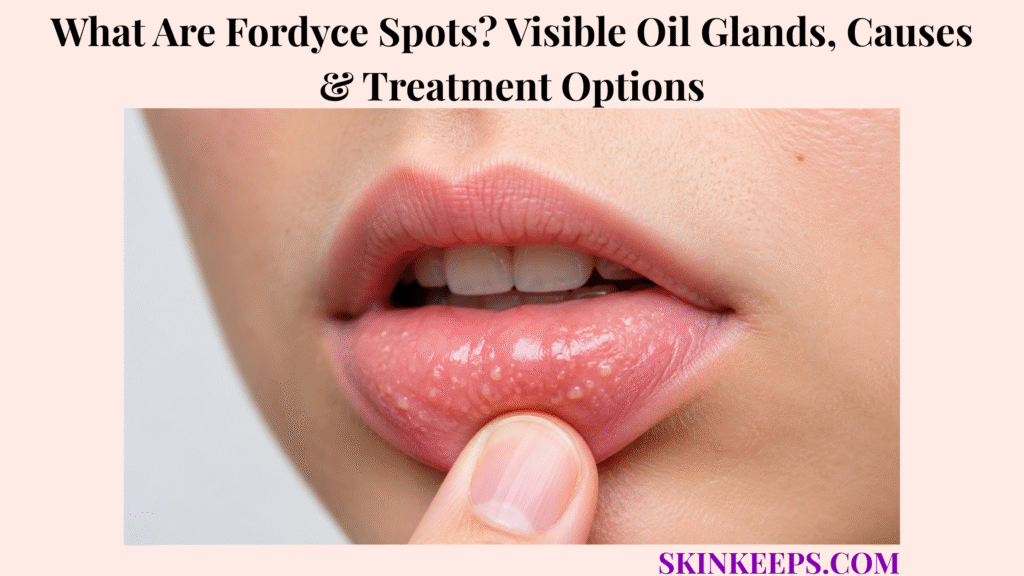
Fordyce spots are visible sebaceous, or oil-producing, glands that appear on thin or hairless areas such as the lips, inside the mouth, or genital skin. They are a harmless normal anatomical variation.
They are not an infection, skin disease, or STI and are not caused by sex or poor hygiene. This page explains appearance, locations, anatomy, myths, lookalikes, diagnosis, optional cosmetic treatment, unsafe removal, and warning signs.
How Can You Recognize Fordyce Spots?
Fordyce spots usually look like tiny smooth white, cream, yellow, pale-red, or skin-coloured spots on thin or hairless skin.
They may be flat or slightly raised and can occur as individual spots, small groups, or larger clusters. Stretching the surrounding tissue often makes them easier to see.
Typical Fordyce spots are usually stable and painless. Blistering, ulceration, bleeding, discharge, a rough surface, rapid growth, or severe itching suggests another diagnosis.
- Tiny white, cream, yellow, pale-red, or skin-coloured spots.
- Flat or slightly raised smooth papules.
- Scattered spots, small groups, or clusters.
- More visible when thin skin is stretched.
- Usually no pain, blister, ulcer, discharge, or bleeding.
- Lip, mouth, penile, scrotal, vulvar, or labial location.
- Clinical review when the pattern is new, changing, rough, painful, or uncertain.
Figure 1. Fordyce spots are usually tiny smooth pale or yellowish glands that become easier to see when thin skin is stretched.
Where Do Fordyce Spots Commonly Appear?
Fordyce spots commonly appear on the vermilion border of the lips, inside the cheeks, oral mucosa, penis, scrotum, vulva, and labia.
Thin mucosal or genital tissue can make sebaceous glands easier to see. Penile spots may appear on the shaft or glans area, while vulvar spots may involve the labia.
Location alone does not confirm the diagnosis. Sudden genital bumps, painful sores, rough growths, or changing lesions need assessment before being labelled Fordyce spots.
| Location | Typical Appearance | Important Boundary |
|---|---|---|
| Lip border | Tiny pale or yellow smooth spots. | Painful blisters or crusted sores may fit another condition. |
| Inner cheek or oral mucosa | Small pale clustered granules. | Ulcer, lump, bleeding, or persistent swelling needs review. |
| Penis or scrotum | Smooth pale or skin-coloured glands. | Warts, herpes, molluscum, PPP, and angiokeratomas can look different. |
| Vulva or labia | Small smooth pale/yellow spots. | New rough, blistering, ulcerated, or changing lesions need examination. |
Why Do Fordyce Spots Become Visible?
Fordyce spots become visible because some sebaceous glands open directly onto the skin or mucosal surface instead of connecting to a hair follicle.
Sebaceous glands produce sebum, an oily substance that helps lubricate skin. Most sebaceous glands drain through a hair follicle, but Fordyce glands sit without an associated follicle and can be seen through thin tissue.
They may be present earlier in life and often become more noticeable around puberty or adulthood as glands and hormones develop. Stretching the skin can also make them more obvious.
Figure 2. A typical sebaceous gland drains into a hair follicle, while a Fordyce gland opens directly onto the skin or mucosal surface and can appear as a pale spot.
What Causes Fordyce Spots—and What Does Not Cause Them?
Fordyce spots reflect normal sebaceous-gland anatomy, not infection, sexual exposure, poor hygiene, or contaminated contact.
Which Normal Factors Influence Fordyce Spot Visibility?
Natural gland anatomy, puberty, hormonal development, gland size, individual variation, and thin or stretched tissue influence how visible Fordyce spots appear.
Dryness or irritation around the area may make existing spots easier to notice, but it does not turn them into an infection.
Which Commonly Blamed Factors Do Not Cause Fordyce Spots?
Fordyce spots are not caused by poor hygiene, sexual activity, HPV, herpes, bacteria, fungus, towels, razors, or contact with another person.
| Suspected Cause | Accurate Explanation |
|---|---|
| Poor hygiene | Fordyce spots are normal glands, not dirt or inadequate washing. |
| Sexual activity | They are not caused by sex or recent exposure. |
| HPV | They are not genital warts. |
| Herpes | They are not viral blisters or sores. |
| Bacteria or fungus | They are not an infection. |
| Towels or skin contact | They do not spread through shared items or contact. |
| Partner transmission | No partner treatment is needed when the diagnosis is clear. |
Are Fordyce Spots Contagious or Sexually Transmitted?
Fordyce spots are not contagious, not sexually transmitted, and do not spread between partners.
They do not indicate infidelity, poor hygiene, recent sexual exposure, herpes, or HPV. Kissing, sexual contact, skin contact, and shared towels do not transmit normal oil glands.
Reassurance should not become overdiagnosis. New or changing genital bumps still need assessment when the appearance is uncertain.
Reassurance: Fordyce spots are harmless, noninfectious, nonsexual, not HPV, not herpes, and do not require partner treatment.
How Are Fordyce Spots Different From Similar Lip, Mouth, and Genital Bumps?
Fordyce spots can resemble other lip, oral, or genital lesions, so surface texture, pain, fluid, location, timing, and change pattern matter.
How Do Fordyce Spots Differ From Herpes?
Fordyce spots are usually smooth, stable, and painless, while herpes may cause painful blisters or sores. On the lips, cold sores can burn, sting, blister, crust, and recur in outbreaks.
How Do Fordyce Spots Differ From Genital Warts?
Fordyce spots are smooth visible oil glands, while HPV-related genital warts may be flat, raised, grouped, irregular, folded, or cauliflower-like and can change in size or number.
How Do Fordyce Spots Differ From Pearly Penile Papules?
Fordyce spots may occur on penile shaft or genital skin, while pearly penile papules usually form orderly rows around the corona or sulcus of the glans.
Both can be harmless normal variants, but they arise from different anatomy and should not be confused with warts.
How Do Fordyce Spots Differ From Molluscum, Milia, Acne, or Mucoceles?
Molluscum often has a central dimple; milia are keratin-filled cysts; acne can inflame, drain, or form comedones; and mucoceles are soft fluid-filled oral swellings.
Open blackheads indicate oxidised pore material rather than a visible Fordyce gland.
Which Conditions Should Not Be Confused With Fordyce Spots?
Fox-Fordyce disease is a separate sweat-gland disorder, while angiokeratoma of Fordyce is a separate vascular condition that may form darker red, blue, purple, or black papules.
| Condition | Surface or Look | Symptoms | Typical Location | Contagious? |
|---|---|---|---|---|
| Fordyce spots | Smooth pale or yellow glands. | Usually none. | Lips, mouth, genital skin. | No. |
| Herpes | Blisters or ulcers. | Pain, burning, sores. | Lips or genital area. | Yes. |
| Genital warts | Rough, folded, flat, raised, or cauliflower-like. | Often painless; may grow. | Genital or anal skin. | Yes, HPV-related. |
| Pearly penile papules | Orderly rows of dome or thread-like papules. | Usually none. | Corona or sulcus of glans. | No. |
| Molluscum | Dome papules with a central dimple. | Often mild or none. | Skin or genital region. | Yes. |
| Milia | Firm tiny white cysts. | Usually none. | Face more common. | No. |
| Acne | Inflamed pores, comedones, pustules. | May be tender. | Face and trunk. | No. |
| Mucocele | Soft oral swelling. | May fluctuate. | Inner lip or mouth. | No. |
How Are Fordyce Spots Diagnosed?
Fordyce spots are usually diagnosed by examining their colour, smooth surface, distribution, symptoms, and location.
A clinician may check whether the spots become clearer when skin is stretched and ask about pain, itching, blistering, ulceration, bleeding, discharge, roughness, sexual exposure, and recent change.
When Are Testing or Biopsy Considered?
Laboratory testing is usually unnecessary for typical Fordyce spots, and biopsy is rarely required.
STI testing or another investigation may be appropriate when herpes, HPV, syphilis, molluscum, or a different diagnosis is suspected. Persistent unusual oral or genital lesions may need dermatology, oral-medicine, or sexual-health assessment.
Figure 3. Stable smooth painless spots fit reassurance, while new, painful, blistering, ulcerated, bleeding, rough, changing, or uncertain lesions should be examined before treatment.
- When the spots appeared and whether they changed.
- Exact location: lips, inner cheek, mouth, penis, scrotum, vulva, or labia.
- Colour: pale, yellow, skin-coloured, red, purple, dark, or black.
- Surface: smooth, rough, blistered, ulcerated, crusted, or cauliflower-like.
- Pain, burning, itching, bleeding, discharge, swelling, or sores.
- Whether stretching the skin makes spots more visible.
- Any recent sexual exposure or STI concern.
- Products already tried, including acids, wart removers, acne creams, or household substances.
- Whether the main goal is reassurance, STI exclusion, or cosmetic treatment.
Do Fordyce Spots Require Treatment?
Typical Fordyce spots do not require treatment because they are benign, noninfectious visible oil glands.
They do not become cancerous and treatment does not prevent infection because no infection is present. Reassurance and observation are often the safest management.
Cosmetic treatment is optional and should depend on distress, site, expected benefit, healing pattern, and the possibility of irritation, pigment change, texture change, incomplete clearance, or scarring.
| Situation | Best Direction | Why |
|---|---|---|
| Typical painless stable spots | Reassurance or observation. | They are normal visible glands. |
| Uncertain genital bumps | Clinical examination. | STIs and normal variants can overlap visually. |
| Painful blisters or ulcers | Medical or sexual-health evaluation. | Not a typical Fordyce pattern. |
| Cosmetic distress | Discuss optional treatment. | Treatment is preference-based, not medically required. |
| Rough growing bumps | Professional assessment. | Wart or another diagnosis is possible. |
| Bleeding or discharge | Medical review. | Not typical of Fordyce spots. |
Which Treatments Can Reduce the Appearance of Fordyce Spots?
Fordyce spot treatments are cosmetic rather than medically necessary and should balance appearance goals against irritation, pigment change, texture alteration, incomplete clearance, and scarring.
Can Topical Treatments Make Fordyce Spots Less Visible?
A clinician may consider a topical retinoid in selected cases, but thin lip and genital tissue can become irritated easily.
Acne acids and strong exfoliants should not automatically be applied to oral or genital tissue. A topical response may be incomplete, and irritation can make the area more noticeable.
Which Procedures Can Remove or Reduce Fordyce Spots?
Dermatologist-directed procedures may include carbon dioxide laser, electrosurgery or electrodessication, micro-punch removal, or cryotherapy in selected cases.
These treatments remove or damage visible gland tissue but cannot guarantee flawless or permanent clearance. Untreated glands may remain visible, and recurrence or new visibility can occur.
| Option | Suitable Use | Expected Benefit | Main Limitation |
|---|---|---|---|
| Reassurance | Typical harmless spots. | Avoids unnecessary injury. | Spots remain visible. |
| Topical retinoid | Selected cosmetic cases. | May reduce visibility. | Irritation and incomplete response. |
| CO2 laser | Cosmetic reduction. | Targets visible glands. | Pigment, texture, and scar risk. |
| Electrosurgery | Selected raised spots. | Destructive removal. | Irritation and scarring risk. |
| Micro-punch | Selected individual glands. | Physical removal. | Procedure marks or scars. |
| Cryotherapy | Selected settings. | Freezing effect. | Pigment change and irritation. |
Which Fordyce Spot Removal Methods Should Be Avoided?
Fordyce spots should not be squeezed, popped, cut, scraped, pierced, burned, frozen, or treated with wart acids at home.
Squeezing may release a little sebum but does not remove the gland. Injury to lip or genital tissue can cause inflammation, bleeding, infection, pigment change, scarring, and delayed diagnosis of a different condition.
| Method | Why It Fails | Possible Harm | Safer Action |
|---|---|---|---|
| Squeezing or popping | The gland remains. | Irritation and inflammation. | Leave alone or seek advice. |
| Needle piercing | Does not confirm diagnosis. | Infection, bleeding, or scarring. | Clinical examination. |
| Cutting or scraping | Creates tissue injury. | Scars and pigment change. | Clinician procedure only when justified. |
| Wart-removal acids | Wrong target if diagnosis is Fordyce spots. | Chemical burn. | Diagnose first. |
| Toothpaste or household products | Irritant exposure. | Burning or dermatitis. | Gentle care. |
| Herpes or wart medicine | Wrong therapy without diagnosis. | Delayed correct care. | Testing or examination when uncertain. |
Can Fordyce Spots Be Prevented?
Fordyce spots cannot be reliably prevented because they are part of natural sebaceous-gland anatomy.
More frequent washing does not remove the glands. Gentle cleansing and moisturising may reduce unrelated dryness or irritation around the spots, but no hygiene routine permanently cleans them out.
Prevention reality: Fordyce spots are normal oil glands. Gentle care can reduce surrounding irritation, while harsh removal products can make the area more noticeable or injured.
When Should Fordyce-Like Spots Be Checked by a Clinician?
Fordyce-like spots should be checked when they appear suddenly, change rapidly, hurt, blister, ulcerate, bleed, discharge, become rough, or cannot be confidently separated from herpes, warts, or another condition.
Cracks or sores at the mouth corners may fit angular cheilitis rather than Fordyce spots.
Seek medical or sexual-health evaluation for painful blisters, open sores, bleeding, discharge, rough or cauliflower-like growths, rapid change, possible STI exposure, dark or black papules, or major uncertainty about a genital or oral lesion.
- New or sudden appearance.
- Rapid change in size, colour, surface, or number.
- Pain, intense itching, or swelling.
- Blisters, ulcers, open sores, or crusting.
- Bleeding or discharge.
- Rough, folded, or cauliflower-like surface.
- Dark red, blue, purple, or black spots.
- Possible STI exposure.
- Difficulty distinguishing the lesion from herpes, warts, molluscum, ulcers, PPP, or another condition.
- Persistent anxiety or sexual distress despite observation.
What Should You Remember About Fordyce Spots?
Fordyce spots are visible oil glands, so most typical cases need reassurance rather than medical or STI treatment.
- Fordyce spots are visible sebaceous glands and a normal anatomical variation.
- They commonly appear on lips, inside the cheeks, oral mucosa, penis, scrotum, vulva, or labia.
- They are not caused by sex, poor hygiene, herpes, HPV, bacteria, or fungus.
- They are not contagious and do not require partner treatment.
- Typical spots are tiny, smooth, stable, and painless.
- Most cases need no treatment.
- Cosmetic treatment is optional and can cause irritation, pigment change, texture change, or scarring.
- New, painful, blistering, ulcerated, bleeding, rough, dark, discharge-producing, or changing lesions should be checked.
What Questions Do People Ask About Fordyce Spots?
Are Fordyce spots a normal part of the skin?
Yes. Fordyce spots are visible sebaceous glands and are considered a harmless normal anatomical variation rather than an infection or skin disease.
Are Fordyce spots an STI?
No. Fordyce spots are not sexually transmitted, not herpes, not HPV, and not caused by sexual activity. They are visible oil glands.
Can Fordyce spots spread to another person?
No. They are noninfectious and do not spread through kissing, sex, skin-to-skin contact, towels, razors, or shared objects.
Why do Fordyce spots become more visible during puberty?
Sebaceous glands may become larger or more noticeable with pubertal and hormonal development, while thin or stretched skin can make them easier to see.
Can Fordyce spots appear on both the lips and genitals?
Yes. They can appear along the lip border, inside the cheeks, on oral mucosa, penis, scrotum, vulva, or labia.
Can you squeeze or pop Fordyce spots?
No. Squeezing may release a little sebum but does not remove the gland and can cause irritation, inflammation, bleeding, infection, pigment change, or scarring.
Do Fordyce spots disappear naturally?
Their visibility may change over time, but they are normal glands and often remain visible. Treatment is usually unnecessary unless cosmetic distress is significant.
Can Fordyce spots become cancerous?
Typical Fordyce spots are benign and do not become cancer. A changing, bleeding, ulcerated, dark, or uncertain lesion should still be examined because it may not be a Fordyce spot.
How can Fordyce spots be removed safely?
Cosmetic reduction should be clinician-directed. Options may include a topical retinoid, carbon dioxide laser, electrosurgery, micro-punch removal, or cryotherapy in selected cases, but incomplete clearance, irritation, pigment change, texture change, and scarring are possible.
When should genital Fordyce-like spots be examined?
Seek examination for sudden appearance, pain, blisters, ulcers, bleeding, discharge, rough or cauliflower-like texture, rapid change, possible STI exposure, or uncertainty about herpes, warts, molluscum, or another genital condition.
Which Sources Support This Fordyce Spot Guidance?
Cleveland Clinic — Fordyce Spots — Harmless visible sebaceous glands, common sites, puberty visibility, non-STI reassurance, diagnosis, optional procedures, and squeezing warning.
DermNet — Fordyce Spots — Ectopic sebaceous-gland anatomy, 1–5 mm appearance, oral and genital locations, clinical diagnosis, and rare biopsy.
DermNet — Pearly Penile Papules — Orderly dome-shaped or thread-like papules around the corona or sulcus and separation from ectopic sebaceous glands.
Cleveland Clinic — Pearly Penile Papules — Harmless non-STI penile papules and genital-bump evaluation guidance.
CDC — Genital Herpes — Herpes as an STI that may form blisters and painful sores around genital, rectal, or oral sites.
CDC — Genital HPV Infection — Genital warts as small or grouped bumps that may be raised, flat, or cauliflower-shaped.
DermNet — Sebaceous Hyperplasia — Separate benign enlargement of sebaceous glands, usually on the forehead or cheeks.
PMC — Dermatoscopy of Nonvenereal Genital Dermatoses — Angiokeratoma of Fordyce as a separate bluish-black vascular papule condition.
This SkinKeeps article is for educational purposes only and does not diagnose or replace medical care. Lip, oral, penile, scrotal, vulvar, labial, or genital spots that are new, painful, intensely itchy, swollen, blistering, ulcerated, bleeding, discharge-producing, rough, crusted, cauliflower-like, rapidly changing, spreading, dark or black, STI-exposure-associated, anxiety-causing, or uncertain should be checked by a qualified healthcare professional. Seek medical or sexual-health evaluation if bumps could be herpes, genital warts, molluscum contagiosum, ulcers, mucoceles, pearly penile papules, vestibular papillae, angiokeratoma of Fordyce, or another condition. Do not diagnose genital or oral spots from photographs, pop or squeeze Fordyce spots, pierce them with needles, cut or scrape them, use wart-removal acids, apply toothpaste or harsh exfoliants, use herpes or wart medication without diagnosis, or treat normal oil glands as poor hygiene.