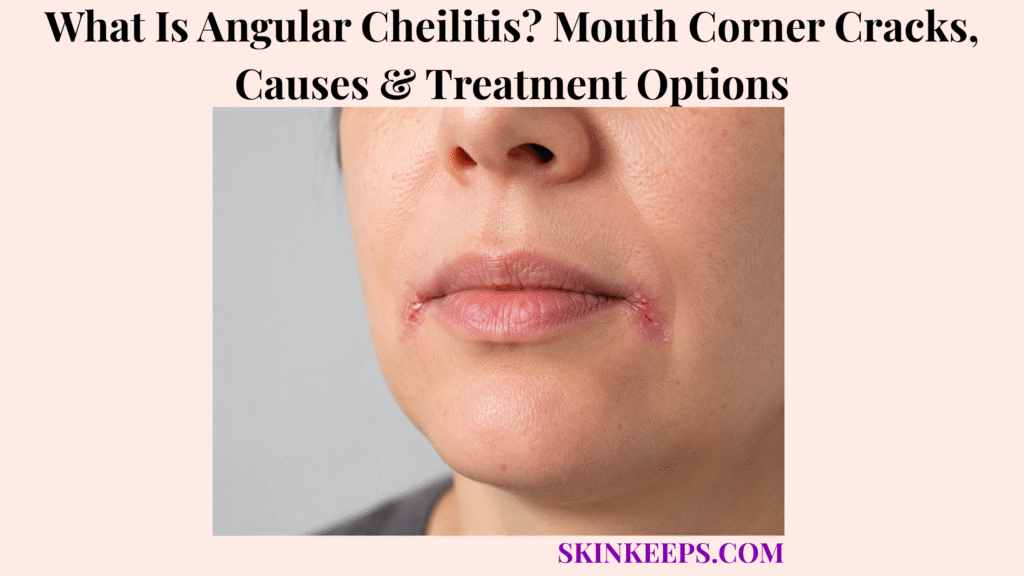
Angular cheilitis is inflammation at one or both corners of the mouth that can cause painful cracks, soreness, crusting, bleeding, swelling, or soggy-looking skin. It is more specific than ordinary dry lips because the problem centers on the mouth corners.
This page explains symptoms, location clues, causes, risk factors, diagnosis, treatment options, recurrence prevention, mistakes, and when medical or dental review is needed. It does not diagnose the reader or present one cream as the universal treatment.
What Is Angular Cheilitis and Why Do Mouth Corners Crack?
Angular cheilitis is inflammation at one or both mouth corners that can cause cracking, soreness, redness or darker discoloration, crusting, bleeding, or macerated skin.
The affected area is the labial commissure, which means the corner where the upper and lower lips meet. Moisture, friction, skin folds, microbes, dental factors, product irritation, and health factors can all contribute.
Why Does Angular Cheilitis Often Start at the Mouth Corners?
Angular cheilitis often starts at the mouth corners because saliva can collect in the creases, soften the skin, and make small fissures reopen during talking, eating, or yawning.
Maceration means skin softening from repeated moisture. Once mouth-corner skin becomes soft and fragile, mouth movement can split it again, and moist cracks can allow Candida or bacteria to persist.
Saliva is a major pathway, but it is not the only cause. Dentures, oral appliances, dry mouth, irritants, deficiencies, and infection can keep the cycle going.
Why Is Angular Cheilitis Not Just Ordinary Chapped Lips?
Angular cheilitis is not just ordinary chapped lips because it concentrates at the mouth corners and may stay moist, crusted, split, infected, or recurrent even when the rest of the lips are not severely dry.
Ordinary lip balm may not fix recurrent angular cheilitis if saliva pooling, Candida, bacteria, denture fit, toothpaste irritation, nutritional deficiency, or another contributor remains untreated.
| Feature | Angular Cheilitis | Ordinary Chapped Lips |
|---|---|---|
| Main location | Corners of the mouth | Wider lip surface |
| Moisture pattern | Often wet, soggy, macerated, or saliva-irritated | Often dry, flaky, tight, or weather-related |
| Cracking pattern | Fissures at one or both corners | Splitting can occur anywhere on the lip |
| Infection role | Candida or bacteria may contribute | Usually barrier dryness unless complicated |
| Recurrence clue | Dentures, lip licking, drooling, products, or deficiencies may keep it returning | Often improves when dryness triggers are corrected |
Practical rule: Recurrent mouth-corner cracks need cause-led care, not repeated balm alone.
What Angular Cheilitis Symptoms Appear at the Mouth Corners?
Angular cheilitis symptoms can include painful cracks, redness or darker discoloration, swelling, crusting, bleeding, blisters, burning, tenderness, and macerated or soggy-looking skin at the mouth corners.
The symptoms often worsen when the mouth opens wide during eating, speaking, brushing, yawning, or laughing. Spicy, salty, or acidic foods may sting because the fissured skin barrier is exposed.
What Does Mild Angular Cheilitis Look Like?
Mild angular cheilitis may look like a small crack, mild redness or discoloration, tightness, dryness, or burning at one mouth corner.
Early symptoms can reopen with mouth movement. Mild does not mean the cause should be ignored if the same corner keeps cracking or becomes painful.
What Does More Inflamed Angular Cheilitis Look Like?
More inflamed angular cheilitis can cause deeper fissures, crusting, bleeding, swelling, white soggy skin, or pain when opening the mouth.
Crusting, pus-like change, spreading redness, warmth, worsening tenderness, significant bleeding, or a non-healing one-sided lesion should be checked instead of repeatedly covered with random products.
| Mouth-Corner Sign | What It May Look or Feel Like | Why It Matters |
|---|---|---|
| Small crack | Thin split at one corner | Early fissure pattern |
| Maceration | White, soggy, softened skin | Suggests saliva moisture involvement |
| Crusting | Dried surface crust or scab | May reflect inflammation or infection |
| Bleeding | Crack bleeds when mouth opens | Needs care if recurrent or significant |
| Burning | Stinging with spicy, salty, or acidic foods | Common irritation symptom |
| Swelling | Puffy mouth-corner skin | May reflect stronger inflammation or infection |
| Deep fissure | Painful split in the corner crease | May persist if cause remains |
Where Does Angular Cheilitis Usually Appear?
Angular cheilitis appears at the labial commissures, the corners where the upper and lower lips meet, and it may affect one side or both sides.
The crack may sit inside the corner crease, just outside the corner, or along the adjacent lip edge. This location helps separate angular cheilitis from wider lip dryness, grouped blisters, chronic lower-lip sun damage, or product-contact rashes.
| Pattern | Possible Clue | What to Check |
|---|---|---|
| One mouth corner | Local irritation, product exposure, dental asymmetry, or localized infection | Duration, recurrence, bleeding, product contact, dental fit |
| Both mouth corners | Saliva pooling, dentures, oral appliances, lip licking, deficiency, or systemic contributor | Denture fit, drooling, dry mouth, recurrence, health context |
| Corner plus surrounding skin | Irritant/contact dermatitis or infection may extend outward | Toothpaste, lip balm, cosmetics, topical medicines, crusting |
What Causes Angular Cheilitis?
Angular cheilitis can be caused by saliva pooling, Candida yeast, bacteria, irritation, dental or denture issues, nutritional deficiency, medication effects, dry mouth, or underlying health conditions.
The cause is not always one thing. Moist cracked corners can begin with saliva irritation and then allow yeast, bacteria, or product irritation to keep inflammation active.
How Does Saliva Pooling Cause Angular Cheilitis?
Saliva pooling causes angular cheilitis by repeatedly wetting the mouth corners, softening the skin, and weakening the barrier until cracks and irritation persist.
Lip licking, drooling, mouth breathing, deep mouth-corner folds, poorly fitting dentures, braces, retainers, or other oral appliances can trap moisture. Licking often worsens the cycle because it adds more saliva and digestive enzymes to already fragile skin.
How Do Candida or Bacteria Contribute to Angular Cheilitis?
Candida or bacteria can contribute to angular cheilitis when cracked, moist mouth-corner skin allows microbes to overgrow or persist.
Candida albicans and Staphylococcus aureus are commonly discussed organisms in angular cheilitis. A historical microbial study of 64 patients cultured Candida albicans in 45 patients and Staphylococcus aureus in 40 patients, showing that mixed microbial involvement can occur.
Candida-related mouth-corner involvement can fit the broader pattern of cutaneous candidiasis in moist skin folds, but not every cracked mouth corner is fungal.
How Can Nutrition or Health Conditions Contribute to Angular Cheilitis?
Nutrition or health conditions can contribute to angular cheilitis when iron deficiency, B vitamin deficiency, diabetes risk, dry mouth, immune suppression, or poor wound healing keeps the corners inflamed.
Recurrent or unexplained cases deserve broader review instead of automatic supplements. Iron or B vitamin treatment should match confirmed or strongly suspected deficiency, and diabetes or immune factors should be assessed when the history supports it.
| Cause Category | Clue | Treatment Direction |
|---|---|---|
| Saliva pooling | Soggy white corners, lip licking, drooling, deep folds | Barrier ointment, moisture reduction, habit correction |
| Candida | Moist cracks, oral thrush context, dentures, immune risk | Antifungal treatment if suspected or confirmed |
| Bacteria | Crusting, pus-like change, worsening redness, tenderness | Antibacterial treatment if suspected or confirmed |
| Dentures / bite | Loose dentures, old dentures, deep mouth-corner folds | Dental review, denture adjustment, bite correction |
| Irritant/allergen | New toothpaste, lip balm, cosmetic, topical medicine | Stop trigger, consider contact dermatitis review |
| Deficiency / health factor | Recurrent, persistent, fatigue, dietary risk, systemic symptoms | Medical review and targeted testing |
Which Risk Factors Make Angular Cheilitis More Likely?
Angular cheilitis is more likely when moisture repeatedly collects at the mouth corners, when dentures or oral appliances alter the bite, or when skin healing is affected by deficiency, dry mouth, diabetes risk, or immune changes.
StatPearls reports angular cheilitis affects about 0.7% of the general American population. It also describes higher risk in older adults and denture wearers, with older-adult prevalence around 11% and denture-wearer prevalence reported up to 28%.
These numbers are context, not a personal diagnosis. The practical question is whether the cracks keep returning because saliva, oral appliances, dentures, irritants, deficiency, or health factors remain present.
- Saliva pooling at mouth corners.
- Frequent lip licking.
- Drooling or mouth breathing.
- Poorly fitting dentures.
- Braces, retainers, or oral appliances.
- Deep mouth-corner folds.
- Dry mouth.
- Pacifier or thumb-sucking in children.
- Iron or B vitamin deficiency risk.
- Diabetes risk or immune suppression.
- New toothpaste, lip balm, cosmetics, or topical medicines.
How Is Angular Cheilitis Different From Other Lip Problems?
Angular cheilitis is different from ordinary chapped lips, cold sores, allergic lip dermatitis, and actinic cheilitis because it mainly affects the mouth corners and often involves moisture-related cracking.
The location and lesion pattern matter. Mouth-corner fissures, grouped blisters, lower-lip sun damage, and product-contact eczema need different evaluation and treatment directions.
How Is Angular Cheilitis Different From Chapped Lips?
Angular cheilitis is different from chapped lips because angular cheilitis concentrates at the mouth corners, while chapped lips usually affect the broader lip surface.
Chapped lips often feel dry, flaky, or tight across the lips. Angular cheilitis may be wet, cracked, crusted, macerated, infected-looking, or recurrent at one or both corners.
How Is Angular Cheilitis Different From Cold Sores?
Angular cheilitis is different from cold sores because cold sores often start with tingling and grouped blisters, while angular cheilitis usually causes cracking and inflammation at the mouth corners.
Grouped blisters and tingling around the lip edge can point away from angular cheilitis and toward cold sores. A clinician should check uncertain, severe, recurrent, or spreading lesions.
How Is Angular Cheilitis Different From Actinic Cheilitis?
Angular cheilitis is different from actinic cheilitis because angular cheilitis affects the mouth corners, while actinic cheilitis usually reflects chronic sun damage on the lower lip.
Persistent lower-lip roughness, scale, white patches, or border blurring may fit actinic cheilitis rather than corner-only cracking.
| Condition | Main Location | Key Clue | Best Next Step |
|---|---|---|---|
| Angular cheilitis | One or both mouth corners | Cracks, maceration, crusting, soreness at commissures | Cause-led care and evaluation if recurrent |
| Chapped lips | Wider lip surface | Dryness, peeling, tightness across lips | Barrier care and dryness trigger correction |
| Cold sores | Lip border or nearby skin | Tingling, grouped blisters, recurrent outbreaks | Clinician review if uncertain or severe |
| Actinic cheilitis | Usually lower lip | Chronic sun-damaged scaling, roughness, border blurring | Dermatology evaluation |
| Allergic contact dermatitis | Product-contact areas around lips | Itchy, eczematous rash after toothpaste, balm, cosmetics, or medication | Stop suspected trigger and consider patch testing |
| Impetigo | Around mouth or nose | Honey-colored crusting, spreading bacterial infection signs | Medical evaluation |
How Is Angular Cheilitis Diagnosed or Checked?
Angular cheilitis is often recognized by examining the mouth corners, but recurrent, severe, infected-looking, or unclear cases may need swabs, dental review, medication review, or blood tests for underlying contributors.
Diagnosis should consider the visible corner pattern and the reason it keeps happening. Photos can help, but diagnosis should not depend only on a picture.
What Does a Clinician or Dentist Check With Angular Cheilitis?
A clinician or dentist checks angular cheilitis by looking at whether one or both corners are cracked, macerated, infected-looking, denture-related, product-triggered, or linked with oral symptoms.
The review may include mouth-corner moisture, denture fit, bite height, oral thrush signs, bacterial infection signs, lip licking, drooling, dry mouth, and product exposures such as toothpaste, lip balm, cosmetics, topical medicines, or dental products.
When Might Tests Be Useful for Angular Cheilitis?
Tests may be useful for angular cheilitis when cracks are recurrent, severe, infected-looking, treatment-resistant, linked with oral thrush, or possibly related to deficiency or allergic contact dermatitis.
A swab or culture may be used when Candida or bacteria are suspected. Blood tests may be considered for iron or B vitamin deficiency when the pattern is recurrent or unexplained.
Patch testing may be considered if allergic contact dermatitis is suspected from toothpaste, lip balm, cosmetics, topical medicines, or dental materials.
- When did the mouth-corner crack start?
- Is it one-sided or both-sided?
- Does it recur in the same place?
- Does the skin look dry, soggy, crusted, bleeding, or infected?
- Do dentures, braces, retainers, or oral appliances rub or trap saliva?
- Do you lick the corners, drool, mouth-breathe, or have dry mouth?
- What toothpaste, lip balm, cosmetics, or topical medicines touched the area?
- Have antifungal, antibiotic, steroid, or barrier treatments been tried?
- Are there mouth sores, oral thrush signs, fatigue, or deficiency concerns?
- Are there diabetes, immune, or medication-related risk factors?
What Treatment Options Help Angular Cheilitis?
Angular cheilitis treatment depends on the cause, but it often combines moisture protection, trigger correction, and antifungal, antibacterial, anti-inflammatory, dental, or nutritional treatment when needed.
No single cream fits every case. Treatment works best when it matches the driver: saliva, Candida, bacteria, dentures, irritants, dry mouth, deficiency, or another health factor.
How Do Barrier Ointments Help Angular Cheilitis Heal?
Barrier ointments help angular cheilitis by shielding cracked mouth corners from saliva, friction, and repeated moisture while the skin repairs.
A thick emollient or petrolatum-style barrier can reduce saliva contact and friction during mouth movement. Barrier care may be enough for simple saliva-irritation cases, but it does not treat fungal or bacterial infection by itself.
When Are Antifungal or Antibiotic Treatments Used for Angular Cheilitis?
Antifungal or antibiotic treatments are used for angular cheilitis when Candida, bacteria, or mixed infection is suspected or confirmed.
An antifungal cream may be used for suspected Candida involvement, while an antibacterial ointment may be used for suspected bacterial involvement. Mixed cases may need combined approaches under clinician guidance.
Honey-colored crusting or spreading bacterial signs may point toward impetigo or another bacterial process, so random long-term antibiotic use should be avoided.
When Do Dental or Nutritional Treatments Help Angular Cheilitis?
Dental or nutritional treatments help angular cheilitis when mouth-corner folds, denture fit, bite height, dry mouth, iron deficiency, or B vitamin deficiency keeps the cracks recurring.
Denture refit, bite-height correction, oral-appliance adjustment, dry-mouth care, or targeted iron/B vitamin correction may be needed in selected cases. Supplements should not be the default unless deficiency is confirmed or strongly suspected by a clinician.
| Likely Cause | Treatment Direction | What to Avoid |
|---|---|---|
| Saliva irritation | Thick barrier ointment, moisture reduction, stop licking | Repeated licking or peeling |
| Candida involvement | Clinician-directed antifungal treatment | Assuming every case is fungal |
| Bacterial involvement | Clinician-directed antibacterial treatment | Long antibiotic use without diagnosis |
| Mixed infection | Combined treatment when clinically appropriate | Random product stacking |
| Denture or bite issue | Dental review, denture fit correction, bite-height assessment | Ignoring oral appliances |
| Irritant/allergen | Remove suspected product, consider patch testing if recurrent | Continuing irritating toothpaste, balm, or cosmetics |
| Deficiency | Targeted iron/B vitamin correction if confirmed | Blind supplementation without evaluation |
How Can Daily Care Prevent Angular Cheilitis From Coming Back?
Daily care for angular cheilitis should keep mouth corners protected, reduce saliva irritation, avoid lip licking, and correct recurring triggers such as denture fit, irritating products, or dryness.
Protective ointment before sleep may help when saliva irritation is part of the cycle. Gently drying the corners after eating or drinking can reduce moisture exposure without harsh rubbing.
Clean dentures, retainers, and oral appliances as directed. Ask about denture fit if cracks recur, and avoid spicy, acidic, or harsh products during painful flares.
- Protect mouth corners with a thick barrier when needed.
- Avoid licking or picking the corners.
- Keep corners gently dry after eating or drinking.
- Pause irritating lip balms, cosmetics, or toothpaste if suspected.
- Clean dentures, retainers, or oral appliances as directed.
- Ask about denture fit if cracks recur.
- Manage dry mouth with clinician or dental guidance.
- Avoid spicy, acidic, or harsh products during painful flares.
- Track recurrence patterns.
What Angular Cheilitis Mistakes Should You Avoid?
The biggest angular cheilitis mistake is treating cracked mouth corners as simple dryness while ignoring saliva pooling, infection, dentures, irritants, or deficiency-related causes.
Licking the corners to “moisten” them usually worsens saliva maceration. Peeling crusts, using harsh antiseptics, applying irritating acids, or relying on steroid creams without guidance can delay healing or mask infection.
| Mistake | Why It Fails | Better Action |
|---|---|---|
| Licking mouth corners | Adds saliva and worsens maceration | Use a barrier ointment instead |
| Treating only with balm repeatedly | Infection, dentures, products, or deficiency may remain | Check the cause pattern |
| Peeling crusts | Reopens fissures and delays healing | Let the area heal and protect it |
| Using harsh products | Increases irritation | Simplify and protect |
| Ignoring dentures | Mouth-corner folds may persist | Get dental review |
| Long steroid use without guidance | Can mask infection or cause side effects | Use clinician-directed care |
| Assuming every case is Candida | Misses bacterial, dental, irritant, or deficiency causes | Match treatment to cause |
When Should Angular Cheilitis Be Checked by a Doctor or Dentist?
Angular cheilitis should be checked when cracks are recurrent, severe, one-sided and persistent, bleeding, infected-looking, painful, not improving, linked with dentures, or associated with other mouth or health symptoms.
Evaluation is especially important when the lesion does not heal, keeps coming back, or looks different from previous episodes.
Which Angular Cheilitis Symptoms Need Medical Review?
Angular cheilitis symptoms need medical review when cracks persist despite barrier care, recur often, bleed significantly, produce pus, spread redness, become very painful, or do not heal.
One-sided persistent lesions, mouth sores, oral thrush signs, widespread lip inflammation, fatigue, weight loss, or deficiency symptoms should be discussed with a clinician rather than treated as harmless dryness.
When Should Dental Review Be Considered?
Dental review should be considered when angular cheilitis recurs with poor denture fit, old or loose dentures, reduced bite height, oral appliances, drooling, or deep mouth-corner folds.
Cracks that start or worsen after new dentures, braces, retainers, or appliance changes may need dental adjustment rather than repeated skin creams.
What Should You Remember About Angular Cheilitis?
The most important thing to remember about angular cheilitis is that mouth-corner cracks usually improve best when the cause — moisture, infection, irritation, dentures, deficiency, or another contributor — is identified and addressed.
The pattern is corner-focused. Candida or bacteria may contribute, but not every case is fungal, and recurrent cases often need product, dental, moisture, or health-factor review.
Frequently Asked Questions About Angular Cheilitis
Is angular cheilitis the same as chapped lips?
No. Chapped lips usually affect the wider lip surface, while angular cheilitis mainly affects one or both mouth corners.
Is angular cheilitis contagious?
Angular cheilitis itself is an inflammatory mouth-corner condition and DermNet describes it as non-contagious, but Candida or bacteria may be involved in some cases, so diagnosis, hygiene, and cause-led treatment still matter.
What causes cracks at the corners of the mouth?
Cracks at the corners of the mouth may involve saliva pooling, lip licking, Candida, bacteria, dentures, oral appliances, irritants, nutritional deficiency, dry mouth, or underlying health conditions.
Is angular cheilitis caused by a vitamin deficiency?
Vitamin or iron deficiency can contribute in some recurrent or unexplained cases, but angular cheilitis has many possible causes and should not be treated as deficiency-only.
What is the best treatment for angular cheilitis?
Treatment depends on the cause and may involve barrier ointment, antifungal treatment, antibacterial treatment, dental correction, trigger removal, or deficiency treatment when appropriate.
Can angular cheilitis go away on its own?
Mild cases may improve, especially if saliva irritation is reduced and the corners are protected, but recurrent, infected-looking, painful, bleeding, or non-healing cases need evaluation.
How is angular cheilitis different from cold sores?
Angular cheilitis usually causes cracks and soreness at the mouth corners, while cold sores often begin with tingling and grouped blisters from herpes virus.
When should angular cheilitis need a doctor or dentist?
Medical or dental review is important for recurrent cracks, severe pain, bleeding, pus, spreading redness, one-sided persistent lesions, denture problems, oral thrush signs, or failure to improve.
Sources & Evidence About Angular Cheilitis
DermNet — Angular Cheilitis was used for the definition, non-contagious framing, saliva exposure, mouth-corner symptoms, clinical diagnosis, Candida/Staphylococcus swab culture context, differential diagnosis, and barrier/emollient care.
Cleveland Clinic — Angular Cheilitis was used for patient-friendly definition, one- or both-corner involvement, cracked sores, symptom examples, age-risk framing, care measures, and provider-evaluation guidance.
StatPearls / NCBI Bookshelf — Angular Cheilitis was used for epidemiology estimates, older-adult and denture-wearer risk, saliva maceration, Candida/Staphylococcus involvement, denture context, and cause-led treatment logic.
StatPearls / NCBI Bookshelf — Cheilitis was used for cheilitis classification and angular cheilitis as moisture-softened tissue with secondary Candida or Staphylococcus involvement.
PubMed — Öhman Clinical and Microbial Study was used for historical microbial culture evidence showing Candida albicans and Staphylococcus aureus can both be isolated from angular cheilitis lesions.
Merck Manual Professional — Lip Ulcers and Cheilitis was used for painful mouth-corner cracks and treatment categories including antifungal, antibiotic, nutritional, and dental directions when appropriate.
Merck Manual Professional — Riboflavin Deficiency was used for deficiency-related mouth-angle maceration and fissuring context.
Cleveland Clinic Journal of Medicine — Angular Cheilitis and Iron Deficiency Context was used for clinical context around nutritional, systemic, medication, and persistent angular cheilitis contributors.
Educational Disclaimer: This SkinKeeps article is for educational purposes only and does not diagnose or replace medical or dental care. Recurrent, severe, bleeding, infected-looking, one-sided persistent, painful, spreading, denture-related, or non-healing mouth-corner cracks should be checked by a qualified healthcare professional or dentist.