Cold sores are small painful blisters, usually on or around the lips, caused by herpes simplex virus that can stay dormant in the body and reactivate later.
They are contagious and are not the same as canker sores inside the mouth. This page covers symptoms, stages, triggers, spread, diagnosis, treatment, self-care, prevention, mistakes, and urgent warning signs.
What Are Cold Sores and Why Do Lip Blisters Form?
Cold sores are small painful blisters, usually on or around the lips, caused by herpes simplex virus that can stay dormant in the body and reactivate later.
They are also called fever blisters, herpes labialis, or oral herpes. HSV-1 is the usual cause, although HSV-2 can sometimes involve the mouth.
After the first infection, HSV can remain inactive in nerve tissue. Later, a trigger can reactivate the virus and cause a recurrent blister outbreak in the lip or mouth-area skin.
Why Are Cold Sores Also Called Fever Blisters?
Cold sores are also called fever blisters because they can appear during illness or fever, although they are caused by herpes simplex virus rather than by having a cold.
Illness, fever, stress, fatigue, sunlight, and immune strain may lower the threshold for an outbreak in some people.
The name “fever blister” is common, but the condition is viral HSV-related, not an ordinary fever rash.
Why Can Herpes Simplex Virus Come Back?
Herpes simplex virus can come back because it remains in the body after the first infection and may reactivate when triggers lower the outbreak threshold.
Recurrences may happen in the same lip or mouth-area region. Some people have rare outbreaks, while others have frequent or predictable ones.
Antiviral medicine can help manage outbreaks, but it does not remove HSV from its resting stage in the body.
Practical rule: Treat cold sores as contagious HSV-related lip blisters, not ordinary dry lips or simple canker sores.
What Do Cold Sores Look and Feel Like?
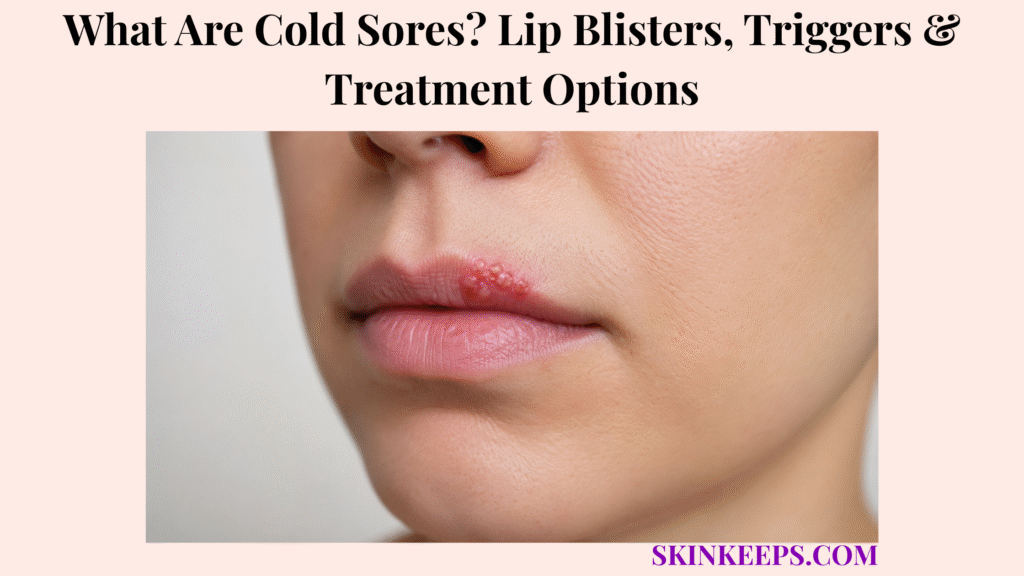
Cold sores often begin with tingling, itching, burning, or pain before small fluid-filled blisters appear, break open, crust, and heal.
The inflamed base may look red, pink, brown, purple-brown, or darker depending on skin tone. Symptoms may include tightness, tenderness, swelling, burning, and pain while eating or drinking.
What Happens Before the Blister Appears?
Before the blister appears, a cold sore may cause tingling, burning, itching, tightness, tenderness, or pain in the same spot where a sore usually develops.
This early warning stage is often called the prodrome.
If a clinician has prescribed antiviral medicine, this is usually the best time to start it because early treatment has the greatest chance of reducing the outbreak.
What Does an Active Cold Sore Look Like?
An active cold sore usually looks like a cluster of small fluid-filled blisters on or around the lip that can break open and form a shallow sore before crusting.
The blisters may contain clear or yellowish fluid. They may open, ooze, sting, crust, and scab as healing begins.
Touching the sore and then touching other skin, eyes, or broken skin can spread HSV, so handwashing matters.
How Long Do Cold Sores Usually Last?
Many cold sores heal without treatment, but healing can take days to a few weeks and medical review is needed if sores are severe, frequent, slow-healing, or high-risk.
Some sources describe improvement within about 10 days, while others describe clearing over 2 to 4 weeks. These are general expectations, not guarantees.
Frequent, severe, spreading, eye-related, immune-risk, eczema-related, pregnancy-related, or slow-healing sores should be checked.
| Stage | What User May Notice | Treatment / Safety Meaning |
|---|---|---|
| Prodrome | Tingling, burning, itch, tightness, tenderness. | Best time for prescribed antiviral treatment. |
| Blister | Small grouped fluid bumps. | High spread caution. |
| Open sore | Blisters break and ooze. | Avoid contact and protect sore. |
| Crust | Scab forms. | Do not pick. |
| Healing | Skin closes. | Continue hygiene and prevention. |
Where Do Cold Sores Usually Appear?
Cold sores usually appear on or around the lips, but they can also affect nearby mouth-area skin such as the corner of the mouth, chin, nose area, or rarely other sites through contact.
The outer lip border is a classic site. The corner of the mouth, nearby chin, or nose area can also be involved.
Inside-mouth ulcers are less typical for cold sores and may be canker sores or another mouth condition. Eye-area symptoms are a safety concern and need urgent care.
| Site | Common Clue | Safety Caution |
|---|---|---|
| Outer lip border | Classic grouped blister site. | Avoid kissing and sharing items. |
| Around mouth | Recurrent blister cluster. | Handwashing prevents spread. |
| Lip corners | Can overlap angular cheilitis. | Check for cracks vs blisters. |
| Chin / nose area | Nearby HSV spread possible. | Avoid touching and picking. |
| Inside mouth | Less typical for cold sores. | Canker sore or other ulcer may be more likely. |
| Finger | Possible spread to broken skin. | Consider herpetic whitlow evaluation. |
| Eye area | Serious complication risk. | Urgent care if eye symptoms occur. |
What Causes Cold Sores?
Cold sores are caused by herpes simplex virus, most commonly HSV-1, although HSV-2 can also cause oral sores in some cases.
HSV is common and should be discussed without stigma. The practical focus is symptom recognition, early treatment, and preventing spread during active outbreaks.
How Does HSV-1 Cause Cold Sores?
HSV-1 causes cold sores by infecting skin or mucous membranes around the mouth, then remaining dormant and reactivating later.
The virus can enter through mouth-area skin, mucous membranes, or small breaks in the skin.
Not everyone with HSV develops visible cold sores, and recurrence patterns vary from person to person.
Can HSV-2 Cause Cold Sores?
HSV-2 more commonly causes genital herpes, but it can sometimes infect the mouth through oral contact.
HSV-1 can also spread from the mouth to the genital area through oral sex during an active oral outbreak or viral shedding.
This page stays focused on oral cold sores, but oral sex should be avoided during an outbreak to reduce transmission risk.
What Triggers Cold Sore Outbreaks?
Cold sore outbreaks can be triggered by illness, fever, sunlight, stress, fatigue, hormonal changes, lip injury, dental work, or immune-system strain.
Triggers vary. A useful plan tracks the pattern rather than blaming the person.
How Do Illness, Fever, and Stress Trigger Cold Sores?
Illness, fever, stress, fatigue, and poor sleep can lower the threshold for HSV reactivation in some people.
Outbreaks may follow a viral illness, fever, heavy stress, poor sleep, or physical exhaustion.
Having a plan for early tingling can help people who notice predictable outbreaks after illness or stress.
How Do Sunlight and Lip Injury Trigger Cold Sores?
Sunlight and lip injury can trigger outbreaks because UV exposure, sunburned lips, dental work, cosmetic procedures, or local trauma can reactivate HSV in susceptible people.
SPF lip balm and shade can help when sun exposure is a trigger.
People with a cold-sore history should tell clinicians before dental work or mouth-area cosmetic procedures when outbreaks are predictable after trauma.
How Do Hormones and Immunity Affect Outbreaks?
Hormonal changes and immune status can affect outbreaks, especially during menstruation, pregnancy, immune suppression, or severe illness.
People with weakened immune systems may have more severe, prolonged, or widespread outbreaks.
Pregnancy, cancer treatment, HIV, transplant medicines, chemotherapy, or immune-suppressing medicines should lower the threshold for medical advice.
| Trigger | How It May Contribute | Prevention Idea |
|---|---|---|
| Illness / fever | Immune stress may reactivate HSV. | Start treatment early if prescribed. |
| Sunlight | UV exposure can trigger recurrence. | SPF lip balm and shade. |
| Stress / fatigue | Lowers outbreak threshold. | Sleep and stress planning. |
| Menstruation / hormones | Predictable recurrence pattern in some people. | Track timing. |
| Lip trauma | Local irritation can trigger outbreak. | Protect lips before dental/cosmetic procedures. |
| Immune suppression | Severe or prolonged outbreaks. | Medical plan. |
How Do Cold Sores Spread?
Cold sores spread through close contact with HSV-infected skin or saliva, especially during tingling, blistering, oozing, or crusting stages.
Spread prevention matters until the sore is fully healed. The goal is practical caution, not shame.
How Can Cold Sores Spread to Other People?
Cold sores can spread through kissing, oral contact, oral sex, close skin contact, and sharing items that touch the mouth during an outbreak.
Do not share lip balm, lipstick, towels, cups, utensils, razors, or cold sore creams during an outbreak.
Avoid kissing and oral sex while a sore is active because HSV can spread through mouth-area contact.
How Can Cold Sores Spread to Your Own Skin or Eyes?
Cold sores can spread to another body area if someone touches the sore and then touches the eyes, broken skin, fingers, or another vulnerable site.
Wash hands before and after applying treatment. Avoid touching, picking, squeezing, or scraping the blister or crust.
Eye pain, eye redness, light sensitivity, vision change, or a sore near the eye needs urgent medical care.
Why Do Babies and Eczema Patients Need Extra Caution?
Babies and people with eczema need extra caution because HSV can cause more serious disease in newborns and can spread widely through eczema-damaged skin.
Do not kiss babies during an active cold sore. Avoid close mouth-area contact with newborns, immunocompromised people, and people with severe eczema during an outbreak.
People with atopic dermatitis or damaged eczema-prone skin should seek urgent care for widespread painful blisters or open sores because eczema herpeticum can be serious.
How Are Cold Sores Different From Other Lip or Mouth Problems?
Cold sores can resemble canker sores, angular cheilitis, impetigo, acne, allergic lip dermatitis, mouth ulcers, and hand-foot-and-mouth disease, so location, recurrence, blisters, crusting, and trigger history matter.
Not every lip blister or mouth sore is HSV. The safest approach is to match the pattern before choosing treatment.
How Are Cold Sores Different From Canker Sores?
Cold sores usually appear on or around the outside of the lips and are contagious HSV lesions, while canker sores usually occur inside the mouth and are not HSV cold sores.
Canker sores are usually inside the mouth, such as inside the lip or cheek, and they do not form the classic outside-lip grouped blister pattern.
A blister inside the mouth is not automatically a cold sore.
How Are Cold Sores Different From Angular Cheilitis?
Cold sores usually form grouped fluid blisters, while angular cheilitis more often causes cracks, soreness, and inflammation at the corners of the mouth.
Both can affect lip corners, so pattern matters. Grouped blisters and a tingling prodrome support HSV more than simple corner cracking.
Angular cheilitis may involve saliva irritation, yeast, bacteria, dentures, or nutritional and medical factors.
How Are Cold Sores Different From Impetigo?
Cold sores are viral HSV blisters, while impetigo is a bacterial infection that often forms honey-colored crusts.
Both can crust and spread. A cold sore can also develop secondary bacterial infection if the skin is picked, cracked, or contaminated.
Antibiotics are not routine for cold sores unless bacterial infection is suspected or diagnosed.
How Are Cold Sores Different From Allergic or Irritant Lip Dermatitis?
Cold sores usually start with tingling and grouped blisters, while allergic or irritant lip dermatitis often follows exposure to lip balm, cosmetics, toothpaste, fragrance, food contact, or skincare products.
Allergic contact dermatitis may cause dry, itchy, cracked, burning, or swollen lips after a product exposure.
Irritation can coexist, but it does not explain classic recurrent HSV blisters by itself.
| Condition | Main Clue | Contagious? | Safer Next Step |
|---|---|---|---|
| Cold sore | Tingling + grouped lip blisters. | Yes. | Antiviral early + avoid spread. |
| Canker sore | Inside-mouth ulcer. | No. | Oral-ulcer care / review if severe. |
| Angular cheilitis | Cracked mouth corners. | Usually not HSV. | Treat cause. |
| Impetigo | Honey-colored bacterial crust. | Yes. | Antibiotic evaluation. |
| Lip dermatitis | Dry/itchy product-trigger rash. | No. | Remove trigger and assess. |
| Acne / folliculitis | Pimple or inflamed follicle. | No. | Avoid picking; assess if unclear. |
| HFMD | Mouth sores + hand/foot rash. | Yes. | Medical/public-health guidance if suspected. |
Some cold sores start as blisters, but not every lip or mouth blister is caused by HSV.
One-sided painful facial blisters with nerve-like pain may need a different evaluation, including shingles in the right clinical pattern.
How Are Cold Sores Diagnosed or Checked?
Cold sores are often diagnosed by their typical tingling, recurrent pattern, and grouped lip blisters, but testing may be used when the diagnosis is unclear, severe, frequent, or high-risk.
A clinician may diagnose typical recurrent cold sores clinically, especially when the pattern repeats in the same area.
What Does a Clinician Check With Cold Sores?
A clinician checks cold sores by reviewing location, tingling or burning before the sore, clustered blisters, crusting pattern, recurrence, triggers, exposure history, immune status, and eye or eczema risk.
The visit may include outbreak timing, trigger pattern, medicines tried, whether symptoms recur in the same spot, and whether there are eye symptoms, newborn exposure, pregnancy concerns, or immune suppression.
Pus, spreading redness, fever with severe illness, dehydration, or worsening pain should be mentioned because bacterial infection or another diagnosis may be present.
When Might HSV Testing Be Used?
HSV testing may be used when the diagnosis is unclear, symptoms are severe or widespread, outbreaks are frequent, or the patient is pregnant, immunocompromised, exposed as a newborn, or has eye/genital involvement.
A swab from an active sore may be used for lab testing when confirmation is needed.
Testing decisions depend on timing, lesion stage, clinical risk, pregnancy, immune status, and whether the result would change care.
What Treatment Options Help Cold Sores?
Cold sore treatment works best when started early, especially during tingling or burning before the blister fully develops.
Treatment choice depends on age, severity, frequency, pregnancy, kidney health, immune status, eye involvement, and how quickly treatment can start.
When Do Antiviral Creams or Tablets Help?
Antiviral creams or tablets help most when started at the first tingling, burning, or early blister stage before the outbreak fully develops.
Antiviral medicines can reduce severity or duration, but they do not cure HSV or remove it from the body.
Oral antivirals may be used for severe, frequent, early, or high-risk outbreaks. Topical antivirals may help some mild cases, but timing still matters.
When Is Suppressive Treatment Considered?
Suppressive antiviral treatment may be considered when cold sores are frequent, severe, predictable, distressing, or higher-risk because of immune suppression or complications.
Suppressive treatment is not routine for everyone. It should be discussed with a clinician who can review risks, benefits, kidney health, pregnancy status, other medicines, and outbreak frequency.
People with predictable outbreaks before procedures or high-trigger events may also need an early-treatment plan.
What Self-Care Can Reduce Discomfort?
Self-care can reduce discomfort by using a cold compress, keeping the lips protected, avoiding picking, washing hands, and avoiding foods or products that sting the sore.
A cold, damp cloth may ease discomfort. Pain relief may be used as advised.
Keep lips protected with non-irritating products, avoid acidic or spicy foods if they sting, and use SPF lip balm if sunlight triggers outbreaks.
| Situation | Best Treatment Direction | Key Caution |
|---|---|---|
| Tingling / prodrome | Start antiviral early if prescribed. | Timing matters. |
| Mild occasional sore | Supportive care ± topical antiviral. | Avoid spread. |
| Severe outbreak | Oral antiviral evaluation. | Start quickly. |
| Frequent recurrence | Suppressive therapy discussion. | Clinician-guided. |
| Immune suppression | Prompt medical treatment. | Higher complication risk. |
| Eczema / widespread rash | Urgent medical review. | Eczema herpeticum risk. |
| Eye symptoms | Urgent eye care. | Vision risk. |
How Should You Care for a Cold Sore Without Spreading It?
Cold sore care should protect the blister, reduce discomfort, and prevent the virus from spreading to other people or other body areas.
Avoid close mouth contact until the sore is fully healed. Keep the sore clean and dry, and avoid picking the scab.
Wash hands before and after applying medicine. Use a cotton swab or clean finger for treatment application, and avoid touching the eyes afterward.
How Can Cold Sore Outbreaks Be Prevented?
Cold sore prevention means identifying personal triggers, protecting lips from sun and injury, starting treatment early, and considering suppressive antivirals when outbreaks are frequent or severe.
Prevention is most useful when it is personal. One person may flare after sun exposure, another after illness, dental work, hormones, or stress.
A written early-treatment plan can help people who repeatedly miss the prodrome window.
What Cold Sore Mistakes Should You Avoid?
The biggest cold sore mistake is waiting until the blister is fully developed before starting treatment, then touching or sharing items while the sore is active.
Do not pop blisters, pick crusts, kiss babies, share lip products, touch the sore then touch the eyes, or use steroid cream on a suspected cold sore unless prescribed.
Do not assume all mouth sores are cold sores, and do not use antibiotics unless bacterial infection is suspected or diagnosed.
| Mistake | Why It Fails | Better Action |
|---|---|---|
| Waiting too long for antiviral | Less benefit after early window. | Start at tingling if prescribed. |
| Popping blisters | Slower healing and spread risk. | Leave intact and protect. |
| Picking crusts | Reopens sore and spreads virus. | Let crust heal. |
| Sharing lip products | Transmits HSV. | Avoid sharing during outbreak. |
| Touching eyes after sore | Eye infection risk. | Wash hands; urgent care for eye symptoms. |
| Kissing baby | Neonatal herpes risk. | Avoid baby contact during active outbreak. |
| Steroid cream without diagnosis | May worsen infection or delay care. | Use only if prescribed. |
When Should Cold Sores Be Checked by a Doctor?
Cold sores should be checked by a clinician when they are severe, frequent, spreading, not healing, near the eyes, occurring in a baby, or affecting someone with eczema or a weakened immune system.
Medical care is also important when a person has trouble eating or drinking, dehydration signs, bacterial infection signs, pregnancy concerns, or immune suppression.
Which Cold Sore Signs Need Medical Review?
Medical review is needed for eye pain, eye redness, light sensitivity, vision change, sores near the eye, severe or widespread outbreaks, frequent recurrences, dehydration risk, bacterial infection signs, or sores that do not heal as expected.
Get care for pus, spreading redness, fever with severe illness, worsening pain, trouble drinking, dizziness, very dry mouth, reduced urination, or sores that are not following the usual healing pattern.
Eye symptoms need urgent care because HSV can affect the eye.
Which People Should Be More Cautious With Cold Sores?
Newborns, young babies, people with eczema, people with weakened immune systems, pregnant people with new or severe HSV symptoms, and people with eye symptoms should be more cautious with cold sores.
Immune-risk situations include HIV, cancer treatment, chemotherapy, transplant medicines, high-dose immune-suppressing medicines, or other conditions that weaken infection defense.
Pregnancy with new or severe HSV symptoms should be discussed with a qualified clinician.
Seek medical care if cold sores involve:
What Should You Remember About Cold Sores?
The most important thing to remember about cold sores is that they are HSV-related lip blisters, so the safest approach is early antiviral treatment, trigger control, and careful spread prevention during active outbreaks.
They are contagious, they can recur, and high-risk contact matters most around babies, eyes, eczema-prone skin, pregnancy concerns, and immune suppression.
Frequently Asked Questions About Cold Sores
Are cold sores herpes?
Yes. Cold sores are usually caused by herpes simplex virus, commonly HSV-1, and are also called fever blisters or herpes labialis.
What does a cold sore look like?
A cold sore often starts with tingling or burning, then small grouped fluid-filled blisters appear on or around the lip, break into shallow sores, crust, and heal.
What triggers cold sores?
Common triggers include illness, fever, sunlight, stress, fatigue, menstrual or hormonal changes, lip injury, dental work, and immune-system strain.
Are cold sores contagious?
Yes, especially during active tingling, blistering, oozing, or crusting. Avoid kissing, oral sex, and sharing lip products, towels, cups, utensils, razors, or lipstick during an outbreak.
Are cold sores the same as canker sores?
No. Cold sores usually occur on or around the outside of the lips and are contagious HSV lesions; canker sores usually occur inside the mouth and are not HSV cold sores.
What is the best treatment for cold sores?
There is no one best treatment for every case. Antiviral treatment works best when started at the first tingling or within the first day of symptoms; frequent or severe outbreaks may need prescription oral antivirals or suppressive treatment.
Should you pop a cold sore?
No. Popping a cold sore can spread virus, worsen irritation, slow healing, and increase secondary infection risk.
When should cold sores need medical care?
Medical care is needed for eye symptoms, newborn exposure, severe or widespread sores, frequent outbreaks, weak immune system, eczema, pregnancy concerns, dehydration, bacterial infection signs, or sores that do not heal.
Sources & Evidence About Cold Sores
CDC — Herpes Overview was used for HSV-1 oral herpes and cold sores or fever blisters on or around the mouth, plus HSV spread basics.
CDC — STI Treatment Guidelines: Herpes was used for early episodic antiviral treatment timing during prodrome or within one day of lesion onset.
NHS — Cold Sores was used for trigger examples, contagious precautions, avoiding kissing babies, canker-sore distinction, high-risk groups, and the 10-day healing expectation language.
American Academy of Dermatology — Cold Sore Overview was used for fever blister terminology, HSV persistence in the body, treatment overview, and immune-risk cautions.
American Academy of Dermatology — Cold Sore Signs and Symptoms was used for prodrome symptoms, blister pattern, transfer risk to other body sites, and eye warning signs.
American Academy of Dermatology — Cold Sore Diagnosis and Treatment was used for diagnosis, swab testing context, antiviral treatment, and when to seek medical care.
American Academy of Dermatology — Cold Sore Self-Care was used for handwashing, avoiding spread, lip protection, and procedure-planning context.
American Academy of Dermatology — Cold Sores and Eczema Risk was used for eczema herpeticum caution and urgent care when HSV spreads through eczema-damaged skin.
Mayo Clinic — Cold Sore Diagnosis and Treatment was used for blister-sample testing, prescription antiviral options, cold compress support, and the 2–4 week untreated-clearing expectation.
DermNet — Herpes Simplex was used for HSV-1 oral/facial infection, recurrent herpes simplex attacks, clinical pattern, early topical antiviral timing, and the point that antivirals do not eradicate dormant HSV.
Cleveland Clinic — Cold Sore Symptoms, Causes and Treatment was used for prodrome-stage wording, contagiousness from early symptoms until healing, and treatment context.
Cleveland Clinic — Oral Herpes was used for oral herpes overview, cold sores on lips and nearby skin, avoiding mouth-area contact until fully healed, and immune-risk context.
Educational Disclaimer: This SkinKeeps article is for educational purposes only and does not diagnose or replace medical care. Cold sores or cold-sore-like symptoms involving the eyes, newborn exposure, severe or widespread blisters, frequent recurrence, trouble eating or drinking, dehydration, pus, spreading redness, fever with severe illness, pregnancy concerns, eczema, immune suppression, cancer treatment, HIV, transplant medicines, or sores that do not heal as expected should be checked by a qualified healthcare professional. Do not pop blisters, pick crusts, kiss babies, share lip products, touch your eyes after touching a sore, or use prescription antiviral, steroid, or antibiotic treatment without appropriate medical guidance.