Genital herpes is a lifelong viral infection of the genital or anal region caused by herpes simplex virus type 1 or type 2. HSV-2 is strongly associated with recurrent genital infection, while HSV-1 can reach genital skin through oral-genital contact.
Many infections are mild, unrecognised, or symptom-free. HSV can spread without visible sores, and oral antiviral treatment can shorten or prevent outbreaks and reduce transmission risk, but it does not remove latent HSV from the body.
How Can You Recognize Genital Herpes on the Skin?
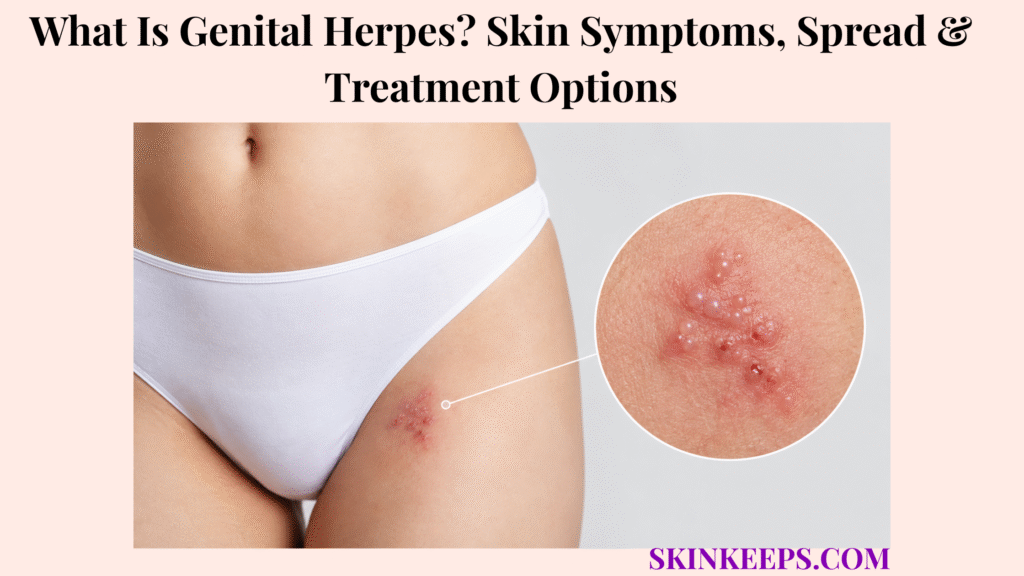
Genital herpes can cause tingling, itching, burning, or tenderness before bumps, blisters, or painful ulcers appear.
Lesions may occur on the vulva, penis, scrotum, perineum, anus, buttocks, or upper thighs. Vaginal, cervical, urethral, or rectal lesions may be internal and difficult to see.
External blisters can open into shallow painful ulcers and later crust as they heal. Redness may be less obvious on deeply pigmented skin, so pain, tenderness, swelling, texture change, and ulceration also matter.
Not every case has classic grouped blisters. Mild infection may look like irritation, a small crack, a pimple, or an ingrown hair.
| Possible Stage | Skin or Mucosal Finding | Common Sensation | What to Do |
|---|---|---|---|
| Prodrome | No visible lesion or mild redness | Tingling, itching, burning, tenderness | Avoid sexual contact and arrange early care if an outbreak is suspected. |
| Early lesion | Small bump or fluid-filled blister | Tender or burning | Seek testing while the lesion is fresh. |
| Ulcer stage | Shallow open sore after a blister breaks | Pain, stinging, urinary discomfort | Clinical assessment and antiviral discussion. |
| Healing | Crusting on external skin or closing ulcer | Pain gradually settles | Avoid picking and sexual contact until fully healed. |
| Atypical pattern | Small crack, irritation, or pimple-like spot | Variable | Do not diagnose by appearance alone. |
Figure 1. Genital herpes may progress from tingling or burning to small blisters, shallow painful ulcers, and healing, but some infections cause only mild irritation, a crack, or no recognised symptoms.
Which Symptoms Can Accompany a First Genital Herpes Outbreak?
A first recognised genital herpes outbreak can include genital or anal ulcers plus fever, headache, fatigue, body aches, and swollen or tender groin lymph nodes.
Painful urination, unusual discharge, multiple ulcers, severe swelling, or difficulty passing urine can occur. Some people notice pain extending into the buttocks, hips, or legs.
A first recognised outbreak may be longer or more severe than later recurrences, but it does not prove that infection was acquired recently. HSV may remain unnoticed for a long time.
- Genital or anal blisters or ulcers.
- Painful urination or urinary difficulty.
- Swollen or tender groin lymph nodes.
- Fever, headache, body aches, or fatigue.
- Unusual genital or vaginal discharge.
- Multiple painful lesions.
- Prompt assessment while lesions are fresh.
How Do Recurrent Genital Herpes Outbreaks Differ From the First Episode?
Recurrent outbreaks are often shorter and less severe than the first recognised episode, but frequency and intensity vary by person and HSV type.
A recurrence may affect the same general nerve-supplied region and begin with tingling, itching, burning, or shooting pain. Some episodes produce only one or two small lesions.
Outbreaks may become less frequent over time, and some people never recognise another episode. HSV-2 generally recurs and sheds more often than genital HSV-1.
Which Factors May Precede a Genital Herpes Recurrence?
Illness, fever, physical or emotional stress, menstruation, friction, surgery, injury, immune suppression, and fatigue may precede recurrence in some people.
Trigger patterns are individual and inconsistent. A recurrence does not prove a new exposure.
Outbreak tracker: date → prodrome → possible trigger → lesion location → treatment start → healing pattern → partner-risk notes.
How Does Genital Herpes Remain in the Body and Return?
HSV enters susceptible skin or mucosal tissue, travels into nearby sensory nerves, and remains inactive in a local nerve ganglion.
The virus may later reactivate and return toward the skin. Reactivation can produce visible lesions or asymptomatic shedding from normal-looking skin.
Antiviral medicines suppress viral replication but do not eliminate latent HSV from nerve cells, so genital herpes is manageable but currently not curable.
Figure 2. After local infection, HSV becomes latent in sensory nerves and may later reactivate, causing a recognised outbreak or releasing virus from normal-looking skin without symptoms.
How Do HSV-1 and HSV-2 Cause Different Genital Herpes Patterns?
Genital herpes can be caused by HSV-1 or HSV-2, and typing matters because recurrence and shedding patterns often differ.
How Does Genital HSV-1 Usually Behave?
Genital HSV-1 is often acquired when oral herpes from cold sores reaches genital skin during oral-genital contact.
It can cause a significant first episode but usually produces fewer genital recurrences and less genital shedding over time than HSV-2. It should not be labelled harmless.
How Does Genital HSV-2 Usually Behave?
Genital HSV-2 is more strongly associated with recurrent genital outbreaks and asymptomatic genital shedding.
Daily suppressive therapy may be considered for frequent or distressing recurrences and for transmission-risk reduction. HSV-2 is not automatically severe in every person.
| Feature | Genital HSV-1 | Genital HSV-2 |
|---|---|---|
| Common acquisition route | Often oral-genital contact. | Usually genital or anal sexual contact. |
| First episode | Can be significant. | Can be significant. |
| Recurrence tendency | Usually fewer recurrences. | Usually more recurrent. |
| Asymptomatic shedding | Generally lower over time. | Generally more frequent. |
| Counselling focus | Type-specific expectations. | Recurrence and transmission reduction. |
| Suppression | Selected frequent or distressing cases. | Often considered for frequent outbreaks or partner-risk reduction. |
How Does Genital Herpes Spread Between People?
Genital herpes spreads through direct contact with infected skin, mucosal surfaces, sores, or secretions during vaginal, anal, or oral sexual contact.
Transmission can involve visible sores, normal-looking genital or anal skin releasing virus, genital fluids, oral skin or saliva in oral-herpes contexts, and shared sex toys that directly contact mucosa.
A partner can transmit HSV without knowing they carry it. Less commonly, infectious fluid can be transferred on fingers after direct lesion contact.
| Contact Type | Possible HSV Source | Visible Symptoms Required? | Risk-Reduction Action |
|---|---|---|---|
| Vaginal sex | Genital skin, sores, or secretions | No | Avoid symptoms and use condoms. |
| Anal sex | Anal or genital skin and sores | No | Avoid symptoms and use barriers. |
| Oral sex | Oral HSV-1, oral skin, saliva, or cold sores | No | Avoid oral sores or prodrome and use barriers. |
| Shared sex toys | Genital secretions and mucosal contact | No | Clean and use a new condom on shared toys. |
| Manual transfer | Infectious lesion fluid on fingers | Less common | Wash hands and avoid touching lesions. |
| Casual objects | Toilet seats, pools, bedding, or soap | Not a usual route | Focus on direct-contact prevention. |
Can Genital Herpes Spread Without Visible Blisters or Sores?
Yes. HSV may be released intermittently from normal-looking genital or anal skin, so transmission can occur when the person feels well and has no visible lesion.
Risk is highest during active sores or prodromal tingling, itching, or burning, but the absence of symptoms does not make risk zero.
Asymptomatic shedding is generally more frequent with genital HSV-2 than genital HSV-1. Prevention therefore combines symptom awareness, barriers, communication, and suppressive therapy when appropriate.
Risk spectrum: active ulcers → prodrome → no symptoms with shedding → no shedding at that moment.
Which Everyday Objects Do Not Usually Spread Genital Herpes?
Genital herpes is not normally acquired from toilet seats, bedding, swimming pools, saunas, soap, cutlery, drinking glasses, or ordinary household contact.
HSV transmission primarily requires direct contact with infected skin, mucosa, sores, or secretions. Shared sex toys are different because they directly contact genital tissue.
| Suspected Source | Usual Genital HSV Risk? | Accurate Framing |
|---|---|---|
| Toilet seat | No typical route | HSV spreads through direct skin or mucosal contact. |
| Bedding | No typical route | Not a usual genital herpes source. |
| Swimming pool or sauna | No typical route | Pool or sauna exposure is not the concern. |
| Soap | No typical route | Casual object contact is not typical. |
| Cutlery or glasses | No typical genital route | Oral HSV context is different from genital transmission. |
| Ordinary towel use | No typical route | General hygiene is sensible during active sores. |
| Shared sex toy | Possible | Clean it and use a new condom or barrier. |
How Is Genital Herpes Different From Other Genital Bumps and Sores?
Genital herpes can resemble several genital bumps or ulcers, so examination and testing are safer than diagnosis by appearance alone.
How Does Genital Herpes Differ From Genital Warts?
Herpes commonly causes painful blisters or ulcers, while genital warts are usually solid, raised, flat, rough, grouped, or cauliflower-like growths.
How Does Genital Herpes Differ From Syphilis?
Primary syphilis can cause a firm ulcer that is often painless, while herpes more often causes painful grouped blisters or shallow ulcers.
Either infection can appear atypically, so appropriate STI testing is needed.
How Does Genital Herpes Differ From Ingrown Hairs and Folliculitis?
Ingrown hairs and folliculitis are usually centred on hair follicles and often follow shaving, waxing, sweat, friction, or tight clothing.
Herpes lesions may cluster, affect hairless mucosal tissue, and progress into shallow painful ulcers.
How Does Genital Herpes Differ From Fordyce Spots or Skin Cracks?
Painless visible oil glands called Fordyce spots are stable benign dots rather than painful blister-to-ulcer lesions.
A skin fissure is a crack caused by barrier breakdown or mechanical stress, although atypical herpes can sometimes resemble a small crack.
| Condition | Lesion Type | Pain | Typical Clue | Diagnostic Step |
|---|---|---|---|---|
| Genital herpes | Blisters progressing to shallow ulcers | Often painful or burning | Prodrome, recurrence, mucosal involvement | Fresh-lesion PCR or NAAT |
| Genital warts | Solid rough, flat, or cauliflower-like growths | Often painless | Persistent solid growth | Clinical and STI evaluation |
| Syphilis | Firm ulcer possible | Often painless initially | Systemic STI context | Blood and lesion testing as indicated |
| Folliculitis | Pustule around a hair | Tender or itchy | Follicle-centred after shaving or friction | Exam and selected culture |
| Ingrown hair | Hair trapped beneath skin | Tender | Hair-removal pattern | Exam |
| Traumatic or inflammatory ulcer | Isolated sore | Variable | Friction, injury, or inflammatory pattern | History, exam, and targeted testing |
How Do Clinicians Test for Genital Herpes?
The most useful test during symptoms is usually a PCR or NAAT swab from a fresh blister or ulcer, with HSV typing when virus is detected.
PCR or NAAT is generally more sensitive than viral culture. Culture may still be used, but its sensitivity falls as lesions heal.
A negative result does not always exclude HSV when the lesion is old, healing, or no longer shedding virus. Seek assessment before blisters or ulcers crust or disappear.
- Clinical examination of lesion location and pattern.
- Swab from a fresh blister or ulcer.
- PCR or NAAT testing when available.
- Typing as HSV-1 or HSV-2.
- Culture interpretation based on lesion age.
- Other STI testing when clinically appropriate.
When Can a Herpes Blood Test Help—and What Can It Not Prove?
Type-specific HSV antibody testing may help in selected situations, but it cannot show the genital site, the source of transmission, or exactly when infection happened.
It may be considered when symptoms suggest herpes but no lesion is available, or when a sexual partner has genital herpes. Antibodies take time to develop, so testing too early can be negative.
Low-positive HSV-2 results may need confirmation. HSV-1 antibodies cannot distinguish oral from genital infection, and HSV IgM testing is not recommended.
| Test | Best Use | Main Limitation | Follow-Up |
|---|---|---|---|
| Lesion PCR or NAAT | Fresh blister or ulcer | Needs an active lesion | Type HSV-1 or HSV-2. |
| Viral culture | Fresh lesion where used | Sensitivity falls as lesions heal | Interpret with timing. |
| Type-specific HSV-2 antibody | Selected no-lesion or partner situations | Early false-negative and low-positive issues | Confirm when indicated. |
| HSV-1 antibody | Shows past HSV-1 exposure | Cannot locate oral versus genital infection | Use clinical context. |
| HSV IgM | Not recommended | Can mislead about new versus recurrent infection | Avoid. |
Which Treatment Options Control Genital Herpes?
Genital herpes treatment uses systemic antiviral medicine to reduce viral replication, shorten outbreaks, reduce recurrences, and lower transmission risk in selected situations.
How Is a First Genital Herpes Episode Treated?
A first clinical episode should receive oral antiviral treatment, even when early symptoms seem mild.
Common medicines include acyclovir, valacyclovir, and famciclovir. The regimen depends on clinical severity, kidney function, pregnancy, immune status, and local guidance; severe disease may require hospital and intravenous treatment.
How Does Episodic Treatment Shorten Recurrent Outbreaks?
Episodic treatment starts antiviral medicine during prodrome or very soon after a recurrent lesion begins.
It can shorten or reduce the severity of an outbreak but does not prevent every future recurrence.
How Does Daily Suppressive Treatment Reduce Recurrences?
Daily suppressive treatment reduces frequent HSV-2 recurrences by about 70%–80% and can improve quality of life.
It can lower—but not eliminate—HSV-2 transmission risk. The decision should consider recurrence frequency, partner status, pregnancy plans, distress, preference, and periodic review.
Why Are Topical Antiviral Creams Not the Main Treatment?
Topical antiviral medicines provide minimal clinical benefit for genital herpes compared with systemic oral therapy and are not the main treatment.
| Strategy | When Used | Main Goal | Timing | Limitation |
|---|---|---|---|---|
| First-episode oral antiviral | First clinical episode | Reduce severity and duration | As soon as assessed | Does not cure HSV |
| Episodic therapy | Recognised recurrence | Shorten an outbreak | Prodrome or early lesion | Requires rapid start |
| Daily suppression | Frequent or distressing recurrence; selected partner-risk reduction | Reduce outbreaks and spread risk | Daily | Risk remains |
| IV antiviral | Severe or complicated disease | Control severe HSV | Hospital setting | Specialist care |
| Topical antiviral | Generally discouraged | Minimal benefit | Not primary | Insufficient for significant genital disease |
How Can Genital Herpes Pain and Skin Irritation Be Managed During an Outbreak?
Comfort measures can reduce pain and irritation but do not replace antiviral treatment when medicine is indicated.
- Clean gently with plain water or clinician-approved saline.
- Pat dry instead of scrubbing.
- Use a wrapped cold pack briefly; never apply ice directly.
- Wear loose, breathable clothing.
- Avoid friction against open lesions.
- Discuss appropriate pain medicine or topical anaesthetic with a clinician.
- Pour water over the external genital area while urinating if stinging occurs.
- Wash hands before and after touching the area.
- Do not pick, pop, or peel blisters and ulcers.
- Avoid vaginal, anal, and oral sex until lesions are healed and prodrome has stopped.
How Can Genital Herpes Transmission Risk Be Reduced?
Transmission risk is reduced through partner communication, avoiding sex during symptoms, condoms or barriers, sex-toy hygiene, and suppressive antiviral therapy when appropriate.
No single method eliminates risk because shedding can occur from skin that is not covered and appears normal.
| Prevention Method | Risk Reduced | Limitation | Best Combined With |
|---|---|---|---|
| Avoid sex during lesions or prodrome | Highest-risk periods | Shedding may occur between outbreaks | Condoms and communication |
| Condoms and barriers | Covered skin and mucosal exposure | Not every shedding area is covered | Symptom awareness |
| Suppressive antiviral therapy | Recurrence and HSV-2 transmission risk | Does not eliminate risk | Condoms and disclosure |
| Partner communication | Supports informed consent | Does not biologically prevent spread | Shared prevention plan |
| Sex-toy cleaning and new condoms | Secretions on shared toys | Requires consistency | Avoid sharing during outbreaks |
| Partner or STI testing | Clarifies selected risks | Test limitations remain | Clinical counselling |
How Should Someone Discuss Genital Herpes With a Sexual Partner?
A genital herpes conversation should happen privately before sexual contact and focus on facts, precautions, and shared decision-making.
- Explain whether HSV-1 or HSV-2 is known.
- State that transmission can occur without symptoms.
- Describe outbreak avoidance, barriers, and antiviral plans.
- Avoid unsupported claims about when or from whom HSV was acquired.
- Give the partner space to ask questions.
- Discuss testing with a clinician when useful.
- Agree on a shared risk-reduction plan.
A new diagnosis does not prove recent infidelity because symptoms can remain unrecognised and blood testing cannot identify timing or source.
How Does Genital Herpes Affect Pregnancy and a Newborn Baby?
Genital herpes should be discussed with the maternity-care team because newborn risk depends on when infection occurred and whether lesions or prodromal symptoms are present near delivery.
Established infection usually carries less neonatal concern than a first infection acquired late in pregnancy. Antiviral treatment may be used during pregnancy and later pregnancy to reduce outbreaks at delivery.
Many people with established genital herpes can have a vaginal delivery. Caesarean delivery may be recommended in selected higher-risk circumstances rather than as a universal rule.
A newborn with poor feeding, fever, unusual sleepiness, irritability, skin or eye lesions, breathing problems, or seizures needs emergency assessment.
- Tell the maternity-care team about known or possible genital HSV.
- Seek prompt specialist care for a first infection during pregnancy.
- Report lesions or prodrome during labour.
- Follow individual antiviral and delivery planning.
- Treat newborn illness or skin/eye lesions as an emergency.
What Complications Can Genital Herpes Cause?
Genital herpes usually causes local outbreaks and distress, but it can occasionally cause urinary, bacterial, neurologic, eye, pregnancy, newborn, or immune-related complications.
| Complication | Warning Sign | Higher-Risk Context | Response |
|---|---|---|---|
| Urinary retention | Cannot pass urine | Severe first outbreak | Urgent care |
| Secondary bacterial infection | Increasing redness, pus, or fever | Open lesions | Medical review |
| Psychological distress | Shame, anxiety, avoidance | Anyone | Support and counselling |
| Severe or widespread HSV | Extensive lesions or high fever | Immune suppression | Urgent hospital care |
| Neurologic disease | Severe headache, neck stiffness, confusion, seizure | Rare but serious | Emergency care |
| Eye involvement | Eye pain, redness, or visual change | Possible hand-to-eye transfer | Emergency eye care |
| Neonatal herpes | Fever, poor feeding, seizure, skin/eye lesion | Newborn | Emergency care |
| HIV-related risk | Relevant STI exposure | HSV-2 context | HIV/STI testing discussion |
When Does Genital Herpes Need Prompt or Emergency Medical Care?
Prompt evaluation is needed for first or uncertain genital lesions, fresh blisters or ulcers suitable for swabbing, severe pain or swelling, painful urination, frequent recurrences, pregnancy, partner exposure, or immune suppression.
Seek urgent or emergency care for inability to urinate, severe headache or neck stiffness, confusion, seizure, eye pain or visual change, high fever with widespread lesions, breathing or organ symptoms, severe disease during immune suppression, or possible neonatal herpes.
Figure 3. Fresh-lesion PCR or NAAT testing with HSV typing supports the right antiviral, recurrence, transmission, pregnancy, and urgent-care plan.
What Should You Remember About Genital Herpes?
Genital herpes is a lifelong HSV-1 or HSV-2 infection that can be managed with accurate testing, antiviral treatment, and layered risk reduction.
- Many infections are mild, unrecognised, or symptom-free.
- Outbreaks may progress from tingling to blisters and painful ulcers.
- HSV remains latent in nearby sensory nerves.
- Transmission can occur without visible lesions.
- A first visible outbreak does not prove recent infection.
- Fresh-lesion PCR or NAAT testing is more useful than appearance alone.
- HSV typing supports recurrence and counselling decisions.
- Blood tests cannot show who transmitted HSV or exactly when.
- Antivirals control outbreaks but do not remove HSV.
- Condoms reduce rather than eliminate risk.
- Pregnancy, severe symptoms, eye or neurologic symptoms, newborn symptoms, and immune suppression need prompt guidance.
What Questions Do People Ask About Genital Herpes?
Can genital herpes cause symptoms without visible blisters?
Yes. Some people notice tingling, itching, burning, irritation, a small crack, or a pimple-like lesion without obvious classic blisters.
Can genital herpes spread when no symptoms are present?
Yes. HSV can be released intermittently from normal-looking skin. Risk is highest during sores or prodrome, but it is not zero between outbreaks.
Can oral herpes cause genital herpes?
Yes. HSV-1 from oral herpes can reach genital skin through oral-genital contact.
How long after exposure can genital herpes symptoms appear?
Symptoms may appear after infection, remain mild or unnoticed, or not be recognised until much later. A precise timing estimate cannot prove when transmission occurred.
Does a first herpes outbreak prove a recent infection?
No. A first recognised outbreak may occur long after HSV entered the body, and testing cannot show exactly when or from whom infection was acquired.
Is genital HSV-1 less likely to recur than genital HSV-2?
Usually. Genital HSV-1 tends to recur and shed less often than genital HSV-2, but individual patterns vary.
Can genital herpes be mistaken for an ingrown hair?
Yes. Mild herpes can resemble a pimple or ingrown hair, while folliculitis and ingrown hairs are usually centred on hair follicles. Testing helps when the diagnosis is uncertain.
Can a blood test show when or from whom herpes was acquired?
No. Type-specific antibody testing may show past HSV exposure in selected cases, but it cannot identify the source or timing of transmission.
Can genital herpes be cured permanently?
No. Current antivirals can shorten outbreaks, reduce recurrences, and lower transmission risk, but they do not remove latent HSV from the body.
How quickly should antiviral treatment begin?
Treatment works best when started early. First episodes should be assessed promptly, and episodic treatment for recurrences is most effective during prodrome or very soon after lesions begin.
Do condoms completely prevent genital herpes?
No. Condoms reduce exposure but do not cover every area that may shed HSV, so they lower rather than eliminate risk.
Can someone with genital herpes have a healthy pregnancy?
Yes. Many people with established genital herpes have healthy pregnancies, but the maternity-care team should know. First infection late in pregnancy, lesions or prodrome at labour, and newborn symptoms need prompt guidance.
Does genital herpes increase the risk of HIV?
HSV-2 is linked with an increased risk of acquiring HIV, so HIV and other STI testing may be appropriate depending on exposure and clinical context.
When should genital herpes symptoms be treated as an emergency?
Emergency care is needed for inability to urinate, severe neurologic symptoms, eye pain or visual change, high fever with widespread lesions, severe disease in an immunocompromised person, or possible neonatal herpes.
Which Sources Support This Genital Herpes Guidance?
CDC — STI Treatment Guidelines: Herpes — PCR/NAAT and culture interpretation, HSV typing, serology limits, IgM warning, oral and suppressive antiviral treatment, pregnancy, and severe disease.
CDC — About Genital Herpes — Patient-friendly symptoms, asymptomatic infection and shedding, direct transmission, object myths, condoms, treatment, testing limits, and pregnancy discussion.
WHO — Herpes Simplex Virus — HSV-1 and HSV-2 patterns, asymptomatic transmission, recurrence, genital HSV-1 through oral contact, HIV association, pregnancy, and neonatal risk.
NHS — Genital Herpes — Blister and ulcer symptoms, darker-skin caveat, lesion swabbing, source/timing limits, treatment framing, comfort care, recurrence, and pregnancy.
This SkinKeeps article is educational and does not diagnose genital herpes or replace medical, sexual-health, maternity, eye, emergency, or newborn care. Seek prompt care for new or uncertain genital sores, pregnancy-related symptoms, inability to urinate, neurologic or eye symptoms, severe or widespread disease, immune suppression, or possible neonatal herpes; do not self-diagnose from photos, pop lesions, use HSV IgM, or assume condoms or antivirals remove all transmission risk.