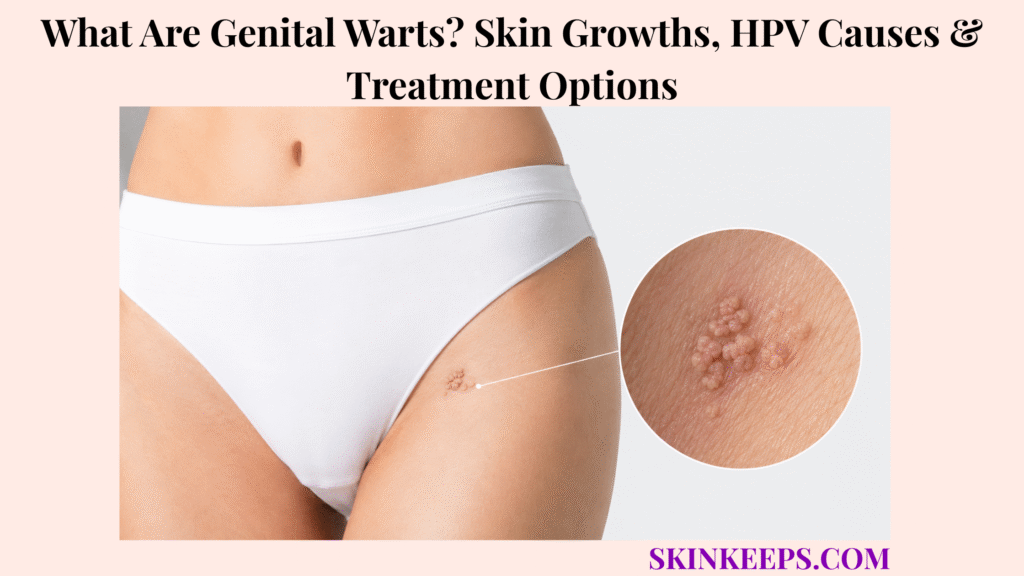
Genital warts are benign skin or mucosal growths caused by certain types of human papillomavirus, or HPV. They may appear as one bump, several grouped bumps, flat patches, stalk-like growths, or cauliflower-like clusters around genital or anal skin.
The growths are often painless, and HPV can spread even when no wart is visible. Treatment can remove visible warts but does not directly eradicate HPV, so diagnosis, treatment choice, recurrence planning, vaccination, and prevention all matter.
How Can You Recognize Genital Warts on the Skin?
Genital warts may appear as flesh-coloured, white, pink, brownish, or grey growths that are flat, raised, stalk-like, rough, smooth, or lobulated.
They can appear singly or in closely packed groups. Some clusters resemble cauliflower, but many warts do not have that classic shape.
The growths are often painless, although itching, irritation, bleeding, or tenderness can occur when they rub against clothing or are injured.
Colour and surface texture vary across skin tones. Flat warts may be difficult to see until the skin is gently stretched during examination.
- Number: one lesion or several grouped growths.
- Shape: flat, raised, stalked, lobulated, or cauliflower-like.
- Surface: smooth, rough, or irregular.
- Colour: flesh-coloured, pale, pink, brownish, or grey.
- Symptoms: painless, itchy, irritated, or bleeding.
- Location: external genital skin, mucosal opening, or anal region.
- Uncertainty: professional examination before treatment.
Figure 1. Genital warts can be flat, raised, stalked, smooth, rough, or clustered and may occur on external or internal anogenital tissue.
Where Can Genital Warts Develop?
Genital warts can develop on external genital skin, around the anus, and in less-visible mucosal areas such as the vagina, cervix, urethra, or anal canal.
External sites include the vulva, labia, vaginal opening, penis shaft, glans, beneath the foreskin, scrotum, groin, perineum, external anus, and perianal skin.
Internal lesions may occur in the vagina, cervix, urethral opening, urethra, or anal canal. Rare oral or throat lesions can follow oral exposure.
People with external anal warts may also have internal anal lesions, including some without a history of receptive anal sex. Internal sites need clinician-directed assessment and treatment.
| Location Group | Examples | Visibility | Care Boundary |
|---|---|---|---|
| External genital skin | Vulva, labia, penis, glans, foreskin, scrotum, groin, perineum | Usually visible | Clinical exam before treatment |
| External anal area | Perianal skin and external anus | Usually visible | Consider anal-canal assessment |
| Internal genital tract | Vagina and cervix | Not always visible | Clinician or specialist treatment |
| Urinary opening | Urethral opening or urethra | May be hidden | Location-specific clinician treatment |
| Anal canal | Intra-anal mucosa | Hidden | Colorectal or trained specialist review |
| Oral or throat tissue | Rare after oral exposure | Variable | Specialist assessment |
How Does HPV Cause Genital Warts?
HPV causes genital warts by infecting cells near the surface of genital or anal skin and changing how those epithelial cells grow.
The virus enters through microscopic breaks in skin or mucosal tissue. Infected cells multiply and form a flat, raised, or stalked growth.
Most HPV infections do not produce visible warts. The immune system may eventually suppress the infection, allowing growths to flatten or disappear.
Visible clearance does not prove that every infected cell has been eliminated, which helps explain recurrence.
Figure 2. HPV infects surface epithelial cells and can create visible growths; immune control may clear or suppress them, but persistence can allow recurrence after treatment.
Which HPV Types Cause Genital Warts?
About 90% of anogenital warts are caused by HPV types 6 and 11, which are classified as low-risk or non-oncogenic HPV types.
These wart-causing types are not the main causes of HPV-related cancer. High-risk HPV types follow a different precancer and cancer pathway.
A person can carry more than one HPV type, so a visible wart does not prove that high-risk HPV is present or absent.
| HPV Category | Usual Outcome | Visible Warts? | Cancer Association | Management Focus |
|---|---|---|---|---|
| Low-risk HPV 6/11 | Anogenital warts | Common | Not the main cancer cause | Wart diagnosis and treatment |
| High-risk HPV types | Precancer or cancer risk | Not usually typical warts | Important | Screening and follow-up |
| Coinfection | Mixed HPV context | Possible | Depends on the additional type | Avoid assumptions and follow screening guidance |
How Do Genital Warts Spread Between People?
Genital warts spread through direct contact with HPV-infected genital, anal, or nearby skin, most often during sexual skin-to-skin contact.
Transmission can occur during vaginal sex, anal sex, oral-genital contact, genital touching without penetration, contact with perianal skin, or shared sex toys that are not cleaned or covered.
Visible warts are not required for transmission, and a person may pass HPV without knowing they carry it.
Condoms reduce risk but cannot cover every area of potentially infected skin.
| Contact Route | Direct Skin Exposure? | Visible Wart Required? | Risk-Reduction Action |
|---|---|---|---|
| Vaginal sex | Yes | No | Use condoms and avoid visible warts or treatment irritation. |
| Anal sex | Yes | No | Use condoms and arrange anal evaluation when needed. |
| Oral-genital contact | Possible | No | Avoid contact with visible lesions and use barriers. |
| Perianal contact | Yes | No | Check perianal and internal symptoms. |
| Shared sex toys | Possible | No | Clean and use a new condom or barrier. |
| Casual contact | Usually no | No | Focus prevention on sexual skin contact. |
Can Genital Warts Appear Long After HPV Was Acquired?
Genital warts can appear weeks, months, or much later after HPV exposure, so a newly visible wart does not prove recent transmission.
Many HPV infections remain unnoticed because no growth develops. Partners may share HPV even when only one person develops visible warts.
The exact source and timing usually cannot be reconstructed, and a new wart should not be used as evidence of recent infidelity.
Timing pathway: exposure → silent infection → possible immune control → delayed wart appearance → treatment → possible recurrence.
Are Genital Warts Contagious After the Growths Disappear?
Transmission uncertainty can remain after visible warts disappear because treatment removes growths but does not prove HPV is gone from nearby skin.
The exact period of contagiousness after wart clearance is not known. Recurrence may reflect persistent infection or hidden lesions rather than a new exposure.
- Wart removed does not equal HPV instantly eradicated.
- Visible clearance does not guarantee zero transmission.
- Treatment success does not prove when HPV was acquired.
- Recurrence does not automatically prove reinfection.
How Are Genital Warts Different From Other Genital Bumps?
Genital warts can resemble harmless anatomical variations, other infections, and suspicious lesions, so uncertain growths should be examined before treatment.
How Do Genital Warts Differ From Genital Herpes?
Genital warts are usually solid HPV-related growths, while genital herpes more often causes fluid-filled blisters that break into painful ulcers.
How Do Genital Warts Differ From Fordyce Spots?
Genital warts are acquired HPV growths, while Fordyce spots are smooth visible oil glands that are not contagious.
How Do Genital Warts Differ From Pearly Penile Papules?
Pearly penile papules form smooth, uniform rows around the corona of the glans, while genital warts are usually more irregular in size, surface, and distribution.
How Do Genital Warts Differ From Molluscum Contagiosum?
Molluscum usually forms smooth dome-shaped bumps with a central indentation, while genital warts may be flat, rough, lobulated, stalked, or cauliflower-like.
How Do Genital Warts Differ From Skin Tags?
Skin tags are soft, smooth folds of ordinary skin, while genital warts may be rougher, clustered, lobulated, or irregular.
How Do Genital Warts Differ From Syphilitic Condyloma Lata?
Condyloma lata from secondary syphilis can form broad, moist, flat genital lesions that resemble warts but require syphilis testing and systemic antibiotic treatment.
How Do Genital Warts Differ From Folliculitis?
Shaving-related folliculitis is usually centred on hair follicles and may contain pus, while genital warts are epithelial growths.
| Condition | Surface | Pain | Typical Arrangement | Contagious? | Confirming Assessment |
|---|---|---|---|---|---|
| Genital warts | Flat, rough, raised, lobulated, or cauliflower-like | Often painless | Single or clustered | Yes, HPV | Clinical exam ± biopsy |
| Genital herpes | Blisters or ulcers | Often painful | Outbreak pattern | Yes, HSV | Fresh-lesion HSV test |
| Fordyce spots | Smooth pale oil glands | No | Numerous uniform spots | No | Clinical exam |
| Pearly penile papules | Smooth uniform papules | No | Rows around the corona | No | Clinical exam |
| Molluscum | Dome-shaped with central dimple | Usually mild or none | Scattered or grouped | Yes | Clinical exam |
| Skin tags | Soft smooth fold | Usually no | Friction areas | No | Clinical exam |
| Condyloma lata | Broad moist flat plaques | Variable | Secondary syphilis pattern | Yes | Syphilis testing |
Which Genital Growths Should Not Automatically Be Labelled Warts?
A genital growth should not automatically be labelled a wart if it is darkly pigmented, hard, fixed, ulcerated, bleeding, rapidly enlarging, persistently painful, irregularly crusted, or treatment-resistant.
These features may indicate another diagnosis, including precancer or squamous cell carcinoma. Repeated destructive wart treatment should not replace tissue sampling.
- Darkly pigmented.
- Hard or indurated.
- Fixed to deeper tissue.
- Ulcerated.
- Spontaneously bleeding.
- Rapidly enlarging.
- Persistently painful.
- Irregularly crusted.
- Unresponsive to appropriate treatment.
- Worsening during treatment.
- Present in an immunocompromised person.
How Do Clinicians Diagnose Genital Warts?
Clinicians usually diagnose typical genital warts through visual examination of the growths and surrounding genital or anal skin.
The examination maps lesion number, size, surface, colour, distribution, symptoms, and external versus internal location.
Inspection beneath the foreskin, around the vaginal opening, or inside the vagina, cervix, urethra, or anal canal may be needed when symptoms or location suggest hidden lesions.
Pregnancy, immune status, previous treatments, and the need for other STI testing are also considered.
- Visual examination.
- External genital and perianal mapping.
- Number, size, surface, and distribution.
- Internal examination when indicated.
- Pregnancy and immune-status review.
- Other STI testing when appropriate.
- Biopsy only when uncertain or atypical.
When Is a Biopsy Needed for Possible Genital Warts?
A biopsy is not needed for every typical wart, but it is important when the diagnosis is uncertain or the lesion has atypical features.
Biopsy is considered for pigmented, ulcerated, bleeding, hard, fixed, treatment-resistant, or worsening growths, especially during immune suppression.
Exophytic cervical lesions require specialist evaluation and exclusion of high-grade disease before treatment.
| Clinical Situation | Usual Next Step |
|---|---|
| Typical external lesion | Clinical diagnosis |
| Uncertain or atypical lesion | Biopsy |
| Treatment-resistant or worsening lesion | Reassess and consider biopsy |
| Immunocompromised person with suspicious growth | Lower threshold for biopsy |
| Exophytic cervical lesion | Exclude high-grade disease before treatment |
| Suspected internal disease | Specialist examination |
Is HPV Testing Useful for Diagnosing Genital Warts?
HPV testing is not recommended to confirm that a visible genital growth is a wart because the result is not confirmatory and does not guide standard wart management.
Cervical HPV tests belong to cervical cancer-screening pathways and are not designed to diagnose external genital bumps.
There is no routine test that defines a person’s complete genital HPV status, and partners should not be sent for HPV testing solely because one partner has genital warts.
| Test or Assessment | Best Use | Not For |
|---|---|---|
| Visual examination | Typical wart diagnosis | Ruling out every lookalike alone |
| Biopsy | Uncertain or atypical lesion | Routine typical wart diagnosis |
| Cervical HPV test | Cervical cancer-screening pathway | Diagnosing external bumps |
| Partner HPV test | Not recommended for wart management | Proving source or timing |
| STI testing | Detecting other infections when appropriate | Confirming a visible wart |
Do Genital Warts Always Require Treatment?
Confirmed genital warts do not always require immediate treatment when they are small, asymptomatic, and reliable follow-up is available.
Untreated warts may disappear, remain unchanged, or increase in size or number. Treatment may be preferred when growths itch, bleed, spread, interfere with hygiene, sex, urination, or childbirth, or cause distress.
No single treatment is best for every person. Location, size, number, pregnancy, immune status, side effects, cost, clinician experience, and preference all matter.
| Situation | Observe? | Treat? | Main Reason |
|---|---|---|---|
| Small confirmed asymptomatic warts | Possible | Optional | Patient preference |
| Growing or spreading warts | Less likely | Yes | Irritation and increasing burden |
| Bleeding or irritated warts | No | Yes | Symptom control |
| Internal lesions | No self-treatment | Clinician care | Location safety |
| Pregnancy obstruction | No | Specialist plan | Delivery or bleeding concern |
| Atypical lesion | No | Biopsy first | Exclude another diagnosis |
Which Prescription Treatments Can Be Applied to External Genital Warts?
Prescription treatments for external genital warts should be used only after a clinician confirms which lesions are warts and demonstrates safe application.
How Does Imiquimod Treat External Genital Warts?
Imiquimod modifies the local immune response and may be used for selected accessible external genital or perianal warts.
Redness, irritation, erosion, and discomfort can occur, and some formulations may weaken condoms or vaginal diaphragms. Pregnancy and inflammatory skin disease require clinical consideration.
How Does Podofilox Treat External Genital Warts?
Podofilox destroys wart cells by interfering with cell division and must be applied only to specifically identified external warts.
Normal surrounding skin can be injured, and it must not be used during pregnancy.
How Do Sinecatechins Treat External Genital Warts?
Sinecatechins is a prescription green-tea catechin ointment for selected external genital or perianal warts.
It may cause redness, itching, burning, swelling, or ulceration. Sexual contact should be avoided while ointment remains on the skin, and it is not used during pregnancy.
| Medication | Action | Suitable Location | Main Limitation | Pregnancy Boundary |
|---|---|---|---|---|
| Imiquimod | Local immune response | Selected external warts | Irritation and possible barrier weakening | Generally avoided until more data are available |
| Podofilox | Destroys wart cells | Selected external warts | Misapplication injures normal skin | Do not use |
| Sinecatechins | Catechin ointment | Selected external or perianal warts | Irritation; avoid sex while on skin | Do not use |
Which Procedures Can Remove Genital Warts?
Clinician-directed procedures remove visible warts by freezing, chemically destroying, cutting, burning, or laser-treating the tissue.
How Does Cryotherapy Remove Genital Warts?
Cryotherapy uses liquid nitrogen to freeze and destroy wart tissue. Pain, swelling, blistering, pigment change, and the need for repeated visits are possible.
How Do TCA or BCA Acids Treat Genital Warts?
TCA and BCA are clinician-applied acids that chemically destroy selected external or internal warts.
They can damage adjacent tissue if applied inaccurately and are not equivalent to home acid treatments.
When Are Excision, Electrosurgery, or Laser Treatment Used?
Excision, electrosurgery, and laser treatment may be used for large, stalked, numerous, resistant, difficult-to-reach, or diagnostically uncertain lesions.
These methods can remove many visible warts quickly but may cause pain, bleeding, pigment change, or scarring, and recurrence remains possible.
| Procedure | Best Suited For | Treatment Speed | Recovery Trade-Off | Recurrence Limitation |
|---|---|---|---|---|
| Cryotherapy | Small or moderate external lesions | Usually repeated visits | Pain, swelling, blistering | HPV may persist |
| TCA/BCA | Selected external or internal lesions | Repeated clinician application | Chemical injury risk | Repeat treatment may be needed |
| Excision | Large, stalked, or uncertain lesions | Often immediate removal | Bleeding or scar risk | Hidden HPV may remain |
| Electrosurgery | Resistant or multiple lesions | Fast visible destruction | Pain or scarring | Not viral eradication |
| Laser | Extensive or difficult lesions | Specialist procedure | Cost, pigment, or scar risk | Recurrence remains possible |
How Are Internal Genital or Anal Warts Treated?
Internal vaginal, cervical, urethral, or anal warts should be treated by clinicians because methods safe for external skin may be unsafe inside mucosal spaces.
- Urethral-opening warts: clinician cryotherapy or surgical removal.
- Vaginal warts: clinician-directed treatment.
- Cervical warts: specialist assessment and exclusion of high-grade disease.
- Intra-anal warts: colorectal or appropriately trained specialist care.
- External anal warts: consider inspection of the anal canal.
- Do not insert external creams into the vagina, urethra, or anal canal unless prescribed for that exact site.
Which Genital Wart Treatment Mistakes Can Damage the Skin?
Hand-and-foot wart removers and home-removal methods can burn, scar, infect, or delay diagnosis when used on genital tissue.
| Unsafe Method | Likely Injury | Why It Fails | Safer Alternative |
|---|---|---|---|
| OTC common-wart remover | Chemical burn | Wrong tissue and diagnosis risk | Clinical diagnosis |
| Salicylic acid | Ulceration or scarring | Not for genital mucosa | Prescription or procedure |
| Cutting or shaving off | Bleeding and infection | Does not treat HPV | Clinician removal |
| Home freezing or burning | Tissue injury | Poor depth control | Clinician cryotherapy |
| Thread tying | Necrosis and infection | Unsafe removal | Exam and safe procedure |
| Vinegar, bleach, toothpaste, or oils | Irritant burn | No reliable benefit | Avoid and seek care |
| Prescription on normal skin | Erosion and pain | Misapplication | Demonstrated application |
- Do not pick, squeeze, or scratch growths.
- Do not treat an uncertain lesion without examination.
- Stop and seek advice for severe ulceration or uncontrolled pain.
- Do not insert external medicine into internal genital or anal sites.
Why Can Genital Warts Return After Treatment?
Genital warts can return because treatment removes visible growths but may not eradicate HPV from nearby skin.
Tiny or hidden lesions may remain, immune control may be incomplete, and immune suppression can increase persistence or recurrence.
Recurrence does not automatically prove reinfection or partner infidelity. A lesion that does not improve after an appropriate course should be reassessed.
Recurrence pathway: visible clearance → persistent HPV or hidden wart → recurrence → reassessment → repeat or alternative treatment.
How Should Genital Warts Be Discussed With Sexual Partners?
A partner conversation should focus on HPV transmission, timing uncertainty, examination, STI testing, vaccination status, and shared prevention rather than blame.
- Tell current partners about the diagnosis.
- Explain that partners may already share HPV without visible warts.
- Avoid claiming when or from whom HPV was acquired.
- Routine partner HPV testing is not recommended for wart management.
- Partners with growths should be examined.
- Other STI testing may be appropriate.
- Discuss barriers, vaccination, and treatment-related sexual precautions.
How Do Genital Warts Affect Pregnancy?
Genital warts during pregnancy should be discussed with the maternity-care team before any treatment is applied.
Warts may enlarge, multiply, or bleed more easily during pregnancy, and treatment response may be incomplete until after delivery.
Podofilox, podophyllin, and sinecatechins are not used during pregnancy. Imiquimod is generally avoided because pregnancy data remain limited.
Caesarean delivery is not recommended solely to prevent HPV transmission, but it may be considered if warts obstruct the pelvic outlet or would cause excessive bleeding.
- Confirm the diagnosis.
- Tell the maternity-care team.
- Avoid contraindicated treatment.
- Assess size, bleeding, and obstruction.
- Use specialist delivery planning only when needed.
How Does Immune Suppression Change Genital Warts?
Immune suppression can make genital warts larger, more numerous, slower to respond, and more likely to recur.
Suspicious or treatment-resistant growths deserve a lower threshold for biopsy because squamous cell carcinoma can sometimes resemble a wart.
HIV and other STI testing may be appropriate based on clinical context, although extensive warts do not automatically prove immune deficiency.
- Numerous lesions.
- Rapid growth.
- Large lesions.
- Treatment failure.
- Frequent recurrence.
- Known immune suppression.
- Atypical appearance.
- Biopsy consideration.
- HIV or STI testing discussion.
Do Genital Warts Increase Cancer Risk?
Typical genital warts are mainly caused by low-risk HPV types 6 and 11, while most HPV-related cancers are linked to different high-risk HPV types.
A typical visible wart does not normally transform into cancer, but another high-risk HPV infection can exist separately.
Routine cervical screening should continue according to the applicable national schedule. Genital warts alone do not automatically require more frequent cervical screening.
Atypical, ulcerated, fixed, pigmented, bleeding, or treatment-resistant lesions need biopsy because precancer or cancer can resemble a wart.
| HPV Context | Visible Lesion | Cancer Framing | Required Action |
|---|---|---|---|
| HPV 6/11 | Genital warts | Low-risk and non-oncogenic | Wart care and prevention |
| High-risk HPV | Often no visible wart | Precancer and cancer pathway | Screening and follow-up |
| Coinfection | Warts plus possible other HPV | Do not assume risk from appearance | Follow screening guidance |
| Atypical growth | Wart-like but suspicious | Possible precancer or cancer | Biopsy and specialist review |
How Can Genital Wart Transmission and Recurrence Risk Be Reduced?
Transmission and recurrence risk can be reduced with layered precautions, but no single method fully prevents HPV spread.
| Strategy | What It Reduces | Limitation | Complementary Action |
|---|---|---|---|
| Avoid sex during visible warts or treatment irritation | High-contact exposure | HPV may persist after clearance | Follow-up |
| Condoms or internal condoms | Covered-skin exposure | Uncovered skin can transmit | Partner discussion |
| Sex-toy cleaning and barriers | Shared contact risk | Requires consistency | Avoid sharing during treatment |
| Avoid shaving over warts | Local injury and possible spread | Does not remove HPV | Use safe treatment |
| Stop smoking | Supports immune control | May need cessation support | Wart follow-up |
| Follow treatment instructions | Reduces skin injury and treatment failure | Recurrence remains possible | Reassess persistent lesions |
| HPV vaccination | Future vaccine-covered infections | Does not treat current warts | Continue screening when applicable |
Can HPV Vaccination Prevent Genital Warts?
HPV vaccination can help prevent future infection with vaccine-covered HPV types that cause many genital warts, but it does not remove existing HPV or treat current warts.
Vaccination works best before HPV exposure, although eligible sexually active people may still benefit because they may not have encountered every covered type.
Vaccination does not replace cervical screening. Eligibility, timing, and dose schedules depend on national guidance and immune status.
- Prevents future vaccine-covered HPV infections.
- Does not treat existing genital warts.
- Does not remove existing HPV.
- Does not replace cervical screening.
- Eligibility follows national vaccination guidance.
When Should Possible Genital Warts Be Checked by a Clinician?
Any new genital or anal growth should be checked before treatment, especially when the diagnosis is uncertain or the lesion is changing.
- Any new genital or anal growth.
- A partner has genital warts.
- Growths itch, bleed, or interfere with hygiene.
- Urine flow changes.
- Lesions appear inside the vagina, anus, or urethra.
- Warts increase in size or number.
- Prescription treatment causes severe irritation.
- Lesions remain after an appropriate treatment course.
- Pregnancy or immune suppression is present.
Prompt specialist review: ulcerated, hard, fixed, darkly pigmented, spontaneously bleeding, rapidly enlarging, persistently painful, irregularly crusted, or treatment-resistant growths need biopsy consideration.
Figure 3. Typical lesions are usually diagnosed clinically, while atypical or resistant growths may need biopsy; treatment depends on location and patient context, and recurrence requires reassessment.
What Should You Remember About Genital Warts?
Genital warts are HPV-caused anogenital growths, usually linked to low-risk HPV types, and care focuses on accurate diagnosis, safe visible-wart removal, and recurrence prevention.
- Genital warts are benign skin or mucosal growths caused by HPV.
- Most anogenital warts are associated with HPV types 6 and 11.
- Warts may be flat, raised, rough, stalked, or cauliflower-like.
- HPV can spread without visible growths.
- A new wart does not reveal when or from whom HPV was acquired.
- Diagnosis is usually visual, but atypical lesions may need biopsy.
- HPV testing is not used to confirm external genital warts.
- Treatment may remove visible warts but cannot guarantee HPV eradication.
- Recurrence can happen after treatment.
- Prescription medicine and procedures must match lesion location.
- Common-wart removers should never be applied to genital tissue.
- Pregnancy and immune suppression require extra clinical guidance.
- HPV vaccination prevents future covered infections but does not treat existing warts.
What Questions Do People Ask About Genital Warts?
Can genital warts be flat and difficult to see?
Yes. Genital warts may be flat, raised, small, large, stalk-like, rough, smooth, or cauliflower-like, and some are easier to see when the skin is gently stretched during examination.
Can HPV spread without visible genital warts?
Yes. HPV can spread through sexual skin-to-skin contact even when no visible wart is present.
How long after HPV exposure can genital warts appear?
They may appear weeks, months, or much later. A visible wart cannot reliably show exactly when HPV was acquired.
Does a new genital wart prove a recent infection?
No. HPV may remain unnoticed for a long time, so a new wart does not prove recent transmission or infidelity.
Are genital warts the same as genital herpes?
No. Genital warts are HPV-caused solid growths, while genital herpes is caused by HSV and more often causes painful blisters or ulcers.
Can genital warts turn into cancer?
Typical genital warts are mainly caused by low-risk HPV types 6 and 11, which are different from the high-risk HPV types responsible for most HPV-related cancers.
Can genital warts disappear without treatment?
Yes. Confirmed warts may resolve, remain unchanged, or increase in size or number. Observation is reasonable only when the diagnosis is secure and follow-up is available.
Can genital warts return after being removed?
Yes. Treatment removes visible growths but may not eradicate HPV from nearby tissue, so recurrence can occur.
Does genital wart treatment cure HPV?
No. Treatment can remove visible warts, but it does not prove HPV has been eradicated or that future transmission risk is zero.
Can pharmacy wart remover be used on genital warts?
No. Medicines for common hand or foot warts can burn or scar genital tissue and may delay the correct diagnosis.
Do condoms completely prevent genital warts?
No. Condoms reduce HPV exposure but do not cover all genital or perianal skin that may carry HPV.
Should a sexual partner be tested for HPV?
Routine HPV testing of partners is not recommended solely because one partner has genital warts. Partners with growths should be examined, and other STI testing may be appropriate.
Can genital warts affect pregnancy or childbirth?
Warts may enlarge or bleed more easily during pregnancy. Some treatments are avoided, and delivery planning is individual; caesarean delivery is not used solely to prevent HPV transmission.
Can the HPV vaccine remove existing genital warts?
No. HPV vaccination helps prevent future vaccine-covered infections but does not remove existing HPV or treat current warts.
Which Sources Support This Genital Warts Guidance?
CDC — STI Treatment Guidelines: Anogenital Warts — HPV 6/11 cause, appearance, locations, diagnosis, biopsy, HPV-test limits, treatments, recurrence, pregnancy, partner care, and immune suppression.
CDC — HPV Infection and Prevention — Low-risk and high-risk HPV distinction, sexual transmission, partner timing uncertainty, condoms, vaccination, and screening boundaries.
American Academy of Dermatology — Genital Warts Diagnosis and Treatment — Clinical diagnosis, prescription and procedural treatment, OTC-wart-medicine warning, and recurrence after visible removal.
WHO — Human Papillomavirus Vaccines — HPV vaccination as prevention for vaccine-covered infections and wider vaccine guidance.
NHS — Genital Warts — Sexual-health assessment, transmission reduction, condom limits, treatment precautions, pregnancy, and vaccination.
This SkinKeeps article is educational and does not diagnose genital warts or replace medical, sexual-health, dermatology, gynecology, urology, colorectal, maternity, cancer-screening, or emergency care. Have new, internal, bleeding, ulcerated, hard, fixed, pigmented, painful, rapidly growing, treatment-resistant, pregnancy-related, or immune-suppression-related genital growths examined; do not use OTC wart removers, acids, cutting, burning, home freezing, thread tying, or internal creams unless specifically prescribed.