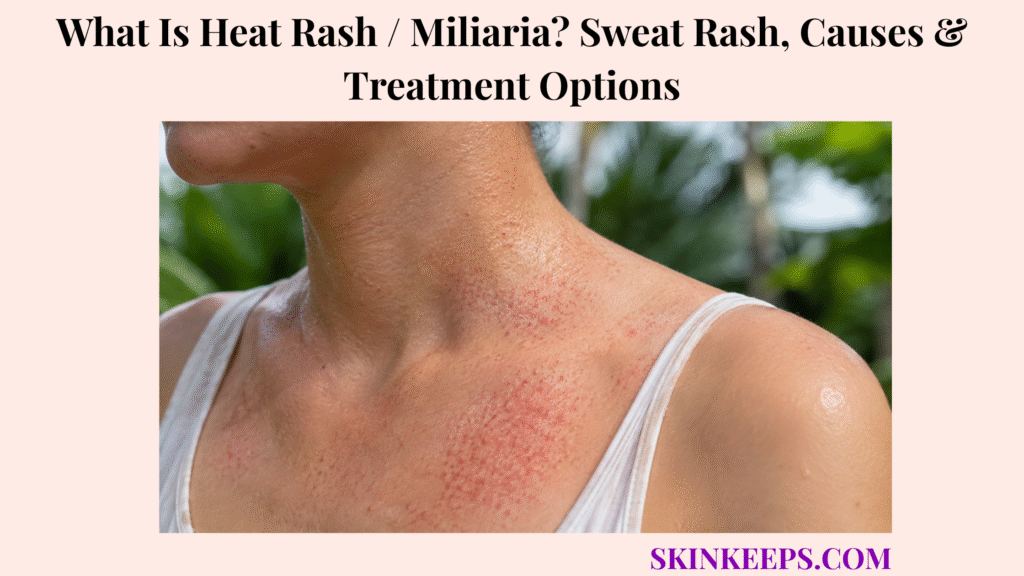
Heat rash, also called miliaria, sweat rash or prickly heat, develops when eccrine sweat ducts become blocked or inflamed and sweat becomes trapped within the skin.
It can affect newborns, children and adults after heat, humidity, fever, strenuous activity, prolonged bed rest or skin occlusion. Mild cases often improve once sweating decreases and the skin cools, but the four miliaria types have different appearances, symptoms and risks.
How Can You Recognize Heat Rash on the Skin?
Heat rash often appears as crops of tiny bumps or superficial blisters after sweating, overheating or skin occlusion.
Lesions may be clear, red, pink, flesh-coloured, grey or whitish. Itching, prickling, stinging, burning and mild swelling vary by type.
The bumps are generally not centred on individual hairs and often cluster beneath clothing, bedding, protective equipment or within folds.
Improvement after moving to a cooler, drier environment supports the diagnosis. On brown or Black skin, redness may be subtle, so texture, blistering, itch and the sweating relationship may be more useful.
- Recent heavy sweating, fever, overheating or occlusion.
- Tiny papules, papulovesicles or clear vesicles.
- Prickling, itch, stinging or burning.
- Covered, folded or friction-prone location.
- Non-follicular lesion pattern.
- Mild swelling possible.
- Cooling response.
- No assumption that every summer rash is miliaria.
Figure 1. Heat rash often appears after sweating or occlusion as tiny non-follicular bumps or superficial blisters in covered, folded, bedding-contact or equipment-contact skin.
Where Does Heat Rash Usually Appear?
Heat rash usually appears where sweat, clothing, bedding, folds or friction keep skin warm and occluded.
Adults commonly develop it on the upper chest, upper back, neck, scalp, armpits, groin, beneath the breasts, around the waistline and under tight clothing or equipment.
Infants often develop it in neck folds, shoulders, chest, back, armpits, groin, diaper-adjacent folds and elbow creases because sweat ducts and temperature regulation are less mature.
| Location | Adult Pattern | Infant or Child Pattern | Why It Occurs |
|---|---|---|---|
| Neck and scalp | Common | Very common | Heat and sweat retention |
| Upper chest and back | Common | Common | Clothing or bedding contact |
| Armpits and groin | Common | Common | Folds and moisture |
| Beneath breasts | Common | Not typical in infants | Occlusion and friction |
| Waistline or equipment areas | Common | Possible | Tight clothing or PPE |
| Diaper-adjacent folds | Not typical | Common | Warmth, moisture and occlusion |
| Elbow creases | Possible | Common | Fold heat and friction |
How Do Blocked Sweat Ducts Create Heat Rash?
Blocked sweat ducts create heat rash when sweat cannot move normally from eccrine glands to pores on the skin surface.
Eccrine glands produce watery sweat for cooling. Heat, moisture, occlusion or immature ducts can interrupt the route from gland to pore.
Trapped sweat stretches or ruptures the duct and leaks into nearby skin, creating clear vesicles, inflamed papules, pustules or deeper papules depending on obstruction depth.
Heat rash is not caused by dirty sweat on the surface; the blockage occurs within the sweat-duct pathway.
Figure 2. Miliaria crystallina, rubra, pustulosa and profunda reflect different obstruction depths, ranging from fragile clear vesicles to deeper papules that may impair sweating.
How Do the Different Types of Miliaria Appear?
Heat rash is an umbrella term covering several sweat-duct obstruction levels rather than one identical eruption.
What Does Miliaria Crystallina Look Like?
Miliaria crystallina is the most superficial form and produces tiny clear fluid-filled vesicles that resemble beads of sweat.
There is little inflammation, itch or pain. The fragile blisters rupture easily and may leave fine scale. It is common in newborns and adults with fever.
What Does Miliaria Rubra Look and Feel Like?
Miliaria rubra is the common prickly-heat form and produces inflamed, non-follicular papules or papulovesicles.
The lesions may be red, pink, darker or greyish, with itch, prickling, burning, stinging and mild swelling that worsen during sweating.
What Is Miliaria Pustulosa?
Miliaria pustulosa is a pustular variant of miliaria rubra.
White-tipped or pus-containing bumps require differentiation from bacterial or yeast folliculitis. Pustules do not automatically prove bacterial infection or require antibiotics.
What Is Miliaria Profunda?
Miliaria profunda is the deepest and rarest form, producing firm flesh-coloured or inflamed papules on the trunk and limbs.
It may follow repeated rubra and can reduce sweating in affected skin, increasing heat-intolerance risk.
| Type | Blockage Depth | Appearance | Symptoms | Main Concern |
|---|---|---|---|---|
| Crystallina | Very superficial | Clear fragile vesicles | Little or none | Usually mild |
| Rubra | Mid-epidermis | Inflamed papules or papulovesicles | Prickly itch or burning | Scratching and irritation |
| Pustulosa | Rubra with pustules | Pus-filled bumps | More inflamed | Infection or folliculitis confusion |
| Profunda | Deepest | Firm deeper papules | Variable | Impaired sweating and heat intolerance |
What Causes Heat Rash to Develop?
Heat rash develops when sweating continues under conditions that block sweat flow or trap moisture against the skin.
Triggers include hot humid weather, strenuous exercise, fever, immature newborn ducts, tight synthetic clothing, waterproof dressings, adhesive or transdermal patches, thick bedding, prolonged bed rest, waterproof mattress covers and occlusive products.
Medicines or illnesses that increase sweating, hospitalization and selected chemotherapy or radiation settings may also contribute.
The operational problem is trapped sweating and occlusion, not hot weather alone.
| Trigger | How It Traps Sweat | Common Area | Adjustment |
|---|---|---|---|
| Hot humidity | Increases sweat and moisture | Trunk, neck and folds | Cooling and ventilation |
| Exercise | Heavy sweat under clothing | Chest, back and folds | Cooler timing and clothing |
| Fever | Sweat beneath bedding | Trunk and neck | Treat fever and lighten bedding |
| Tight clothing | Occlusion and friction | Waist, groin and chest | Loose breathable fabric |
| Waterproof dressing | Blocks evaporation | Covered skin | Minimise when medically safe |
| Bed rest | Heat and pressure under bedding | Back and folds | Reposition and ventilate |
| Occlusive product | Blocks pores and evaporation | Applied area | Use lighter products |
Who Is More Likely to Develop Heat Rash?
Heat rash can affect any age, but risk rises when ducts are immature, sweating is heavy or skin remains warm and occluded.
Higher-risk groups include newborns, layered children, people entering tropical climates, athletes, outdoor workers, military or PPE users, people with fever, hospitalized or bedridden patients and people with excessive sweating.
Repeated previous episodes increase concern for deeper duct injury, especially in adults with prolonged tropical exposure.
| Risk Context | Why It Matters | Likely Pattern |
|---|---|---|
| Newborn | Immature ducts and temperature regulation | Crystallina or rubra |
| Hot humid climate | More sweating and moisture retention | Rubra |
| Heavy activity | Sweat under clothing | Rubra |
| Fever or bed rest | Sweat under bedding | Crystallina or rubra |
| Protective gear | Occlusion and friction | Rubra or pustulosa |
| Repeated episodes | Possible deeper duct injury | Profunda concern |
Is Heat Rash Contagious or Caused by Infection?
Heat rash is not contagious and is not primarily caused by infection.
It cannot spread through touch, towels, bedding or clothing and is not caused by poor hygiene or fungus.
The rash can involve more areas on the same person if additional ducts become blocked. Scratched or damaged lesions can develop secondary bacterial infection, which is a separate complication.
- Contagious: no.
- Fungal infection: no.
- Poor hygiene: no.
- Blocked or inflamed eccrine ducts: yes.
- Secondary bacterial infection after skin damage: possible.
- Household or partner treatment for ordinary miliaria: unnecessary.
How Is Heat Rash Different From Folliculitis?
Heat rash usually forms non-follicular papules or vesicles, while folliculitis forms bumps or pustules centred on hair follicles.
Miliaria closely follows overheating or occlusion and often produces a broad prickly sensation that improves with cooling.
Folliculitis may show a hair emerging through each lesion, more pustules and greater tenderness, with treatment based on bacterial, yeast-related, irritant or inflammatory cause.
| Clue | Heat Rash | Folliculitis |
|---|---|---|
| Lesion centre | Sweat duct; not hair-centred | Hair follicle-centred |
| Surface | Papule, vesicle or occasional pustule | Pustule or inflamed follicle |
| Trigger | Heat, sweat and occlusion | Microbial, friction or inflammatory |
| Main symptom | Prickling or itch | Tenderness, itch or pain |
| Cooling response | Often improves | Usually incomplete |
| Testing | Usually none | Culture or KOH when indicated |
How Is Heat Rash Different From Eczema or Contact Dermatitis?
Heat rash creates numerous tiny sweat-related bumps or vesicles, while eczema and contact dermatitis often form broader inflamed patches.
Eczema is usually dry, scaly, cracked or recurrent. Contact dermatitis often matches a textile, adhesive, cosmetic or product exposure and may produce swelling, scale or larger blisters.
Sweat can worsen all three, so discrete non-follicular bumps and rapid cooling response favour miliaria.
| Condition | Initial Lesion | Trigger | Scale | Course |
|---|---|---|---|---|
| Heat rash | Tiny papules or vesicles | Sweat and occlusion | Minimal | Often short after cooling |
| Eczema | Dry or scaly patches | Barrier tendency and irritants | Common | Recurrent or chronic |
| Contact dermatitis | Inflamed patch or blisters | Specific contact exposure | Possible | Persists if exposure continues |
How Is Heat Rash Different From Hives or Cholinergic Urticaria?
Heat rash lesions last hours or days, while cholinergic urticaria produces short-lived itchy welts that usually fade within minutes to hours.
Miliaria remains as papules or vesicles where sweat is trapped. Cholinergic urticaria starts quickly during exercise, heat or emotional stress and behaves like transient migrating wheals.
Antihistamines are more central to hives care than to sweat-duct obstruction.
| Feature | Heat Rash | Cholinergic Urticaria |
|---|---|---|
| Lesion | Papule or vesicle | Small wheal |
| Duration | Hours to days | Minutes to a few hours |
| Location | Covered and sweat-trapping skin | Trunk or neck spreading outward |
| Mechanism | Blocked eccrine duct | Inducible urticaria |
| Cooling | Stops continued obstruction | May end trigger |
| Antihistamine role | Adjunct | Central treatment |
How Is Heat Rash Different From Grover’s Disease?
Heat rash closely follows heat, humidity or occlusion, while Grover’s disease may persist or recur even after cooling.
Miliaria affects infants, children and overheated adults and forms tiny papules, vesicles or pustules.
Grover’s disease mainly affects middle-aged or older adults with rough, crusted or eroded central-chest and back papules that may last weeks or months.
| Feature | Heat Rash / Miliaria | Grover’s Disease |
|---|---|---|
| Main trigger | Sweat trapping and occlusion | May worsen with heat but not always triggered by it |
| Common age | Infants, children and overheated adults | Middle-aged or older adults |
| Lesions | Tiny papules, vesicles or pustules | Rough, crusted or eroded papules |
| Course | Often improves quickly with cooling | May persist or recur |
| Testing | Usually clinical | Biopsy if uncertain |
How Is Heat Rash Different From Fungal Rashes in Skin Folds?
Heat rash forms tiny sweat-related bumps or vesicles, while fungal fold rashes usually form broader moist or scaly plaques.
Candida may cause a moist fold plaque with satellite pustules, while dermatophyte infection may have a scaly advancing border.
Persistent maceration, odour, cracking or satellite lesions may need scraping, culture or antifungal assessment rather than continued cooling alone.
| Pattern | More Suggestive Of |
|---|---|
| Tiny sweat bumps after occlusion | Miliaria |
| Moist plaque with satellite pustules | Candida-type fold rash |
| Scaly advancing edge | Dermatophyte infection |
| Persistent maceration and odour | Intertrigo or infection assessment |
How Is Heat Rash Different From a Sun Rash?
Heat rash is triggered by sweating and duct blockage, while polymorphic light eruption is triggered by ultraviolet exposure.
Miliaria often affects covered or occluded skin and can occur without direct sunlight.
Polymorphic light eruption develops on sun-exposed skin within hours or days of UV exposure and may recur seasonally.
| Clue | Heat Rash | Polymorphic Light Eruption |
|---|---|---|
| Primary trigger | Sweat and occlusion | Ultraviolet exposure |
| Distribution | Covered, folded or friction-prone | Sun-exposed areas |
| Onset | During or after sweating | Hours or days after sunlight |
| Lesions | Tiny papules or vesicles | Papules, plaques or blisters |
| Prevention | Cooling and ventilation | Sun protection and exposure control |
How Do Clinicians Diagnose Heat Rash?
Clinicians usually diagnose heat rash from timing, lesion pattern, body location and response to cooling.
Assessment reviews heat, fever or sweating; clothing, bedding or equipment occlusion; lesion depth and type; follicular relationship; body distribution; itch, prickling or pain; medication and hospitalization history; and infection or heat-illness signs.
There is no routine blood test that confirms heat rash.
- Heat, fever or sweating timing.
- Occlusive clothing, bedding, dressing or equipment.
- Clear vesicle, inflamed papule, pustule or deep papule.
- Follicular versus non-follicular pattern.
- Body distribution.
- Prickling, itch, pain or tenderness.
- Cooling response.
- Medication and hospitalization context.
- Secondary infection signs.
- Heat-exhaustion or heat-stroke signs.
When Are Skin Tests or a Biopsy Needed for Possible Miliaria?
Skin tests or biopsy are unnecessary for most classic heat rash but may help when disease is severe, recurrent, persistent, pustular, vesicular, deep or uncertain.
Bacterial culture can evaluate pustules, fungal scraping or culture can assess scaly folds, viral testing can evaluate grouped vesicles and punch biopsy can assess repeated deep papules or persistent atypical disease.
Tzanck smear may help in selected vesicular presentations, but modern viral testing is often more specific. Biopsy can show obstruction depth but is unnecessary for rapidly resolving classic cases.
| Presentation | Possible Test | Purpose |
|---|---|---|
| Pustules | Bacterial culture | Confirm or exclude bacterial infection |
| Scaly fold rash | Fungal scraping or culture | Assess Candida or dermatophyte |
| Grouped vesicles | Viral testing; selected Tzanck | Exclude herpes or newborn vesicular disease |
| Recurrent deep papules | Punch biopsy | Assess profunda or alternative disease |
| Persistent truncal papules | Biopsy if needed | Exclude Grover’s or another dermatosis |
Does Heat Rash Require Treatment?
Mild heat rash usually does not need prescription treatment because cooling and reducing sweating are the first steps.
Crystallina often settles rapidly after cooling, while rubra may need itch relief. Pustular or infected disease may require targeted antimicrobial treatment.
Profunda requires closer evaluation because impaired sweating can increase heat-illness risk. Failure to improve should trigger diagnostic reassessment, not indefinite home treatment.
| Situation | Best Direction | Reason |
|---|---|---|
| Clear painless vesicles | Cool and observe | Often self-limited |
| Itchy papules | Cooling plus symptom relief | Itch control |
| Pustules | Clinical assessment | Infection or folliculitis possible |
| Deep recurrent papules | Medical review | Sweating impairment risk |
| Persistent rash | Reconsider diagnosis | May not be miliaria |
| Heat-illness symptoms | Urgent care | Temperature control risk |
How Can Mild Heat Rash Be Treated at Home?
Mild heat rash is treated by cooling the skin, removing occlusion and reducing further sweating.
- Move into shade, ventilation or air conditioning.
- Pause strenuous activity.
- Remove excess clothing.
- Change out of damp garments.
- Wear loose lightweight breathable fabrics.
- Use lightweight bedding.
- Take a cool or lukewarm shower or bath.
- Apply a cool damp cloth.
- Allow skin to air-dry when practical.
- Drink adequate fluids.
- Pat or tap rather than scratch.
- Keep folds dry without vigorous rubbing.
Continuing heavy exercise while only applying lotion undermines the main treatment.
Which Treatments Can Relieve Heat-Rash Itching and Inflammation?
Calamine, mild topical corticosteroids and antihistamines may relieve symptoms, but none replaces cooling and sweat reduction.
How Can Calamine Lotion Help Heat Rash?
Calamine may cool and lightly dry the skin, reducing mild prickling and irritation.
It can over-dry some skin, should be applied lightly and should not be covered with an occlusive dressing.
When Are Mild Topical Corticosteroids Used?
A mild topical corticosteroid may reduce inflammation and itch in miliaria rubra for a limited period.
Potency must match age and body site. Strong preparations should not be used casually on babies, folds or large areas.
Can Antihistamines Reduce Prickly-Heat Itching?
Antihistamines may help selected people with troublesome itch but do not unblock sweat ducts.
Sedating products can cause drowsiness, and age, pregnancy, other medicines and medical conditions affect suitability.
| Option | Target | Role | Limitation | Caution |
|---|---|---|---|---|
| Calamine | Prickling and irritation | Cooling and drying | Can over-dry | Avoid occlusion |
| Mild topical steroid | Inflammation and itch | Short-term adjunct | Does not fix sweating | Caution in babies, folds and large areas |
| Antihistamine | Itch or sleep disruption | Adjunct | Does not unblock ducts | Drowsiness and interaction risk |
How Is Miliaria Pustulosa or Infected Heat Rash Treated?
Miliaria pustulosa or possible infected heat rash should be reassessed when pustules are painful, spreading, warm, crusted or associated with fever.
- Increasing pain or tenderness.
- Expanding redness.
- Warmth.
- Pus or crusting.
- Swelling.
- Foul drainage.
- Fever or systemic illness.
Assessment may include culture. Antiseptic, topical antibiotic or systemic antibiotic treatment is reserved for bacterial infection that is confirmed or strongly suspected.
Cooling and reducing occlusion continue, while folliculitis, impetigo and fungal disease are reconsidered.
Decision: itchy non-tender bumps → cooling; pustules without systemic signs → assessment; spreading pain, redness or fever → prompt care.
How Should Heat Rash Be Managed in Babies?
Heat rash in babies is managed by gently cooling the environment, removing excess layers and monitoring feeding, urine output and behaviour.
- Remove unnecessary clothing layers.
- Use loose lightweight clothing.
- Keep the sleeping area cool and ventilated.
- Avoid heavy blankets.
- Check neck, armpit and groin folds.
- Use a cool or lukewarm bath.
- Pat dry gently.
- Avoid thick greasy products over the rash.
- Do not use medicated creams without age-appropriate advice.
- Maintain feeding and hydration.
- Monitor temperature and general behaviour.
Babies are vulnerable to both overheating and becoming too cold, so the goal is comfortable temperature control rather than aggressive chilling.
Why Can Miliaria Profunda Increase Heat-Illness Risk?
Miliaria profunda can increase heat-illness risk because repeated deep duct obstruction may reduce sweating in affected skin.
Less sweat reaches the surface for evaporation, while unaffected areas may sweat more to compensate. Extensive anhidrosis limits heat release and makes exercise or physical work harder to tolerate.
Dizziness, headache, weakness, nausea, cramps, rapid pulse, confusion, fainting, very hot skin or inability to cool require urgent heat-illness evaluation.
Heat-risk pathway: deep duct blockage → reduced sweating → retained heat → heat exhaustion → possible heat stroke.
Which Heat-Rash Treatment Mistakes Should Be Avoided?
Treatment mistakes worsen the same problem that caused the rash: heat, trapped sweat, moisture and blocked evaporation.
| Unsafe Action | Why It Worsens Miliaria | Possible Harm | Safer Alternative |
|---|---|---|---|
| Heavy exercise in heat | More sweating | More rash or heat illness | Pause or move activity |
| Tight synthetic clothing | Blocks evaporation | Occlusion and friction | Loose breathable fabric |
| Staying in damp clothing | Keeps skin wet | Ongoing irritation | Change promptly |
| Thick greasy products | Add occlusion | Worsening rash | Avoid over active rash |
| Airtight dressings | Trap sweat | More obstruction | Minimise when safe |
| Scrubbing or exfoliating | Irritates skin | Barrier damage | Gentle washing |
| Popping blisters | Opens skin | Infection risk | Leave intact |
| Undiluted oils, alcohol or acids | Irritant exposure | Burns and dermatitis | Avoid harsh remedies |
| Strong steroid without guidance | Masks disease and thins skin | Side effects | Use only when advised |
| Antibiotic without infection | Wrong target | Side effects and resistance | Use only if indicated |
| Indefinite antifungal | May treat wrong diagnosis | Delay and irritation | Test persistent fold rash |
| Talcum near infant face | Inhalation risk | Breathing irritation | Avoid loose powder |
How Long Does Heat Rash Last—and Can It Return?
Heat rash often improves quickly after cooling but can return whenever heavy sweating and occlusion return.
Crystallina may settle within about a day, while mild rubra often improves within a few days. Scratching, infection or deeper disease may prolong recovery.
Repeated tropical, occupational or equipment exposure can cause recurrence, and persistent deep disease may impair sweating.
Temporary post-inflammatory hyperpigmentation or lighter marks may remain after inflammation, especially on darker skin, but uncomplicated miliaria usually does not scar.
Course: heat exposure → rash → cooling → improvement → re-exposure → possible recurrence.
How Can Heat Rash Be Prevented?
Heat rash prevention depends on controlling heat, humidity, sweat and occlusion together.
- Wear loose lightweight breathable clothing.
- Avoid excessive layering.
- Use moisture-wicking fabric during activity.
- Take regular cooling breaks.
- Schedule strenuous exercise during cooler hours.
- Change damp clothes promptly.
- Keep sleeping areas cool and ventilated.
- Use lightweight bedding.
- Avoid prolonged contact with waterproof surfaces.
- Reposition bedridden patients as medically appropriate.
- Minimise unnecessary occlusive dressings.
- Avoid thick products on heat-prone skin.
- Acclimatise gradually to hot environments.
- Dress infants comfortably rather than heavily wrapping them.
- Review sweating-inducing medicines with the prescriber instead of stopping them independently.
When Should Heat Rash Be Checked by a Clinician?
Heat rash should be checked when it does not improve after cooling, keeps recurring, becomes pustular or painful, affects an infant, or appears with heat-illness symptoms.
- No improvement after several days.
- Continues in a cooler environment.
- Frequent recurrence.
- Sleep-disrupting itch.
- Pustules or deep firm papules.
- Uncertain rash in a baby.
- Hospitalization, immunocompromise or chemotherapy.
- Rash beginning after a new medicine.
- Prescription treatment being considered.
Prompt or emergency care: fever with increasing redness or pain, pus, warmth, spreading swelling, large blisters, extensive peeling, mouth, eye or genital involvement, breathing difficulty, reduced infant feeding or urine, dizziness, vomiting, profound weakness, confusion, fainting, severe overheating or inability to sweat.
Figure 3. Mild heat rash is managed by cooling and removing occlusion, while persistent, pustular, deep, infant-related or heat-illness presentations require reassessment and targeted testing.
What Should You Remember About Heat Rash / Miliaria?
Heat rash develops when eccrine sweat ducts become blocked or inflamed, trapping sweat within the skin.
- Heat rash is also called miliaria, sweat rash or prickly heat.
- Crystallina causes clear superficial vesicles.
- Rubra causes itchy or prickly inflamed bumps.
- Pustulosa produces pustules and may mimic infection.
- Profunda is rare, deeper and can impair sweating.
- Heat, humidity, fever, exercise, clothing and prolonged occlusion increase risk.
- Heat rash is not contagious or fungal.
- Cooling and drying are first-line.
- Calamine, antihistamines and mild steroids are adjuncts.
- Pustules do not automatically require antibiotics.
- Recurrent deep disease and heat-illness symptoms need medical assessment.
What Questions Do People Ask About Heat Rash / Miliaria?
Is heat rash the same as prickly heat?
Prickly heat usually refers to miliaria rubra, the itchy or prickly inflamed form. Heat rash or miliaria is broader and also includes crystallina, pustulosa and profunda.
What do heat-rash bumps look like?
They may be tiny clear blisters, red or pink bumps, grey or whitish bumps on darker skin, pustules or deeper firm papules depending on the type.
Can heat rash occur without hot weather?
Yes. Fever, heavy bedding, overdressing, prolonged bed rest, non-breathable clothing, protective equipment, dressings, occlusive products or hospitalization can trap sweat even in cooler weather.
Why do babies develop heat rash easily?
Babies have immature sweat ducts and less mature temperature regulation, so warm rooms, heavy blankets, extra layers and skin folds trap sweat more easily.
Is heat rash contagious?
No. It cannot spread through touch, towels, bedding or clothing. More areas on the same person may become involved if heat, sweating and occlusion continue.
Can heat rash spread across the body?
It can affect additional areas of one person’s skin when more sweat ducts become blocked, but it is not transmitted to other people.
How is heat rash different from folliculitis?
Heat rash usually forms non-follicular bumps or vesicles after sweating or occlusion, while folliculitis produces bumps or pustules centred on individual hairs.
Can heat rash produce pus-filled bumps?
Yes. Miliaria pustulosa can contain pustules, but painful, warm, spreading or fever-associated pustules may indicate folliculitis or secondary infection.
Does heat rash itch more when you sweat?
Yes, especially miliaria rubra. Continued sweating can increase prickling, stinging or burning because more sweat is trapped in obstructed ducts.
Can thick moisturizer make heat rash worse?
Thick greasy products may worsen heat rash by increasing occlusion or blocking evaporation. Avoid heavy products over active sweat-prone areas.
Should heat-rash blisters be popped?
No. Popping blisters or pustules opens the skin, increases irritation and raises infection risk.
How quickly does heat rash clear?
Mild heat rash often improves within a few days after cooling, and superficial crystallina may improve faster. Persistent, recurrent, pustular or deep disease needs assessment.
Can heat rash leave dark or light marks?
Temporary dark or light marks can remain after inflammation, especially in darker skin tones, but uncomplicated heat rash usually heals without scarring.
Can repeated heat rash stop the skin from sweating?
Repeated deeper miliaria, especially profunda, can reduce sweating in affected skin and increase heat intolerance.
When does heat rash require medical treatment?
Medical assessment is appropriate for several-day persistence, worsening despite cooling, frequent recurrence, sleep-disrupting itch, pustules, deep papules, infant uncertainty, hospitalization, immunocompromise, chemotherapy or a new medicine.
Which heat-rash symptoms could indicate heat exhaustion?
Dizziness, headache, weakness, nausea, muscle cramps, rapid pulse, confusion, fainting, very hot skin, severe overheating or inability to cool require urgent heat-illness assessment.
Which Sources Support This Heat-Rash Guidance?
DermNet — Miliaria — Eccrine sweat-duct obstruction, miliaria types, causes, features, complications, diagnosis, biopsy, Tzanck smear, treatment and outcome.
Mayo Clinic — Heat Rash Symptoms and Causes — Adult and infant locations, type descriptions, mechanism, risk factors, complications and prevention.
NHS — Heat Rash / Prickly Heat — Symptoms across skin tones, non-contagious status, cooling care, calamine, antihistamines, hydrocortisone caution and care threshold.
DermNet — Cholinergic Urticaria — Heat and exercise-related transient wheals and timing differences from persistent miliaria lesions.
NHS — Polymorphic Light Eruption — Ultraviolet-triggered sun rash, onset after exposure, sun-exposed distribution and recurrence.
This SkinKeeps article is educational and does not diagnose or replace dermatology, paediatric, primary-care, infectious-disease, emergency or heat-illness evaluation. Seek care for rash lasting several days despite cooling, frequent recurrence, pustules, deep papules, infant uncertainty, immunocompromise, chemotherapy, new-medicine onset, fever with spreading pain or redness, pus, large blisters, peeling, mucosal involvement, breathing difficulty, reduced infant feeding or urine, dizziness, vomiting, weakness, confusion, fainting, severe overheating or inability to sweat. Do not pop lesions, scrub, use harsh chemicals, strong steroids, unnecessary antibiotics, indefinite antifungals or talcum near an infant’s face.