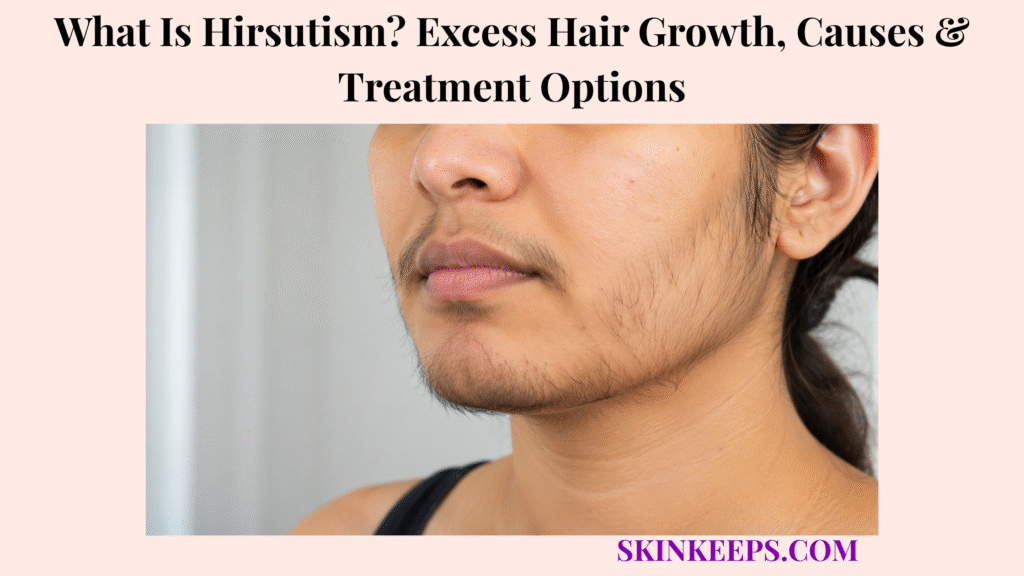
Hirsutism is excessive growth of coarse, dark terminal hair in androgen-sensitive areas such as the face, chest, abdomen, back or inner thighs. It does not mean every visible, unwanted or fine body hair.
PCOS is the most common associated endocrine condition, but some people have normal androgen tests and sensitive follicles. Sudden progression, voice deepening or other virilizing changes need prompt investigation; treatment combines cause-directed care with safe removal of existing hair.
How Can You Recognize Hirsutism?
Hirsutism is recognized by coarse, dark terminal hairs that increase in androgen-sensitive areas rather than fine, soft or isolated hairs alone.
- Hair becomes thicker, longer and more pigmented.
- Growth follows an androgen-sensitive distribution.
- Hair increases progressively after puberty.
- Shaving, waxing or plucking is needed more often.
- Acne or scalp hair thinning may accompany growth.
- Menstrual cycles may become irregular.
- The pattern may differ across families and ethnic backgrounds.
- Hair removal before examination can hide visible severity, so self-report matters.
Figure 1. Hirsutism means coarse pigmented terminal hair in androgen-sensitive areas; fine vellus hair, isolated hairs and generalized excess hair require a different assessment.
Where Does Hirsutism Usually Cause Excess Hair Growth?
Hirsutism usually affects the upper lip, chin, jawline, neck, chest, abdomen, back and inner thighs.
| Area | Typical Pattern | Clinical Note |
|---|---|---|
| Upper lip and chin | Coarse pigmented facial hair | Common patient-important area |
| Jawline and sideburns | Progressive terminal hairs | Assess associated signs |
| Front of neck | Coarse hair | Consider full distribution |
| Chest and nipples | Terminal hairs around sternum or areolae | Isolated hairs may be normal |
| Upper/lower abdomen | Midline terminal hair | Part of mFG scoring |
| Upper/lower back | Coarse hair | Part of mFG scoring |
| Inner thighs/upper arms | Variable involvement | Context and progression matter |
One isolated chin or nipple hair does not automatically establish hirsutism.
How Is Hirsutism Different From Normal Body-Hair Variation?
Normal terminal-hair density varies with genetics, family background and ethnicity, so assessment must consider context and progression.
Clinical scoring thresholds vary between populations, and hair removal can hide severity.
Regular periods and absence of androgen-excess signs make a dangerous endocrine cause less likely, but distress can still justify treatment.
| Question | Normal Variation More Likely | Hirsutism Evaluation More Useful |
|---|---|---|
| Texture | Fine or stable terminal hair | Coarse progressive terminal hair |
| Pattern | Familial and non-progressive | Androgen-sensitive distribution |
| Cycles | Regular | Irregular or absent |
| Associated signs | None | Acne, scalp loss or virilization |
| Impact | Low or manageable | Patient-important distress |
How Is Hirsutism Different From Hypertrichosis?
Hirsutism is androgen-pattern terminal hair growth, while hypertrichosis is excessive hair outside the typical androgen-sensitive pattern.
| Feature | Hirsutism | Hypertrichosis |
|---|---|---|
| Hair type | Coarse terminal hair | Vellus or terminal hair |
| Pattern | Androgen-sensitive | Localized or generalized |
| Main question | Androgen effect or follicle sensitivity? | Medicine, genetic or systemic cause? |
| Common workup | PCOS and androgen assessment | Exposure and systemic review |
| Example medicine | Androgenic exposure | Minoxidil can cause generalized growth |
How Do Androgens Change Fine Hair Into Coarse Terminal Hair?
Androgens can convert fine vellus hairs into thicker, darker terminal hairs when follicles are genetically sensitive.
Testosterone can be converted locally into stronger dihydrotestosterone, or DHT. Androgen-receptor and enzyme activity then influence follicle enlargement and hair-shaft thickness.
Existing terminal hairs do not disappear immediately when androgen activity improves because facial hair cycles are long and asynchronous.
Figure 2. Ovarian or adrenal androgen production, reduced SHBG and local follicular sensitivity can convert fine vellus hair into thicker, darker terminal hair; normal tests do not exclude a sensitive-follicle pattern.
What Causes Hirsutism?
Hirsutism can result from PCOS, idiopathic follicular sensitivity, adrenal or ovarian androgen disorders, selected medicines or external androgen exposure.
| Cause Group | Examples | Typical Clue |
|---|---|---|
| Common endocrine | PCOS | Gradual growth with menstrual or metabolic signs |
| Idiopathic | Sensitive follicles with normal tests | Regular cycles and stable pattern |
| Adrenal | Nonclassic CAH, Cushing syndrome or tumour | Adrenal features or concerning labs |
| Ovarian | Hyperthecosis or androgen-producing tumour | Rapid progression or virilization |
| Medication/exposure | Testosterone, anabolic steroid, danazol or valproate | Timing follows exposure |
| Follicular biology | Normal androgen level but strong response | Clinical hirsutism with normal tests |
How Does Polycystic Ovary Syndrome Cause Hirsutism?
PCOS can cause hirsutism by increasing active androgen signals that stimulate sensitive follicles.
When coarse terminal hair appears with irregular periods, scalp thinning or acne, clinicians may assess a broader androgen-excess pattern rather than treating hair alone.
Dark velvety changes such as acanthosis nigricans can support evaluation for insulin resistance.
- Irregular or absent periods.
- Infrequent ovulation or fertility difficulty.
- Acne or female-pattern scalp thinning.
- Insulin resistance and lower SHBG.
- Higher free testosterone activity.
- Metabolic risk.
- Polycystic ovarian morphology in selected cases.
Not every person with PCOS has ovarian cysts, and facial hair alone cannot confirm PCOS.
What Is Idiopathic Hirsutism?
Idiopathic hirsutism describes androgen-pattern terminal hair despite regular menstrual cycles and normal androgen testing.
Possible explanations include increased follicular sensitivity, stronger local conversion to DHT, genetic variation and laboratory limitations.
Idiopathic does not mean imaginary; treatment is reasonable when hair causes distress.
Which Adrenal Disorders Can Cause Hirsutism?
How Does Nonclassic Congenital Adrenal Hyperplasia Cause Hirsutism?
Nonclassic congenital adrenal hyperplasia usually reflects partial 21-hydroxylase deficiency and increased adrenal androgen production.
Hirsutism, acne, irregular periods or reduced fertility may occur. Early-morning 17-hydroxyprogesterone is used for selected screening.
How Can an Adrenal Tumour Cause Hirsutism?
An androgen-producing adrenal tumour can cause rapidly progressive hirsutism and virilization.
Adrenal imaging is targeted to a concerning clinical and biochemical pattern rather than ordered for every mild case.
How Can Cushing Syndrome Cause Excess Hair?
Cushing syndrome can cause excess hair with easy bruising, purple stretch marks, muscle weakness, central weight gain, high blood pressure or altered glucose regulation.
Testing is symptom-directed.
| Disorder | Accompanying Signs | Screening Direction | Imaging Trigger |
|---|---|---|---|
| Nonclassic CAH | Acne, irregular periods or family/ethnic risk | Early-morning 17-OHP | Specialist-directed |
| Adrenal tumour | Rapid progression or virilization | DHEAS and androgen profile | Suspicious signs or labs |
| Cushing syndrome | Bruising, striae, weakness and central weight | Cushing testing | Symptom-directed |
Which Ovarian Conditions Can Cause Severe Hirsutism?
Ovarian causes include PCOS, androgen-producing tumours, ovarian hyperthecosis and severe insulin-resistance states.
| Ovarian Cause | Pattern | Concern Level |
|---|---|---|
| PCOS | Gradual development during reproductive years | Common |
| Ovarian hyperthecosis | Progressive, often after menopause | Specialist evaluation |
| Androgen-producing tumour | Rapid or virilizing pattern | Prompt evaluation |
Speed of change and virilization are more concerning than slow growth beginning near puberty.
Which Medicines Can Cause Hirsutism or Excess Hair Growth?
Some medicines and external hormone exposures can cause androgen-pattern hirsutism or generalized hypertrichosis.
- Testosterone therapy or accidental testosterone-gel contact.
- Anabolic steroids.
- Danazol.
- Valproate.
- Selected androgenic progestins.
- Some immunosuppressive medicines.
- Minoxidil.
- Long-term glucocorticoid exposure through endocrine effects.
A medication review matters, but medicine-related hair growth should not be confused with a drug rash, which follows a different skin-reaction pathway.
Essential medicines should not be stopped without prescriber guidance.
Which Hirsutism Symptoms Suggest Virilization?
Virilization means androgen effects beyond hair growth and requires prompt evaluation.
- Voice deepening.
- Clitoral enlargement.
- Rapidly increasing muscle mass.
- Male-pattern scalp recession or pronounced balding.
- Marked acne or oily skin.
- Reduced breast tissue.
- Menstrual periods stopping.
- Rapid increase in facial or body hair.
Red flag: rapid hair growth plus voice, muscle, clitoral or menstrual change → prompt endocrine evaluation.
When Is Sudden Hirsutism More Concerning Than Gradual Hair Growth?
Sudden or rapidly progressive hirsutism is more concerning than stable years-long growth, particularly when virilization appears.
| Feature | Gradual Pattern | Concerning Rapid Pattern |
|---|---|---|
| Timing | Years after puberty | Progression over months |
| Cycles | Stable or chronically irregular | Abrupt stopping |
| Virilization | Absent | Present |
| Mass symptoms | Absent | Pelvic or abdominal mass/pain |
| Direction | Routine endocrine assessment | Prompt specialist investigation |
How Is Hirsutism Assessed in Adolescents?
Adolescent hirsutism should be taken seriously while recognizing that puberty can normally change hair growth and menstrual regularity.
Severe or progressive hair, persistent cycle irregularity, significant acne, scalp hair loss or virilization deserves evaluation.
Treatment for distressing hair does not need to wait for every PCOS uncertainty to resolve, and longitudinal follow-up can clarify the pattern.
Why Does New Hirsutism After Menopause Need Careful Evaluation?
New severe or rapidly progressive hirsutism after menopause needs evaluation because ovarian hyperthecosis or an androgen-producing tumour may need exclusion.
A few additional facial hairs can occur with age-related hormonal change, but rapid widespread growth or virilization is not automatically normal.
Medication and supplement exposure should also be reviewed.
How Do Clinicians Diagnose Hirsutism?
Clinicians diagnose hirsutism by examining terminal-hair distribution, progression and related endocrine signs, then using tests to identify the cause when needed.
- Age at onset and speed of progression.
- Menstrual and fertility history.
- Acne and scalp hair loss.
- Weight and metabolic changes.
- Voice, muscle or clitoral changes.
- Family hair-growth pattern.
- Medicine and supplement exposure.
- Previous hair-removal methods.
- Pregnancy plans and psychological impact.
- Modified Ferriman–Gallwey score when useful.
Hirsutism is a clinical finding; blood tests and imaging investigate the cause.
How Does the Modified Ferriman–Gallwey Score Measure Hirsutism?
The modified Ferriman–Gallwey score grades coarse terminal hair in nine androgen-sensitive areas.
Each area receives a score from 0 to 4, and the values are added. The 2023 PCOS guideline supports ethnicity- and population-sensitive interpretation, often around a threshold of 4–6.
| Area | Score Range | Important Limitation |
|---|---|---|
| Upper lip | 0–4 | Hair removal can hide severity |
| Chin | 0–4 | Localized distress may be high |
| Chest | 0–4 | Ethnic variation matters |
| Upper/lower abdomen | 0–4 each | Only terminal hair is counted |
| Upper/lower back | 0–4 each | Scoring is subjective |
| Upper arms and thighs | 0–4 each | Sideburns/buttocks not in traditional score |
A low total does not invalidate patient-important facial hair.
Which Blood Tests Are Used to Investigate Hirsutism?
Blood tests usually assess androgen activity first, then target adrenal, ovarian, pituitary, thyroid or metabolic causes when symptoms support them.
| Test | Clinical Question | Interpretation Issue | Management Impact |
|---|---|---|---|
| Total testosterone | General androgen excess? | Use a reliable assay | High result prompts workup |
| Free testosterone / FAI | Biologically active androgen? | SHBG changes interpretation | Supports hyperandrogenism |
| SHBG | Binding protein level? | Affected by insulin and hormones | Explains free fraction |
| DHEAS | Adrenal contribution? | Pattern-dependent | May prompt adrenal evaluation |
| 17-hydroxyprogesterone | Nonclassic CAH? | Early-morning sample | Specialist testing |
| Pregnancy / prolactin / thyroid | Other cycle cause? | Symptom-directed | Changes treatment |
| Glucose / lipids | Metabolic PCOS risk? | Risk-based | Metabolic care |
Combined oral contraceptives alter SHBG and androgen production, which can complicate laboratory interpretation.
Does Every Person With Unwanted Facial Hair Need Hormone Testing?
Not every person with mild stable localized facial hair needs hormone testing, but testing is important when growth is moderate, progressive or linked to endocrine signs.
| Pattern | Testing Direction |
|---|---|
| Mild localized stable hair, regular cycles, no endocrine signs | Cosmetic management may begin without routine androgen testing |
| Abnormal hair score or moderate/severe growth | Androgen testing |
| Irregular periods, infertility, acne or scalp loss | Androgen and cause-directed testing |
| Acanthosis or metabolic signs | Metabolic and PCOS assessment |
| Rapid progression or virilization | Prompt comprehensive evaluation |
When Are Pelvic Ultrasound, CT or MRI Needed?
Imaging should answer a defined ovarian or adrenal question rather than being ordered for mild unwanted hair alone.
| Clinical Question | Possible Imaging | Reason |
|---|---|---|
| PCOS remains uncertain | Pelvic ultrasound in selected adults | Assess ovarian morphology |
| Ovarian lesion suspected | Pelvic ultrasound or specialist imaging | Rapid androgen excess or mass |
| Adrenal source suspected | Adrenal CT or MRI | Concerning DHEAS or virilization |
| Adolescent PCOS assessment | Ultrasound usually not routine | Morphology can be nonspecific |
| Mild isolated hair | No routine imaging | Low yield |
Polycystic ovarian morphology alone does not prove PCOS.
Does Hirsutism Require Treatment?
Treatment is optional when a serious cause has been excluded, but it is reasonable whenever hair growth causes distress or affects daily life.
Hair removal alone may fit mild idiopathic hirsutism. Hormonal treatment slows new growth but does not immediately remove established terminal hair.
Combining cause-directed medical care with direct hair removal often provides the best practical result.
Which Temporary Hair-Removal Methods Can Manage Hirsutism?
Temporary methods remove existing terminal hair while medical treatments work slowly on future growth.
Frequent shaving, waxing or epilation can irritate follicles, so recurring tender bumps should be separated from folliculitis.
| Method | Speed | Duration | Main Risk | Best Use |
|---|---|---|---|---|
| Shaving/trimming | Immediate | Short | Minor irritation | Face or body |
| Threading/tweezing | Immediate | Longer | Pain and follicle irritation | Small areas |
| Waxing/epilation | Immediate | Longer | Ingrown hair and pigment change | Larger areas if tolerated |
| Depilatory cream | Fast | Short | Chemical irritation | Patch-test first |
| Bleaching | Fast camouflage | Variable | Irritation | Fine visible dark hair |
Does Shaving Make Hirsutism Hair Grow Back Thicker?
Shaving does not make hair biologically thicker, darker or faster-growing.
It cuts the shaft at skin level without changing the follicle, hair count or biological diameter.
Blunt short regrowth can feel coarser and look darker than a naturally tapered hair.
| Claim | Fact |
|---|---|
| Blunt regrowth may feel thicker | Yes |
| Shaving enlarges the follicle | No |
| Shaving increases hair count | No |
| Shaving accelerates biological growth | No |
How Does Eflornithine Cream Slow Facial Hair Growth?
Eflornithine cream slows facial hair production but does not remove hair that already exists.
Visible improvement can take about six to eight weeks, and shaving or another method may still be needed.
Hair growth returns after stopping. Dryness, itching, stinging or follicular irritation can occur, and pregnancy or breastfeeding use needs medical review.
How Do Combined Oral Contraceptives Treat Hirsutism?
Combined oral contraceptives reduce ovarian androgen production and increase SHBG, which lowers free testosterone activity.
- Reduce ovarian androgen production.
- Increase androgen-binding protein.
- Lower biologically active free testosterone.
- Regulate menstrual cycles.
- May improve acne.
- Gradually reduce new terminal-hair stimulation.
They are a common first pharmacologic option for eligible people not seeking pregnancy. Clotting, migraine, smoking and cardiovascular risks must be reviewed, and effect is usually judged after at least six months.
When Are Antiandrogen Medicines Used for Hirsutism?
Antiandrogens may be added when combined oral contraceptives or cosmetic therapy do not provide enough improvement, but reliable contraception is essential when pregnancy is possible.
| Medicine | Action | Monitoring | Pregnancy Restriction | Major Risk |
|---|---|---|---|---|
| Spironolactone | Blocks androgen action | Potassium/BP as needed | Reliable contraception | Hyperkalaemia and bleeding change |
| Finasteride | Reduces DHT pathway | Specialist review | Strict avoidance | Fetal genital-development risk |
| Cyproterone acetate | Antiandrogen/progestin | Region-specific | Contraception | Dose-specific safety issues |
| Flutamide | Antiandrogen | Not routine | Pregnancy prevention | Severe liver toxicity |
Guidelines support antiandrogen add-on after an adequate trial and recommend against monotherapy without effective contraception.
Can Metformin Reduce Hirsutism?
Metformin may support metabolic PCOS care, but it is usually not the strongest treatment when visible hirsutism is the main goal.
It improves insulin sensitivity, may support cycles and is more central for impaired glucose regulation or diabetes risk.
Visible hair improvement is generally modest compared with combined oral contraceptives. Gastrointestinal effects are common initially, and long-term use may warrant vitamin B12 review in at-risk patients.
Can Lifestyle Changes Improve Hirsutism?
Lifestyle changes can support metabolic and reproductive health in PCOS, but existing coarse terminal hair does not disappear rapidly from lifestyle change alone.
- Healthy eating patterns.
- Regular physical activity.
- Prevention of further weight gain.
- Weight reduction when personally appropriate.
- Sleep and stress support.
- Insulin-resistance and cardiovascular-risk care.
- Smoking cessation.
People at every body weight deserve evaluation and treatment; medical care should not be withheld until weight changes occur.
How Does Laser Hair Reduction Treat Hirsutism?
Laser hair reduction uses light energy to target melanin in pigmented hair follicles.
Only some hairs are in the correct active-growth phase at one time, so multiple sessions and maintenance may be needed.
Because treatment irritation can leave darker or lighter marks, people prone to pigment change such as chloasma / melasma should use experienced providers and cautious settings.
| Hair/Skin Pattern | Expected Benefit | Main Risk |
|---|---|---|
| Dark coarse hair | Stronger laser target | Pain, burns or pigment change |
| Brown hair | Device-dependent benefit | Pigment alteration |
| Blonde/white/grey hair | Poor target | Low benefit |
| Darker skin tone | Possible with suitable wavelength/settings | Hyperpigmentation or hypopigmentation |
| Persistent androgen excess | Regrowth possible | May need hormonal control |
When Is Electrolysis Better Than Laser Hair Reduction?
Electrolysis may be better for blonde, grey, red or white hair because it treats individual follicles without relying on melanin.
| Feature | Laser | Electrolysis |
|---|---|---|
| Best hair | Dark pigmented hair | Any hair colour |
| Area speed | Faster for large areas | Slower, follicle by follicle |
| Skin-tone need | Wavelength and settings critical | Technique still matters |
| Sessions | Multiple | Many |
| Best use | Large pigmented-hair area | Small or residual light-hair area |
Why Does Hirsutism Treatment Take Several Months to Work?
Treatment takes months because hormonal medicines affect future follicle activity while existing terminal hairs remain until removed or shed.
Early improvement may mean slower regrowth or less frequent removal. Substantial pharmacologic improvement usually needs at least six months, and maximum benefit can take longer.
Timeline: start treatment → slower regrowth → fewer or finer new hairs → reassess at six months or later.
Can Hirsutism Return After Successful Treatment?
Hirsutism can return when hormonal or follicular drivers persist, so maintenance may be needed.
Hair can regrow after stopping hormonal treatment or eflornithine, and laser provides long-term reduction rather than guaranteed complete elimination.
Treating a reversible androgen source may produce greater improvement, while PCOS and idiopathic patterns often require ongoing management.
How Is Hirsutism Managed When Pregnancy Is Planned?
Pregnancy planning changes treatment because antiandrogens, combined contraceptives and some other medicines may be unsafe or incompatible with conception.
- Review every hormonal and antiandrogen medicine before conception.
- Stop combined contraceptives when conception is attempted.
- Do not use spironolactone, finasteride or other antiandrogens during pregnancy.
- Follow strict precautions for retinoids.
- Review eflornithine because pregnancy evidence is limited.
- Prefer suitable temporary physical removal methods.
- Individualize laser/electrolysis decisions.
- Manage fertility treatment separately from hair treatment.
Medication changes need a safe clinician-guided preconception plan.
How Can Hirsutism Affect Mental Health and Quality of Life?
Hirsutism can affect body image, social life, intimacy, anxiety and daily routine even when visible hair seems mild to someone else.
- Embarrassment or body-image distress.
- Anxiety or depressive symptoms.
- Avoidance of photos or social events.
- Intimacy difficulty.
- Time spent removing hair.
- Financial burden.
- Skin damage from repeated removal.
- Cultural or gender-expectation distress.
Visible severity does not reliably predict emotional impact; treatment goals should reflect the person’s priorities.
Which Hirsutism Treatment Mistakes Should Be Avoided?
Hirsutism care should avoid missed red flags, fetal risk, unrealistic timelines and unsuitable hair-removal methods.
| Mistake | Why It Fails | Possible Harm | Safer Action |
|---|---|---|---|
| Assume every facial hair means PCOS | Ignores normal and other causes | Wrong diagnosis | Assess the full pattern |
| Ignore rapid progression | Misses red flags | Delayed tumour/adrenal workup | Prompt evaluation |
| Antiandrogen without contraception | Fetal risk | Genital-development harm | Reliable contraception |
| Expect results in weeks | Hair cycles are slow | Premature stopping | Six-month reassessment |
| Rely on metformin alone | Modest hair effect | Persistent distress | Match treatment to goal |
| Use unregulated supplements | Uncertain dose and effects | Delay or adverse effects | Evidence-based care |
| Depilatory without patch test | Chemical irritation | Burn or pigment change | Patch test |
| Unsuitable laser | Wrong skin/hair match | Burn or pigment change | Experienced provider |
| Diagnose tumour from one result | Assays can mislead | Unnecessary panic | Confirm and interpret clinically |
When Should Excess Hair Growth Be Checked by a Clinician?
Coarse hair should be checked when it causes concern, increases, appears with endocrine symptoms, starts after menopause or progresses suddenly.
- Growth is increasing or distressing.
- Periods are irregular or absent.
- Acne or scalp thinning develops.
- Pregnancy is difficult to achieve.
- Acanthosis or metabolic signs appear.
- Medicine or supplement exposure may contribute.
- Hair-removal methods repeatedly injure skin.
- Hormonal treatment is being considered.
Prompt assessment: thick dark hair that progresses over months, voice deepening, unexpected muscle gain, clitoral enlargement, abrupt menstrual stopping, severe scalp loss, new postmenopausal growth or a pelvic/abdominal mass or pain.
Figure 3. Hirsutism care combines pattern recognition, selective endocrine testing, treatment that slows future terminal-hair growth and direct removal of existing hair, with prompt investigation of virilization or rapid progression.
Can Hirsutism Be Cured Permanently?
Whether hirsutism can be permanently resolved depends on its cause because PCOS and idiopathic patterns often require ongoing management.
Treating a hormone-producing tumour, nonclassic CAH or another reversible endocrine disorder can reduce further stimulation.
Hormonal treatment mainly slows new terminal-hair development. Existing hairs usually need shaving, laser, electrolysis or another removal method.
The realistic goal is to exclude serious disease, reduce new growth, remove established hair safely and lower daily-life burden.
What Should You Remember About Hirsutism?
Hirsutism is coarse terminal-hair growth in an androgen-sensitive pattern, not every visible or unwanted hair.
- It differs from generalized hypertrichosis and ordinary fine body hair.
- PCOS is the most common associated endocrine condition.
- Normal androgen tests can coexist with sensitive follicles.
- Menstrual irregularity, acne and scalp thinning support an androgen-excess pattern.
- Rapid progression or virilization needs prompt investigation.
- Diagnosis combines distribution, progression, history and selective testing.
- Combined contraceptives are a common first hormonal treatment when suitable.
- Antiandrogens require reliable pregnancy prevention.
- Metformin is mainly a metabolic PCOS treatment.
- Shaving does not biologically thicken hair.
- Laser works best on pigmented hair; electrolysis can treat any hair colour.
- Medical treatment generally needs at least six months before judging response.
Frequently Asked Questions About Hirsutism?
What type of excess hair is considered hirsutism?
Hirsutism means coarse, pigmented terminal hair in androgen-sensitive areas such as the upper lip, chin, chest, abdomen, back or inner thighs.
Is all facial hair in women abnormal?
No. Hair density varies with genetics, family background and ethnicity. Isolated or stable hairs may be normal, although distress or progression can still justify assessment.
How is hirsutism different from hypertrichosis?
Hirsutism follows an androgen-sensitive terminal-hair pattern, while hypertrichosis means excessive hair outside that pattern and can be generalized, localized, vellus or terminal.
Does hirsutism always mean testosterone is high?
No. Idiopathic hirsutism can occur with regular periods and normal androgen tests when follicles are particularly sensitive.
Is PCOS the most common cause of hirsutism?
PCOS is the most common associated endocrine condition, but not every person with hirsutism has PCOS.
Can someone have hirsutism with regular periods?
Yes. Idiopathic hirsutism can occur with regular menstrual cycles and normal androgen results.
Can hirsutism occur without PCOS?
Yes. Other possibilities include idiopathic hirsutism, medicines, nonclassic adrenal hyperplasia, Cushing syndrome, ovarian hyperthecosis and rare androgen-producing tumours.
Which medications can cause excess facial or body hair?
Possible causes include testosterone exposure, anabolic steroids, danazol, valproate, androgenic progestins, minoxidil and some immunosuppressive medicines.
Does shaving make hirsutism worse?
No. Shaving does not change the follicle, hair number, growth speed, colour or biological thickness; blunt regrowth may only feel coarser.
Which blood tests are used for hirsutism?
Testing can include total testosterone, free testosterone or a calculated free-androgen measure, SHBG, DHEAS, 17-hydroxyprogesterone and targeted metabolic or endocrine tests.
When does hirsutism require ultrasound or scans?
Imaging is targeted when PCOS remains uncertain, an ovarian or adrenal androgen source is suspected, virilization appears, laboratory results are concerning or a mass is present.
Can sudden facial hair indicate an ovarian or adrenal tumour?
Rarely, yes—particularly when hair progresses over months or appears with voice deepening, clitoral enlargement, abrupt menstrual stopping, severe scalp hair loss or other virilization.
How long do hormone treatments take to reduce hair growth?
Visible improvement usually takes months, and pharmacologic treatment generally needs at least six months before response is judged.
Which contraceptive pills can help hirsutism?
Combined oral contraceptives can help eligible reproductive-age patients by lowering ovarian androgen activity and raising SHBG. Selection depends on clotting, migraine, smoking and cardiovascular risks.
Can spironolactone be used without contraception?
Antiandrogens such as spironolactone should not be used without reliable contraception when pregnancy is possible because of fetal risk.
Does metformin remove facial hair caused by PCOS?
Metformin may help metabolic PCOS features and sometimes menstrual cycles, but it is usually less effective than combined oral contraceptives when visible hirsutism is the main goal.
Does eflornithine cream permanently remove facial hair?
No. Eflornithine slows facial hair growth while it is used, does not remove existing hair and loses its benefit after discontinuation.
Is laser hair removal effective for PCOS-related hirsutism?
Laser can reduce pigmented hair, particularly dark coarse hair, but hormonal control may be needed to reduce regrowth when androgen excess persists.
Is electrolysis better for blonde or white facial hair?
Often, yes. Electrolysis does not depend on melanin and can treat blonde, white, grey or red hairs one follicle at a time.
Can hirsutism return after laser or hormonal treatment?
Yes. Hair can regrow when hormonal drivers persist, after eflornithine is stopped or over time after laser, so maintenance may be needed.
Which hirsutism treatments must be stopped before pregnancy?
Antiandrogens such as spironolactone and finasteride must be reviewed and stopped safely; combined contraceptives stop when conception is attempted, and retinoids require strict pregnancy precautions.
Can hirsutism be permanently cured?
It depends on the cause. Reversible hormone sources may improve substantially, but PCOS and idiopathic hirsutism often need ongoing control and maintenance hair removal.
Which hirsutism symptoms require urgent medical assessment?
Rapid growth over months, voice deepening, clitoral enlargement, unexpected muscle gain, abrupt menstrual stopping, severe scalp hair loss, new postmenopausal growth, or a pelvic or abdominal mass or pain needs prompt assessment.
Which Sources Support This Hirsutism Guidance?
Endocrine Society — Hirsutism Guideline Resources — Definition, androgen testing, 17-hydroxyprogesterone screening, patient-important treatment, contraception with antiandrogens, six-month trials and direct hair-removal guidance.
2023 International Evidence-Based PCOS Guideline — ASRM — PCOS-related hirsutism, ethnicity-sensitive scoring, combined contraceptives, antiandrogens with contraception, metformin, laser and quality-of-life guidance.
NHS — Excessive Hair Growth / Hirsutism — Patient-facing definition, common body sites, PCOS association, sudden growth and lower-voice warning signs, temporary removal and specialist referral.
ACOG — Hyperandrogenic Adolescent — Adolescent evaluation, psychosocial burden, laboratory assessment, treatment while PCOS remains uncertain and response timelines.
Society for Endocrinology — Androgen Excess in Women — Current evaluation of rapid progression, virilization, biochemical androgen excess and targeted ovarian or adrenal investigation.
This SkinKeeps article is educational and does not diagnose or replace endocrinology, gynecology, dermatology, adolescent, fertility, pregnancy, mental-health or primary care. Seek prompt assessment for rapidly worsening coarse hair, voice deepening, clitoral enlargement, unexpected muscle gain, severe scalp loss, abrupt menstrual stopping, new postmenopausal hirsutism or pelvic or abdominal mass or pain. Do not diagnose PCOS or a tumour from hair alone, use antiandrogens without reliable contraception, stop prescribed medicines abruptly, rely on unregulated hormone supplements, or use depilatory or laser treatment without appropriate skin-safety review.