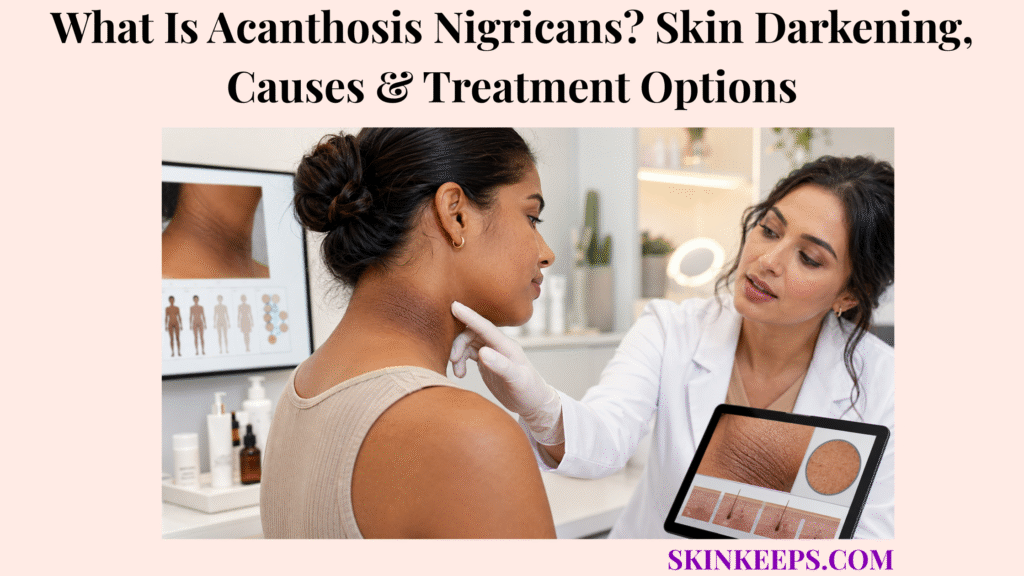
Acanthosis nigricans is a skin condition that causes darker, thicker, often velvety-looking skin, usually in folds such as the neck, armpits, or groin. This pattern involves skin darkening, skin thickening, and a velvety texture, so it should not be treated as dirt or ordinary dark marks.
This guide explains symptoms, body locations, possible causes, risk factors, medical evaluation, treatment options, daily skin care, mistakes, and when a dermatologist or doctor should check sudden or rapidly spreading changes. The goal is cause-led care, not scrubbing, bleaching, or self-diagnosis.
What Is Acanthosis Nigricans and Why Does It Cause Skin Darkening?
Acanthosis nigricans is a skin condition that causes darker, thicker, often velvety-looking skin, usually in body folds such as the neck, armpits, and groin.
Acanthosis nigricans includes both color change and texture change. The affected skin may look darker, feel thicker, and develop a soft or velvety surface in skin folds.
It is not dirt and should not be scrubbed off. It should be treated as a skin sign that may need cause-based evaluation, not as simple discoloration.
| Feature | Acanthosis nigricans | Ordinary dark marks |
|---|---|---|
| Main change | Darker and thicker skin | Mostly color change |
| Texture | Often soft, velvety, or thickened | Usually flat |
| Common location | Skin folds and creases | Anywhere after irritation or injury |
| Cause meaning | May point to underlying driver | Often follows local inflammation |
| Care focus | Medical evaluation plus gentle care | Cause-specific pigmentation care |
Practical rule: Acanthosis nigricans should be treated as a skin sign that may need cause-based evaluation, not as dirt.
How does acanthosis nigricans change skin texture?
Acanthosis nigricans changes skin texture by making affected areas feel thicker, softer, rougher, or velvety rather than only darker.
Darkened skin patches and thickened patches may have poorly defined borders and a skin-fold pattern. The change may develop slowly, so texture can become noticeable before the color change is understood.
Why acanthosis nigricans is not the same as ordinary hyperpigmentation
Acanthosis nigricans is not the same as ordinary hyperpigmentation because it usually includes thickening and texture change, not only increased color.
Ordinary hyperpigmentation is often mostly color-based, while acanthosis nigricans often appears in folds and may reflect an underlying metabolic, hormonal, medication-related, family, or rare internal-disease association.
What Acanthosis Nigricans Symptoms Appear on the Skin?
Acanthosis nigricans symptoms usually include dark patches, brown, gray, or black-looking patches with a thicker, soft, velvety surface in skin folds.
The symptoms are both visual and tactile. Some people notice color first, while others feel thicker skin or a velvety surface before the patch looks obvious.
Visibility can vary by skin tone and lighting. Texture, location, timing, and change pattern are safer cues than color alone.
Where does acanthosis nigricans usually appear?
Acanthosis nigricans usually appears in skin folds and creases such as the neck, armpits, groin, under breasts, elbows, knees, and knuckles.
Neck darkening, armpit darkening, and groin darkening are common patterns, but every dark fold is not automatically acanthosis nigricans. Fold location helps separate the pattern from random dark marks.
What does acanthosis nigricans feel like?
Acanthosis nigricans can feel thicker, softer, or velvety, and the affected skin is usually not painful.
The surface may feel different before the reader understands what they are seeing. Mild itching can occur, and nearby skin tags may appear in some fold-based patterns.
How can acanthosis nigricans look different on darker skin tones?
Acanthosis nigricans can look different on darker skin tones because the color may appear gray-brown, dark brown, or nearly black, while texture may be easier to feel early.
Color variation should not lead to assuming every dark patch is acanthosis nigricans. Texture, fold pattern, onset timing, and spread are important recognition cues.
| Symptom | What the user may notice | Why it matters |
|---|---|---|
| Darkened patches | Brown, gray, or black-looking areas | Shows color change |
| Thickened surface | Skin feels raised, soft, or velvety | Shows texture change |
| Fold pattern | Neck, armpits, groin, or under breasts | Helps distinguish from random dark marks |
| Mild itching | Some areas may itch slightly | Irritation or friction may coexist |
| Slow spread | Patches become more noticeable over time | Timeline helps evaluation |
| Sudden spread | Rapid change or widespread areas | Needs faster medical review |
Practical rule: Acanthosis nigricans symptoms should be judged by color, texture, location, timing, and change pattern.
What Causes Acanthosis Nigricans Beneath the Skin Surface?
Acanthosis nigricans can have several causes, but it is commonly associated with insulin resistance and diabetes risk.
The skin sign may reflect several different pathways, including metabolic changes, hormonal conditions, medicines, family tendency, or rare internal disease warning patterns.
Acanthosis nigricans should trigger cause-based thinking, not automatic self-diagnosis.
How can insulin resistance contribute to acanthosis nigricans?
Insulin resistance can contribute to acanthosis nigricans when higher insulin signaling affects skin cell growth in folds and creases.
Neck and skin-fold changes can be a clue to ask about metabolic evaluation. A clinician may consider blood glucose or A1C testing, but acanthosis nigricans does not prove prediabetes or type 2 diabetes.
How can hormones contribute to acanthosis nigricans?
Hormones can contribute to acanthosis nigricans when endocrine changes affect insulin signaling, oil-related skin behavior, weight patterns, or skin growth signals.
PCOS, puberty changes, menstrual-cycle patterns, and other endocrine disorders may be discussed when symptoms overlap. This does not diagnose PCOS or a hormone disorder.
Which medicines can trigger acanthosis nigricans?
Some medicines can trigger medication-related acanthosis nigricans or make it more noticeable, so medication history should be reviewed with a clinician when the change is new or unexplained.
Corticosteroids, hormone-related medicines, and nicotinic acid are examples sometimes discussed in medical review. Readers should not stop prescribed medicine without a healthcare professional.
When can acanthosis nigricans happen without a serious condition?
Acanthosis nigricans can sometimes appear without a serious underlying condition, especially when family tendency, body-weight patterns, or gradual long-term development are part of the context.
A family pattern or gradual development can happen. Medical review still matters when the change is new, spreading, sudden, or unexplained.
| Possible cause | Skin pathway | What to check |
|---|---|---|
| Insulin resistance | Growth signals may affect skin thickening | Blood sugar or metabolic evaluation |
| Diabetes-related risk | May overlap with insulin resistance | A1C or glucose discussion |
| Hormonal conditions | Endocrine shifts may contribute | PCOS or hormone symptoms |
| Medicines | Some medicines may trigger changes | Medication review |
| Family tendency | Genetics may influence pattern | Family history and onset age |
| Rare internal disease | Sudden widespread change can be a warning sign | Faster medical evaluation |
Practical rule: Acanthosis nigricans should trigger cause-based thinking, not automatic self-diagnosis.
Which Risk Factors Make Acanthosis Nigricans More Likely?
Acanthosis nigricans risk can increase with insulin resistance, obesity, diabetes risk, hormonal conditions, family tendency, and some medicines.
Risk factors are evaluation clues, not moral judgments. They help a clinician decide whether to review blood sugar, hormones, medicines, family history, onset speed, and spread.
How do weight and insulin resistance relate to acanthosis nigricans?
Weight and insulin resistance relate to acanthosis nigricans as evaluation clues, not as reasons to blame the person with darkened skin folds.
Clinicians may check metabolic health when the pattern fits. The safer message is medical evaluation, not “just lose weight.”
How can family history affect acanthosis nigricans?
Family history can affect acanthosis nigricans because some people may have a genetic tendency toward similar fold-based skin changes.
Early appearance or family pattern can happen. That pattern does not remove the need for medical review if the change is new, sudden, or spreading.
How can age and sudden onset change acanthosis nigricans concern?
Age and sudden onset can change acanthosis nigricans concern because gradual fold darkening is different from new, rapid, widespread, or unexplained adult-onset change.
Slow development can happen over time. Sudden, widespread, or rapidly worsening changes need faster evaluation, especially when adult-onset is unexplained.
- Metabolic risk or insulin resistance.
- Diabetes or prediabetes concern.
- Higher body weight or recent weight change.
- PCOS or hormonal symptoms.
- Family tendency.
- Certain medicines.
- Sudden adult-onset changes.
- Rapidly spreading or widespread patches.
Practical rule: Risk factors should guide medical review, not blame or self-diagnosis.
How Is Acanthosis Nigricans Diagnosed or Checked by a Clinician?
Acanthosis nigricans diagnosis is often recognized by skin appearance, but clinicians may check for underlying causes such as blood sugar changes, insulin resistance, hormonal conditions, medication triggers, or rare internal disease signs.
A clinician may identify the pattern visually and then ask questions to find the driver. Testing is not identical for everyone.
Evaluation should look for the cause, not only the skin color.
What skin clues help identify acanthosis nigricans?
Skin clues that help identify acanthosis nigricans include fold location, velvety thickening, gradual spread, symmetry, and sometimes nearby skin tags.
Location and texture come first. Skin tags can be an associated clue, but they are not required for diagnosis.
What health questions may be asked with acanthosis nigricans?
Health questions with acanthosis nigricans often focus on timing, speed of change, weight or metabolic history, family history, hormone symptoms, diabetes symptoms, and medication use.
A clinician may ask when the change started, how fast it spread, whether family members have similar patches, and what products or medicines were used.
Which tests may be considered for acanthosis nigricans?
Tests for acanthosis nigricans may be considered when a clinician wants to check blood sugar, insulin resistance, hormonal patterns, medication effects, or unclear skin findings.
Blood glucose, A1C, insulin markers, hormonal evaluation, or biopsy may be considered based on the case. The clinician chooses tests based on the pattern, history, and red flags.
- When the patch first appeared.
- How quickly it changed.
- Photos showing change over time.
- Current medicines and supplements.
- Family history of similar patches.
- Diabetes or prediabetes history.
- PCOS or hormone-related symptoms.
- Recent weight or health changes.
- Products used on the area.
- Prior lab results if available.
Practical rule: Acanthosis nigricans evaluation should look for the cause, not only the skin color.
What Acanthosis Nigricans Treatment Options Address the Cause?
Acanthosis nigricans treatment usually starts by identifying and addressing the underlying cause, because the darkened patches may fade over time once the cause is managed.
Treatment direction depends on the likely driver. Cause-led treatment may focus on metabolic support, hormone-related care, medication review, monitoring, or faster evaluation for red flags.
Full clearing should not be promised. Fading can be gradual and incomplete.
How can treating insulin resistance help acanthosis nigricans?
Treating insulin resistance may help acanthosis nigricans when improved metabolic control reduces the signals that contribute to skin thickening and darkening.
Blood sugar and metabolic management should be clinician-guided. Improvement may be gradual and should not be framed as a quick cosmetic fix.
How can hormonal treatment affect acanthosis nigricans?
Hormonal treatment can affect acanthosis nigricans when a clinician identifies an endocrine condition that is contributing to the skin change.
PCOS management or endocrine care may be discussed in selected cases. Treatment choices should be clinician-guided, and skin changes may improve slowly after underlying control.
What happens if medicine is causing acanthosis nigricans?
If medicine is causing acanthosis nigricans, the safest next step is medication review with the prescribing clinician rather than stopping the medicine alone.
The prescriber may decide whether a change is appropriate. Stopping medication independently can be unsafe.
Why cause-led treatment may not fully clear acanthosis nigricans
Cause-led treatment may not fully clear acanthosis nigricans because color and thickness can fade slowly and some texture change may remain.
Dermatologic treatment can be considered after cause review if appearance remains a concern. Realistic expectations reduce frustration and unsafe over-treatment.
| Likely driver | Medical focus | Skin expectation |
|---|---|---|
| Insulin resistance | Blood sugar or metabolic management | Patches may fade gradually |
| Hormonal condition | Clinician-guided endocrine care | Skin may improve with control |
| Medication trigger | Medication review with prescriber | Change may improve if trigger is adjusted |
| Family tendency | Diagnosis and monitoring | Skin may persist but can be managed |
| Cosmetic thickness/color concern | Dermatology-directed skin treatment | Appearance may improve, but cause still matters |
| Sudden or widespread onset | Faster evaluation | Skin treatment waits until cause is reviewed |
Practical rule: Acanthosis nigricans treatment should start with the cause before focusing on appearance.
What Skin Treatments Can Improve Acanthosis Nigricans Appearance?
Skin-directed treatments for acanthosis nigricans may help lighten color or reduce thickness, but they do not replace evaluation for underlying causes.
Appearance treatments are secondary to medical evaluation. They may help selected cases, but they do not treat the underlying driver by themselves.
Which topical treatments may be used for acanthosis nigricans?
Topical treatments for acanthosis nigricans may include dermatologist-selected creams, gels, retinoids, or keratolytics for color, thickness, or texture.
Prescription lightening agents and texture treatments should be clinician-selected. Skin folds can irritate easily, so harsh DIY use can worsen discomfort or color.
How can laser treatments help acanthosis nigricans texture?
Laser treatments may help acanthosis nigricans texture in selected cases by targeting thickness or surface appearance under dermatologist supervision.
Laser is not first-line for the underlying cause. Cost, maintenance, irritation risk, and realistic expectations should be discussed before treatment.
Why over-the-counter bleaching or scrubbing is risky for acanthosis nigricans
Over-the-counter bleaching or scrubbing is risky for acanthosis nigricans because irritation can worsen discomfort, uneven color, and post-inflammatory hyperpigmentation.
Harsh lightening, acids, or scrubbing can inflame folds and make later color change harder to manage. That irritation-linked darkening is closer to post-inflammatory hyperpigmentation than true cause-led acanthosis nigricans treatment.
| Option | Goal | Best use | Caution |
|---|---|---|---|
| Prescription creams | Lighten or smooth affected skin | Dermatologist-selected cases | Irritation risk in folds |
| Retinoids | Support skin turnover and texture | Selected thickened areas | Can sting or peel |
| Keratolytic approaches | Reduce roughness or thickness | Clinician-guided use | Overuse can irritate |
| Laser treatments | Improve thickness or appearance | Dermatology procedure setting | Does not treat underlying cause |
| Gentle moisturizer | Reduce dryness and friction discomfort | Supportive care | Does not remove cause |
| Avoiding irritants | Prevent worse darkening from inflammation | Daily fold care | Requires consistency |
Practical rule: Skin treatments may support appearance, but acanthosis nigricans needs cause-based evaluation first.
What Daily Skin Care Supports Acanthosis Nigricans Safely?
Daily skin care for acanthosis nigricans should reduce friction, irritation, and harsh product use while medical causes are being evaluated or treated.
Skincare can reduce irritation, but it cannot replace medical evaluation. The goal is to protect affected folds, not scrub the color away.
How should acanthosis nigricans areas be cleansed?
Acanthosis nigricans areas should be cleansed gently because the darkened skin is not dirt and should not be rubbed or scrubbed off.
A gentle cleanser can help keep folds clean. Patting skin dry is safer than abrasive rubbing.
How should friction around acanthosis nigricans be reduced?
Friction around acanthosis nigricans should be reduced by limiting rubbing, tight clothing pressure, sweat buildup, and irritating products in skin folds.
Neck folds, armpits, and groin folds can be friction-prone. Reducing rubbing can also lower chafing-type irritation in areas where skin, sweat, and clothing repeatedly rub.
Which products should be avoided on acanthosis nigricans?
Products to avoid on acanthosis nigricans include unsupervised bleaching products, harsh acids, abrasive scrubs, and fragrance-heavy formulas that irritate folds.
Folds can react more easily to harsh products. Repeated burning, rash-like redness, or itching after a product may fit an allergic contact dermatitis pattern rather than safe acanthosis nigricans care.
- Cleanse affected folds gently.
- Do not scrub darkened skin.
- Pat folds dry instead of rubbing.
- Reduce friction from tight clothing.
- Manage sweat and moisture.
- Avoid harsh acids in folds unless clinician-directed.
- Avoid unsupervised bleaching products.
- Moisturize if skin feels dry or rubbed.
- Seek evaluation for new, spreading, or unexplained patches.
Practical rule: Daily care should protect acanthosis nigricans areas from irritation, not try to scrub the color away.
What Acanthosis Nigricans Mistakes Should You Avoid?
The biggest acanthosis nigricans mistake is treating it only as a cosmetic stain while ignoring possible underlying metabolic, hormonal, medication-related, or rare serious causes.
Mistakes can delay proper care or irritate folds. Surface-only thinking can also lead to scrubbing, bleaching, self-diagnosis, or stopping medicines without guidance.
Why should you not scrub acanthosis nigricans aggressively?
You should not scrub acanthosis nigricans aggressively because the darkened skin is not dirt, and friction can irritate folds.
Scrubbing does not remove the underlying skin change. Friction can worsen irritation and make discoloration look darker after inflammation.
Why should you not use strong bleaching products without guidance?
Strong bleaching products should not be used on acanthosis nigricans without guidance because folds can react with burning, peeling, uneven lightening, or worse darkening after irritation.
Chemical irritation and burns can happen in sensitive folds. Strong products should be discussed with a dermatologist rather than used as DIY treatment.
Why should acanthosis nigricans not be ignored if it spreads quickly?
Acanthosis nigricans should not be ignored if it spreads quickly because sudden or widespread change can signal a need for faster medical evaluation.
Rapid spread does not always mean cancer, but it is a red flag pattern. Faster medical review is safer than waiting or treating only the surface.
Why should acanthosis nigricans not be self-diagnosed as diabetes?
Acanthosis nigricans should not be self-diagnosed as diabetes because it can be associated with insulin resistance but cannot prove diabetes without clinical evaluation and lab testing.
Blood sugar or A1C testing may be considered. The skin sign suggests a reason to check, not a final diagnosis.
| Mistake | Risk | Better action |
|---|---|---|
| Scrubbing dark folds | Irritation and darker appearance | Cleanse gently |
| Treating it as dirt | Delays evaluation | Check texture and location |
| Using strong bleaching products | Chemical irritation or burns | Ask a dermatologist |
| Ignoring rapid spread | Misses red flags | Seek medical review |
| Assuming diabetes | Creates fear without testing | Get lab-based evaluation |
| Stopping medicine alone | Can be unsafe | Review with prescriber |
| Using only cosmetic care | Misses underlying cause | Start with cause-led care |
Practical rule: Acanthosis nigricans mistakes usually come from treating the surface while ignoring the cause.
When Should Acanthosis Nigricans Be Checked by a Dermatologist or Doctor?
Acanthosis nigricans should be checked by a healthcare professional when it is new, unexplained, rapidly spreading, sudden, painful, very itchy, associated with other symptoms, or causing concern.
Evaluation is especially important when the pattern is new, fast, widespread, symptomatic, or unexplained. A primary care clinician, endocrinologist, or dermatologist may be involved depending on the likely cause.
Which acanthosis nigricans warning signs need faster care?
Acanthosis nigricans warning signs need faster care when the change is sudden, rapidly spreading, widespread, symptomatic, or appearing in unusual sites.
Sudden onset, rapid spreading, widespread involvement, mouth involvement, lip involvement, palm involvement, unexplained weight loss, or new adult-onset change should be checked without assuming the cause.
When should children or teens with acanthosis nigricans be evaluated?
Children or teens with acanthosis nigricans should be evaluated when neck or fold darkening appears with metabolic risk, family history of diabetes, puberty changes, or other symptoms.
A pediatrician or dermatologist can decide whether blood sugar, family history, puberty changes, or other symptoms need review. This does not diagnose diabetes.
What should you bring to an acanthosis nigricans appointment?
To an acanthosis nigricans appointment, bring photos, a timeline, current medicines, family history, metabolic history, other symptoms, and products used on the area.
Photos and a timeline help show speed of change. Medicine history, product use, family history, metabolic changes, hormone symptoms, and other symptoms help guide cause-led evaluation.
Practical rule: Acanthosis nigricans should be checked faster when onset, spread, symptoms, or location are unusual.
What Should You Remember About Acanthosis Nigricans?
Acanthosis nigricans is usually a skin sign that deserves cause-based thinking, not just surface-lightening treatment.
It changes both skin color and texture, often in folds, and it may point toward an underlying cause. Safer care combines medical evaluation, gentle fold care, and realistic expectations.
Practical rule: Acanthosis nigricans is safer to manage when the cause, timing, texture, and spread are all considered together.
Frequently Asked Questions About Acanthosis Nigricans
Is acanthosis nigricans caused by poor hygiene?
No. Acanthosis nigricans is not caused by poor hygiene and should not be scrubbed off. It changes both skin color and texture, often in folds. Harsh scrubbing can irritate the area and may make darkening look worse.
Does acanthosis nigricans always mean diabetes?
No. Acanthosis nigricans can be associated with insulin resistance or diabetes risk, but it does not prove diabetes by itself. A clinician may consider blood sugar or A1C testing based on the person’s symptoms, risk factors, and medical history.
Can acanthosis nigricans go away?
Acanthosis nigricans may fade when the underlying cause is managed, but improvement can be slow and may not be complete. Skin-directed treatments may help appearance in selected cases, but they should not replace evaluation for the cause.
What is the best treatment for acanthosis nigricans?
The best acanthosis nigricans treatment is usually cause-led. That means checking for drivers such as insulin resistance, hormonal conditions, medicines, or other health changes first. Dermatologist-guided creams or procedures may be considered if appearance remains a concern.
When is acanthosis nigricans serious?
Acanthosis nigricans may need faster medical review when it appears suddenly, spreads quickly, becomes widespread, affects unusual areas, causes pain or severe itching, or appears in adulthood without a clear cause. These signs do not diagnose a serious disease, but they should be checked.
Sources & Evidence About Acanthosis Nigricans
American Academy of Dermatology — Acanthosis Nigricans Overview was used for the definition, darkened and thickened skin description, velvet-like texture, and warning against scrubbing.
American Academy of Dermatology — Acanthosis Nigricans Signs and Symptoms was used for symptoms, skin-fold locations, slow development, sudden-onset warning, and dermatologist evaluation boundaries.
American Academy of Dermatology — Acanthosis Nigricans Diagnosis and Treatment was used for dermatologist diagnosis, blood-test possibility, prescription creams, gels, ointments, and laser treatment boundaries.
Mayo Clinic — Acanthosis Nigricans Symptoms and Causes was used for dark, thick, velvety skin in folds and creases, common locations, itch, odor, and skin-tag context.
NHS — Acanthosis Nigricans was used for cause-directed evaluation, underlying-condition framing, and why the skin change should be checked by a GP or clinician.
DermNet — Acanthosis Nigricans was used for metabolic, hormonal, medication-related, inherited, and rare malignant associations, plus clinical features and diagnosis/treatment overview.
StatPearls / NCBI Bookshelf — Acanthosis Nigricans was used for insulin-resistance association, diabetes and metabolic-disorder context, medication associations, malignancy warning context, and referral boundaries.
Educational Disclaimer: This article is for general skin education only and does not diagnose, treat, prescribe, or replace professional medical advice. If acanthosis nigricans appears suddenly, spreads quickly, becomes widespread, is painful or very itchy, appears with unexplained health changes, affects unusual areas, or causes concern, consult a qualified dermatologist, doctor, or healthcare professional.