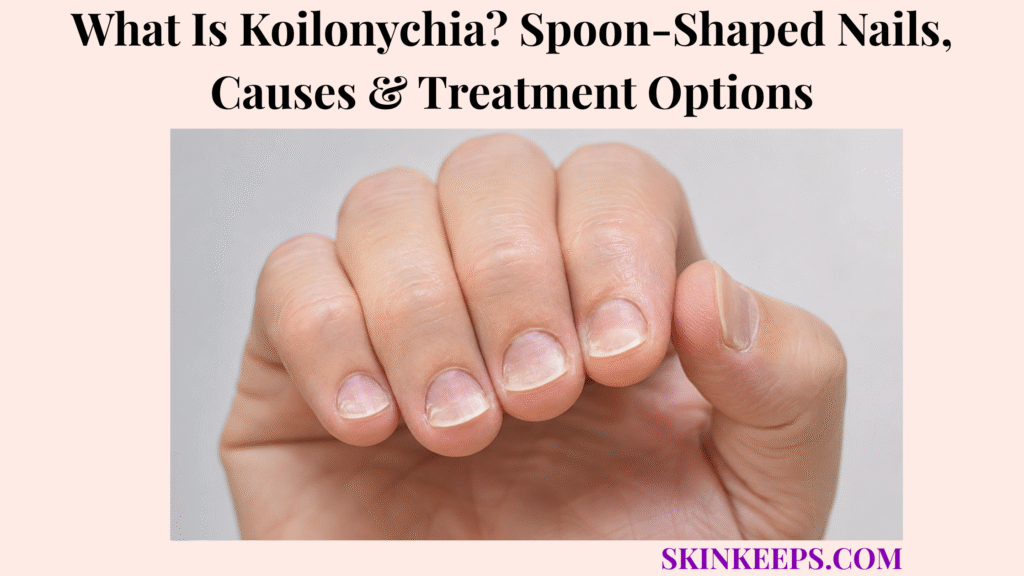
Koilonychia is a nail-plate deformity in which one or more fingernails or toenails become flattened and centrally concave, creating a spoon-shaped appearance. The affected nail plate may also become thin, brittle, soft, flexible or prone to splitting.
Iron deficiency is an important association, but spoon-shaped nails do not automatically mean iron-deficiency anaemia. Local nail disease, repeated trauma, occupational exposure, inherited factors and physiological childhood development can also produce koilonychia, so identifying why normal nail growth changed matters more than treating nail shape alone.
Newly acquired spoon-shaped nails affecting several nails—especially with fatigue, breathlessness, dizziness, unusual bleeding, digestive symptoms or unexplained weight loss—should receive medical assessment. Iron supplements should not be started solely because nails look spoon-shaped.
How Can You Recognize Koilonychia?
Koilonychia is recognized by progressive flattening and central depression of the nail plate with upward-curving lateral or distal edges.
What Do Spoon-Shaped Nails Look Like?
Koilonychia changes the normally convex nail plate into a flattened or centrally depressed plate with elevated edges.
- Early nails may look flatter than normal before a clear spoon shape develops.
- Established koilonychia has a central concavity with raised lateral or distal edges.
- The nail may also be thin, brittle, flexible or split.
- Fingernails and toenails can both be affected.
- Not every affected nail shows every secondary feature.
Can One Nail or Several Nails Be Affected?
Koilonychia can affect a single nail or multiple nails, and the distribution helps guide the search for an underlying cause.
- A single abnormal nail raises attention to local trauma, pressure, infection or another local nail disorder.
- Similar changes across several nails make systemic, inherited or widespread causes more relevant.
- Fingernail-only or toenail-only patterns can also help direct the history.
- Distribution alone cannot identify the cause.
What Is the Water-Drop Sign in Koilonychia?
A markedly concave koilonychial nail may retain a small water drop within its central depression.
This observation demonstrates concavity rather than cause. It should not be used as a test for iron deficiency.
Is Koilonychia Normal in Young Children?
Temporary koilonychia, particularly involving toenails, can occur during normal nail development in otherwise healthy infants and young children.
Childhood spooning does not automatically indicate anaemia, but persistent, severe, symptomatic or clinically unusual nail changes still merit assessment.
Figure 1. Koilonychia changes the usual convex nail contour into a flattened and then centrally concave plate with raised lateral or distal edges. Nail shape confirms the morphology, not the cause.
What Causes Koilonychia?
Koilonychia has multiple causes, with chronic iron deficiency representing the classic acquired association alongside local nail disease, repeated trauma, occupational exposure and inherited or physiological factors.
How Is Iron Deficiency Related to Koilonychia?
Chronic iron deficiency is the classic acquired systemic association with koilonychia.
- Persistent deficiency can weaken or alter nail-plate growth.
- Only a proportion of iron-deficient people develop spoon-shaped nails.
- The severity of nail spooning does not reliably measure the severity of iron deficiency.
- Nail appearance therefore cannot diagnose iron-deficiency anaemia.
What Can Cause the Iron Deficiency Behind Spoon Nails?
Identifying iron deficiency is only the first step because the clinical question is why iron stores became depleted.
- Insufficient dietary iron intake.
- Chronic menstrual blood loss.
- Gastrointestinal blood loss.
- Malabsorption such as coeliac disease.
- Increased iron requirements in selected life stages.
- Other causes determined by age, symptoms and clinical context.
Which Nail and Skin Diseases Can Cause Koilonychia?
Disorders that damage or distort the nail unit can produce secondary koilonychia.
A fungal nail infection / onychomycosis more often causes thickening, discolouration, crumbling or subungual debris, but distortion and secondary spooning can occur.
Nail psoriasis can produce pitting, separation, thickening or characteristic colour change that points beyond isolated koilonychia.
Lichen planus can thin, ridge or split the nail and may damage the nail matrix enough to change overall shape.
Can Trauma or Occupational Exposure Cause Spoon Nails?
Repeated mechanical trauma, pressure and selected occupational exposures can distort nail growth enough to produce koilonychia.
- Repeated nail trauma can alter matrix or plate mechanics.
- Tight footwear is relevant when selected toenails are affected.
- Chronic wet work or selected occupational chemical or petroleum exposure may contribute in some cases.
- These causes are more plausible when the distribution matches the repeated exposure.
Can Koilonychia Be Inherited or Occur Without Disease?
Familial, congenital, idiopathic and physiological forms of koilonychia can occur without iron deficiency or another identifiable systemic disease.
This is one reason iron treatment should follow evidence of deficiency rather than the nail shape alone.
Figure 2. Chronic iron deficiency is the classic acquired association, but koilonychia can also arise from nail disease, repeated trauma or exposure, inherited disease, idiopathic cases or physiological childhood nail development.
How Is Koilonychia Different From Other Nail Changes?
Koilonychia is distinguished from other nail deformities by its central depression and upward-curving edges rather than increased convexity, downward side curvature or generalized nail thickening.
How Is Koilonychia Different From Nail Clubbing?
Koilonychia curves inward centrally, whereas nail clubbing produces increased convexity with enlargement of the fingertip.
Clubbing follows a different diagnostic pathway because the distal fingertip becomes bulbous and the nail curves more outward rather than forming a central spoon-like depression.
How Is Koilonychia Different From a Pincer Nail?
A pincer nail develops excessive transverse curvature with the sides bending downward, whereas koilonychia depresses the centre and lifts the edges upward.
Pincer nails may compress the side tissues, while koilonychia is defined by central concavity.
How Is Koilonychia Different From Fungal Nail Disease?
Fungal nail disease more commonly produces thickening, discolouration, crumbling and subungual debris than the clean central depression typical of koilonychia.
A distorted fungal nail can occasionally become spoon-shaped, so suspicious thick, crumbly or discoloured nails may need fungal testing.
How Is Koilonychia Different From Nail Psoriasis or Lichen Planus?
Nail psoriasis and nail lichen planus usually produce additional structural abnormalities that distinguish them from isolated koilonychia.
Pitting, separation, thickening, ridging, splitting or inflammatory damage suggests a broader nail disorder rather than a simple isolated spoon shape.
| Nail Change | Defining Shape or Pattern |
|---|---|
| Koilonychia | Central depression with raised lateral or distal edges. |
| Clubbing | Increased convexity with enlargement of the distal fingertip. |
| Pincer nail | Excessive transverse curvature with the sides bending downward. |
| Fungal nail disease | Thickened, irregular, discoloured or crumbly nail plate, sometimes with secondary distortion. |
How Is the Cause of Koilonychia Diagnosed?
Diagnosing the cause of koilonychia combines nail distribution, medical history, systemic symptoms and targeted testing rather than relying on nail appearance alone.
What History Helps Identify the Cause of Koilonychia?
The diagnostic history should determine when koilonychia began, how many nails are affected and whether local, familial or systemic clues are present.
- Onset and speed of change.
- One nail versus several nails.
- Affected relatives.
- Repeated trauma or tight footwear.
- Chemical or occupational exposure.
- Chronic nail disease.
- Fatigue, weakness, dizziness, breathlessness, palpitations, pica or a sore tongue.
- Menstrual blood loss, gastrointestinal symptoms, dietary restriction or unexplained weight loss.
These symptoms can support concern for iron deficiency or another systemic disorder, but none is specific on its own.
Which Blood Tests Are Most Useful When Iron Deficiency Is Suspected?
A complete blood count and iron studies form the core laboratory assessment when iron deficiency is clinically suspected in a person with koilonychia.
- Complete blood count.
- Haemoglobin.
- Red-cell indices.
- Ferritin.
- Transferrin saturation when clinically useful.
Ferritin reflects iron stores but can be raised by inflammation, so it requires interpretation in clinical context.
Why Must the Cause of Iron Deficiency Be Investigated?
Confirmed iron deficiency requires investigation of its source because replacing iron without correcting ongoing blood loss or impaired absorption can allow deficiency to recur.
The next step depends on age, menstrual history, gastrointestinal symptoms, diet, malabsorption risk and other findings rather than a universal work-up for every reader.
When Are Nail Tests or a Biopsy Needed?
Typical koilonychia does not routinely require nail biopsy, but nail-specific testing becomes relevant when infection or another nail-matrix disorder is suspected.
- Fungal testing is useful when thickening, crumbling, discolouration or separation suggests onychomycosis.
- Specialist assessment is appropriate when morphology is atypical or the diagnosis remains uncertain.
- Biopsy is reserved for selected unclear nail-matrix or nail-bed disorders rather than routine koilonychia.
How Is Koilonychia Treated, and How Long Do Nails Take to Recover?
Koilonychia improves by correcting its underlying reversible cause and allowing a healthier nail plate to grow gradually from the nail matrix.
How Is Iron-Deficiency-Related Koilonychia Treated?
Iron-deficiency-related koilonychia is treated by confirming and correcting iron deficiency while addressing the reason the deficiency developed.
- Clinician-directed oral iron is commonly used when appropriate.
- Intravenous iron is reserved for selected clinical situations.
- The existing deformed nail does not instantly reshape.
- Healthier nail grows from the matrix and progressively replaces the abnormal plate.
- Iron-related koilonychia is generally reversible when deficiency is successfully corrected.
Why Should Iron Supplements Not Be Started From Nail Appearance Alone?
Spoon-shaped nails alone do not establish iron deficiency, so iron supplementation should follow appropriate clinical and laboratory assessment.
Koilonychia has several possible causes, and unnecessary iron treatment is not an appropriate diagnostic experiment.
How Are Non-Iron Causes of Koilonychia Treated?
Non-iron koilonychia requires treatment of the specific nail disease, exposure or mechanical factor responsible for abnormal nail growth.
- Fungal disease follows an antifungal pathway after appropriate diagnosis.
- Inflammatory nail disease receives disease-specific treatment.
- Repeated trauma is managed by reducing mechanical injury.
- Tight footwear should be corrected when toenail pressure is relevant.
- Occupational exposure requires appropriate protection or exposure reduction.
- Familial or idiopathic disease may rely mainly on nail protection when no reversible cause exists.
How Should Spoon-Shaped Nails Be Protected?
Protecting koilonychial nails reduces secondary breakage while healthier nail grows from the matrix.
- Keep nails reasonably short.
- Smooth sharp edges rather than aggressively buffing the surface.
- Moisturize brittle nails and surrounding skin.
- Use appropriate gloves during prolonged wet work or chemical exposure.
- Choose roomy footwear when repeated toenail pressure is relevant.
- Treat nail protection as supportive care, not as a substitute for cause-directed treatment.
How Long Does Koilonychia Take to Recover?
Koilonychia resolves slowly because improvement depends on replacement of the abnormal nail plate by new growth.
- Improvement first appears near the nail base.
- Fingernails require several months to grow out.
- Iron-related fingernail normalization is often described over about 4–6 months.
- Toenails grow much more slowly and may take around 18 months to grow out completely.
- These are approximate biological growth timelines rather than guaranteed treatment deadlines.
When Should Koilonychia Be Checked Promptly?
Newly acquired koilonychia deserves prompt medical assessment when several nails are affected or systemic symptoms suggest anaemia, blood loss or another underlying disorder.
- Fatigue, dizziness, shortness of breath or palpitations.
- Heavy menstrual bleeding.
- Gastrointestinal symptoms or unexplained weight loss.
- Difficulty swallowing.
- Chest pain, fainting, severe breathlessness or significant ongoing bleeding.
Difficulty swallowing together with iron-deficiency anaemia and koilonychia raises concern for Plummer–Vinson syndrome and requires medical evaluation.
Figure 3. Koilonychia care moves from recognition to focused evaluation, then to cause-directed treatment and protected nail regrowth. The visible nail shape improves only as healthier plate grows outward from the nail matrix.
What Should You Remember About Koilonychia?
Koilonychia is a spoon-shaped nail sign whose clinical importance lies less in the visible deformity itself than in identifying why normal nail growth changed.
- The nail centre becomes depressed while the lateral or distal edges rise.
- Koilonychia is a sign, not one standalone disease.
- Iron deficiency is an important but non-exclusive association.
- Local nail disease, trauma, exposure, inherited and physiological causes also occur.
- Recognition should be followed by cause-directed evaluation.
- Iron status should be confirmed when deficiency is suspected.
- If deficiency exists, its source should also be investigated.
- Treatment targets the underlying cause while the nail is protected.
- Recovery is slow because the abnormal plate must physically grow out.
Frequently Asked Questions About Koilonychia?
Does koilonychia always mean iron-deficiency anaemia?
No. Iron deficiency is the classic acquired association, but koilonychia can also occur with local nail disease, repeated trauma or exposure, inherited conditions, idiopathic cases and physiological childhood nail development.
Which tests are used when koilonychia appears?
Testing depends on the clinical context. When iron deficiency is suspected, a complete blood count and iron studies—especially ferritin, with transferrin saturation when useful—help assess iron status. Nail-specific tests are used only when another nail disorder is suspected.
Can healthy children have koilonychia?
Yes. Temporary spooning, particularly of toenails, can occur during normal nail development in otherwise healthy infants and young children. Persistent, severe, symptomatic or unusual changes still deserve clinical assessment.
Will koilonychia return to normal after treatment?
Acquired reversible koilonychia often improves once the underlying cause is corrected, but the existing deformed nail does not instantly reshape. Healthier nail must grow from the matrix and gradually replace the abnormal plate.
How long does koilonychia take to grow out?
Fingernails generally require several months to replace the abnormal plate. Iron-related fingernail normalization is often described over roughly 4–6 months, while toenails grow much more slowly and may take around 18 months to grow out completely.
Which Sources Support This Koilonychia Guidance?
StatPearls / NCBI — Spoon Nails — Definition, morphology, water-drop sign, causes, evaluation, cause-directed treatment and approximate regrowth timelines.
PMC — Nails in Systemic Disease — Koilonychia morphology, iron-deficiency association, local trauma and physiological childhood context.
PMC — Nailing the Diagnosis: Koilonychia — Iron-deficiency pathways, coeliac disease, gastrointestinal context, trauma and occupational exposure.
NCBI — Clinical Manifestations of Iron-Deficiency Anaemia — Fatigue, weakness, dyspnoea, palpitations, dizziness, pica, glossitis and spoon-shaped nails.
PubMed — Koilonychia: Pathophysiology, Differential Diagnosis and Clinical Relevance — Differential diagnosis, dermatologic causes, childhood physiological koilonychia and clinical evaluation framework.