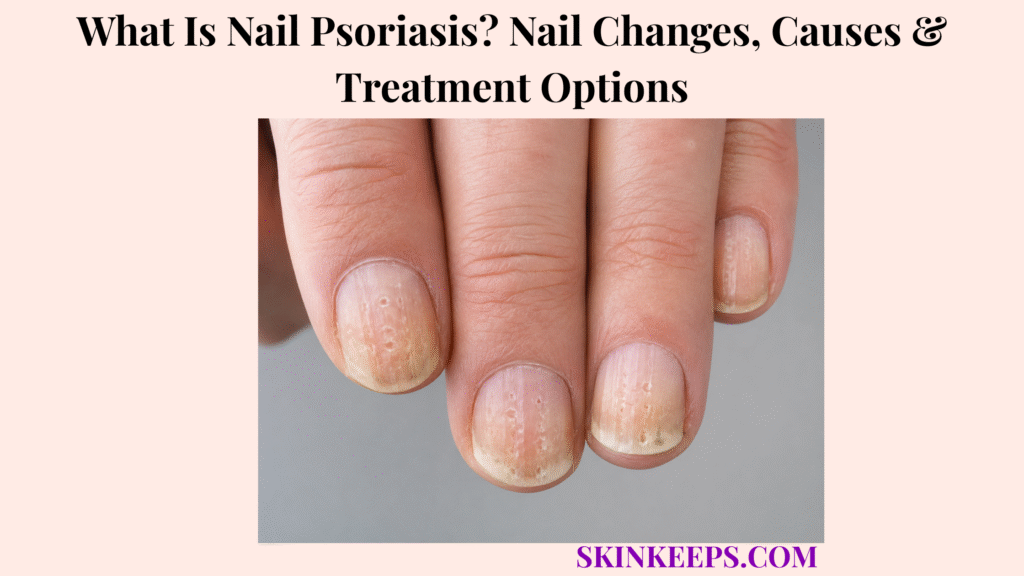
Nail psoriasis is psoriatic inflammation of the structures that produce and support the nail, especially the nail matrix and nail bed. Matrix inflammation can produce pitting, ridges, white changes and crumbling, while nail-bed inflammation can cause oil-drop discoloration, lifting, subungual thickening and splinter haemorrhages.
Psoriatic nail disease can be painful, interfere with hand function or footwear and is associated with psoriatic arthritis, although nail changes alone do not diagnose joint disease. Nail fungus can closely mimic or coexist with psoriasis, and visible recovery is slow because damaged nail has to grow outward before healthier nail replaces it.
This article is for educational purposes only and does not constitute medical advice, diagnosis, or treatment. A new or rapidly changing nail abnormality, a widening or irregular dark streak, pigment extending onto the surrounding skin, unexplained bleeding or a persistent growth beneath a nail, severe pain or swelling, progressive loss of nail function, or new persistent joint pain, stiffness or swelling should be evaluated by a licensed dermatologist or qualified healthcare professional.
How Can You Recognize Nail Psoriasis?
Nail psoriasis can cause pitting, oil-drop discoloration, nail lifting, subungual thickening, ridging, crumbling and splinter haemorrhages depending on whether inflammation affects the nail matrix or nail bed.
What Does Nail Pitting Look Like?
Nail pitting appears as multiple tiny depressions in the nail plate caused by disrupted nail formation within the matrix.
The pits can look like irregular ice-pick depressions scattered over the plate. Numerous irregular pits in someone with compatible psoriasis are supportive, but a few pits are not specific to psoriasis.
What Is the Oil-Drop or Salmon-Patch Sign?
An oil-drop or salmon patch is a translucent yellow-red or yellow-brown area beneath the nail caused by psoriatic inflammation of the nail bed.
This relatively characteristic bed sign can precede nail lifting, but it is not required in every psoriatic nail.
Why Does Nail Psoriasis Cause Onycholysis?
Psoriatic inflammation can separate the nail plate from the nail bed, producing onycholysis and a pale or white detached area beneath the nail.
Air enters beneath the detached plate as attachment fails. Trauma and fungal infection can also cause onycholysis, so lifting alone does not establish psoriasis.
Why Does Material Build Up Beneath a Psoriatic Nail?
Nail-bed psoriasis can accelerate keratin accumulation beneath the nail, producing subungual hyperkeratosis and progressive thickening.
The buildup can raise and distort the plate and create pressure discomfort in shoes. A thick nail still requires differential diagnosis because psoriasis is not the only cause.
Can Nail Psoriasis Cause Ridges, Crumbling or Splinter Haemorrhages?
Yes; nail-matrix psoriasis can cause ridging, grooves, white changes and crumbling, while nail-bed disease can produce splinter haemorrhages.
The matrix controls plate formation, so inflammation there alters the plate itself. Nail-bed inflammation can create thin longitudinal haemorrhagic lines beneath the plate.
Can Nail Psoriasis Affect Only One or Two Nails?
Yes; nail psoriasis can affect only one or two nails, but isolated-nail disease deserves greater diagnostic caution because fungus, trauma, lichen planus and nail tumours can mimic it.
Known psoriasis elsewhere strengthens the clinical context, but one atypical nail should not be labelled psoriatic automatically.
Figure 1. Matrix psoriasis disrupts nail-plate production, whereas nail-bed psoriasis primarily alters nail attachment and subungual tissue.
Why Does Nail Psoriasis Develop, and What Does It Reveal About Psoriatic Disease?
Nail psoriasis develops when the same immune-mediated inflammation responsible for psoriasis affects the nail unit, and its presence can signal broader skin or joint disease.
What Causes Nail Psoriasis?
Nail psoriasis results from immune-mediated psoriatic inflammation involving the nail matrix, nail bed, hyponychium or surrounding nail folds.
Inflammation of the matrix disrupts nail production, while inflammation of the bed alters attachment and subungual tissue. No single environmental trigger explains every case.
Can Nail Psoriasis Occur Without Skin Psoriasis?
Yes; nail psoriasis can occasionally occur without obvious psoriasis elsewhere on the skin.
Many patients have established psoriasis, but absent skin plaques do not automatically exclude nail disease. Isolated nail abnormalities require a more careful differential assessment.
Why Can Nail Injury Make Psoriasis Worse?
Nail trauma can trigger or worsen psoriatic inflammation through the Koebner phenomenon.
Aggressive manicures, cuticle injury, nail biting, picking, scraping beneath a detached nail and repeated wet or manual work can injure the nail unit. Koebnerization means psoriasis develops or worsens at sites of injury.
Is Nail Psoriasis Associated With Psoriatic Arthritis?
Yes; nail psoriasis is strongly associated with psoriatic arthritis, although nail abnormalities alone do not diagnose joint disease.
Persistent morning stiffness, swollen joints, finger or toe pain, or an entire swollen digit called dactylitis should prompt assessment for broader psoriatic joint disease.
Can Nail Psoriasis and Nail Fungus Occur Together?
Yes; psoriatic nails can also develop nail fungus or onychomycosis, which can complicate both diagnosis and interpretation of treatment response.
Fungal infection does not exclude psoriasis, and psoriasis does not exclude fungus. Laboratory testing becomes useful when infection would change treatment.
Figure 2. Nail psoriasis can occur with skin psoriasis, psoriatic arthritis, trauma-related Koebner worsening, or coexisting onychomycosis, so the nail should not be interpreted in isolation.
How Is Nail Psoriasis Distinguished and Diagnosed?
Nail psoriasis is usually diagnosed clinically, but fungal testing or selective biopsy may be required when another nail disorder remains plausible.
How Is Nail Psoriasis Different From Nail Fungus?
Nail psoriasis and onychomycosis can both cause thickening, discoloration, lifting and subungual debris, so appearance alone may not reliably separate them.
Pitting, oil-drop change and compatible skin or joint disease favour psoriasis, while distal fungal invasion and laboratory confirmation favour onychomycosis. Both conditions can coexist.
How Is Nail Psoriasis Different From Nail Trauma?
Mechanical trauma can cause ridging, lifting and discoloration that resembles nail psoriasis, but injury history and exposure pattern can help distinguish it.
Shoe pressure, manicure injury, occupational trauma and repeated picking can produce dystrophy without psoriasis. The same trauma can also trigger genuine psoriasis through Koebnerization.
How Is Nail Psoriasis Different From Nail Lichen Planus?
Nail lichen planus more often causes progressive longitudinal ridging, splitting, thinning and potentially permanent matrix scarring, which can overlap with but differ from typical nail psoriasis.
Progressive thinning, scarring or nail-plate loss deserves specialist assessment because permanent matrix injury can occur in scarring nail disorders.
When Should a Psoriatic Nail Be Tested for Fungus?
Fungal testing is useful when onychomycosis remains plausible, especially before systemic immunosuppressive treatment or when nail disease fails to respond as expected.
A clinician can submit nail clippings or subungual material for microscopy, culture or other appropriate laboratory testing. Testing is selective rather than mandatory for every classic psoriatic nail.
Is Nail Psoriasis Usually Diagnosed Clinically?
Yes; a dermatologist can often diagnose nail psoriasis from characteristic matrix and nail-bed changes together with the person’s skin and joint findings.
Examination considers morphology, which nails are affected, psoriasis elsewhere and musculoskeletal symptoms. The Nail Psoriasis Severity Index, or NAPSI, can quantify matrix and bed involvement for severity tracking but is not a standalone diagnostic test.
When Is Nail Biopsy Needed?
Nail biopsy is uncommon and is reserved for persistent diagnostic uncertainty, isolated atypical disease or concern about a nail-unit tumour.
Matrix biopsy can permanently alter nail growth, so the diagnostic benefit must outweigh the injury risk. Routine biopsy is not part of ordinary nail-psoriasis assessment.
Which Nail Changes Should Not Simply Be Labelled Psoriasis?
A new or widening dark longitudinal streak, pigment spreading onto surrounding skin, unexplained bleeding, a persistent nail mass or one rapidly changing nail should not automatically be labelled psoriasis.
These changes can require evaluation for melanoma or another nail-unit tumour rather than escalation of psoriasis treatment.
Figure 3. Nail psoriasis is usually diagnosed clinically, with fungal testing or selective biopsy added only when infection, scarring disease or a nail-unit tumour remains plausible.
How Is Nail Psoriasis Treated?
Nail psoriasis treatment depends on how many nails are affected, whether inflammation involves the matrix or nail bed, symptom burden and whether substantial skin psoriasis or psoriatic arthritis is also present.
When Is Topical Treatment Appropriate?
Topical treatment is most practical for mild or early nail psoriasis affecting only a few nails.
Options include potent topical corticosteroids, calcipotriol and tazarotene. The abnormality and target anatomy matter, and local treatment requires patience because nail response develops slowly.
Why Does Nail-Matrix Disease Need Different Treatment Placement From Nail-Bed Disease?
Matrix disease must be targeted near the proximal nail-forming area, while nail-bed disease requires treatment to reach the tissue beneath the nail plate.
The matrix is the proximal production zone, whereas the bed lies beneath the plate. Treatment location should therefore match disease location without encouraging self-directed invasive application.
When Are Corticosteroid Injections Used?
Intralesional corticosteroid injections can be useful for selected patients with significant disease in only a small number of nails when topical treatment is insufficient.
They are clinician-directed and can be particularly useful for selected matrix disease. Pain and local tissue atrophy are relevant adverse effects, so self-injection is inappropriate.
When Is Systemic Treatment More Appropriate?
Systemic treatment becomes more appropriate when many nails are affected, nail disease causes major functional or quality-of-life impairment, or significant skin psoriasis or psoriatic arthritis also requires systemic control.
The decision should reflect nails, skin, joints and total disease burden rather than one mildly pitted nail.
Which Systemic Psoriasis Treatments Can Improve Nail Disease?
Systemic treatments used for moderate-to-severe psoriasis or psoriatic arthritis can also improve nail psoriasis.
Options include methotrexate, acitretin, cyclosporine, apremilast and biologic treatment. Biologic classes with nail-response evidence include TNF, IL-17 and IL-23 pathway inhibitors.
Drug selection follows the entire psoriasis and arthritis profile rather than a universal “best biologic” based on nail appearance alone.
Do Lasers Have an Established Role in Nail Psoriasis?
No; lasers have been studied for nail psoriasis but do not currently have the same established first-line role as topical, injected or systemic therapies.
Evidence is smaller and still evolving, so laser treatment should not be presented as a proven standard or cure.
What If Nail Fungus Is Present Too?
Coexisting nail fungus should be treated as well because untreated infection can maintain thickening, discoloration and nail separation despite improvement in psoriatic inflammation.
Dual pathology means each condition should be confirmed and managed appropriately rather than assuming one diagnosis explains every residual nail change.
| Disease Context | Main Treatment Direction | Recovery Expectation |
|---|---|---|
| Mild few-nail disease | Topical treatment | Healthy plate grows outward gradually |
| Selected few-nail resistant disease | Intralesional corticosteroid | Response still takes time to become visible |
| Multiple nails / major functional burden | Consider systemic therapy | Judge nails with total psoriasis burden |
| Significant skin psoriasis or psoriatic arthritis | Systemic treatment based on overall disease | Skin, joints and nails guide success |
| Psoriasis + confirmed fungus | Treat both conditions | Residual dystrophy may have two causes |
| Laser interest | Explain evidence limitations | Not established first-line therapy |
How Long Does Nail Psoriasis Take to Improve, and How Can Flares Be Reduced?
Nail psoriasis usually improves slowly because damaged nail must grow outward and be replaced by healthier nail even after inflammation begins responding to treatment.
Why Does Nail Psoriasis Improve So Slowly?
Nail psoriasis improves slowly because nails grow gradually, so abnormal plate and subungual material may remain visible for months after inflammation begins to settle.
AAD notes that clearing subungual buildup can take six months or longer. Clinical control therefore comes before complete cosmetic normalization, and old abnormal nail does not automatically indicate treatment failure.
Can Nail Psoriasis Come Back?
Yes; nail psoriasis is part of a chronic inflammatory disease and can flare again after improvement.
Severity can fluctuate with broader psoriasis activity and repeated trauma. Treatment aims for durable control rather than a guaranteed permanent cure.
How Should Psoriatic Nails Be Trimmed?
Psoriatic nails should generally be kept short and trimmed carefully to reduce leverage, catching and additional separation from the nail bed.
Digging or scraping beneath detached nails should be avoided because mechanical removal can worsen onycholysis and increase infection risk.
Should Cuticles Be Cut or Pushed Back?
Aggressive cuticle cutting or pushing should be avoided because nail-fold injury can trigger psoriasis and increase infection risk.
Gentle nail care protects the proximal nail structures and reduces Koebner-triggering trauma.
Can Nail Polish or Artificial Nails Be Used?
Ordinary nail polish may be used to camouflage some nail changes, while artificial nails require more caution because added mechanical stress can worsen nail lifting.
Gentle buffing can camouflage pitting, but cosmetic covering does not treat inflammation. Artificial nails can increase leverage and onycholysis risk.
How Should Psoriatic Nails Be Protected During Work?
Protective gloves can reduce repeated water, chemical and mechanical exposure that may aggravate nail psoriasis during household, gardening or occupational work.
Wet work, detergents, chemicals and manual trauma can irritate the nail unit. Appropriate gloves and regular moisturizing reduce avoidable injury.
When Should Nail Psoriasis Be Reassessed?
Nail psoriasis should be reassessed when disease keeps worsening despite treatment, causes substantial pain or functional loss, fungal infection becomes possible, new joint symptoms appear or one nail develops an unusual pigmented or bleeding change.
Persistent joint pain, morning stiffness, swelling, dactylitis, suspected fungus, isolated atypical change, a dark streak or bleeding can signal a need to reconsider diagnosis, associated disease or treatment intensity.
What Should You Remember About Nail Psoriasis?
Nail psoriasis is psoriatic inflammation of the nail matrix and nail bed, and recognizing which structure is affected helps explain the nail changes and guide treatment.
- Nail psoriasis affects the nail unit.
- Matrix disease causes pitting, ridging and crumbling.
- Nail-bed disease causes oil-drop change, lifting and subungual buildup.
- Psoriasis can affect nails without obvious skin plaques.
- Trauma can worsen disease through Koebnerization.
- Nail psoriasis is associated with psoriatic arthritis.
- Joint symptoms deserve attention.
- Fungus can mimic psoriasis.
- Fungus and psoriasis can coexist.
- Diagnosis is usually clinical.
- Fungal testing is selective.
- Nail biopsy is uncommon.
- Mild few-nail disease often uses topical treatment.
- Selected resistant few-nail disease may use injections.
- Extensive nail, skin or joint disease may need systemic therapy.
- Systemic drug choice depends on total psoriasis burden.
- Laser evidence remains limited.
- Nail improvement is slow.
- Trauma reduction supports recovery.
Map matrix vs bed → exclude fungus and mimics → check skin and joints → treat according to burden → protect nail → wait for healthy regrowth.
Frequently Asked Questions About Nail Psoriasis
The most important nail-psoriasis questions concern early signs, fungal differentiation, isolated nail disease, psoriatic-arthritis association and slow recovery.
What Are the First Signs of Nail Psoriasis?
Early nail psoriasis may cause small pits, subtle oil-drop discoloration, ridging or early nail lifting depending on whether the matrix or nail bed is inflamed. Matrix disease alters plate production, while bed disease affects attachment and subungual tissue.
How Can You Tell Nail Psoriasis From Nail Fungus?
Nail psoriasis and nail fungus can look similar, so characteristic psoriatic signs and fungal testing may both be needed when the diagnosis is uncertain. The two conditions can also coexist.
Can Nail Psoriasis Occur Without Skin Psoriasis?
Yes; nail psoriasis can occasionally occur without obvious psoriasis elsewhere on the skin. Isolated nail disease deserves more careful assessment because infection, trauma and other nail disorders can mimic it.
Is Nail Psoriasis Associated With Psoriatic Arthritis?
Yes; nail psoriasis is strongly associated with psoriatic arthritis, although nail disease alone does not establish the diagnosis. Persistent joint pain, swelling, stiffness or dactylitis warrants assessment.
How Long Does Nail Psoriasis Take to Improve?
Visible nail improvement commonly takes months because healthier nail must grow outward and replace the previously damaged plate. Slow cosmetic recovery does not automatically mean the inflammation remains uncontrolled.
Which Sources Support This Nail Psoriasis Guidance?
DermNet — Nail Psoriasis — Primary morphology and anatomy source for nail-matrix and nail-bed disease, pitting, oil-drop change, onycholysis, subungual hyperkeratosis, splinter haemorrhages, isolated nail disease, fungus coexistence, NAPSI and diagnostic context.
American Academy of Dermatology — What Is Nail Psoriasis, and How Can I Treat It? — Used for signs and symptoms, nail psoriasis without visible skin psoriasis, psoriatic-arthritis association, topical therapy, injections, systemic therapy, fungal testing and slow improvement.
American Academy of Dermatology — 7 Nail-Care Tips That Can Reduce Nail Psoriasis — Used for Koebner-triggering trauma, short nails, gloves, cuticle protection, avoiding subungual scraping, nail polish and artificial-nail caution.
Systematic Review — Efficacy and Safety of Nail Psoriasis Targeted Therapies — Used for evidence that TNF, IL-17 and IL-23 pathway treatments and other targeted therapies can improve nail psoriasis without creating a universal “best biologic” claim.
Nail Psoriasis: A Review of Treatment Options — Used for treatment escalation concepts, systemic treatment context and biologic-class improvement in disabling or broader psoriatic disease.
American Academy of Dermatology — How to Check Your Nails for Melanoma — Used specifically for dark nail streaks, pigment around the nail, nail lifting and subungual growth as warning features that should not be labelled psoriasis automatically.
DermNet — Treatment of Psoriasis — Used for broader systemic psoriasis-treatment context when nail disease occurs with substantial skin or joint burden.