Neurodermatitis, also called lichen simplex chronicus, is a chronic localized itch disorder in which repeated scratching or rubbing causes the skin to become thick, rough and leathery. This lichenification exaggerates normal skin lines and usually forms one or several well-defined plaques in areas that are easy to reach.
The itch often starts before the thick plaque develops, and scratching then changes the skin in a way that can make the area itch even more. Treatment therefore has to suppress the itch, interrupt scratching and identify the original trigger rather than treating the visible thickening alone.
This article is for educational purposes only and does not constitute medical advice, diagnosis, or treatment. Persistent or severe unexplained itching, rapidly changing or enlarging thickened plaques, significant pain, open sores, pus, spreading redness, fever, persistent genital symptoms, widespread unexplained itching, or a lesion that does not improve despite appropriate treatment should be evaluated by a licensed dermatologist or qualified healthcare professional.
How Can You Recognize Neurodermatitis?
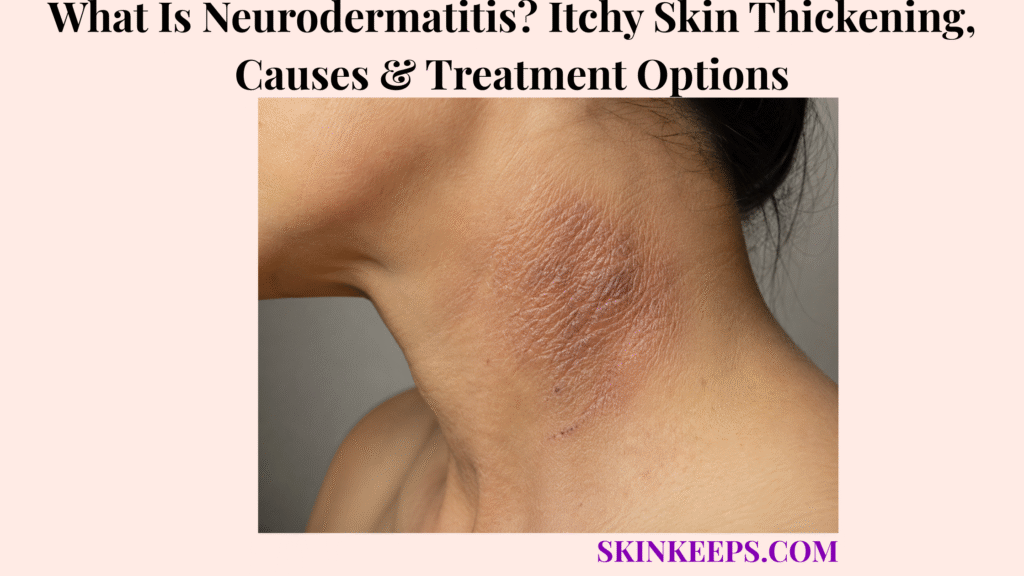
Neurodermatitis usually appears as one or several intensely itchy, well-defined plaques that become thick, rough and leathery after repeated rubbing or scratching.
What Does Neurodermatitis Look Like?
Neurodermatitis produces a thickened lichenified plaque with rough texture, scale, scratch marks and exaggerated normal skin lines.
The surface can develop a criss-cross pattern as normal skin creases become increasingly prominent. Excoriations, scaling and surrounding scratch marks may appear when the itch remains active.
Colour can shift toward hyperpigmentation or hypopigmentation rather than following one universal “red rash” appearance.
Why Does Neurodermatitis Make the Skin Thick and Leathery?
Repeated rubbing and scratching cause chronic epidermal thickening called lichenification, which can make the altered skin increasingly itchy.
Mechanical injury repeatedly stimulates the epidermis and reinforces the sequence itch → scratching → thickening → stronger itch → more scratching. The thicker plaque therefore represents a consequence of chronic scratching while also helping perpetuate the cycle.
Where Does Neurodermatitis Usually Develop?
Neurodermatitis usually develops on areas that are easy to reach repeatedly, including the neck, scalp, wrists, forearms, ankles, shins, thighs and genital or perianal skin.
One plaque or several separate plaques can occur. Reachability and repeated rubbing support the diagnosis, but location alone does not establish neurodermatitis.
Can Neurodermatitis Look Different on Darker Skin or Affect the Scalp?
Yes; darker skin may show more brown, grey-brown, hyperpigmented or hypopigmented change, while scalp scratching can break hairs and cause localized hair loss.
Erythema may be less visually obvious in darker skin, making texture, lichenification and exaggerated skin markings especially useful clues.
Scalp disease can break hair shafts or cause localized alopecia. Regrowth depends on how much injury has occurred, and permanent scarring can limit recovery in severely damaged areas.
Figure 1. Neurodermatitis is sustained by a feedback loop: itch triggers scratching, scratching produces lichenification, and the altered skin can become increasingly itchy.
Why Does Neurodermatitis Develop, and What Keeps the Itch–Scratch Cycle Going?
Neurodermatitis develops when a local itch repeatedly triggers scratching, while the original itch can come from dry skin, another dermatosis, irritation, neuropathic signals or other triggers.
What Can Start the Itch–Scratch Cycle?
There is no single neurodermatitis trigger; dry skin, irritation, heat, sweating, tight clothing, inflammatory skin disease and nerve-related itch can all start or amplify localized scratching.
Xerosis, repeated friction, environmental irritants, impaired blood flow and injured or irritated nerves can all create an initial itch signal. Once lichenification is established, the plaque itself may continue itching even when the first trigger becomes difficult to identify.
Can Eczema, Psoriasis, Scabies or Fungal Disease Trigger Neurodermatitis?
Yes; another itchy skin disorder can initiate repetitive scratching that later produces a secondary neurodermatitis plaque.
Atopic dermatitis can provide a chronic inflammatory and barrier-related source of itch.
Psoriasis can also create a persistently itchy plaque that becomes secondarily lichenified through rubbing.
Scabies can produce intense itch that leads to scratching, but the mite infestation itself requires separate treatment and should not be mistaken for neurodermatitis.
Fungal infection can create a similar trigger when clinically plausible. Treating the thick plaque alone may fail while the primary itchy disorder remains active.
Can Contact Allergy or Nerve Problems Cause the Itch?
Yes; localized contact allergy, irritation or neuropathic itch can initiate chronic scratching and eventually produce lichenification.
Clothing, personal-care products, occupational materials and other irritants or allergens can sustain a localized itch. Patch testing becomes useful when allergic contact dermatitis is genuinely suspected rather than as a routine test for every plaque.
Burning, tingling, altered sensation or a characteristic nerve distribution can suggest neuropathic itch such as brachioradial pruritus or radiculopathy. Ordinary itch should not be labelled neuropathic without compatible features.
Do Stress and Anxiety Cause Neurodermatitis?
Stress and anxiety can intensify itching and habitual scratching, but neurodermatitis should not be described as a purely psychological disorder.
A more accurate model combines physical triggers, itch behaviour and emotional amplification. Stress can make the cycle harder to interrupt without explaining every case or making the symptoms “all in the mind.”
Widespread unexplained pruritus does not automatically fit localized neurodermatitis and may require a broader dermatologic or systemic evaluation.
Figure 2. Dry skin, inflammatory disease, contact exposure, infestation, fungal disease or neuropathic itch can initiate scratching; stress may amplify the cycle without defining the disorder by itself.
How Is Neurodermatitis Distinguished and Diagnosed?
Neurodermatitis is usually diagnosed clinically from a localized lichenified plaque and a history of repetitive scratching, while testing is directed toward the condition that may have caused or mimicked the itch.
How Is Neurodermatitis Different From Atopic Dermatitis, Psoriasis and Prurigo Nodularis?
Neurodermatitis is dominated by a localized scratch-driven lichenified plaque, whereas atopic dermatitis is a broader inflammatory eczema, psoriasis forms characteristic inflammatory plaques, and prurigo nodularis produces multiple firm itchy nodules.
Neurodermatitis is often localized and visibly lichenified with evidence of scratching. Atopic dermatitis more broadly reflects chronic inflammatory and barrier dysfunction, while psoriasis has its own characteristic plaque pattern.
Prurigo nodularis is dominated by discrete firm papules or nodules rather than one or a few primarily lichenified plaques. These disorders can overlap or coexist, so morphology is interpreted together with history.
Why Does Genital Neurodermatitis Need Careful Evaluation?
Genital neurodermatitis requires careful assessment because chronic vulvar, scrotal or perianal itch may be secondary to contact dermatitis, fungal disease, psoriasis, neuropathic itch or another genital dermatosis.
Sensitive genital skin can become heavily lichenified through repeated rubbing, but the original cause still needs attention. Persistent genital itch should not be casually self-diagnosed as neurodermatitis when another dermatosis, infection or neural trigger remains plausible.
Which Tests Are Used When the Cause Is Uncertain?
Testing is targeted to the suspected underlying trigger rather than performed routinely in every case of neurodermatitis.
Patch testing can investigate suspected allergic contact dermatitis. Fungal scraping or culture can evaluate a plausible dermatophyte or Candida infection, while a bacterial swab becomes useful when drainage, crusting or another sign suggests secondary infection.
When Is a Skin Biopsy Needed?
Skin biopsy is usually unnecessary for a classic neurodermatitis plaque but can help when the morphology is atypical, treatment fails or another persistent dermatosis remains possible.
Psoriasis, lichen planus and other chronic dermatoses can remain in the differential. A persistent atypical plaque can also require exclusion of mycosis fungoides, although persistent itching by itself does not imply lymphoma.
Figure 3. Neurodermatitis is usually diagnosed clinically, but the clinician also searches for dermatitis, contact allergy, infection or neuropathic itch and orders only the tests that fit that suspicion.
How Is Neurodermatitis Treated?
Neurodermatitis treatment works by suppressing itch and inflammation, physically interrupting scratching, repairing the skin barrier and treating the condition that originally triggered the itch.
What Is the Main Goal of Neurodermatitis Treatment?
The main goal is to stop the itch–scratch cycle long enough for inflamed, thickened skin to heal.
A practical sequence is suppress itch → stop scratching → heal the barrier → remove the trigger. Medication alone can fail when scratching continues unconsciously or the initiating disease remains active.
How Do Topical Corticosteroids and Occlusion Help?
Topical corticosteroids reduce inflammation and itch, while carefully selected occlusion can protect the plaque from scratching and increase medication penetration through thickened skin.
Corticosteroid strength and treatment duration depend on body site, plaque thickness and patient factors. A thick limb plaque and sensitive genital or facial skin should not be treated as though they have identical steroid requirements.
Occlusive dressings can reduce night-time scratching and improve penetration through lichenified skin. Potent corticosteroid occlusion should be clinician-directed because occlusion increases absorption.
How Do Moisturizers, Cool Compresses and Steroid-Sparing Treatments Help?
Moisturizers and cool compresses reduce dryness and itch, while tacrolimus or pimecrolimus can provide selected steroid-sparing anti-inflammatory treatment.
Regular moisturization supports barrier repair and reduces xerosis. A cool compress or brief soak can temporarily relieve itching and soften thickened skin before prescribed topical therapy.
Calcineurin inhibitors are useful in selected situations, particularly where prolonged corticosteroid exposure is undesirable, but they are not universally superior to topical steroids.
What Can Help Night-Time or Neuropathic Itching?
Night-time or nerve-related itching may require treatment beyond routine topical therapy when sleep disruption or neuropathic symptoms continue the scratching cycle.
A selected sedating antihistamine may be used in some patients to reduce night-time scratching and support sleep. Its use does not mean neurodermatitis is fundamentally a histamine-allergy disorder.
When burning, tingling or neural distribution suggests neuropathic itch, the neural trigger should be investigated. Specialist-directed treatment can include medicines such as gabapentin or pregabalin without implying that every chronic itch needs neuropathic medication.
What Should Be Rechecked When Neurodermatitis Does Not Improve?
Persistent neurodermatitis should trigger reassessment of ongoing scratching, the original itch trigger and the diagnosis before treatment is simply escalated.
The troubleshooting sequence is: has scratching actually stopped → is eczema or psoriasis still active → was contact allergy missed → is fungal infection present → is the itch neuropathic → is the diagnosis correct?
Selected refractory lesions can require intralesional corticosteroid, phototherapy or other specialist treatment, while systemic immunomodulation is seldom necessary for ordinary localized disease.
Figure 4. Effective treatment combines trigger control, itch suppression, scratch prevention and barrier repair, then maintains those gains long enough for thickened skin to remodel.
How Can Neurodermatitis Recurrence and Complications Be Reduced?
Neurodermatitis is less likely to recur when scratching is interrupted consistently, individual triggers are controlled and the underlying source of itch remains treated.
How Can Unconscious Scratching Be Reduced?
Physical barriers, short nails and habit-reversal strategies can reduce automatic scratching that occurs during rest, distraction or sleep.
Appropriate coverings can create a physical pause between itch and scratching. Habit reversal focuses on recognizing the urge and substituting a less damaging response rather than blaming the person for scratching.
Which Everyday Triggers Should Be Reduced?
Trigger reduction should focus on the person’s actual aggravators, such as heat, sweating, tight clothing, excessive dryness or irritating products and materials.
Individual trigger control is more useful than a universal avoidance list. Unsupported dietary restrictions are not a standard way to treat localized neurodermatitis.
How Long Does Thickened or Discoloured Skin Take to Recover?
Itching may improve before the thickened texture and pigment changes disappear because lichenified skin needs time to remodel after scratching stops.
Lichenification, hyperpigmentation and hypopigmentation can remain after active itching improves, especially in darker skin tones where pigment change may be more prominent. Residual colour change does not automatically mean the itch–scratch cycle is still active.
Can Scratching Cause Infection or Other Quality-of-Life Problems?
Yes; repeated scratching can create open wounds and secondary infection, while severe neurodermatitis can disrupt sleep, concentration and genital comfort or sexual function.
Increasing pain, swelling, spreading redness, drainage or fever can suggest secondary infection. Excoriation alone is not proof that a bacterial infection is present.
When Should Persistent Neurodermatitis Be Reassessed?
Neurodermatitis should be reassessed when a plaque enlarges, remains intensely itchy despite appropriate treatment, becomes painful or infected, ulcerates, repeatedly returns despite scratching control or no longer fits the expected diagnosis.
The central question should be reopened: why is this area still itching? Persistent disease can reflect an untreated trigger, contact allergy, fungal disease, neuropathic itch or an alternative diagnosis rather than a need for indefinite topical-treatment escalation.
What Should You Remember About Neurodermatitis?
Neurodermatitis is the same disorder as lichen simplex chronicus and is maintained by an itch–scratch cycle in which repeated rubbing creates thickened skin that becomes increasingly itchy.
- Neurodermatitis and lichen simplex chronicus are the same disorder.
- Neurodermatitis itself is not contagious.
- It is more than ordinary dry skin.
- Lichenification develops through repeated scratching and rubbing.
- The original itch can have another cause.
- Localized reachable plaques are typical.
- Colour changes can look different across skin tones.
- Scalp scratching can damage hair.
- Eczema, psoriasis, irritation, infection, infestation and neuropathic itch can contribute.
- Stress may amplify the cycle but does not solely explain it.
- Diagnosis is usually clinical.
- Testing is trigger-directed.
- Biopsy is selective.
- Treatment must suppress both itch and scratching.
- Topical corticosteroids are important local therapy.
- Barrier repair matters.
- Behavioural scratching control matters.
- The underlying trigger must remain treated.
- Texture and pigment may recover slowly.
- Recurrence is more likely when the trigger or scratching returns.
Find trigger → Break itch → Stop scratching → Heal skin → Maintain trigger control → Prevent recurrence.
Frequently Asked Questions About Neurodermatitis
The most important neurodermatitis questions concern its relationship to lichen simplex chronicus, the cause of skin thickening, contagiousness, treatment and recurrence.
Is Neurodermatitis the Same as Lichen Simplex Chronicus?
Yes; neurodermatitis and lichen simplex chronicus are two names for the same chronic itch–scratch disorder. Repeated rubbing creates lichenification, which means thickened leathery skin with exaggerated surface lines.
What Causes Skin to Become Thick in Neurodermatitis?
Repeated scratching and rubbing stimulate the epidermis to thicken, producing the leathery skin change called lichenification. The altered plaque can then itch more and perpetuate further scratching.
Is Neurodermatitis Contagious?
No; neurodermatitis itself is not contagious. A separate initiating trigger such as scabies or fungal infection can be contagious and should not be confused with the secondary lichenified plaque.
How Is Neurodermatitis Treated?
Treatment combines itch suppression, anti-inflammatory therapy, skin-barrier repair, scratching prevention and treatment of the original itch trigger. Topical corticosteroids, moisturizers, protective strategies and selected steroid-sparing treatments can all have a role.
Can Neurodermatitis Go Away Permanently?
Neurodermatitis can clear substantially, but recurrence is possible if the original itch trigger or habitual scratching returns. Long-term control therefore depends on maintaining both trigger management and scratching prevention.
Which Sources Support This Neurodermatitis Guidance?
DermNet — Lichen Simplex Chronicus / Neurodermatitis — Primary source for synonym terminology, lichenification, criss-cross skin markings, body distribution, skin-of-colour variation, scalp hair effects, secondary triggers, neuropathic itch, diagnosis, behavioural treatment and recurrence.
American Academy of Dermatology — Neurodermatitis Overview — Used for the itch–scratch cycle, non-contagious status, localized reachable sites, sleep disruption and the core goal of stopping scratching.
American Academy of Dermatology — Neurodermatitis Signs and Symptoms — Used for intense itch, localized patches, repeated rubbing and progressive thickening.
American Academy of Dermatology — Neurodermatitis Causes — Used for xerosis, atopic dermatitis, psoriasis, neural triggers, poor blood flow, heat, sweating, tight clothing and stress-related amplification.
American Academy of Dermatology — Neurodermatitis Diagnosis and Treatment — Used for clinical diagnosis, infection swab, targeted testing, topical corticosteroids, cool compresses, itch interruption and individualized treatment.
Mayo Clinic — Neurodermatitis: Symptoms and Causes — Used for night-time scratching, sleep and sexual-function effects, recurrence, infection risk and the distinction between neurodermatitis and its aggravating factors.
DermNet — Lichen Simplex of the Vulva — Used selectively for genital neurodermatitis, underlying dermatosis/contact/fungal/neuropathic triggers and the need for targeted testing in persistent vulvar disease.
DermNet — Prurigo — Used only for the prurigo nodularis differential, where firm itchy nodules contrast with primarily lichenified neurodermatitis plaques.