
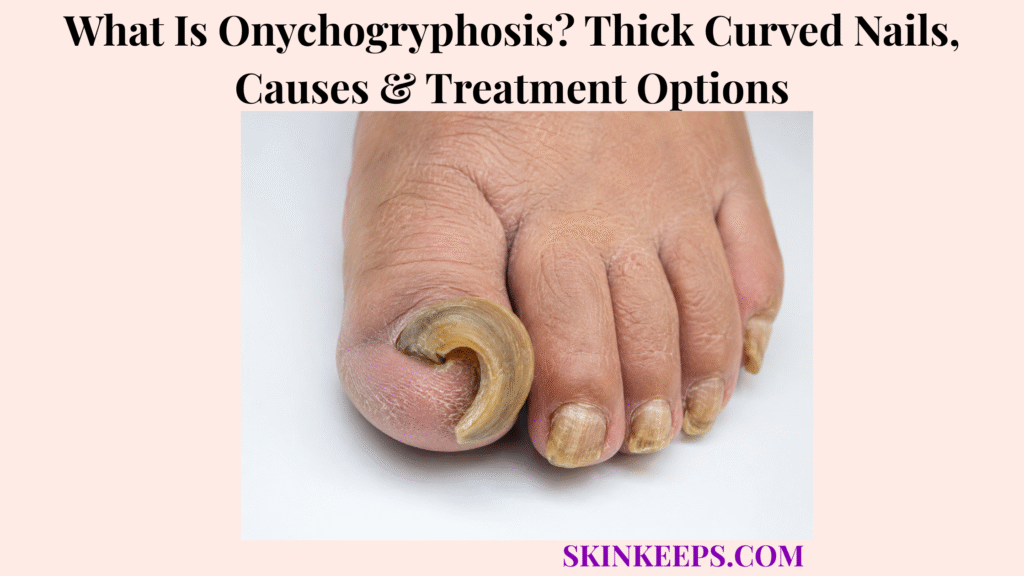
Onychogryphosis is a structural nail-growth disorder in which the nail becomes markedly thick, hard, elongated and progressively curved, eventually producing the characteristic ram’s-horn appearance. The great toenail is affected most often, although other toenails and, less commonly, fingernails can be involved.
Acquired onychogryphosis is associated with ageing, chronic shoe pressure, repeated trauma, difficulty with nail care and impaired peripheral circulation. Nail fungus can mimic or coexist with the deformity, and treatment ranges from repeated professional debridement to selected permanent matricectomy when severe recurrent disease cannot be controlled conservatively.
This article is for educational purposes only and does not constitute medical advice, diagnosis, or treatment. A severely thick or curved nail that is painful, cutting into surrounding skin, associated with redness, swelling, drainage or recurrent infection, too difficult to trim safely, or occurs in someone with diabetes, neuropathy or impaired circulation should be evaluated by a licensed dermatologist, podiatry professional or qualified healthcare professional. New unexplained pigmentation, bleeding, erosion or a persistent growth beneath a nail also requires assessment rather than being attributed automatically to onychogryphosis.
How Can You Recognize Onychogryphosis?
Onychogryphosis is recognized by a nail that becomes markedly thick, hard and opaque, then grows excessively long and curves or twists into a horn-like shape.
What Does Onychogryphosis Look Like as It Progresses?
Onychogryphosis usually progresses from abnormal nail thickening to excessive elongation and increasingly pronounced upward or sideways curvature.
The plate often becomes hard, opaque and yellow to yellow-brown and can become difficult to cut. Early thickening is less specific, while advanced curvature and excessive length make the diagnosis much more distinctive.
Which Nails Are Usually Affected, and Why Does the Nail Curve?
The great toenail is affected most often, and uneven production of hypertrophic nail tissue can progressively direct the nail away from its normal straight growth path.
One or both great toenails can be involved, although other toenails and fingernails are possible. Asymmetrical matrix or nail-bed output can create upward or lateral deviation, but one identical mechanism does not explain every case.
Can Onychogryphosis Become Painful or Affect Footwear?
Yes; a large thick curved nail can press against shoes, neighbouring toes or surrounding nail folds and cause mechanical pain or difficulty with footwear.
Pressure can produce tenderness, adjacent-toe contact, difficulty walking, an ingrown edge or nail-fold inflammation. Pain does not automatically mean infection.
Is Every Thick Toenail Onychogryphosis?
No; simple nail thickening is onychauxis, while onychogryphosis specifically combines marked thickening with excessive length and abnormal curvature.
Onychomycosis, psoriasis and trauma can all create thick nails. The practical distinction is onychauxis = thick, whereas onychogryphosis = thick + long + curved.
Figure 1. The defining progression is thickening → elongation → unequal growth → increasing curvature → ram’s-horn deformity.
Why Does Onychogryphosis Develop, and Who Is More Likely to Get It?
Acquired onychogryphosis is associated with disturbed nail growth from repeated trauma, chronic footwear pressure, ageing, impaired nail care and reduced peripheral circulation.
How Do Ageing and Difficulty With Nail Care Contribute?
Onychogryphosis becomes more common in older adults because years of nail pressure or trauma can combine with reduced mobility and difficulty trimming increasingly thick nails.
Mobility limitation, reduced self-care ability and dementia can make safe routine nail maintenance difficult, allowing overgrowth to progress. This is a care-access problem rather than a reason to blame the person for “poor hygiene.”
Can Tight Shoes or Previous Nail Injury Cause Onychogryphosis?
Repeated shoe pressure and previous injury to the nail matrix or nail bed can disrupt normal nail growth and contribute to progressive onychogryphosis.
Poorly fitting shoes, chronic great-toe pressure, repetitive microtrauma and prior nail-bed injury can all disturb nail production. Hallux valgus can change pressure mechanics and increase repeated contact at the great toe.
How Are Poor Circulation and Diabetes Related to Onychogryphosis?
Reduced peripheral circulation is a recognized association with onychogryphosis, while diabetes becomes especially relevant when vascular disease, neuropathy or impaired foot care increases treatment and wound-healing risk.
Diabetes does not directly explain every deformed nail. Circulation, sensation, skin integrity and wound-healing capacity matter particularly before aggressive trimming, avulsion or matricectomy.
Can Skin, Foot or Congenital Conditions Contribute?
Psoriasis, ichthyosis, hallux valgus and rare congenital disorders can contribute to abnormal nail growth, although acquired onychogryphosis remains much more common.
Nail psoriasis can distort nail production through matrix and nail-bed inflammation. Congenital onychogryphosis is rare and can begin much earlier than the usual acquired form.
Figure 2. Ageing, nail-care difficulty, pressure, trauma, toe mechanics, circulation and underlying nail disease can combine to disturb growth progressively.
How Is Onychogryphosis Distinguished and Diagnosed?
Onychogryphosis is usually diagnosed clinically from marked nail thickening, excessive length and progressive curvature, while fungal testing and broader foot assessment identify important coexisting causes or treatment risks.
How Is Onychogryphosis Different From Nail Fungus?
Onychogryphosis is defined by structural elongation and horn-like curvature, while nail fungus / onychomycosis more characteristically causes fungal discoloration, subungual debris, brittleness, crumbling or nail separation.
The appearances overlap, and neither morphology is absolute. A curved nail does not exclude fungus, and a yellow thick nail does not prove fungus; both conditions can occur in the same nail.
How Does Onychogryphosis Differ From Other Nail Deformities?
Onychauxis causes thickening without the defining excessive curvature, while nail psoriasis and congenital nail malalignment create different structural patterns that can occasionally contribute to or resemble onychogryphosis.
Nail psoriasis can produce pitting, onycholysis, oil-drop change and subungual hyperkeratosis. Congenital malalignment causes the great toenail to grow at an abnormal angle from infancy or childhood rather than developing the usual acquired ram’s-horn pattern later in life.
When Should a Thick Curved Nail Be Tested for Fungus?
Fungal testing is appropriate when onychomycosis remains clinically plausible because secondary fungal infection can coexist with an onychogryphotic nail.
Nail clippings or subungual material can be tested for dermatophytes, yeasts or moulds. Testing is most useful when fungal confirmation would change treatment rather than being mandatory for every classic ram’s-horn nail.
What Else Should Be Assessed Before Onychogryphosis Is Treated?
Assessment should include footwear pressure, toe alignment, surrounding nail folds, secondary infection, sensation and peripheral circulation before treatment intensity is selected.
Ingrown edges, paronychia, hallux deformity, neuropathy and diabetes-related foot risk can alter the safest management plan. A nail procedure should not be planned in isolation from the foot that must heal afterward.
Figure 3. Onychogryphosis is usually recognized clinically, while selective fungal testing and assessment of pressure, skin, circulation and sensation guide safer treatment.
How Is Onychogryphosis Treated?
Onychogryphosis is usually managed first with professional mechanical reduction and pressure control, while recurrent severe symptomatic disease may require nail avulsion and permanent matricectomy.
How Does Mechanical Debridement Treat Onychogryphosis?
Mechanical debridement reduces the thickness and excessive length of an onychogryphotic nail, relieving pressure without permanently stopping nail growth.
A trained clinician can use heavy-duty nail instruments and a nail bur or drill to reduce bulk and subungual keratin. This can improve shoe fit, reduce pressure and make ongoing maintenance easier.
Debridement is maintenance rather than permanent cure because the nail matrix remains active and the nail continues to grow.
When Should Professional Nail Care Be Preferred Over Home Cutting?
Professional nail care is safer when the nail is extremely thick or when diabetes, neuropathy, poor circulation or fragile surrounding skin increases the risk of injury from self-cutting.
Very thick plates are difficult to control with ordinary clippers, and accidental cuts can heal poorly in high-risk feet. Adequate toe-box room and reduced repetitive pressure should accompany nail reduction.
Are Antifungals or Nail Avulsion Used for Onychogryphosis?
Antifungal treatment is used only when fungal infection is present, while nail avulsion may be considered when conservative reduction does not adequately control a painful or severely deformed nail.
Antifungals treat confirmed or coexisting infection rather than the structural deformity itself. Nail avulsion removes the nail plate, but if the matrix remains intact the deformed nail can grow back.
What Is Matricectomy, and When Is It Considered?
Matricectomy permanently destroys or removes the nail matrix and is a more definitive option for selected patients with severe recurrent symptomatic onychogryphosis.
Chemical, surgical, electrosurgical or laser techniques may be used by clinicians, but the decision depends on severity, recurrence, pain, vascular status, wound-healing capacity and patient preference.
The central trade-off is less recurrence in exchange for intentional permanent loss of the treated nail.
| Clinical Situation | Main Management Direction |
|---|---|
| Manageable thick curved nail | Professional debridement |
| Ongoing footwear pressure | Correct shoe fit / reduce pressure |
| Confirmed fungal coexistence | Treat fungus separately |
| Severe symptomatic nail | Consider nail avulsion |
| Severe recurrent disease | Consider avulsion + matricectomy |
| Diabetes / neuropathy / poor circulation | Professional assessment before aggressive treatment |
What Complications Can Onychogryphosis Cause, and How Can Recurrence Be Reduced?
Untreated or recurrent onychogryphosis can cause pressure pain, ingrown nail edges, paronychia, secondary fungal infection and difficulty with footwear or walking.
How Can Onychogryphosis Cause Ingrown Nails or Paronychia?
A markedly curved nail can press into surrounding nail folds, causing an ingrown edge and repeated tissue injury that can promote paronychia.
The mechanism is curvature → nail-fold pressure → tissue injury → inflammation and possible infection. A painful nail fold is not automatically infected, so drainage, spreading redness and other signs matter.
Does Onychogryphosis Return After Debridement or Nail Removal?
Yes; the nail commonly thickens and curves again after conservative reduction, and it can also regrow after nail avulsion when the matrix remains intact.
Debridement leaves the matrix untouched, so recurrence is expected and maintenance often needs repetition. Plate-only avulsion also preserves the matrix; matricectomy is the step that intentionally prevents regrowth.
How Can Future Worsening Be Reduced?
Regular nail reduction, correctly fitted footwear and reduction of repeated toe pressure can limit excessive regrowth and reduce mechanical complications.
Long-term care can include regular maintenance, adequate shoe room, reduction of repetitive trauma, management of toe deformity when appropriate, treatment of confirmed fungal infection and closer monitoring of high-risk feet.
When Should an Onychogryphotic Nail Be Reassessed?
An onychogryphotic nail should be reassessed when pain increases, it repeatedly becomes ingrown or infected, safe trimming is no longer possible, or an unexpected pigmented, bleeding, eroded or mass-like change develops.
Persistent drainage, recurrent paronychia, unexplained pigmentation, bleeding, erosion or a subungual growth should reopen the diagnosis rather than being attributed automatically to the structural deformity.
What Should You Remember About Onychogryphosis?
Onychogryphosis is a structural nail-growth disorder defined by marked thickening, excessive elongation and abnormal curvature rather than nail thickness alone.
- The great toenail is affected most often.
- Advanced disease produces a ram’s-horn appearance.
- Onychauxis means thickness without the defining horn-like curvature.
- Ageing, trauma and footwear pressure are major associations.
- Poor circulation can contribute and changes treatment safety.
- Diabetes matters through vascular, neuropathy and foot-care context rather than as a universal direct cause.
- Nail psoriasis and structural foot problems can contribute.
- Congenital disease is rare.
- Nail fungus can mimic or coexist with onychogryphosis.
- A yellow thick nail does not automatically prove fungus.
- Diagnosis is usually clinical and fungal testing is selective.
- Footwear, surrounding skin, sensation and circulation should be assessed.
- Debridement is maintenance treatment for many cases.
- Antifungals treat fungus, not the structural deformity.
- Nail avulsion alone can be followed by regrowth.
- Matricectomy prevents regrowth but permanently removes the nail.
- Complications include pain, ingrowing, paronychia and fungal infection.
Recognize structural deformity → Check fungus and contributing factors → Reduce nail safely → Control pressure → Escalate recurrent severe disease → Maintain long-term care.
Frequently Asked Questions About Onychogryphosis
The most important onychogryphosis questions concern why nails become horn-like, how the disorder differs from fungus, whether conservative treatment works, why it returns and when permanent treatment is considered.
What Causes a Toenail to Become Thick and Curved Like a Horn?
Onychogryphosis develops when abnormal nail growth produces progressive thickening, excessive length and uneven curvature, often in the setting of chronic trauma, footwear pressure, ageing or impaired circulation. No single trigger explains every case.
How Can You Tell Onychogryphosis From Nail Fungus?
Onychogryphosis is defined by excessive nail length and horn-like curvature, while fungal infection more often produces discoloration, debris, brittleness and crumbling, although both conditions can occur together. Fungal testing can help when uncertainty would change treatment.
Can Onychogryphosis Be Treated Without Removing the Nail?
Yes; many cases can be managed with repeated professional debridement and reduction of footwear pressure without removing the entire nail. Maintenance usually needs repetition because debridement does not change the matrix.
Does Onychogryphosis Grow Back After Treatment?
Yes; regrowth is common after trimming, debridement or nail avulsion when the nail matrix remains intact. Matricectomy is the definitive option that intentionally prevents regrowth.
When Does an Onychogryphotic Nail Need Surgical Removal?
Surgical treatment becomes more reasonable when severe deformity repeatedly causes pain or complications and conservative nail reduction no longer provides acceptable control. Circulation, wound healing, recurrence and the permanent nail-loss trade-off must be considered.
Which Sources Support This Onychogryphosis Guidance?
DermNet — Onychogryphosis — Primary source for definition, ram’s-horn morphology, great-toenail predominance, ageing, trauma, shoe pressure, circulation, fungal coexistence, diagnosis, complications, debridement, avulsion and matricectomy.
DermNet — Nail Terminology — Used specifically to distinguish onychogryphosis from onychauxis and other nail-shape terminology.
American Family Physician — Onychomycosis: Rapid Evidence Review — Used for fungal-nail differential, confirmation before antifungal treatment and the overlap between onychomycosis and other nail dystrophies.