Onychotillomania is recurrent picking, pulling, rubbing or manipulation of the nails and surrounding nail tissues that can damage the nail plate, cuticle, nail folds and nail-producing matrix. The behavior can occur consciously in response to an urge or automatically with limited awareness, and repeated trauma can create visible grooves, ridges, wounds and irregular nail growth.
Onychotillomania belongs to the broader body-focused repetitive behavior, or BFRB, framework, but triggers and awareness differ between people. Nail fungus and psoriasis can mimic or coexist with picking damage, while treatment focuses on protecting the nail and changing the repetitive behavior before prolonged matrix trauma causes permanent dystrophy.
This article is for educational purposes only and does not constitute medical advice, diagnosis, or treatment. Persistent nail picking that causes bleeding, open wounds, significant pain, swelling, pus, recurrent infection, progressive nail destruction or inability to control the behavior despite repeated attempts should be evaluated by a licensed dermatologist or qualified healthcare professional; psychological or psychiatric support can also be appropriate when the behavior causes substantial distress or interferes with daily life.
How Can You Recognize Onychotillomania?
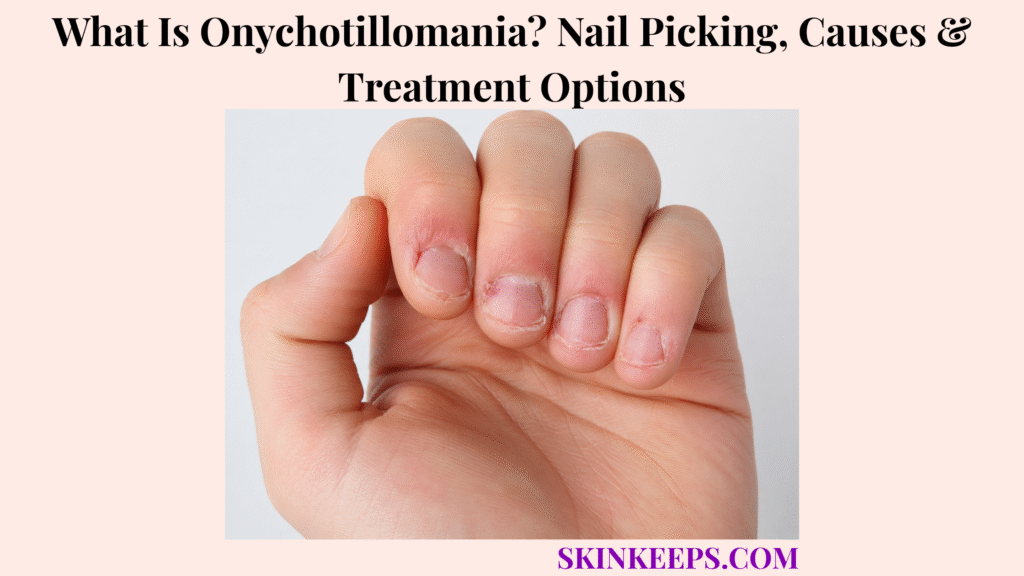
Onychotillomania often produces an irregular pattern of grooves, ridges, damaged cuticles, rough nail plates, small haemorrhages and periungual wounds caused by repeated external manipulation.
What Does Nail-Picking Damage Usually Look Like?
Nail picking can create irregular grooves, ridges, splitting, thinning, crusting, cuticle loss, small haemorrhages and erosions around the nail.
The plate may look uneven, rough or partly thinned, while the proximal or lateral folds can become scaly, crusted or eroded. Repeated manipulation can also create irregular pigmentation and local bleeding.
Different picking, rubbing, pulling or pushing patterns create different nail appearances, so identical damage should not be expected on every affected nail.
What Is Habit-Tic Nail Deformity?
Habit-tic deformity is a specific onychotillomania pattern caused by repeated proximal nail-fold manipulation, usually producing a central depression with multiple transverse ridges on one or both thumbnails.
The resulting “washboard nail” often combines a central longitudinal depression with repeated parallel transverse ridges. Cuticle loss, proximal-fold thickening or bolstering and an enlarged lunula can accompany more established disease.
Habit-tic deformity is one recognizable pattern within the wider onychotillomania spectrum rather than a synonym for every form of nail picking.
Can Nail Picking Cause Dark Streaks or Other Pigment Changes?
Yes; repeated nail-matrix trauma can cause small haemorrhages or trauma-related longitudinal pigmentation, but persistent unexplained nail pigment still requires proper assessment.
A known repetitive trauma pattern can plausibly produce frictional melanonychia or small haemorrhagic changes. A new or persistent dark band without a clear mechanical explanation should not automatically be dismissed as picking damage.
Do People Always Know They Are Picking Their Nails?
No; onychotillomania can occur as focused conscious picking or as automatic manipulation performed with limited awareness during another activity.
Focused picking often follows a recognized urge or sensory imperfection and may bring temporary relief after manipulation. Automatic picking can occur while studying, watching television, concentrating or sitting idle before the person fully notices the behavior.
Onychotillomania is not the same as onychophagia: onychotillomania primarily involves picking or manipulating the nail unit, whereas onychophagia specifically means nail biting. The two behaviors can coexist.
Figure 1. Onychotillomania injures the nail unit mechanically; repeated picking or rubbing can damage the cuticle, folds and matrix and produce irregular grooves, ridges, wounds and distorted regrowth.
Why Does Onychotillomania Develop, and What Keeps Nail Picking Going?
Onychotillomania is a multifactorial BFRB in which emotional, sensory and situational triggers can reinforce repeated nail manipulation through temporary relief, stimulation or an urge to correct rough nail irregularities.
Which Situations or Feelings Can Trigger Nail Picking?
Common triggers can include stress, anxiety, boredom, frustration, concentration, understimulation, overstimulation or simply noticing an irregular nail edge.
Studying, screen time, waiting and other idle periods can become high-risk situations for automatic picking, while a rough cuticle or uneven nail edge can create a tactile trigger for focused picking.
Trigger patterns are individual, so no single emotional explanation applies to every person with onychotillomania.
Why Can Nail Picking Become Difficult to Stop?
Picking can become self-reinforcing when it temporarily relieves tension, provides sensory stimulation or creates a feeling that a rough nail has been corrected.
The cycle can become: notice roughness or another trigger → pick → experience temporary relief or sensory reward → create new damage → notice a new irregularity → pick again.
This reinforcement model explains why simply telling someone to “stop” does not address the mechanism maintaining the behavior.
Does Anxiety or OCD Cause Onychotillomania?
Anxiety and obsessive-compulsive symptoms can coexist with or worsen nail picking, but neither is required for someone to develop onychotillomania.
Onychotillomania is clinically recognized within the BFRB and obsessive-compulsive-and-related framework, but it is not a separately named DSM-5-TR diagnosis in the same way as trichotillomania or excoriation disorder.
Anxiety, depression or OCD can coexist and deserve separate assessment when symptoms are present. Nail appearance or picking behavior alone should not be used to assign those diagnoses.
Can Other Body-Focused Repetitive Behaviors Occur at the Same Time?
Yes; onychotillomania can coexist with nail biting, skin picking or hair pulling, which may indicate a broader BFRB pattern requiring treatment beyond one damaged nail.
The presence of another BFRB can change the treatment plan by making broader trigger mapping, behavioral therapy or mental-health support more useful.
Figure 2. Picking can persist because it provides temporary relief, stimulation or correction of a rough edge, while the resulting damage creates new irregularities that restart the cycle.
How Is Onychotillomania Distinguished and Diagnosed?
Onychotillomania is usually diagnosed clinically from the pattern of mechanical nail trauma combined with a nonjudgmental history of picking behavior, triggers, awareness and unsuccessful attempts to stop.
How Is Onychotillomania Different From Nail Fungus and Nail Psoriasis?
Onychotillomania usually shows irregular mechanical damage around the nail plate, cuticle and folds, while fungus more often causes thickening and subungual debris and psoriasis more often produces pitting, oil-drop changes or onycholysis.
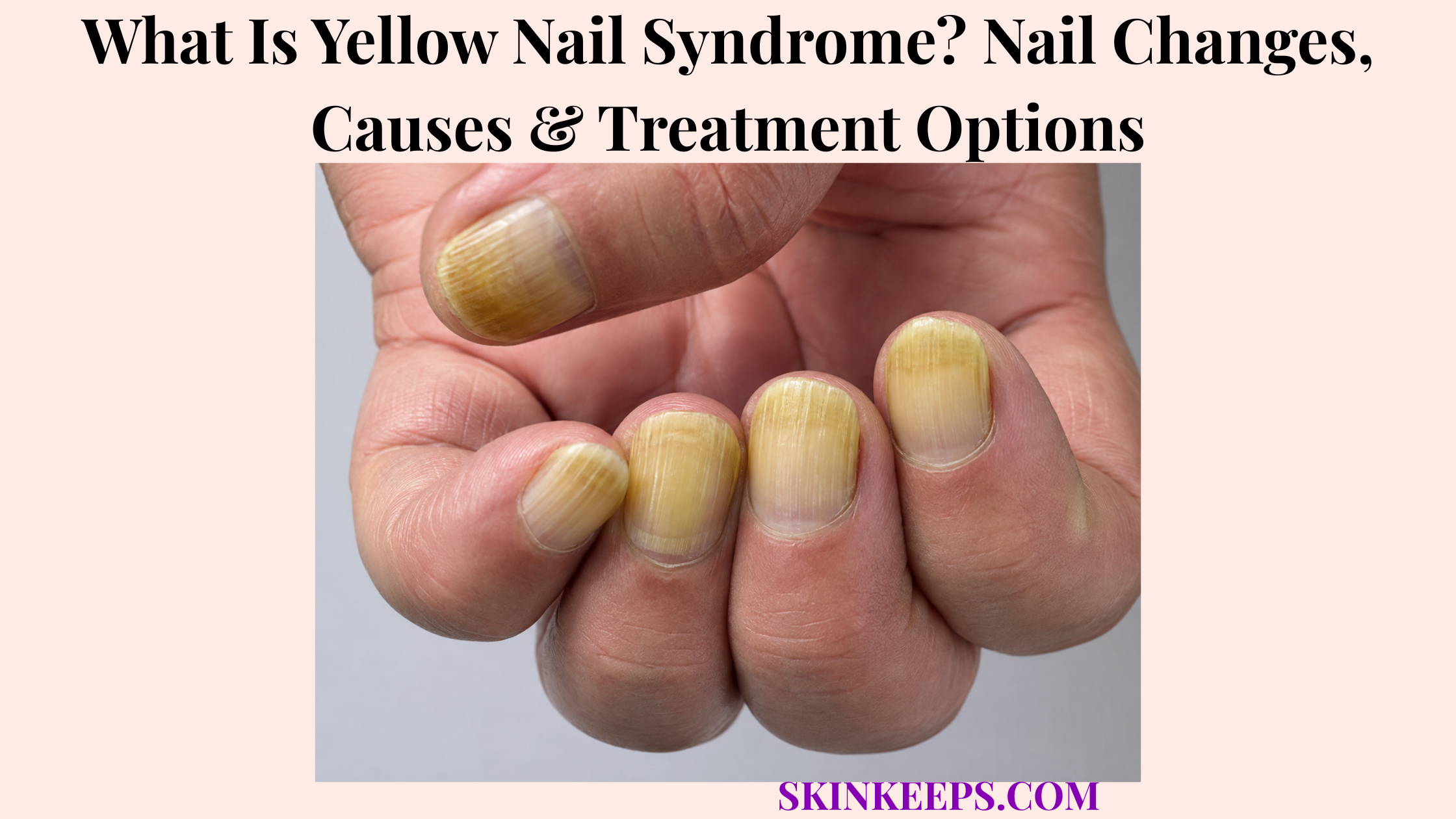
Nail fungus / onychomycosis becomes more plausible with yellow-brown thickening, crumbling and subungual debris rather than a pattern dominated by cuticle injury and irregular excoriation.
Nail psoriasis becomes more plausible with pitting, oil-drop or salmon-patch change, onycholysis and subungual hyperkeratosis.
Mechanical picking can coexist with fungal or psoriatic nail disease, so finding one process does not exclude the other.
How Is Habit-Tic Deformity Different From Median Canaliform Nail Dystrophy?
Habit-tic deformity usually shows transverse washboard ridges plus evidence of proximal nail-fold manipulation, while median canaliform dystrophy more characteristically forms a central longitudinal groove with branching ridges.
Both can affect thumbnails and can overlap in appearance, and some authors have proposed related mechanisms. A central groove therefore does not automatically establish either diagnosis without considering morphology and behavioral history.
How Is Onychotillomania Diagnosed, and What Role Does Dermoscopy Play?
Diagnosis is primarily clinical, while dermoscopy can provide supportive evidence of recurrent mechanical trauma but cannot replace the behavioral history.
Examination should include all nails, cuticles, surrounding skin and nail folds. History should ask nonjudgmentally about rubbing, pushing, picking or pulling, whether behavior is focused or automatic, common triggers, distress or impairment and previous attempts to stop.
Dermoscopy may reveal irregular haemorrhage, longitudinal wavy lines, crusting or scaling that supports mechanical trauma, but these findings are not diagnostic in isolation.
When Are Fungal Testing or Nail Biopsy Needed?
Fungal testing is appropriate when onychomycosis remains plausible, while nail biopsy is rarely needed unless another persistent nail disorder or tumour remains a meaningful concern.
Microscopy or culture can be used when the nail has fungal-pattern thickening, debris or crumbling and confirmation would change therapy. Repeated empiric antifungal treatment without evidence can delay the correct diagnosis.
Biopsy belongs mainly to atypical, persistent or diagnostically uncertain lesions rather than classic behavioral nail damage.
Figure 3. Diagnosis combines mechanical signs with a nonjudgmental focused-versus-automatic picking history, then uses fungal testing or biopsy only when competing diagnoses remain plausible.
How Is Onychotillomania Treated?
Onychotillomania treatment combines physical protection of the damaged nail with behavioral strategies that increase awareness, identify triggers and replace picking with a non-damaging competing response.
How Do Physical Barriers and Nail Care Help?
Bandages, medical tape or suitable protective dressings can shield damaged nails from further picking while smoother nail and cuticle care removes tactile irregularities that may trigger renewed manipulation.
Physical barriers serve two functions: they protect injured tissue and interrupt automatic access to the target nail. Selected hydrocolloid dressings can also protect damaged nail folds when clinically appropriate.
Rough nail edges can be smoothed carefully rather than repeatedly picked. Open or infected tissue should not be hidden under cosmetic coverings that interfere with appropriate wound or infection care.
How Does Habit-Reversal Training Help Stop Nail Picking?
Habit-reversal training helps by making picking more conscious and replacing it with a competing response that is physically incompatible with nail manipulation.
The core sequence is awareness training → trigger identification → competing response. Awareness training identifies the earliest hand movement, urge or setting that precedes picking.
A competing response can be a brief non-damaging action such as making a fist or holding another object. The exact response is individualized rather than limited to one prescribed movement.
What Is Stimulus Control?
Stimulus control changes the environment around nail picking so automatic access to the nail or common triggering situations becomes less reinforcing.
Examples include covering the target nail, removing picking tools, smoothing rough edges, identifying screen-time or study triggers and changing routines that repeatedly lead the hand toward the nail.
The aim is to redesign high-risk situations rather than rely on willpower alone.
When Are Psychological Treatment or Medicines Considered?
Psychological treatment becomes especially useful when picking is difficult to control, causes significant distress or impairment, or occurs with broader BFRBs or mental-health symptoms, while medication remains a more limited and individualized adjunct.
CBT, habit-reversal training and trigger-focused work are central behavioral approaches. Referral becomes more useful after repeated failed attempts to stop, significant embarrassment or distress, school/work or relationship impact, other BFRBs, or separate anxiety, depression or OCD symptoms.
Treatment evidence specific to onychotillomania remains limited, and there is no established routine medication standard for isolated nail picking. N-acetylcysteine and selected psychiatric medicines have been explored in BFRBs or case-based treatment, while antidepressants may be used for a separate psychiatric disorder; these options require clinician-guided individual assessment rather than self-directed medication.
Figure 4. Treatment pairs immediate physical protection with trigger identification, habit-reversal training, competing responses and stimulus control so the matrix can produce healthier nail while relapse-prevention skills continue.
Can Nails Recover After Onychotillomania, and How Can Relapse Be Reduced?
Nails often improve when repeated picking stops before permanent matrix damage occurs, but healthy growth takes months and longstanding trauma can leave persistent nail dystrophy.
Can a Damaged Nail Grow Back Normally?
Yes; a nail can often regain a more normal appearance once repeated trauma stops, provided the nail matrix has not developed permanent scarring.
When the behavior stops, the protected matrix can produce a healthier nail plate that gradually grows outward. Longstanding injury makes the final cosmetic result less predictable.
Why Does Nail Improvement Take Months?
Stopping nail picking does not remove already damaged nail, so improvement appears gradually as new nail grows from the matrix and pushes the injured portion outward.
The earliest useful recovery sign is smoother healthier growth near the nail base. Existing grooves, splits or pigment can remain visible until the damaged plate advances toward the tip.
What Complications Can Repeated Nail Picking Cause?
Repeated picking can cause open wounds, cuticle loss, bleeding, paronychia, secondary fungal infection and permanent nail dystrophy when the matrix is repeatedly injured.
Open periungual tissue can become inflamed or infected, and paronychia can develop when the nail folds are repeatedly damaged.
Secondary fungal infection can also coexist in damaged nails, but not every picked nail becomes infected. Chronic matrix scarring is the complication most relevant to permanent nail shape.
How Can Relapse Be Reduced, and When Should the Diagnosis Be Reassessed?
Relapse is less likely when triggers are recognized early, competing responses and barriers are reused during high-risk periods, and persistent nail abnormalities are reassessed if they continue after picking has stopped.
A relapse plan can continue awareness training, identify recurring situations, reinstate barriers during high-risk periods, smooth or protect rough nail areas, use competing responses and address associated BFRBs.
Reassessment is appropriate when damage continues despite behavioral strategies, wounds repeatedly become infected, permanent deformity develops, the behavior causes marked distress, or the nail remains abnormal after confirmed cessation. Persistent changes should reopen the differential for fungus, psoriasis, structural nail disease or another diagnosis.
What Should You Remember About Onychotillomania?
Onychotillomania is recurrent nail picking or manipulation that can occur consciously or automatically and is best treated by interrupting both the mechanical nail damage and the behavioral cycle that produces it.
- Onychotillomania is recurrent nail manipulation.
- It belongs to the body-focused repetitive behavior family.
- Picking can be focused and conscious or automatic with limited awareness.
- The nail plate, cuticle, folds and matrix can all be injured.
- Damage varies according to the manipulation pattern.
- Habit-tic deformity is one specific onychotillomania pattern.
- Habit-tic deformity often affects one or both thumbnails.
- Onychophagia means nail biting and is not the same behavior.
- Stress and anxiety can trigger or worsen picking but are not the sole cause.
- OCD is not automatically present.
- Sensory irregularities can reinforce repeated picking.
- Other BFRBs can coexist.
- Diagnosis is mainly clinical and the behavioral history should be nonjudgmental.
- Fungus and psoriasis are important mimics and can coexist with picking.
- Dermoscopy is supportive rather than diagnostic.
- Fungal testing is selective and biopsy is rarely necessary.
- Physical barriers protect healing nails.
- Habit-reversal training increases awareness and adds competing responses.
- Stimulus control modifies triggering environments.
- Medication evidence for isolated onychotillomania remains limited.
- Nail recovery depends on stopping repeated matrix trauma.
- Longstanding matrix injury can leave permanent dystrophy.
- Relapse prevention requires continued trigger awareness and reusable strategies.
Recognize mechanical damage → Identify picking pattern → Exclude mimics → Protect nail → Interrupt behavior → Allow healthy growth → Prevent relapse.
Frequently Asked Questions About Onychotillomania
The most important onychotillomania questions concern why nail picking develops, how it differs from nail biting, whether damage can become permanent, how habit-reversal training works and whether treatment can succeed.
What Causes Someone to Repeatedly Pick Their Nails?
Nail picking can be triggered by stress, boredom, concentration, sensory discomfort or nail irregularities and may persist because the behavior temporarily provides relief or stimulation. No single psychological cause applies to everyone.
Is Onychotillomania the Same as Nail Biting?
No; onychotillomania mainly involves picking or manipulating the nail unit, while onychophagia specifically means biting the nails. Both behaviors can occur in the same person.
Can Nails Permanently Deform From Repeated Picking?
Yes; long-term repeated trauma to the nail matrix can cause permanent dystrophy, although many nails improve substantially when picking stops before permanent scarring develops. Recovery is gradual because healthier nail has to grow outward from the matrix.
How Can Habit-Reversal Training Help Stop Nail Picking?
Habit-reversal training increases awareness of picking triggers and teaches a competing response that makes nail manipulation more difficult when the urge appears. Awareness, trigger recognition and a practical replacement response work together.
Can Onychotillomania Be Treated Successfully?
Yes; meaningful improvement is possible when nail protection, behavioral treatment and management of associated triggers or mental-health conditions are combined consistently. Relapse can occur, and longstanding matrix damage may remain even after the behavior improves.
Which Sources Support This Onychotillomania Guidance?
Lee & Lipner — Update on Diagnosis and Management of Onychophagia and Onychotillomania — Primary source for the BFRB framing, distinction between nail biting and nail picking, diagnostic history, psychiatric comorbidity context, behavioral treatment principles and the limited evidence base for standardized treatment.
DermNet — Habit-Tic Deformity — Used for washboard morphology, thumbnail predominance, proximal-fold manipulation, cuticle loss, focused/automatic behavior, differential diagnosis, physical barriers, habit reversal and permanent dystrophy risk.
Cleveland Clinic — Body-Focused Repetitive Behavior Disorders — Used for the broader BFRB framework, conscious versus unaware behavior, trigger/reward concepts, associated BFRBs and current DSM-5-TR classification context.
American Academy of Dermatology — Nail Fungus: Diagnosis and Treatment — Used only for the fungal differential and the need for appropriate diagnostic confirmation before cause-specific antifungal treatment.
American Academy of Dermatology — Nail Psoriasis — Used for pitting, crumbling, lifting and subungual changes that help distinguish inflammatory nail psoriasis from primarily mechanical picking damage.