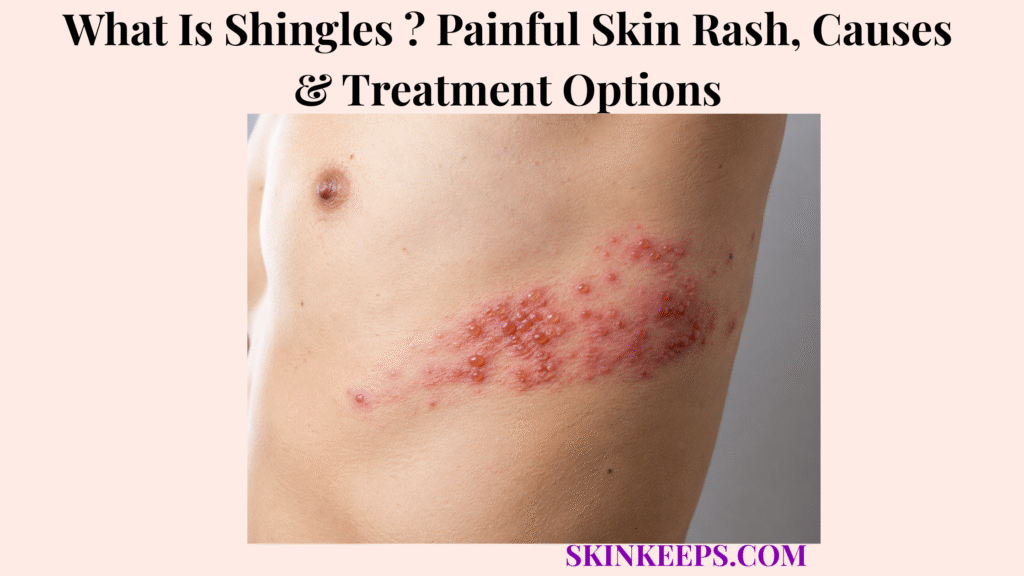
Shingles, or herpes zoster, occurs when varicella-zoster virus (VZV) that remained dormant after an earlier chickenpox infection reactivates in sensory nerve tissue. The reactivated virus can inflame a nerve and the skin it supplies, producing burning, tingling, unusual sensitivity or deep pain followed by a typically one-sided blistering rash.
The rash often forms grouped fluid-filled blisters within one or two adjacent dermatomes, but shingles is more than a skin eruption. Active lesions can transmit VZV to a susceptible person and cause chickenpox, early antiviral assessment matters, and complications such as postherpetic neuralgia, eye disease or neurologic involvement can remain important after the skin begins healing.
This article is for educational purposes only. A new painful one-sided blistering rash—especially near the eye—or severe neurologic symptoms should be medically assessed promptly.
What Is Shingles and What Does the Painful Rash Look and Feel Like?
Shingles is reactivation of latent varicella-zoster virus that usually causes burning or nerve pain followed by a one-sided cluster of fluid-filled blisters in a dermatomal pattern.
How Is Shingles Related to Chickenpox?
Chickenpox is the primary VZV infection, while shingles develops later when the same virus reactivates from its latent state in sensory nerve ganglia. After chickenpox resolves, VZV can remain dormant for years; shingles occurs when that latent virus becomes active again rather than from a newly acquired “shingles virus.”
Why Does Shingles Usually Affect One Side of the Body?
Shingles usually remains one-sided because reactivated VZV travels along the skin territory supplied by the affected sensory nerve. A typical eruption involves one or two adjacent dermatomes, most often on the trunk or face, and usually does not cross the body’s midline.
Can Shingles Pain Start Before the Rash?
Yes; burning, tingling, itching, tenderness, stabbing pain or unusual skin sensitivity can begin several days before shingles blisters become visible. This prodromal nerve pain can be highly localized to the later dermatome, but unexplained pain without a rash does not by itself prove shingles.
How Does the Shingles Rash Develop and Heal?
The shingles eruption typically progresses from localized pain or tingling to grouped bumps and fluid-filled vesicles, followed by drying, crusting and healing. New vesicles commonly continue forming for about 3–5 days, lesions usually scab over in roughly 7–10 days, and the overall rash commonly heals within about 2–4 weeks.
Figure 1. Shingles often begins with localized nerve symptoms before visible vesicles, and persistent nerve pain can outlast the rash.
Why Does Shingles Develop, Who Is at Risk, and Can It Spread?
Shingles develops when immune control of latent VZV declines enough for the virus to reactivate, with risk increasing particularly with age and immune suppression.
Why Does Varicella-Zoster Virus Reactivate?
The exact trigger for an individual shingles episode is often unclear, but reduced VZV-specific immune control allows latent virus to reactivate. The process is better understood as loss of immune containment of a dormant virus than as exposure to a new shingles infection.
Who Is More Likely to Develop Shingles?
Shingles becomes more common with increasing age and in people whose immune systems are weakened by disease or immune-suppressing treatment. Cancer, transplantation, HIV and some immunosuppressive medicines can increase risk because they can reduce the cellular immune response that normally helps keep VZV latent.
Is Shingles Contagious?
Shingles is not passed from one person to another as shingles, but active lesions can expose a susceptible person to VZV and cause chickenpox. In other words, the contagious element is the virus from active lesions; the recipient does not directly “catch shingles.”
When Can Someone With Shingles Spread VZV?
Transmission risk is present while active vesicular lesions remain, and covering lesions plus good hand hygiene can reduce exposure until they dry and scab. People with shingles are not considered contagious before the blisters appear or after all lesions have crusted.
Figure 2. Shingles comes from reactivation of VZV already in the body. Active shingles lesions can transmit VZV to a susceptible person, who may then develop chickenpox.
How Is Shingles Diagnosed and Distinguished From Other Painful or Blistering Rashes?
Shingles is often diagnosed clinically from one-sided nerve pain plus grouped vesicles in a characteristic dermatome, while atypical cases may require VZV PCR testing.
How Does a Doctor Usually Diagnose Shingles?
A typical shingles diagnosis is supported by the combination of unilateral burning or pain, dermatomal distribution and grouped fluid-filled blisters. Once the characteristic rash appears, the pattern is often distinctive enough for a clinical diagnosis, but atypical presentations require more caution.
When Is PCR Testing Used?
VZV PCR is particularly useful when the rash is atypical, lesions are unusual, immune suppression changes the presentation or the diagnosis remains uncertain. PCR detects VZV DNA and is the most useful laboratory test for confirming herpes zoster when laboratory confirmation is needed.
What Conditions Can Be Mistaken for Shingles?
Contact dermatitis, herpes simplex, bacterial skin infections, scabies and other blistering disorders can sometimes resemble shingles, especially when distribution is atypical or the pain pattern is unclear.
An exposure-linked itchy or vesicular eruption may fit allergic contact dermatitis better than shingles when the eruption follows the shape of contact rather than a painful sensory dermatome.
Superficial crusted lesions can raise the possibility of impetigo, especially when bacterial crusting dominates and the one-sided neuropathic prodrome is absent.
Intense nocturnal itch, burrows and similar symptoms among close contacts are more consistent with scabies than with the typical painful unilateral vesicular band of shingles.
Can Shingles Cause Pain Without an Obvious Rash?
VZV reactivation can occasionally produce compatible nerve pain with little or no typical rash, but unexplained localized pain should not be self-diagnosed as shingles without clinical assessment. Before a rash appears, many other neurologic, musculoskeletal and internal causes can produce localized pain, so the diagnostic threshold should remain high.
Figure 3. The most convincing shingles pattern combines neuropathic symptoms, a unilateral dermatome and grouped vesicles; PCR helps when morphology or distribution is atypical.
How Is Shingles Treated?
Shingles treatment prioritizes prompt antiviral therapy to reduce viral replication, together with pain control, supportive rash care and monitoring for complications.
Why Is Early Antiviral Treatment Important?
Antiviral treatment is most useful when shingles is recognized and treated promptly during the early part of the eruption. Early therapy can speed lesion resolution, reduce new lesion formation and viral shedding, and lessen the severity of acute pain, so a new compatible rash should not be managed as a “wait and see” skin problem.
Which Antiviral Medicines Are Used?
Common antiviral medicines used against shingles include acyclovir, valacyclovir and famciclovir, with drug choice, dose and duration determined clinically. Treatment decisions depend on factors such as age, kidney function, immune status, disease extent and complication risk; this article does not provide a patient dosing regimen.
How Is Shingles Pain Managed?
Shingles pain treatment is separate from antiviral treatment and may range from ordinary analgesia to neuropathic-pain-directed therapy depending on severity. Antivirals target VZV replication; pain medicines target the inflammatory and nerve-pain consequences of the infection.
How Should the Rash Be Cared for While It Heals?
Shingles lesions should be kept clean, protected from repeated scratching and covered when appropriate to reduce irritation and exposure to blister fluid. Supportive care can improve comfort, but topical skin products do not replace systemic antiviral treatment when antiviral therapy is indicated.
When Does Shingles Need More Intensive Treatment?
Disseminated disease, severe immune suppression, ocular involvement, neurologic symptoms or major systemic complications require more intensive medical assessment and treatment. The threshold for escalation should be lower when lesions spread outside the expected dermatome or the patient is significantly immunocompromised.
Rapidly spreading warmth, swelling and tenderness around healing lesions may indicate secondary cellulitis rather than uncomplicated shingles healing and should be medically reassessed.
Figure 4. Shingles management starts with prompt antiviral assessment, then separates pain and lesion care from complication monitoring and future vaccine prevention.
What Complications Can Shingles Cause, How Can Future Episodes Be Prevented, and When Is Care Urgent?
The major shingles risks extend beyond the rash itself and include persistent nerve pain, eye disease, neurologic complications and secondary skin problems, while vaccination reduces future shingles and complication risk in eligible adults.
What Is Postherpetic Neuralgia?
Postherpetic neuralgia occurs when nerve pain continues after the shingles rash has healed and is the most common important complication of herpes zoster. The pain can remain burning, aching, electric or hypersensitive for months or even years, especially in older adults, so rash healing should not be treated as proof that the disease burden is over.
Can Shingles Affect the Eye, Ear or Nervous System?
Yes; facial shingles can threaten the eye, and selected cases can also cause hearing, facial-nerve or other neurologic complications. Rash on the forehead, nose or around the eye, eye pain or visual change requires prompt assessment because herpes zoster ophthalmicus can cause lasting ocular injury; ear symptoms with facial weakness or hearing changes also warrant urgent evaluation.
Can Shingles Leave Skin Changes After Healing?
Shingles can occasionally leave scarring or persistent pigment change after the vesicles resolve, particularly after more inflamed, secondarily infected or repeatedly traumatized lesions.
Persistent dark marks after the rash may reflect post-inflammatory hyperpigmentation, which is a color change and should be distinguished from ongoing VZV activity or a structural scar.
How Does Shingrix Help Prevent Shingles and Its Complications?
Shingrix is a recombinant zoster vaccine used to reduce the risk of shingles and complications such as postherpetic neuralgia in eligible adults. Current CDC guidance recommends a 2-dose series for adults aged 50 years and older and for adults aged 19 years and older who are or will be immunodeficient or immunosuppressed because of disease or therapy.
Should Someone Who Already Had Shingles Still Receive Shingrix?
Eligible adults may still be recommended to receive Shingrix even after a previous episode of shingles. A prior episode does not guarantee lifelong protection against recurrence, and Shingrix is preventive rather than a treatment for an active shingles episode.
When Does Shingles Need Prompt or Urgent Medical Evaluation?
A suspected new shingles eruption should be assessed promptly, with particular urgency for eye-area disease, widespread blistering, severe immune suppression, neurologic symptoms or rapidly worsening illness. Eye pain, visual change, forehead or nose involvement, ear symptoms with facial weakness, extensive lesions, marked systemic illness or rapidly increasing confusion or weakness should not be managed as routine home rash care.
Do not wait for every blister to appear before seeking assessment for a new one-sided painful vesicular eruption, especially when the face or eye is involved or the person is significantly immunocompromised.
What Should You Remember About Shingles?
Shingles is reactivation of latent VZV along a sensory nerve, so the key clinical pattern is one-sided nerve pain followed by grouped dermatomal blisters, with early treatment and complication monitoring remaining important even after the skin begins to heal.
- Shingles and herpes zoster are the same condition, caused by varicella-zoster virus.
- Chickenpox is the primary VZV infection; shingles is later reactivation of latent virus.
- Shingles is commonly unilateral and follows one or two adjacent dermatomes.
- Pain, burning, tingling or unusual sensitivity can begin before the rash.
- Grouped vesicles develop, dry and usually crust within about 7–10 days.
- The overall rash commonly heals within roughly 2–4 weeks.
- Increasing age and immune suppression raise shingles and complication risk.
- Active shingles lesions can transmit VZV; a susceptible contact can develop chickenpox rather than shingles.
- Typical disease is often diagnosed clinically, while PCR is useful when the presentation is atypical or uncertain.
- Antiviral assessment should occur promptly; acyclovir, valacyclovir and famciclovir are commonly used agents.
- Pain management is separate from antiviral treatment.
- Postherpetic neuralgia can persist after the skin has healed.
- Eye-area shingles, neurologic symptoms, disseminated disease and major immune suppression require urgent escalation.
- Secondary bacterial infection can complicate damaged lesions.
- Shingrix reduces future shingles and complication risk in eligible adults, including many people who have already had shingles.
Core pathway: Previous VZV infection → latency → reactivation → one-sided nerve pain → dermatomal vesicles → prompt antiviral assessment → healing ± persistent nerve pain → complication monitoring and vaccination prevention.
Frequently Asked Questions About Shingles
The main shingles questions concern chickenpox, contagiousness, recurrence, rash duration and pain that continues after healing.
Is Shingles Caused by the Same Virus as Chickenpox?
Yes; chickenpox and shingles are both caused by varicella-zoster virus, with shingles representing later reactivation of virus left latent after the original infection.
Is Shingles Contagious to Other People?
A person does not usually catch shingles from someone else, but active shingles lesions can transmit VZV to a susceptible person and cause chickenpox.
Can Shingles Occur More Than Once?
Yes; shingles can recur even though many people experience only one episode.
How Long Does a Shingles Rash Usually Last?
Shingles blisters usually crust within about 7–10 days, while the overall rash commonly clears within roughly 2–4 weeks.
Can Shingles Pain Continue After the Rash Has Healed?
Yes; persistent nerve pain after the rash resolves is called postherpetic neuralgia and can continue for months or longer.
Which Sources Support This Shingles Guidance?
CDC — Clinical Overview of Shingles (Herpes Zoster) — Used for VZV reactivation, risk factors, transmission, dermatomal distribution, complications, early treatment and the preferred antiviral medicines.
CDC — Clinical Features of Shingles — Used for pain-before-rash, one- or two-dermatome distribution, vesicle formation, 2–4 week healing, postherpetic neuralgia, ocular disease, disseminated disease and secondary bacterial infection.
CDC — Laboratory Testing for Varicella-Zoster Virus — Used for PCR as the most useful laboratory confirmation method for atypical or uncertain herpes zoster.
CDC — Shingles Vaccine Recommendations — Used for the 2-dose Shingrix recommendations for adults 50 years and older and immunocompromised adults 19 years and older, including vaccination after previous shingles.
CDC — About Shingles — Used for patient-facing transmission precautions, antiviral treatment, recurrence and the distinction between active shingles exposure and chickenpox in susceptible contacts.
American Academy of Dermatology — Shingles Diagnosis and Treatment — Used for prompt medical assessment, antiviral-treatment framing, pain management and urgent ophthalmology assessment for eye involvement.