
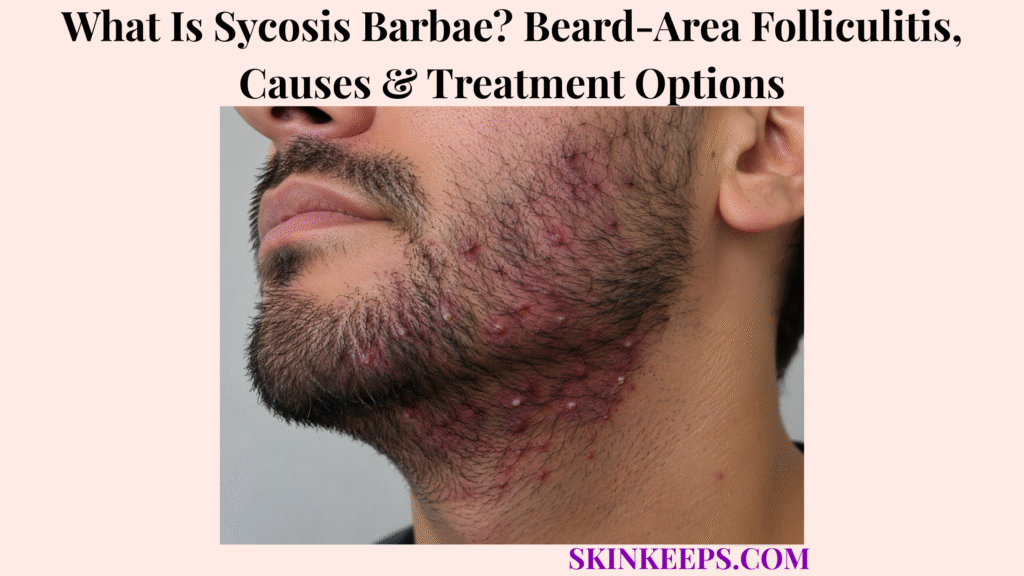
Sycosis barbae is a deep, persistent form of beard-area folliculitis in which infection and inflammation extend beyond superficial follicular pustules. It is most often associated with Staphylococcus aureus and can progress to tender nodules, drainage, sinus tracts, scarring and permanent loss of beard hair.
Because beard bumps can also come from ingrown hairs, fungal infection, acne or localized abscesses, persistent deep disease should not be diagnosed from appearance alone. Recurrent or treatment-resistant cases may need bacterial culture, review of shaving-tool or nasal reservoirs, and cause-directed treatment to protect follicles from irreversible damage.
This article is for educational purposes only. Deep painful beard nodules, recurrent drainage, spreading swelling, fever, scarring or beard hair loss should be professionally evaluated.
What Is Sycosis Barbae and How Can Beard Folliculitis Progress Into Deeper Disease?
Sycosis barbae is the deep-seated form of folliculitis barbae, where infection and inflammation extend around beard follicles and can produce nodules, abscess-like lesions, sinus tracts and permanent scarring.
How Is Sycosis Barbae Related to Folliculitis Barbae?
Sycosis barbae develops when superficial beard-follicle infection becomes deeper and more persistent rather than remaining limited to small follicular pustules.
The broader folliculitis category includes superficial inflammation of hair follicles, while sycosis barbae specifically signals deeper disease in beard-bearing skin with a greater risk of structural follicular damage.
What Happens to Hair Follicles in Sycosis Barbae?
Bacterial inflammation extends deeper around affected follicles and into adjacent tissue, producing persistent tenderness, swelling, drainage and sometimes connecting sinus tracts.
DermNet describes S. aureus colonization as the usual cause of folliculitis barbae and notes that deeper seeding can produce sycosis barbae with abscesses and inflammation between follicles.
What Does Sycosis Barbae Look and Feel Like?
Sycosis barbae usually causes deep tender beard-area nodules or swollen pustular lesions that persist, may discharge pus or serous fluid, and do not behave like a brief superficial shaving eruption.
The lesions can look boil-like or abscess-like, but the key pattern is multiple involved terminal beard follicles with deeper persistent inflammation rather than a single isolated bump.
Where Does Sycosis Barbae Usually Occur?
Sycosis barbae follows terminal beard follicles, most often involving the cheeks, chin, jawline, moustache area and upper neck.
Distribution helps establish the beard-follicle pattern, but location alone is not diagnostic because acne, pseudofolliculitis and tinea barbae can affect overlapping areas.
Why Can Sycosis Barbae Cause Permanent Beard Hair Loss?
Deep inflammation can destroy the follicular unit, after which scar tissue may replace the damaged follicle and prevent normal hair regrowth.
Dark marks can also persist after inflammation; hyperpigmentation is a separate post-inflammatory color change and should not be confused with the more serious structural problem of follicular scarring.
What Causes Sycosis Barbae and Why Does It Keep Coming Back?
Sycosis barbae is usually driven by Staphylococcus aureus, while shaving trauma, contaminated grooming equipment, persistent bacterial carriage, resistance or an incorrect competing diagnosis can contribute to recurrence.
Is Staphylococcus aureus the Main Cause?
Yes; bacterial folliculitis barbae is most commonly associated with Staphylococcus aureus, and deeper extension of that infection can produce sycosis barbae.
Carriage of the organism does not automatically mean disease, but it becomes clinically relevant when repeated follicular infection occurs in the same beard area.
How Can Shaving Contribute to Sycosis Barbae?
Shaving across active pustules can traumatize inflamed follicles and mechanically transfer bacteria to neighboring beard follicles.
Shaving is therefore a recurrence factor rather than a complete explanation for the disease; sycosis barbae is deeper infectious folliculitis, not simply razor irritation.
Can Razors or Electric Shavers Cause Reinfection?
Yes; previously used razors, electric shavers and grooming tools can act as bacterial reservoirs and reintroduce S. aureus to the beard area.
Tool care matters most in recurrent disease, and equipment should not be shared. Cleaning and replacement should follow manufacturer-safe methods rather than improvised chemical recipes.
How Can Nasal Staphylococcus Carriage Cause Recurrence?
Asymptomatic nasal S. aureus carriage can repeatedly reseed beard skin and contribute to recurrent follicular infection.
This is why recurrent or recalcitrant disease may prompt clinician-directed reservoir assessment; routine nasal decolonization is not necessary for every isolated beard pustule.
Can Fungi or Viruses Cause Similar Beard Eruptions?
Yes; dermatophytes and selected viral or fungal folliculitides can produce beard-area eruptions that require entirely different treatment.
A poor response to appropriate antibacterial treatment should therefore trigger diagnostic reconsideration rather than automatic escalation of the same antibiotic strategy.
How Is Sycosis Barbae Diagnosed and Distinguished From Razor Bumps or Tinea Barbae?
Sycosis barbae is diagnosed from persistent deep beard-follicle inflammation, with bacterial culture useful in recurrent, severe or treatment-resistant disease and alternative diagnoses excluded when the pattern does not fit.
How Does a Dermatologist Diagnose Sycosis Barbae?
Diagnosis begins by identifying beard-centered follicular lesions and determining whether deeper nodules, drainage, sinus formation, scarring or hair loss show progression beyond superficial folliculitis.
History of shaving, prior treatment, recurrence and affected sites helps define the pattern, but testing becomes more important when expected therapy fails.
When Are Bacterial Swabs or Cultures Needed?
Culture is particularly useful when beard folliculitis is recurrent, refractory, widespread or unusually severe.
A pustule swab can help identify the organism and antibiotic susceptibility, while nasal sampling may be considered when persistent staphylococcal carriage is suspected.
How Is Sycosis Barbae Different From Pseudofolliculitis Barbae?
Sycosis barbae is deeper infectious folliculitis, whereas pseudofolliculitis barbae is primarily a foreign-body inflammatory reaction caused by cut beard hairs re-entering or penetrating the skin.
The two conditions can coexist, especially when shaving-related follicular trauma makes ingrown-hair lesions more susceptible to secondary infection.
How Is Sycosis Barbae Different From Tinea Barbae?
Tinea barbae is a dermatophyte fungal infection that can produce inflammatory plaques, nodules, pustules, boggy kerion-like swelling and hair loss.
Animal exposure, easily removed hairs, annular or boggy plaques and poor antibacterial response increase suspicion for tinea barbae, which is evaluated with hair or skin fungal testing rather than treated as bacterial sycosis by default.
How Is Sycosis Barbae Different From Acne?
Acne can cause papules, pustules and nodules in beard-bearing skin, but it is not primarily a staphylococcal infection tracking terminal beard follicles.
Acne is more strongly supported by acne-specific morphology such as comedones and its typical distribution, while sycosis centers on infected beard follicles with deeper persistent inflammatory disease.
How Is Sycosis Barbae Different From a Skin Abscess?
A skin abscess is a localized pus-filled cavity, while sycosis barbae is a deeper follicular disease pattern that can create multiple abscess-like lesions and sinus tracts across beard follicles.
A discrete fluctuant collection may fit a skin abscess better and can require a drainage-based management approach that differs from treating diffuse beard-follicle disease.
How Is Sycosis Barbae Treated?
Sycosis barbae treatment depends on infection depth, severity and organism, with deeper or persistent bacterial disease often needing systemic therapy and recurrent disease benefiting from culture-guided treatment.
How Are Bacterial Beard-Follicle Infections Treated?
Limited superficial bacterial folliculitis can sometimes be treated with clinician-selected topical antibacterial therapy, while deep sycosis barbae may require oral systemic treatment because infection extends beyond the superficial follicular opening.
No single antibiotic is appropriate for every case; local resistance, allergy history, disease severity and culture results can change the choice.
Why Can Oral Antibiotics Be Needed?
Oral antibiotics can be necessary because deeper follicular and surrounding-tissue infection may not be adequately reached by topical treatment alone.
The need for systemic therapy is one reason deep nodules, sinus tracts, drainage or scarring should be medically assessed instead of managed indefinitely with over-the-counter products.
How Does Culture Change Treatment?
Culture can identify the causative organism and its antimicrobial susceptibility when empiric treatment fails or disease repeatedly returns.
This helps distinguish resistance from inadequate depth of therapy or an incorrect diagnosis such as fungal infection.
When Is Nasal Decolonization Considered?
Nasal decolonization may be considered for recurrent or recalcitrant documented S. aureus disease when persistent carriage is contributing to reinfection.
It should be clinician-directed rather than routine self-treatment because isolated disease does not automatically justify a decolonization regimen.
What If the Cause Is Fungal or Viral?
Treatment must match the organism: bacterial disease needs antibacterial therapy, dermatophyte disease needs antifungal treatment, and viral folliculitis requires appropriate antiviral management.
If infection spreads beyond localized beard follicles into progressively expanding skin and subcutaneous inflammation, cellulitis becomes an important complication or alternative diagnosis requiring prompt medical assessment.
How Should Shaving and Beard Care Be Managed to Prevent Recurrence and Scarring?
Recurrence prevention combines reduced follicular trauma, safer grooming-tool practices, reservoir assessment when appropriate and reassessment of disease that continues despite reasonable shaving changes.
Should Close Shaving Continue During an Active Flare?
Repeated close shaving directly over active pustules or nodules can worsen trauma and spread bacteria, so temporary shaving modification may be appropriate while active disease is being treated.
This does not mean everyone must remain clean-shaven or stop grooming indefinitely; the goal is to avoid repeatedly cutting through inflamed lesions.
How Should Razors and Electric Shavers Be Managed?
Razors and electric shavers should be managed to reduce bacterial recolonization through appropriate cleaning, timely blade replacement and avoidance of shared contaminated equipment.
Use device-safe manufacturer guidance rather than unverified disinfectant concentrations that could damage the equipment or skin.
Can Better Shaving Technique Prevent Every Recurrence?
No; sycosis barbae can recur despite improved shaving technique when nasal carriage, resistant bacteria, persistent deep infection, tool reservoirs or an incorrect diagnosis remains.
Repeated recurrence should therefore prompt culture or diagnostic reassessment rather than an endless cycle of shaving modifications alone.
Why Should Scarring and Beard Hair Loss Be Monitored?
Once deep inflammation destroys a beard follicle and replaces it with scar tissue, hair loss from that follicle may be permanent.
Increasing scar formation or expanding alopecia is therefore a sign that disease control is not merely cosmetic; preserving remaining follicular units becomes an important treatment goal.
When Should Sycosis Barbae Be Evaluated Promptly?
Medical assessment is warranted for deep painful nodules, repeated pus drainage, abscess-like swelling, treatment failure, recurrent disease, scarring, beard hair loss or spread beyond the original beard area.
Fever, rapidly increasing facial or neck swelling, marked systemic illness or spreading erythema increases urgency because deeper or spreading bacterial infection may be present.
When Should Tinea Barbae Be Suspected Instead?
Tinea barbae becomes more likely with animal or barber exposure, annular plaques, boggy inflammatory swelling, easily removed hairs or poor response to antibacterial treatment.
That pattern should trigger fungal evaluation rather than continued antibacterial treatment without diagnostic confirmation.
What Should You Remember About Sycosis Barbae?
Sycosis barbae is deep, potentially scarring beard folliculitis that differs from ordinary razor bumps and requires cause-directed treatment plus recurrence control to protect beard follicles.
- Sycosis barbae is the deep-seated form of folliculitis barbae.
- Staphylococcus aureus is the most common bacterial cause.
- Persistent tender nodules, drainage, abscess-like lesions and sinus tracts suggest deeper disease.
- Deep follicular destruction can cause permanent scarring and beard hair loss.
- Post-inflammatory dark marks can occur but are different from follicular scarring.
- Shaving can spread bacteria locally when active lesions are cut or traumatized.
- Razors and electric shavers can act as bacterial reservoirs.
- Nasal staphylococcal carriage can contribute to recurrence.
- Recurrence is not explained by poor hygiene alone.
- Pseudofolliculitis barbae is primarily ingrown-hair inflammation, not the same disease.
- Pseudofolliculitis and sycosis can coexist.
- Tinea barbae can mimic deep bacterial beard disease and requires antifungal treatment.
- Culture is most useful in recurrent, resistant, widespread or severe disease.
- Deep bacterial disease may require systemic therapy.
- Decolonization is selective rather than routine.
- Poor antibacterial response should trigger reconsideration of the diagnosis.
- Temporary shaving modification may reduce trauma during active disease.
- Persistent recurrence, scarring or hair loss warrants reassessment.
- Fever or rapidly spreading swelling increases urgency.
Frequently Asked Questions About Sycosis Barbae
The main sycosis barbae questions concern its relationship to folliculitis, shaving, razor bumps, permanent hair loss and recurrence after treatment.
Is Sycosis Barbae the Same as Folliculitis Barbae?
Sycosis barbae is the deeper, more persistent form of folliculitis barbae rather than a separate superficial follicular disorder.
Is Sycosis Barbae Caused by Shaving?
Shaving can worsen or spread bacterial follicular infection, but sycosis barbae reflects deeper infection rather than shaving trauma alone.
How Is Sycosis Barbae Different From Razor Bumps?
Sycosis barbae is deeper infectious folliculitis, while pseudofolliculitis barbae is mainly inflammation caused by ingrown beard hairs.
Can Sycosis Barbae Cause Permanent Beard Hair Loss?
Yes. Deep inflammation can destroy beard follicles, causing scar formation and permanent hair loss in affected areas.
Can Sycosis Barbae Come Back After Antibiotic Treatment?
Yes. Recurrence can occur when bacterial carriage, contaminated tools, resistant organisms, persistent deep infection, or an incorrect diagnosis remains.
DermNet — Folliculitis barbae. Supports sycosis barbae as deep-seated folliculitis barbae, S. aureus involvement, sinus tracts and abscesses, scarring/hair loss, nasal and shaving-equipment reservoirs, culture in refractory disease, and topical/systemic treatment principles.
DermNet — Pseudofolliculitis barbae. Supports the ingrown-hair foreign-body mechanism of razor bumps and the fact that pseudofolliculitis and infectious folliculitis can coexist.
MSD Manual Professional — Pseudofolliculitis Barbae. Supports the distinction between recurved-hair inflammation and infectious beard folliculitis.
DermNet — Tinea barbae. Supports fungal beard infection as an important alternative diagnosis, particularly with inflammatory plaques, nodules, hair involvement and exposure history.