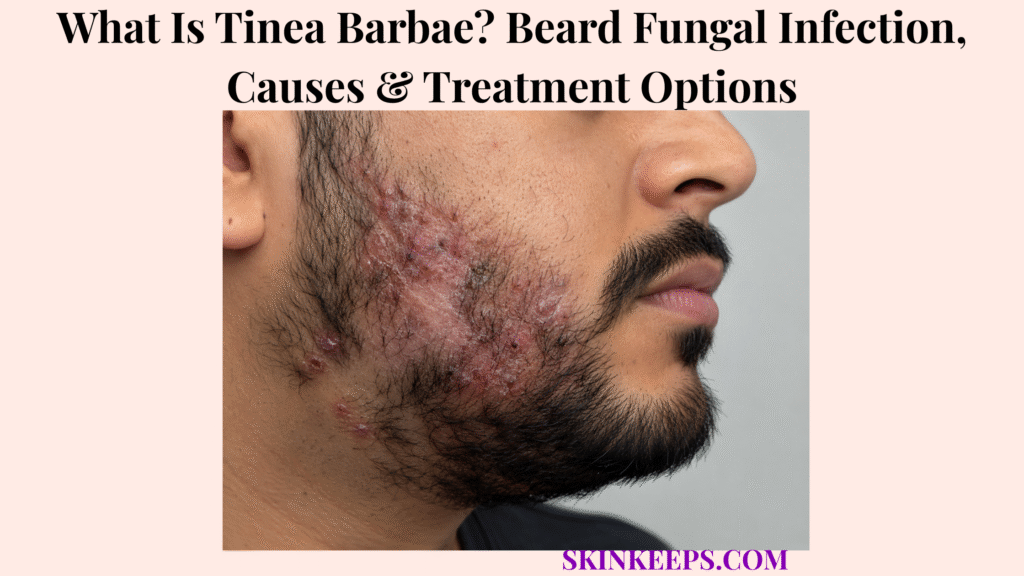
Tinea barbae, sometimes called beard ringworm, is a dermatophyte fungal infection of beard-bearing skin, terminal hairs and hair follicles. It can range from a relatively mild scaly patch to deep inflammatory nodules, pustules and kerion-like swelling that loosen hairs and may damage follicles.
The infection can follow contact with infected animals, people or contaminated grooming equipment. Because bacterial folliculitis, ingrown-hair disease and fungal infection can resemble one another in the beard area, fungal microscopy or culture can be important, and confirmed follicular tinea barbae usually needs oral antifungal treatment rather than an antibacterial cream.
Medical note: This article is for educational purposes only. Deep painful beard nodules, kerion-like swelling, rapid hair loss, scarring, significant pus or crusting, or fungal disease that persists despite appropriate treatment should be medically evaluated.
What Is Tinea Barbae and What Does Beard Ringworm Look and Feel Like?
Tinea barbae is a dermatophyte infection of beard-bearing skin and terminal hairs that can cause scale, pustules, loose hairs or deep inflammatory nodules depending on disease severity.
Which Part of the Beard Does Tinea Barbae Infect?
Dermatophytes can invade keratinized beard skin and the hair shaft or follicular unit, which is why tinea barbae behaves differently from a small superficial patch of ringworm on non-hair-bearing skin. Hair involvement can produce breakage, easy extraction of affected hairs and deeper inflammation around follicles.
Which Fungi Commonly Cause Tinea Barbae?
Tinea barbae is classically associated with Trichophyton dermatophytes, especially zoophilic species such as T. verrucosum from cattle and organisms in the T. mentagrophytes complex. The exact organism can vary by geography and exposure, so a short species list should not be treated as exhaustive.
Is Tinea Barbae the Same as Ringworm?
Tinea barbae is one form of ringworm: both are dermatophyte infections, but “tinea barbae” specifically identifies disease involving the beard and moustache area, where coarse terminal hairs and follicles can become infected.
What Does Mild Tinea Barbae Look Like?
Mild or less inflammatory disease can produce scaly or annular beard patches, follicular papules or pustules, mild itch and broken or loose hairs. The appearance can overlap with other facial rashes, so morphology alone is not always enough when hair involvement is suspected.
What Does Inflammatory Tinea Barbae Look Like?
Inflammatory tinea barbae can produce tender boggy plaques or nodules, pustules, crusting, discharge and kerion-like swelling around infected hairs. A dramatic inflammatory lesion is not automatically bacterial; zoophilic dermatophytes can provoke a strong host inflammatory response.
Can Tinea Barbae Cause Permanent Beard Hair Loss?
Yes. Severe or prolonged deep inflammation can injure beard follicles, causing temporary hair loosening initially and, in some cases, scarring with permanent loss of hair from destroyed follicles. Early diagnosis and effective treatment reduce prolonged inflammatory exposure but cannot guarantee that established scarring will reverse.
What Causes Tinea Barbae and How Does the Infection Spread?
Tinea barbae develops after dermatophytes reach susceptible beard skin and hair from an infected animal, another person or contaminated items, with animal exposure remaining an important classic source.
Can Tinea Barbae Spread From Animals?
Yes. Tinea barbae is often associated with zoophilic dermatophytes, so cattle, livestock, horses and infected pets can be relevant exposure sources. A patient who improves but repeatedly returns to an untreated infected animal can be re-exposed.
Can Tinea Barbae Spread From Another Person?
Yes. Dermatophytes can spread through direct skin contact with an infected person, although classic tinea barbae is often linked more strongly to animal exposure than person-to-person spread. Transmission patterns vary with the dermatophyte species involved.
Can Barber Equipment or Razors Spread Tinea Barbae?
Contaminated razors, beard trimmers, towels or barber equipment can transfer infected skin scale or hair material. This makes shared or inadequately cleaned grooming items a plausible transmission or reinfection route rather than proof that a specific barber caused the infection.
Who Is More Likely to Develop Tinea Barbae?
Risk is higher in people with terminal beard hair who have close contact with infected animals or people, exposure to contaminated grooming items, or immune suppression. Occupational livestock exposure can be a particularly useful clue in deep inflammatory beard disease.
Can Steroid Creams Make Tinea Barbae Harder to Recognize?
Yes. Corticosteroids can suppress visible inflammation without eradicating dermatophytes, altering the border and color of the eruption while the fungus persists. This steroid-modified presentation—often called tinea incognito—can delay recognition, so corticosteroid monotherapy should not be used for a rash that may be ringworm.
How Is Tinea Barbae Diagnosed and Distinguished From Other Beard-Area Conditions?
Tinea barbae is diagnosed by combining the beard-hair clinical pattern and exposure history with fungal testing when needed, especially because bacterial folliculitis, sycosis barbae and pseudofolliculitis can produce similar pustules or nodules.
Why Should Tinea Barbae Be Confirmed With Fungal Testing?
Fungal confirmation matters because a deep beard eruption can look bacterial, shaving-related or fungal while requiring very different treatment. Clinicians may sample scale or plucked affected hairs to demonstrate fungal elements and avoid prolonged empiric treatment for the wrong mechanism.
How Does KOH Microscopy Help Diagnose Tinea Barbae?
KOH microscopy allows clinicians to examine sampled skin scale or affected hairs for fungal structures such as hyphae or spores. A positive preparation supports dermatophyte infection, while a negative result in a strongly suspicious or treatment-resistant case may still require culture or further assessment.
Why Is Fungal Culture Useful?
Fungal culture can confirm dermatophyte disease and help identify the organism, particularly when infection is atypical, persistent or refractory. Species identification can also become more important when resistance is suspected, although advanced molecular testing may be needed for some emerging dermatophytes.
How Is Tinea Barbae Different From Sycosis Barbae?
Tinea barbae is a dermatophyte fungal infection, whereas sycosis barbae is deep bacterial folliculitis, commonly associated with Staphylococcus aureus. Both can cause pustules, nodules, crusting and scarring, so microbiologic testing can be decisive when clinical appearance overlaps.
How Is Tinea Barbae Different From Pseudofolliculitis Barbae?
Tinea barbae is infectious fungal disease, while pseudofolliculitis barbae results from beard hairs curving back into the skin and triggering foreign-body inflammation. Ingrown hairs, a close-shaving relationship and lack of fungal evidence favor pseudofolliculitis, although more than one beard condition can coexist.
How Can Tinea Barbae Be Distinguished From Acne?
Acne can cause papules, pustules and nodules in beard-bearing skin, but comedones and acne-specific follicular plugging support acne rather than dermatophyte invasion of terminal beard hairs.
How Is Tinea Barbae Different From a Beard-Area Abscess?
A skin abscess is a localized pus-filled bacterial cavity, while inflammatory tinea barbae can create boggy fungal nodules or kerion-like swelling without the same drainable bacterial-cavity mechanism. Apparent “pus” does not by itself establish bacterial disease.
How Is Tinea Barbae Treated?
Tinea barbae usually requires systemic antifungal treatment because dermatophytes can infect coarse terminal beard hairs and follicles beyond the reach of topical therapy alone.
Why Are Oral Antifungals Usually Needed?
Hair-shaft and follicular involvement make topical penetration less reliable than it is for a small superficial skin patch. For this reason, clinician-prescribed oral antifungal therapy is the usual treatment basis for confirmed tinea barbae, particularly when disease is inflammatory or clearly hair-bearing.
Which Oral Antifungals Are Used?
Common clinician-selected options include terbinafine and itraconazole, while the best choice depends on the likely organism, drug interactions, contraindications, local resistance and the individual patient. Dose and treatment duration should be individualized rather than copied from a generic regimen.
Can Topical Antifungal Creams Treat Tinea Barbae?
Topical antifungals may be adequate for selected mild superficial cases, but they should not be presented as reliably sufficient when terminal hairs and follicles are infected. Failure of a topical cream does not automatically prove resistance; it may simply reflect disease depth or an incorrect diagnosis.
Are Antibiotics Useful for Tinea Barbae?
No. Antibiotics do not eradicate dermatophytes. They become relevant only if a separate bacterial infection is identified or strongly suspected; for example, spreading bacterial cellulitis superimposed on fungal disease requires its own antibacterial pathway.
Should Corticosteroids Be Used for Highly Inflamed Tinea Barbae?
Corticosteroids should never replace effective antifungal treatment. In selected severe inflammatory cases, a specialist may add a short anti-inflammatory course while continuing antifungal therapy, but routine self-treatment with steroid cream can disguise or worsen dermatophyte infection.
What If Tinea Barbae Does Not Improve With Standard Antifungal Treatment?
Persistent disease should prompt re-confirmation of the diagnosis, review of adherence and ongoing exposure, fungal culture or speciation, and consideration of an alternative diagnosis or resistant dermatophyte. CDC guidance on emerging ringworm emphasizes monitoring treatment response and considering susceptibility testing when infection does not improve as expected.
How Can Tinea Barbae Reinfection and Beard-Follicle Damage Be Prevented, and When Is Specialist Care Needed?
Preventing recurrence requires effective antifungal treatment plus source control—such as addressing an infected animal, avoiding contaminated grooming tools and reassessing disease that remains deep or refractory before scarring progresses.
Should an Infected Animal or Pet Be Checked?
Yes. When animal exposure is a plausible source, veterinary evaluation of the animal may be necessary because successful treatment of the person does not prevent reinfection if the dermatophyte reservoir remains untreated.
How Should Razors and Grooming Tools Be Managed?
Razors, beard trimmers and reusable grooming tools should be cleaned appropriately and not shared, while contaminated disposable blades should be replaced. The goal is to reduce transfer of infected hair and scale; unsupported home chemical recipes are unnecessary and can damage equipment or skin.
Should Someone Shave Over Active Tinea Barbae Lesions?
Repeated close shaving over actively inflamed lesions should be avoided because it can traumatize the skin and spread infected material across adjacent beard areas. Gentle grooming that avoids cutting through pustules or boggy plaques is more consistent with infection control while treatment is underway.
Can Tinea Barbae Return After Successful Treatment?
Yes. Recurrence can follow incomplete treatment, renewed contact with an infected animal or person, reuse of contaminated grooming items, another untreated dermatophyte site, a wrong original diagnosis or antifungal resistance. Recurrence should trigger source review rather than blame about hygiene alone.
Why Does Early Treatment Matter for Beard Hair Preservation?
Prompt diagnosis and effective antifungal therapy limit the duration of follicular inflammation and may reduce the risk of scarring alopecia. Once inflammation has permanently destroyed a follicle and replaced it with scar tissue, full regrowth from that follicle cannot be assumed.
When Should Tinea Barbae Be Evaluated Promptly?
Prompt dermatologic assessment is appropriate for deep painful nodules, boggy kerion-like swelling, extensive crust or drainage, rapid hair loss, visible scarring, recurrence, immune suppression, diagnostic uncertainty or disease that continues despite appropriate antifungal therapy.
When Should Animal Exposure Increase Suspicion?
Tinea barbae becomes more plausible when a new inflammatory beard eruption follows direct contact with cattle, farm animals, horses or an infected pet. This exposure clue is especially useful when hairs loosen easily and the lesion is more boggy or inflammatory than ordinary facial ringworm.
When Should Antifungal Resistance Be Considered?
Resistance deserves consideration when confirmed or highly likely dermatophytosis remains severe or persistent despite an appropriate course, particularly when there is relevant travel or epidemiologic context. Treatment failure should first trigger diagnostic reconfirmation because wrong diagnosis, inadequate exposure control and adherence problems can also explain non-response.
What Should You Remember About Tinea Barbae?
Tinea barbae is a dermatophyte infection of terminal beard hairs and follicles, so accurate fungal diagnosis, systemic treatment when hair is involved and control of the transmission source are more important than treating it like an ordinary facial rash.
- Tinea barbae is a fungal dermatophyte infection, not a worm.
- It specifically involves beard- or moustache-bearing skin and may infect terminal hairs and follicles.
- Trichophyton species are important causes, and animal reservoirs are common in classic disease.
- Mild disease can scale or itch, while inflammatory disease can form pustules, nodules and kerion-like swelling.
- Affected hairs may loosen or break.
- Deep inflammation can scar and may cause permanent beard hair loss.
- Animal, human and contaminated-tool transmission can occur.
- Corticosteroids can disguise or worsen dermatophyte infection if used without effective antifungal treatment.
- KOH microscopy and fungal culture help confirm the diagnosis when needed.
- Tinea barbae is fungal, sycosis barbae is bacterial, and pseudofolliculitis is ingrown-hair inflammation.
- Acne and bacterial abscesses can also mimic beard-area disease.
- Oral antifungal therapy is usually required when terminal hairs and follicles are involved.
- Topical therapy is limited to selected mild superficial disease.
- Antibiotics do not treat the dermatophyte itself.
- Persistent disease needs diagnostic reconfirmation rather than endless empiric treatment.
- Animal or grooming-item reservoirs should be addressed to reduce reinfection.
- Resistance is an emerging concern but is not the only explanation for treatment failure.
- Deep, scarring or refractory disease deserves specialist assessment.
Frequently Asked Questions About Tinea Barbae
The main tinea barbae questions concern contagiousness, bacterial sycosis, permanent hair loss, oral antifungal therapy and animal transmission.
Is Tinea Barbae Contagious?
Yes. Dermatophytes can spread from infected animals or people and from contaminated grooming tools or surfaces. Classic tinea barbae is often strongly linked to animal exposure, but transmission route varies with the organism.
How Is Tinea Barbae Different From Sycosis Barbae?
Tinea barbae is a dermatophyte fungal infection of beard hair and follicles, while sycosis barbae is deep bacterial folliculitis, commonly associated with Staphylococcus aureus. Their treatments are fundamentally different.
Can Tinea Barbae Cause Permanent Beard Hair Loss?
Yes. Severe or prolonged deep inflammation can damage beard follicles and sometimes cause scarring with permanent hair loss, although not every case scars.
Does Tinea Barbae Require Oral Antifungal Medicine?
Usually yes when terminal beard hairs and follicles are involved. Selected very mild superficial disease may sometimes respond to topical antifungal therapy, but deep follicular disease generally needs systemic treatment.
Can Tinea Barbae Spread From Cattle, Pets, or Other Animals?
Yes. Animal transmission is an important source of classic tinea barbae, especially with zoophilic Trichophyton species, so the exposure source may need veterinary attention to prevent reinfection.
DermNet — Tinea Barbae. Supports the beard and moustache dermatophyte definition, common zoophilic Trichophyton causes, animal exposure, inflammatory morphology, microscopy/culture confirmation and the usual need for oral antifungal therapy.
MSD Manual Professional — Tinea Barbae. Supports risk-factor assessment, KOH examination of plucked hairs, fungal culture/biopsy when needed, systemic antifungal treatment and the scarring potential of deep inflammatory disease.
CDC — Clinical Overview of Ringworm. Supports dermatophyte transmission, diagnostic testing before treatment, clinical overlap with other rashes and the warning that corticosteroid creams can worsen ringworm.
CDC — Emerging Ringworm for Clinicians. Supports monitoring treatment response, consideration of susceptibility testing for non-response and the emerging relevance of antifungal-resistant dermatophytes.
CDC — What Causes Ringworm. Supports person, animal and contaminated-object transmission and reinforces that ringworm is caused by fungi rather than worms.