Molluscum contagiosum is a contagious poxvirus skin infection that causes small, smooth, firm bumps with a characteristic central dimple. The papules are usually skin-coloured, pink, white or pearly and are especially common in children.
The immune system can clear molluscum naturally, but lesions may persist for months while the virus spreads to other people or to new skin sites on the same person. Observation is reasonable for many uncomplicated cases, while genital disease, troublesome eczema, immune suppression or significant symptoms can make active treatment more useful.
This article is for educational purposes only and does not constitute medical advice, diagnosis, or treatment. Genital molluscum-like bumps, widespread or unusually large lesions, persistent or worsening pain, redness, swelling, drainage, significant surrounding eczema, or extensive molluscum in someone with a weakened immune system should be evaluated by a licensed dermatologist or qualified healthcare professional.
How Can You Recognize Molluscum Contagiosum?
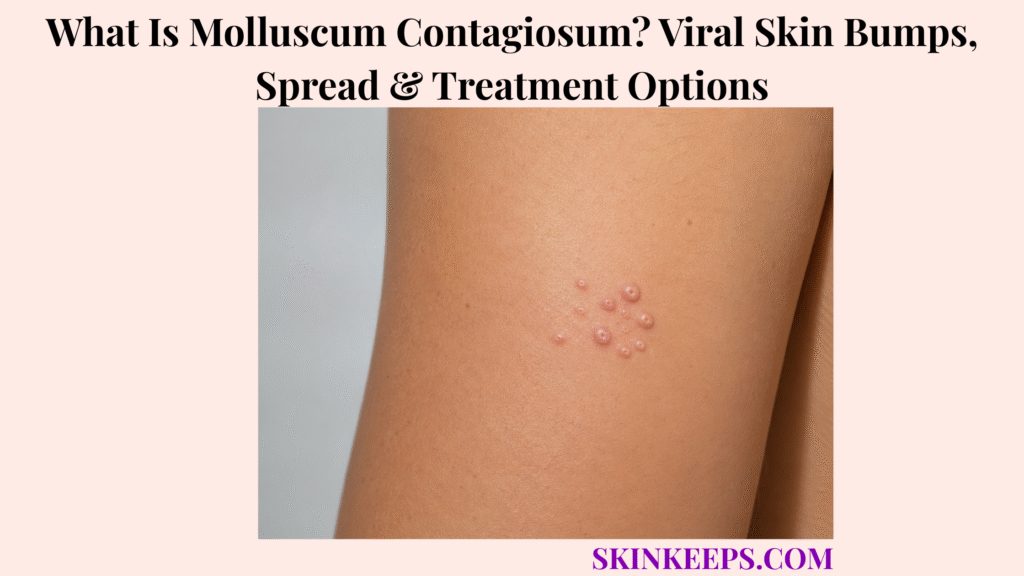
Molluscum contagiosum usually appears as clusters of small, smooth, firm, skin-coloured, pink or pearly bumps with a characteristic central dimple.
What Do Molluscum Contagiosum Bumps Look Like?
Typical molluscum lesions are small, smooth, dome-shaped papules that are usually skin-coloured, pink, white or pearly.
They feel firm and may occur singly or in groups. Many range from pinhead size to roughly pencil-eraser size, but size alone does not define the diagnosis.
What Is the Central Dimple in a Molluscum Bump?
The central dimple is an indentation called umbilication that commonly forms in mature molluscum papules.
A whitish keratinous core may be visible in the centre. The material should not be squeezed or picked because manipulation can spread virus, injure the skin and increase the chance of secondary bacterial infection.
Where Do Molluscum Bumps Usually Develop?
Molluscum commonly affects the trunk, arms and skin folds in children but can occur on many other body sites.
Common locations include the armpits, backs of the knees and groin. Palms and soles are uncommon sites, but distribution alone should not be used to diagnose or exclude molluscum.
Are Molluscum Bumps Painful or Itchy?
Most molluscum papules cause little or no discomfort, although some become itchy, sore or irritated.
Itch can encourage scratching and autoinoculation. Pain is more likely when a lesion has been rubbed, scratched or secondarily infected.
Why Can Molluscum Suddenly Become Red and Inflamed?
Molluscum lesions can become red, swollen or crusted when the immune system begins attacking the infection, and this does not automatically mean bacterial infection.
This inflammatory phase can occur shortly before spontaneous clearance. Surrounding eczematous dermatitis can also develop.
What Does Molluscum Look Like in Someone With a Weakened Immune System?
Significant immune suppression can cause molluscum lesions to become unusually numerous, large, persistent or prominent on the face.
Extensive disease can resist ordinary treatment and may require a different management strategy.
Figure 1. Ordinary lesions can become inflamed shortly before clearance, while extensive or atypical disease follows a separate reassessment pathway.
What Causes Molluscum Contagiosum, and How Does It Spread?
Molluscum contagiosum is caused by a poxvirus that spreads through direct skin contact, contaminated objects and transfer of virus from one lesion to another area of the same person’s skin.
What Virus Causes Molluscum Contagiosum?
Molluscum contagiosum is caused by molluscum contagiosum virus, which belongs to the poxvirus family.
The infection primarily involves the epidermis and forms characteristic skin papules rather than a generalized viral illness in most healthy people.
How Does Molluscum Spread From One Person to Another?
Molluscum spreads mainly through direct skin-to-skin contact and through shared objects that have contacted active lesions.
Potential fomites include towels, clothing, toys and sports or swimming equipment.
Can Molluscum Spread Around the Same Person’s Body?
Yes; molluscum can spread to new skin sites through autoinoculation when lesions are scratched, picked, rubbed or shaved over.
Autoinoculation means transfer of virus from an existing lesion to previously unaffected skin on the same person.
Can Molluscum Contagiosum Spread Through Sexual Contact?
Yes; intimate skin-to-skin contact is an important transmission route for many adult genital molluscum infections.
Molluscum in a child should not automatically be interpreted as sexually transmitted because ordinary nonsexual spread is common in childhood.
Does Swimming Pool Water Spread Molluscum?
Swimming-associated spread appears more likely through shared towels, toys and equipment than through pool water itself.
Towels, goggles, kickboards and shared toys are more practical transmission concerns.
Why Can Eczema Lead to More Molluscum Lesions?
Atopic dermatitis can increase molluscum spread because impaired skin-barrier function and scratching make autoinoculation easier.
Managing eczema and itch can reduce scratching-driven self-spread.
Figure 2. Molluscum spreads between people by contact or contaminated objects and across one person’s skin through autoinoculation.
How Is Molluscum Contagiosum Distinguished and Diagnosed?
Molluscum is usually diagnosed clinically by its smooth dome-shaped papules and central umbilication, while atypical, genital or extensive lesions require closer assessment.
How Is Molluscum Different From Common Warts?
Common warts usually have a rough, keratotic or cauliflower-like surface, whereas molluscum lesions are smoother and typically contain a central dimple.
How Is Molluscum Different From Acne or Folliculitis?
Folliculitis typically produces follicle-centred inflammatory papules or pustules, while molluscum produces smoother, more uniform centrally dimpled papules.
How Is Genital Molluscum Different From Other Genital Bumps?
Genital molluscum usually forms smooth centrally dimpled papules, but genital warts, folliculitis and skin tags can resemble it closely enough to require clinical assessment.
Can Molluscum Usually Be Diagnosed Just by Looking at It?
Yes; most molluscum contagiosum cases are diagnosed clinically from the characteristic appearance and distribution of the lesions.
Routine blood testing and imaging are unnecessary for ordinary disease.
When Is Microscopy or Biopsy Needed?
Microscopy or biopsy is rarely needed for classic molluscum but may be useful when a lesion looks atypical or another diagnosis remains possible.
When Should Extensive Molluscum Prompt Further Medical Evaluation?
Numerous, unusually large, facial or persistent molluscum lesions in an adult can justify evaluation for impaired immune function.
Extensive molluscum alone does not diagnose an immune disorder.
| Feature | Molluscum | Common Wart | Folliculitis | Genital Wart |
|---|---|---|---|---|
| Surface | Smooth | Rough / keratotic | Inflamed / follicular | Often papillomatous |
| Central dimple | Typical | Absent | Absent | Absent |
| Cause | Poxvirus | HPV | Multiple causes | HPV |
| Strong clue | Umbilication | Keratosis | Follicle-centred pustule | Genital papillary growth |
| Diagnosis | Usually clinical | Usually clinical | Clinical | Clinical assessment |
Does Molluscum Contagiosum Need Treatment?
Most uncomplicated molluscum contagiosum in healthy people can be observed without treatment, while genital, symptomatic, eczema-associated or extensive disease may benefit from active therapy.
Will Molluscum Go Away Without Treatment?
Yes; uncomplicated molluscum usually clears naturally in healthy people as the immune system controls the infection.
Lesions can persist for months and new papules can appear while older ones disappear. Observation is legitimate management rather than neglect.
When Is Active Treatment More Reasonable?
Active treatment is more reasonable when molluscum is genital, associated with troublesome eczema, extensive in an immunocompromised patient, symptomatic or causing substantial ongoing spread or distress.
How Is Cantharidin Used for Molluscum Contagiosum?
Cantharidin topical solution is a healthcare-provider-applied treatment approved for molluscum contagiosum in adults and children aged 2 years and older.
YCANTH is provider-applied and causes a controlled local blistering reaction. It should not be treated as a do-it-yourself home product.
What Is Berdazimer Gel?
Berdazimer topical gel is a prescription nitric-oxide-releasing treatment approved for molluscum contagiosum in adults and children aged 1 year and older.
ZELSUVMI is a prescription topical treatment used according to the prescribed regimen. Cantharidin is provider-applied; berdazimer is a prescription gel used at home as directed.
When Are Cryotherapy or Curettage Used?
Cryotherapy and curettage can treat molluscum lesions but are selected according to age, lesion number, site and tolerance because they may cause pain, irritation or scarring.
Should Parents Use Internet “Molluscum Removers”?
Unregulated online molluscum-removal products should not be assumed safe or FDA-approved because some can cause significant irritation, skin injury or scarring.
How Is Molluscum Managed in Someone With HIV or Significant Immune Suppression?
In severe molluscum associated with major immune suppression, restoring immune function can be more important than repeatedly destroying individual lesions.
For HIV-associated severe molluscum, effective antiretroviral therapy can improve immune control and may help lesions resolve.
Figure 3. Healthy uncomplicated disease can be observed; treatment and host-directed care become more important as clinical burden increases.
How Can Molluscum Spread Be Reduced, and When Should It Be Rechecked?
Molluscum spread can be reduced by avoiding scratching and shaving over lesions, covering exposed bumps when practical and not sharing personal items that contact affected skin.
How Can You Stop Molluscum From Spreading Across Your Own Skin?
Avoiding scratching, picking and shaving across molluscum lesions reduces autoinoculation to nearby skin.
How Can Spread to Other People Be Reduced?
Covering exposed molluscum lesions and avoiding shared towels, clothing and other personal items can reduce transmission to other people.
For swimming, visible lesions can be covered with a watertight dressing and shared towels, kickboards, goggles and toys should be avoided.
Does a Child With Molluscum Need to Stay Home From School or Daycare?
No; children with molluscum contagiosum usually do not need to stay home from school or daycare.
How Long Can Molluscum Remain Contagious?
Molluscum can remain contagious while active lesions are present.
Can Someone Get Molluscum Again After It Clears?
Yes; clearing molluscum does not guarantee lifelong immunity, so future exposure can cause another infection.
Which Changes Need Medical Reassessment?
Molluscum should be reassessed when lesions become significantly painful, increasingly red or draining, spread extensively, involve the genital area, remain unusually persistent or occur with suspected immune suppression.
What Should You Remember About Molluscum Contagiosum?
Molluscum contagiosum is a usually self-limited poxvirus skin infection that causes smooth centrally dimpled papules and often clears naturally in healthy people.
- Molluscum is caused by a poxvirus.
- Typical lesions are smooth, firm and centrally umbilicated.
- Many lesions are painless.
- Redness can reflect immune clearance.
- Direct skin contact and contaminated objects spread infection.
- Scratching and shaving can cause autoinoculation.
- Adult genital disease may involve sexual transmission.
- Childhood disease should not automatically be labelled sexually transmitted.
- Eczema can increase local spread.
- Diagnosis is usually clinical.
- Observation is valid for uncomplicated disease.
- Active treatment depends on context.
- Cantharidin and berdazimer have different administration methods and age indications.
- Children usually continue school or daycare.
Recognize → understand spread → distinguish mimics → observe or treat proportionately → reduce transmission → reassess complicated disease.
Frequently Asked Questions About Molluscum Contagiosum
The most common molluscum questions concern lesion appearance, transmission, natural clearance, treatment options and genital spread in adults.
What Do Molluscum Contagiosum Bumps Look Like?
Molluscum usually causes small, smooth, firm, skin-coloured, pink or pearly bumps with a characteristic central dimple. Some lesions become red or crusted as immune clearance begins.
How Does Molluscum Contagiosum Spread?
Molluscum spreads through direct skin contact, contaminated shared objects and autoinoculation caused by touching, scratching or shaving over lesions. Intimate skin contact is also relevant for many adult genital cases.
Does Molluscum Contagiosum Go Away Without Treatment?
Yes; uncomplicated molluscum usually clears naturally in healthy people, so treatment is not required for every lesion. Natural clearance can take months.
What Are the Treatment Options for Molluscum Contagiosum?
Molluscum treatment options include observation, clinician-applied or prescription topical therapy, and selected procedures such as cryotherapy or curettage. Cantharidin and berdazimer are distinct treatments with different administration methods.
Is Molluscum Contagiosum Sexually Transmitted in Adults?
Adult genital molluscum can be transmitted through intimate sexual skin-to-skin contact, although nonsexual transmission also occurs. Genital papules deserve clinical assessment when the diagnosis is uncertain.
Which Sources Support This Molluscum Contagiosum Guidance?
CDC — About Molluscum Contagiosum — Used for poxvirus cause, lesion morphology, transmission, natural recovery, school/daycare context and reinfection.
CDC — Preventing Molluscum in Schools, Daycares, and Pools — Used for school attendance, lesion covering, swimming precautions and the shared-object rather than pool-water emphasis.
American Academy of Dermatology — Molluscum Contagiosum: Signs and Symptoms — Used for distribution, morphology, itch/pain context and inflammation before clearance.
American Academy of Dermatology — Molluscum Contagiosum: Diagnosis and Treatment — Used for clinical diagnosis, treatment indications, eczema, immunosuppression, cantharidin, cryotherapy, curettage and unsafe self-treatment warnings.
American Academy of Dermatology — Molluscum Contagiosum: Overview — Used for self-limited disease, contagious period and observation.
FDA — YCANTH (Cantharidin) Approval — Used specifically for provider administration and approval in adults and children aged 2 years and older.
FDA — ZELSUVMI (Berdazimer) Drug Trials Snapshot — Used specifically for berdazimer’s nitric-oxide-releasing mechanism and approval in adults and children aged 1 year and older.