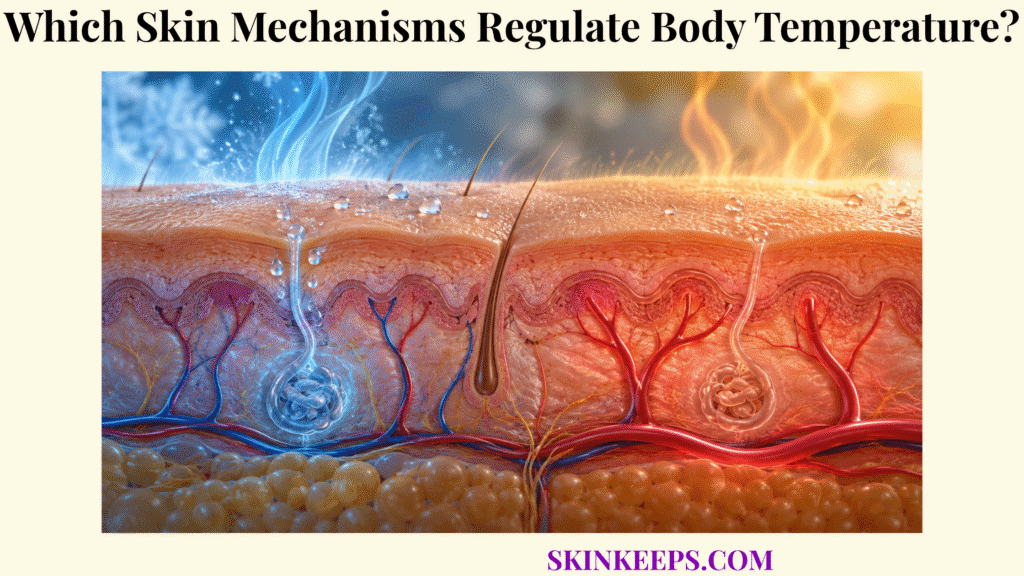
Skin mechanisms regulate body temperature by detecting external thermal change, altering cutaneous blood flow, producing sweat for evaporative cooling, and reducing surface heat transfer during cold exposure under the central coordination of the hypothalamus. Skin therefore has both sensory and effector roles, while central nervous-system circuits determine how those responses are combined with whole-body physiology.
This article explains how skin detects temperature, how the nervous system coordinates responses, how heat is transported toward or away from the surface, how sweating becomes cooling through evaporation, how cold-defense mechanisms conserve heat, and why environmental or physiological stress can overwhelm normal thermoregulation.
How Does Skin Thermoregulation Detect Changes in Body and Environmental Temperature?
Skin thermoregulation begins when temperature-sensitive cutaneous sensory afferents detect warming or cooling and transmit that information toward central nervous-system circuits, where it is integrated with core-temperature signals to coordinate appropriate thermal responses. Thermoregulation is one of several major skin functions, but the skin supplies peripheral information and major effectors rather than acting as the body’s independent thermostat.
How Do Cutaneous Thermoreceptors Detect Warming and Cooling at the Skin Surface?
Cutaneous thermoreceptors detect warming and cooling through temperature-sensitive sensory nerve endings whose ion channels change activity as local skin temperature changes. Warm-sensitive and cold-sensitive primary afferents are not one universal receptor type; different populations respond across different thermal ranges.
Transient receptor potential, or TRP, ion channels participate in peripheral thermosensation by converting temperature-dependent membrane events into changes in sensory-neuron activity. The resulting receptor potentials can trigger action potentials that carry thermal information toward the central nervous system.
How Are Temperature Signals Transmitted Through Sensory Nerves?
Temperature-sensitive afferent neurons convert local thermal changes into electrical signals that travel through peripheral nerves and spinal pathways toward thermoregulatory centers in the brain. These afferent pathways provide information about skin temperature while separate central thermosensors contribute information about internal temperature.
How Does the Hypothalamus Integrate Skin and Core-Temperature Information?
The hypothalamic preoptic region integrates thermal information from peripheral skin receptors with signals reflecting internal temperature and then coordinates autonomic responses such as sweating and cutaneous vascular change. The hypothalamus is the central coordinator; the skin provides sensory input and executes several important effector responses.
Heat load: cutaneous vasodilation + eccrine sweating · Cold load: cutaneous vasoconstriction + broader heat-conservation responses.
How Do Cutaneous Heat-Loss Mechanisms Release Excess Body Heat?
Cutaneous heat-loss mechanisms increase transfer of internally generated heat toward the skin surface through vasodilation and then allow that heat to leave the body through radiation, convection, conduction, and—during substantial heat stress—evaporation. This separation between internal transport and environmental exchange is central to understanding skin blood-flow heat exchange.
How Does Vasodilation Increase Warm Blood Flow Toward the Skin Surface?
Cutaneous vasodilation increases skin perfusion by reducing vascular resistance, allowing more warm blood from deeper tissues to circulate near the body surface during heat stress. In nonglabrous human skin, substantial reflex vasodilation during whole-body heating involves an active sympathetic vasodilator system rather than simply passive opening of vessels.
Skin vasodilation therefore transports more internal heat toward the surface, but it does not itself guarantee net cooling. The heat still has to cross the body-environment boundary through one or more physical heat-transfer routes.
How Does Increased Skin Blood Flow Promote Heat Transfer to the Environment?
Increased skin blood flow promotes heat dissipation by transporting heat from the body core toward the skin, where thermal energy can then move to the environment if favorable physical gradients exist. Blood flow is an internal transport mechanism; radiation, convection, conduction, and evaporation are boundary-transfer mechanisms.
How Do Radiation, Convection, and Conduction Contribute to Heat Loss?
Radiation, convection, and conduction remove heat when the skin is warmer than the relevant surrounding surfaces, air, water, or objects, but these dry heat-transfer pathways lose effectiveness or reverse when the environment becomes hotter than the skin. Radiation transfers thermal energy without direct contact, convection transfers heat between skin and moving air or water, and conduction transfers heat between materials in direct physical contact.
When ambient temperature approaches or exceeds skin temperature, dry heat loss shrinks and can become heat gain. Under these conditions, evaporation carries an increasing share of the burden for net heat loss.
How Does Sweating Help the Skin Lower Body Temperature?
Sweating lowers body temperature when eccrine glands secrete fluid onto the skin and that liquid evaporates, converting water to vapor and carrying thermal energy away from the body. This is the core mechanism behind skin sweating and cooling during substantial heat stress.
How Do Eccrine Sweat Glands Respond When Body Temperature Rises?
As internal and skin temperatures rise, central thermoregulatory circuits increase sympathetic cholinergic stimulation of eccrine sweat glands, causing them to secrete watery sweat onto the skin surface. Acetylcholine released from sympathetic postganglionic fibers is the principal neurotransmitter driving human thermoregulatory sweating.
Eccrine glands contain a secretory coil that produces fluid and a duct that carries sweat toward the skin surface. Humans rely heavily on this system because evaporation can dissipate large amounts of heat even when dry heat exchange becomes ineffective.
Why Does Sweat Cool the Body Only When It Evaporates From the Skin?
Sweat cools effectively only when liquid water evaporates because the phase change from liquid to vapor requires energy that is drawn from thermal energy at the skin surface. The cooling benefit of sweat evaporation therefore depends on how much secreted sweat actually enters the vapor phase.
Sweat that drips from the body, is wiped away, or remains pooled under clothing has not produced the same evaporative cooling effect as sweat that changes phase and leaves the skin as water vapor.
How Do Humidity, Airflow, and Clothing Affect Evaporative Cooling?
Evaporative cooling becomes less efficient when high humidity, low airflow, or restrictive clothing reduces the water-vapor gradient or traps moist air near the skin, while suitable airflow can remove humid boundary-layer air and support continued evaporation. High humidity therefore limits the environment’s evaporative capacity rather than necessarily stopping sweat-gland secretion.
This distinction explains why a person can be covered in sweat yet continue storing heat: more liquid sweat on the skin does not automatically mean more heat is being removed.
How Do Skin Heat-Conservation Mechanisms Reduce Heat Loss in Cold Conditions?
Skin heat-conservation mechanisms reduce heat loss during cold exposure primarily by constricting cutaneous blood vessels to reduce warm blood flow near the surface, while subcutaneous tissue provides passive insulation and piloerection contributes only a limited insulating effect in humans. These mechanisms conserve existing body heat; they are not major sources of new heat production.
How Does Cutaneous Vasoconstriction Reduce Blood Flow Near the Skin Surface?
Cold exposure increases sympathetic vasoconstrictor activity in cutaneous vessels, reducing their diameter and decreasing the amount of warm core blood delivered near the skin surface. Sympathetic noradrenergic nerves release norepinephrine and related cotransmitters that increase vascular smooth-muscle constriction.
Skin vasoconstriction is a major first-line response to cooling because it lowers the amount of internally generated heat transported toward peripheral tissues where it can be lost to the environment.
How Does Reduced Peripheral Blood Flow Limit Heat Transfer to the Environment?
Reduced peripheral blood flow limits heat loss by increasing the thermal separation between warm internal tissues and the cooler skin surface, thereby decreasing the amount of core heat available for environmental transfer. Perfusion falls substantially in many skin regions during cold stress, but circulation does not normally disappear from the entire skin.
How Does Subcutaneous Tissue Provide Insulation That Slows Heat Loss?
Subcutaneous adipose tissue slows heat transfer because fat has relatively low thermal conductivity, increasing the resistance between deeper warm tissues and the cooler body surface. Skin subcutaneous insulation is therefore a passive thermal property rather than an active vasomotor response.
The whole-body effect varies with tissue thickness, body composition, blood flow, activity, environmental exposure, and where adipose tissue is distributed. Higher skin perfusion can partly bypass the insulating effect by carrying warm blood closer to the surface.
What Limited Role Does Piloerection Play in Human Heat Conservation?
Piloerection raises body hairs through arrector pili contraction and can theoretically trap an insulating air layer, but the effect contributes little to whole-body heat conservation in humans because most human body hair is sparse compared with a dense mammalian coat. Goosebumps are therefore a real autonomic response without being a major human insulation mechanism.
| Thermal condition | Skin response | Heat-transfer effect | Main outcome |
|---|---|---|---|
| Rising body heat | Cutaneous vasodilation | More warm blood reaches skin. | Increases opportunity for environmental heat loss. |
| Rising body heat | Eccrine sweating | Evaporation removes heat from skin. | Provides powerful cooling when evaporation is possible. |
| Skin warmer than surroundings | Radiation, convection, conduction | Heat moves outward down a thermal gradient. | Supports dry heat loss. |
| Cold exposure | Cutaneous vasoconstriction | Less warm blood reaches the surface. | Conserves core heat. |
| Cold exposure | Subcutaneous insulation | Slows transfer through tissue. | Reduces outward heat flux. |
| Cold exposure | Piloerection | Slightly alters the hair-air interface. | Small whole-body conservation role in humans. |
These mechanisms do not operate independently; central thermoregulatory circuits continuously adjust them according to combined skin, core, environmental, and behavioral conditions.
Which Skin Temperature-Control Responses Work Together During Changing Conditions?
Skin temperature-control responses work as a coordinated system in which thermal sensory input is continuously integrated with core-temperature information and translated into graded changes in skin blood flow and sweating rather than simple all-or-none reactions. The balance shifts with heat load, cold exposure, exercise, clothing, hydration status, and the surrounding environment.
What Happens When Body Temperature Rises?
When body heat rises sufficiently, cutaneous blood flow increases and eccrine sweating begins or intensifies, delivering heat toward the skin and increasing evaporative heat loss. Vasodilation improves core-to-surface heat transport while sweating supplies water for phase-change cooling.
What Happens When Environmental Temperature Falls?
When cold signals increase, cutaneous vasoconstriction reduces surface blood flow and conserves core heat while whole-body responses outside the skin may add behavioral and metabolic heat production. Shivering, behavioral shelter, clothing changes, and metabolic thermogenesis are important but are not primarily skin mechanisms.
How Does the System Adjust When Conditions Change Rapidly?
Rapid changes in skin temperature alter peripheral thermal input before core temperature necessarily changes substantially, allowing thermoregulatory circuits to begin adjusting vascular and sweating responses early. Skin-temperature feedback can therefore shorten response time and reduce the size of later core-temperature disturbances.
| Condition | Dominant skin mechanism | Supporting mechanism | Physiological result |
|---|---|---|---|
| Mild warmth | Increased skin blood flow | Behavioral adjustments | Greater dry heat exchange if the gradient permits. |
| Strong heat stress | Vasodilation + sweating | Increased cardiac output | Greater heat transport and evaporative cooling. |
| High heat + humidity | Sweating increases but evaporation becomes limited | Vasodilation | Heat-storage risk rises. |
| Mild cold | Vasoconstriction | Insulation | Reduced surface heat loss. |
| Strong cold | Strong vasoconstriction | Broader shivering and behavioral responses | Core heat conservation plus heat production outside the skin. |
What Can Overwhelm the Skin’s Thermoregulatory Mechanisms?
Skin thermoregulatory mechanisms can be overwhelmed when environmental heat or cold, impaired evaporation, fluid loss, disease, or reduced physiological capacity creates a heat-transfer demand greater than the body can compensate for. Failure therefore reflects a whole-body mismatch between heat load and available thermoeffector capacity rather than a single defective skin response.
Why Does High Humidity Reduce the Effectiveness of Evaporative Cooling?
High humidity reduces evaporative cooling because surrounding air already contains more water vapor, narrowing the vapor-pressure gradient that drives sweat evaporation away from the skin. More secreted sweat may remain liquid, drip from the body, or saturate clothing without providing equivalent additional cooling.
How Can Dehydration Limit Sweat Production and Heat Dissipation?
Significant dehydration can reduce heat-dissipation capacity by lowering circulating fluid volume, increasing cardiovascular strain, attenuating cutaneous vasodilation, and eventually reducing or delaying sweating responses. The magnitude of these effects depends on the severity of hypohydration, exercise intensity, environmental heat, acclimatization, and individual physiology.
Mild thirst should not be interpreted as proof that sweating has stopped. Human studies instead show graded changes in cardiovascular and thermoregulatory performance as fluid deficit becomes physiologically important.
Why Can Extreme Heat Exceed the Capacity of Vasodilation and Sweating?
Extreme heat becomes uncompensable when the body generates or gains heat faster than maximal skin blood flow and sweat evaporation can remove it, causing progressive internal heat storage. As ambient temperature rises toward or above skin temperature, radiation, convection, and conduction contribute less net heat loss and may become routes of heat gain.
If high humidity, restrictive clothing, low airflow, impaired sweating, or cardiovascular limitations prevent enough evaporation, core temperature can continue rising despite heavy sweating.
How Can Extreme Cold Overwhelm Vasoconstriction and Insulation?
Extreme or prolonged cold can overwhelm vasoconstriction and tissue insulation when environmental heat loss continues faster than metabolic and behavioral systems can replace or conserve body heat. Wind, wet clothing, cold-water immersion, prolonged exposure, reduced mobility, aging, and impaired thermoregulatory function can increase this risk.
| Stress condition | Main mechanism limited | Physiological consequence |
|---|---|---|
| High humidity | Sweat evaporation | More sweat remains unevaporated and heat storage increases. |
| Low airflow / restrictive clothing | Evaporative and convective exchange | Skin cannot transfer heat as efficiently. |
| Dehydration | Sweating + cutaneous circulation | Heat dissipation becomes harder and cardiovascular strain rises. |
| Extreme environmental heat | Vasodilation + evaporation reach maximum useful capacity | Core heat can accumulate. |
| Extreme or prolonged cold | Vasoconstriction + insulation become insufficient | Core heat loss can exceed replacement. |
| Impaired sweating or vascular function | Thermoeffector response | Greater susceptibility to heat or cold illness. |
What Are the Key Takeaways About the Skin’s Temperature-Regulation Systems?
The key fact about the skin’s temperature-regulation systems is that the skin senses thermal change and alters heat exchange, while the hypothalamus centrally coordinates those responses with the rest of the body.
- Thermoreceptors: Cutaneous sensory afferents detect warming and cooling and send thermal information toward the CNS.
- Central control: The hypothalamus integrates peripheral and internal thermal information and coordinates thermoregulatory responses.
- Vasodilation: Increased skin blood flow transports more body heat toward the surface during heat stress.
- Dry heat exchange: Radiation, convection, and conduction can remove heat when environmental gradients favor outward transfer.
- Sweating: Eccrine glands supply water to the skin surface.
- Evaporation: Sweat must evaporate to provide efficient cooling.
- Vasoconstriction: Reduced skin blood flow limits transfer of core heat toward the surface during cold exposure.
- Insulation: Subcutaneous tissue slows heat transfer through peripheral tissue.
- Piloerection: Goosebumps are a real autonomic response but make only a limited contribution to whole-body insulation in humans.
- Environmental limits: High humidity, extreme heat, severe cold, dehydration, clothing, and impaired thermoeffector function can reduce thermoregulatory effectiveness.
What Common Questions Do People Ask About Skin Thermoregulation?
Common questions about skin thermoregulation focus on whether skin controls temperature itself, why sweating sometimes fails to cool, why skin turns red or pale, and how humidity changes heat tolerance.
Does the Skin Control Body Temperature by Itself?
No. Skin provides thermal sensing and major heat-exchange mechanisms, but central thermoregulatory control depends primarily on hypothalamic and nervous-system integration.
Why Does Skin Become Redder During Heat Exposure?
Skin can become redder during heat exposure because cutaneous vasodilation increases blood flow through vessels near the body surface to support heat transfer, although visible redness is not a precise measure of heat dissipation.
Why Can a Person Sweat Heavily Without Cooling Effectively?
Heavy sweating may provide limited cooling when high humidity, low airflow, or clothing prevents much of the sweat from evaporating, because secretion alone removes less heat than successful evaporation.
Why Does Skin Become Pale or Cool During Cold Exposure?
Cold exposure activates cutaneous vasoconstriction, reducing warm blood flow near the surface and often lowering skin temperature as the body conserves core heat.
Does Body Fat Help Keep the Body Warm?
Subcutaneous fat can increase tissue insulation and slow heat transfer, but whole-body cold tolerance also depends on blood flow, muscle activity, clothing, body size, environment, and other physiological factors.
NCBI Bookshelf — Physiology, Temperature Regulation: hypothalamic coordination, peripheral and central thermoreceptors, whole-body thermoregulatory mechanisms, dry heat transfer, evaporation, and heat/cold failure boundaries.
Acta Physiologica / PMC — Skin temperature: its role in thermoregulation: the contribution of skin-temperature signals to thermoregulatory feedback and response timing.
Journal of Applied Physiology / PMC — Mechanisms and modifiers of reflex induced cutaneous vasodilation and vasoconstriction in humans: active cutaneous vasodilation, sympathetic noradrenergic vasoconstriction, skin blood-flow responses, and modifiers such as hydration.
Frontiers in Bioscience / PMC — Mechanisms and controllers of eccrine sweating in humans: preoptic control, sympathetic cholinergic pathways, eccrine sweat-gland activation, temperature integration, and body-fluid effects.
Comprehensive Physiology / PMC — Human temperature regulation under heat stress in health, disease, and injury: human heat-loss thermoeffectors, skin blood flow, sweating, evaporative heat loss, environmental limits, and uncompensable heat stress.
Experimental Physiology / PubMed — Sweat evaporation in humans: A molecular and thermodynamic perspective: latent heat of vaporization, why evaporation cools, and how humidity, airflow, clothing, and local conditions influence evaporative efficiency.
Nutrients / PMC — Hydration Status and Cardiovascular Function: hypohydration, cardiovascular strain, impaired cutaneous vasodilation, and context-dependent thermoregulatory effects.
Psychophysiology / PubMed — Diverse stimuli induce piloerection and yield varied autonomic responses in humans: evidence that human piloerection remains a real autonomic response to thermal as well as nonthermal stimuli, while its whole-body insulating role is limited.
Medical note: This article explains normal thermoregulation physiology and is not an emergency diagnostic or treatment guide. Severe heat illness can become medically dangerous when thermoregulation fails. Confusion, altered consciousness, fainting, seizures, severe weakness, very high body temperature, or inability to cool during heat exposure requires urgent medical evaluation. Severe cold exposure also requires prompt medical attention when there is confusion, marked drowsiness, loss of coordination, reduced consciousness, severe uncontrollable or later absent shivering, suspected hypothermia, or suspected cold tissue injury.