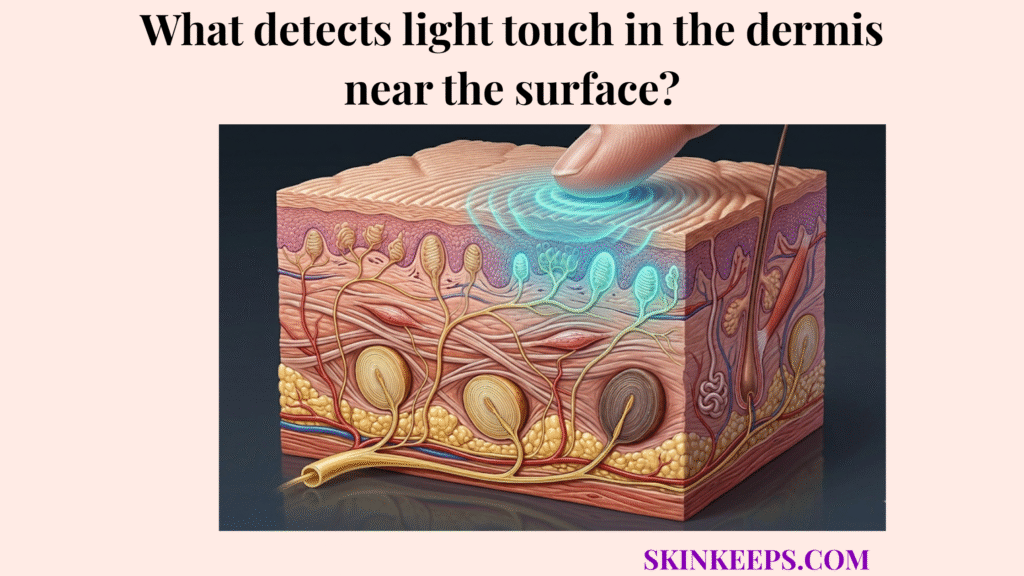
The main structure that detects light touch in the dermis near the surface is the Meissner’s corpuscle, a superficial mechanoreceptor specialized for gentle contact, flutter, slip, and low-force skin deformation.
Meissner’s corpuscles detect light touch with extreme efficiency, making them especially important in glabrous skin, such as the fingertips, palms, and lips. This highly localized concentration highlights how receptor density varies across dermal regions of the body to support manual dexterity and precise grip.
Understanding this biological mechanism requires isolating their anatomical location, evaluating their rapid adaptation, tracing their mechanical transduction, comparing them to deeper receptors, and identifying how neuropathy and aging impair their function.
What is the biological baseline for how Meissner’s corpuscles detect light touch?
Meissner’s corpuscles detect light touch because they are superficial low-threshold mechanoreceptors positioned in the dermal papillae, where small surface forces can be converted into rapid tactile signals.
They operate as encapsulated tactile corpuscles residing directly beneath the epidermis in hairless skin. Their entire physiological structure specializes in dynamic light touch rather than heavy, sustained pressure.
This biological baseline depends directly on combining a highly sensitive receptor body with a remarkably shallow tissue depth, ensuring nothing blunts the initial contact signal.
StatPearls states that Meissner corpuscles are located superficially in the dermal papillae at a depth of about 150 micrometers, are approximately 20–40 micrometers in diameter and 80–150 micrometers in length, and may occur as one corpuscle in every two to four dermal papillae. Those figures support the idea that the receptor is intentionally built for shallow-force detection rather than deep mechanical loading (StatPearls, 2023).
How does anatomical placement help Meissner’s corpuscles detect light touch?
Anatomical placement helps Meissner’s corpuscles detect light touch because the receptors sit close enough to the epidermal surface for subtle, rapidly changing contact to deform them efficiently.
Light touch produces exceptionally shallow deformation within the skin layers. A heavy compression force easily penetrates millimeters into the tissue, but a brush against a fingertip barely indents the immediate surface.
A deeper receptor misses that delicate input entirely because the mechanical energy dissipates before reaching it. Superficial placement in the papillary dermis directly improves texture detection, slip recognition, and fine tactile acuity.
StatPearls places Meissner corpuscles at roughly 150 μm depth in dermal papillae, while the Frontiers review describes the glabrous skin as containing very large numbers of fast-conducting tactile fibres and models superficial type-1 receptor systems near the skin surface. That pairing supports the idea that shallow receptor placement is fundamental to high-resolution touch detection (StatPearls, 2023) (Frontiers, 2022).
How does rapid adaptation explain how Meissner’s corpuscles detect light touch?
Rapid adaptation explains how Meissner’s corpuscles detect light touch because these receptors respond best to changes in contact, especially touch onset, motion, flutter, and release, rather than to unchanging static pressure.
A rapidly adapting receptor functions by generating rapid electrical bursts immediately when the skin is touched and again when the touch is removed, but it stops firing when the pressure becomes constant.
This biological “on-signal / off-signal” mechanism specifically enables the skin to sense when an object moves, slips, or vibrates gently against it. Rapid adaptation detects the dynamic deformation necessary to adjust grip instantly.
The NCBI Neuroscience chapter states that Meissner’s corpuscles are particularly efficient at transducing low-frequency vibrations around 30–50 Hz, while StatPearls describes them as most sensitive to 10–50 Hz and notes their role in slip detection and quick adaptation. These values strongly support the idea that Meissner’s corpuscles are tuned to changing tactile events rather than sustained force (Neuroscience, 2001) (StatPearls, 2023).
How does mechanical transduction facilitate how Meissner’s corpuscles detect light touch?
Mechanical transduction facilitates how Meissner’s corpuscles detect light touch by turning shallow tissue deformation into neural firing at the receptor’s afferent ending.
The sequence begins when contact deforms the skin surface, shifting the internal collagen structure of the corpuscle. This structural shift physically bends the nerve terminal inside, opening ion channels and generating an action potential, the electrical burst that carries data to the brain.
Mechanical transduction is the biological conversion of physical force into a nervous system language. The receptor acts mechanically first and neurologically second.
StatPearls explains that external force is transduced through collagen fibers connected to the lamellae, and that physical deformation bends the nerve axon terminals to generate an action potential. The same chapter also states that Meissner corpuscles can respond to skin indentations of less than 10 micrometers, which gives this section a concrete threshold for shallow-force responsiveness (StatPearls, 2023).
How do Meissner’s corpuscles compare to other receptors in how they detect light touch?
Meissner’s corpuscles differ from other cutaneous receptors because they are the superficial rapidly adapting dermal receptors most specialized for dynamic light touch rather than deep vibration, sustained pressure, or skin stretch.
Pacinian corpuscles specialize in high-frequency deep vibration, residing in the deep dermis with massive receptive fields that blur fine detail. Meissner’s corpuscles, by contrast, maintain tiny receptive fields to sharpen superficial tactile discrimination.
Ruffini endings stretch deep within the dermis to detect sustained tissue tension. Meissner’s corpuscles adapt rapidly and stop firing under static conditions, filtering out sustained stretch to focus entirely on movement.
The Merkel cell-neurite complex resides in the basal epidermis and fires continuously to encode static fine detail, like reading Braille. Meissner’s corpuscles detect the flutter and friction of the finger moving across the page.
| Receptor type | Primary stimulus | Main location | Adaptation | Core role |
|---|---|---|---|---|
| Meissner’s corpuscles | Light touch, flutter, slip | Superficial dermis / dermal papillae | Rapidly adapting | Dynamic fine touch |
| Pacinian corpuscles | High-frequency vibration, deep pressure | Deep dermis / subcutaneous tissue | Rapidly adapting | Deep vibration sensing |
| Ruffini endings | Stretch, sustained force | Deeper dermis | Slowly adapting | Skin tension detection |
| Merkel-cell system | Sustained light pressure, edges, form | Epidermis | Slowly adapting | Static fine detail |
The NCBI Neuroscience chapter states that Meissner afferents account for about 40% of the sensory innervation of the human hand, Pacinian corpuscles respond to high frequencies around 250–350 Hz and make up 10–15% of cutaneous receptors in the hand, while Merkel disks account for about 25% of hand mechanoreceptors and specialize in static discrimination of shapes, edges, and rough textures. That quantitative split makes Meissner’s role uniquely dynamic and superficial (Neuroscience, 2001).
What conditions impair how Meissner’s corpuscles detect light touch?
Aging and peripheral neuropathic damage impair how Meissner’s corpuscles detect light touch by reducing receptor integrity, weakening afferent support, or both.
These biological impairments cause tactile dulling even when the epidermal barrier and visible skin surface appear entirely normal and intact.
How does aging impair how Meissner’s corpuscles detect light touch?
Aging impairs how Meissner’s corpuscles detect light touch because the receptors decline in size, density, and structural complexity over time.
As the corpuscle shrinks and its neural branching simplifies, the receptor captures less mechanical data from the surface, leading to a steady drop in tactile acuity.
StatPearls states that the size, density, and complexity of Meissner corpuscles decline significantly with age, and links these changes to age-related decreases in touch sensitivity (StatPearls, 2023).
How does peripheral neuropathy impair how Meissner’s corpuscles detect light touch?
Peripheral neuropathy impairs how Meissner’s corpuscles detect light touch because neuropathic damage reduces corpuscle density, distorts corpuscle structure, and weakens the neural pathway needed for light-touch transmission.
Diabetic neuropathy actively destroys both the receptor housing and the afferent fibre, effectively severing the communication line between the fingertip and the brain.
A 2021 MDPI study on diabetic neuropathy reported that Meissner corpuscle density was reduced by about 80% in non-painful diabetic distal symmetric polyneuropathy and was almost completely absent in painful diabetic distal symmetric polyneuropathy, with Meissner corpuscles identified in only 2 of 10 subjects in that group. These figures give the strongest quantitative anchor for neuropathy-related light-touch decline (MDPI, 2021).
What are the key summary facts for how Meissner’s corpuscles detect light touch?
The key facts are that Meissner’s corpuscles are superficial dermal mechanoreceptors, their position in dermal papillae favors shallow-force detection, and their rapid adaptation makes them especially effective for dynamic light touch.
What steps can you take to support how Meissner’s corpuscles detect light touch?
Meissner’s corpuscles detect light touch best when the skin surface, receptor environment, and peripheral nerve connection remain structurally intact.
Tactile preservation focuses on safeguarding overall skin and nerve health rather than reversing deep receptor loss with cosmetic creams.
Quick Answers About How Meissner’s Corpuscles Detect Light Touch
What detects light touch in the dermis near the surface?
Meissner’s corpuscles are the main superficial dermal mechanoreceptors that detect light touch near the surface. They are specialized for gentle contact, flutter, slip, and low-force dynamic skin deformation rather than deep pressure or prolonged static load.
Where are Meissner’s corpuscles located?
Meissner’s corpuscles are located in the dermal papillae of glabrous skin, immediately beneath the epidermis. StatPearls places them at about 150 μm depth and describes them as occurring in roughly one of every two to four dermal papillae, which fits their role as shallow light-touch receptors.
Why do Meissner’s corpuscles sit so close to the skin surface?
Meissner’s corpuscles sit close to the skin surface because light touch creates shallow tissue deformation, not deep-force transmission. A superficial receptor can therefore detect small moving contact more efficiently than a deeper one, which is why Meissner’s corpuscles are optimized for fine tactile acuity and slip detection.
Are Meissner’s corpuscles rapidly adapting receptors?
Yes. Meissner’s corpuscles are rapidly adapting mechanoreceptors, which means they respond most strongly when touch begins, changes, moves, or ends. That adaptation pattern makes them especially useful for detecting flutter, object slip, and dynamic surface contact rather than sustained static pressure.
What vibration range are Meissner’s corpuscles most sensitive to?
Meissner’s corpuscles are most sensitive to low-frequency vibration, with StatPearls giving a range of 10–50 Hz and the Neuroscience chapter highlighting around 30–50 Hz. That quantitative range matches their role in dynamic light-touch detection rather than deep high-frequency vibration sensing.
How do Meissner’s corpuscles turn touch into a nerve signal?
Meissner’s corpuscles convert touch into a nerve signal through mechanotransduction. Shallow skin deformation moves the corpuscle’s lamellar structure and connected collagen framework, bends the associated afferent nerve ending, and triggers an action potential that carries tactile information centrally. StatPearls also notes responses to indentations of less than 10 μm.
How are Meissner’s corpuscles different from Pacinian corpuscles?
Meissner’s corpuscles are superficial rapidly adapting receptors for dynamic light touch, while Pacinian corpuscles are deeper rapidly adapting receptors for deep pressure and high-frequency vibration. The Neuroscience chapter places Pacinian sensitivity around 250–350 Hz, which sharply separates their function from the low-frequency range used by Meissner’s corpuscles.
How are Meissner’s corpuscles different from Merkel cells?
Meissner’s corpuscles detect dynamic light touch, flutter, and slip in the superficial dermis, while Merkel cell–neurite complexes specialize in sustained light pressure, edges, form, and static fine detail at the epidermal level. In the hand, Merkel-related mechanoreceptors account for about 25% of tactile innervation, while Meissner-related afferents account for about 40%.
Which skin areas contain the most Meissner’s corpuscles?
Meissner’s corpuscles are concentrated in glabrous skin with high tactile precision, especially the fingertips, palms, lips, and similar fine-touch regions. Their distribution reflects how receptor density varies across dermal regions of the body: they are most numerous where the skin needs to detect delicate motion, slip, and texture change quickly and accurately.
Does aging weaken how Meissner’s corpuscles detect light touch?
Yes. Aging weakens Meissner-based light-touch performance because the size, density, and structural complexity of Meissner’s corpuscles decline over time. StatPearls links these age-related changes to reduced tactile sensitivity, especially in skin areas that depend on fine dynamic touch.
Does neuropathy reduce Meissner’s corpuscles?
Yes. Neuropathy can markedly reduce Meissner corpuscle density and impair light-touch signaling. In a 2021 Journal of Clinical Medicine study, Meissner corpuscle density fell by about 80% in non-painful diabetic distal symmetric polyneuropathy and was almost absent in the painful form, where Meissner corpuscles were found in only 2 of 10 subjects.
Why do Meissner’s corpuscles matter for grip control?
Meissner’s corpuscles matter for grip control because they detect slip between the skin and an object before a stable hold is lost. Their rapid adaptation and dynamic sensitivity make them especially important for adjusting finger force during object handling and fine manual control.
What is the simplest correct summary of Meissner’s corpuscle function?
The simplest correct summary is this: Meissner’s corpuscles are superficial rapidly adapting mechanoreceptors that detect dynamic light touch. Their shallow position, sensitivity to low-frequency tactile change, and ability to encode slip and flutter make them the clearest answer to this topic.
Conclusion
In conclusion, Meissner’s corpuscles detect light touch because their superficial dermal location, rapid adaptation pattern, and receptor–axon structure are all optimized for dynamic low-force tactile signaling.
Their position in the dermal papillae catches shallow deformation, their rapid adaptation encodes changing textures, and their mechanical transduction converts those forces into precise neural signals, standing in sharp contrast to deeper or static receptors that handle vibration and sustained form. While aging and neuropathy disrupt this delicate architecture, understanding their exact biology makes it clear why fine tactile precision is so highly localized in human skin.
The skin does not simply cover the body; it reads the environment, and Meissner’s corpuscles are the rapidly translating fingertips of that biological intelligence.