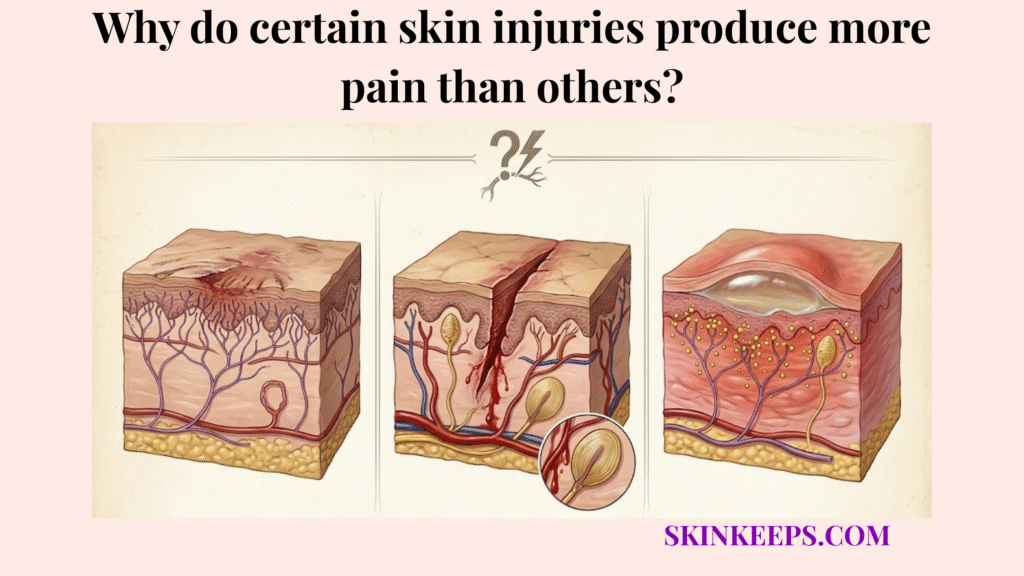
Certain skin injuries produce more pain because pain depends on how many nerve endings are activated, how exposed those nerve endings remain, and where on the body the injury occurs.
A tiny wound like a paper cut can hurt intensely if it occurs in a densely innervated area and leaves superficial nerve endings exposed to the air. In contrast, a visually larger, deeper wound on the thigh might throb heavily but lack the same initial, agonizing sharpness.
Understanding this phenomenon requires examining how nociceptors function, how anatomical depth alters nerve exposure, why receptor density matters, how injury types compare, and which treatments safely blunt the pain signal.
What is the biological baseline for why certain skin injuries produce more pain?
The biological baseline for why certain skin injuries produce more pain is nociceptor activation: pain begins when free nerve endings detect damaging mechanical, thermal, or chemical stress and convert that damage into electrical signaling.
Specialized pain-detecting free nerve endings, known as nociceptors, reside throughout the skin to warn the brain of tissue damage. These sensors act as the primary alarm system for the epidermal and dermal layers.
Pain intensity emerges from this neural signaling rather than from the visible size of the wound itself. If the nerves are highly activated, the brain registers severe pain, regardless of how small the skin defect appears.
StatPearls and NCBI nursing fundamentals both describe 2 major nociceptive fiber types when detailing which receptors transmit sharp vs dull pain in the dermis: A-delta fibers and C fibers. A-delta fibers mediate the initial sharp, stinging, or pricking component of pain, while C fibers mediate the slower, diffuse, dull, burning, or aching component (Kendroud et al., 2022) (Ernstmeyer et al., 2024). That two-fiber distinction is the clearest quantitative starting point for the pain-signaling baseline.
How does anatomical depth explain why certain skin injuries produce more pain?
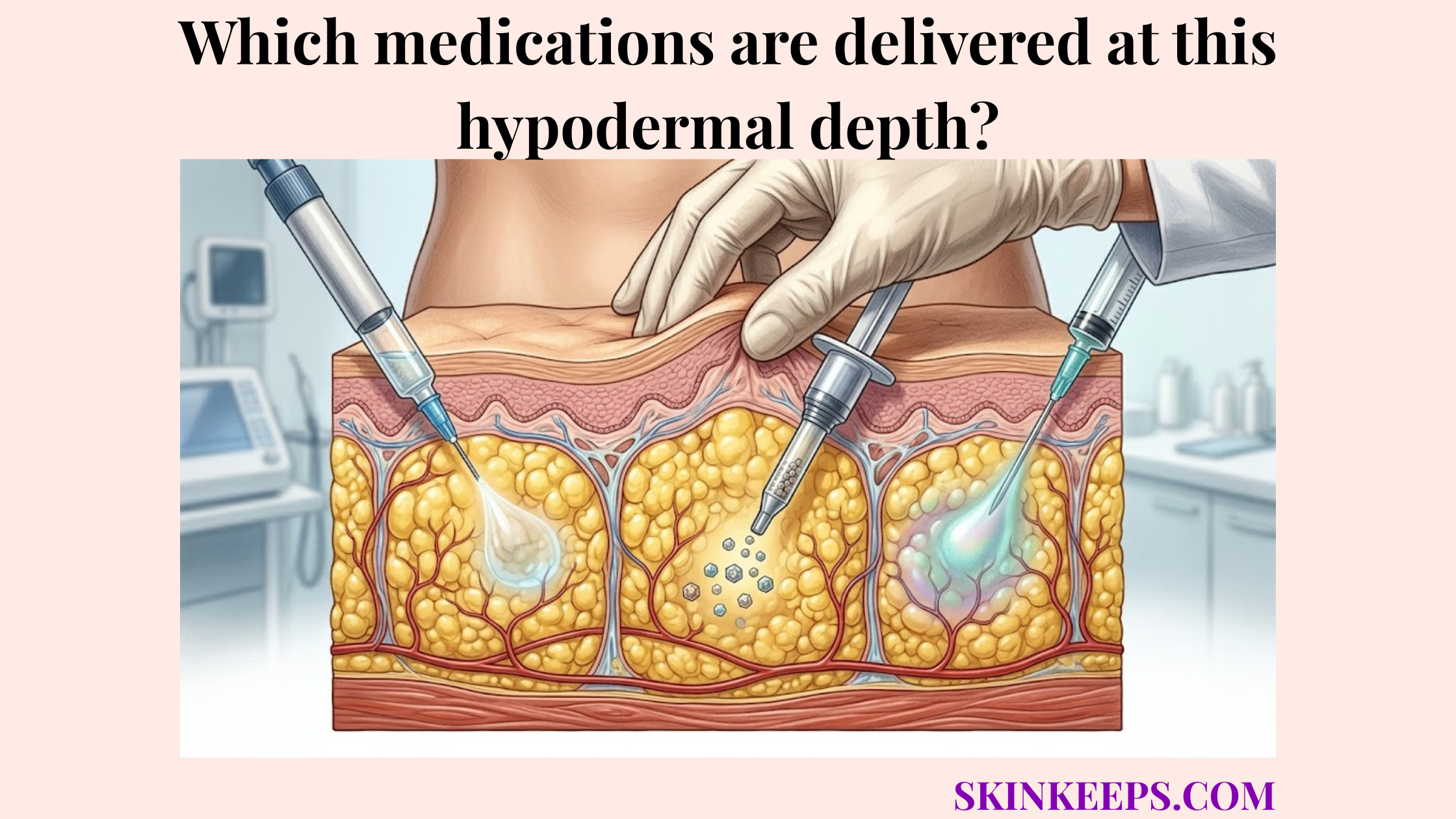
Anatomical depth explains why certain skin injuries produce more pain because superficial wounds often leave damaged nerve endings exposed to the environment, while deeper wounds may be relatively insulated or may damage the very nerve endings that would otherwise keep firing sharply.
A superficial wound removes the top protective layers of the skin, leaving thousands of exposed nerve endings highly vulnerable to air, movement, water, and chemical irritants. This is why epidermal barrier disruption often causes intense stinging even from minor friction.
Conversely, a deep wound is not always the sharpest-feeling injury because severe trauma can destroy the local nociceptors entirely, silencing the immediate pain transmission from the center of the defect. This inverse relationship explains exactly how injury depth affects dermal pain perception.
StatPearls notes that superficial partial-thickness burns are very painful because their nerve endings remain intact and irritated, whereas deep partial-thickness burns are less painful because many nerve endings are already damaged. The same source reports that superficial partial-thickness burns usually heal in 10 to 15 days, while deep partial-thickness burns heal more slowly over 3 to 5 weeks, reinforcing that pain intensity and visible depth are not linearly matched (Walker et al., 2023).
How does receptor density dictate why certain skin injuries produce more pain?
Receptor density dictates why certain skin injuries produce more pain because densely innervated body regions can generate a stronger pain alarm from the same amount of tissue damage than less-sensitive areas can.
The physical location of an injury fundamentally changes the pain experience because the body distributes sensory nerves unevenly to prioritize interaction and protection.
A minor cut on a densely innervated region like a fingertip, the lips, or the face triggers a massive sensory response compared to an identical cut on the back or thigh.
The MSD Manual states that the fingertips and toes contain many nerves and are extremely sensitive to touch, which supports why small superficial injuries in those regions can feel disproportionately painful.
How does nerve exposure worsen why certain skin injuries produce more pain?
Nerve exposure worsens why certain skin injuries produce more pain because an open superficial wound can keep reactivating damaged nerve endings long after the original injury occurred.
When a tissue alarm signal remains uncovered, environmental factors like air drafts, water, soap, and mechanical friction act as constant restimulation triggers. This constant environmental bombardment is precisely why superficial dermal nerve endings are more reactive compared to deeper, insulated fibers.
This repeated restimulation explains why very small wounds, like a shallow paper cut, can keep stinging intensely for hours or days.
Wound-pain guidance notes that minimizing the time a wound is exposed to air reduces irritation and pain, and moist-wound-healing sources explain that drying makes exposed nerve endings more hypersensitive.
How do injury mechanisms compare regarding why certain skin injuries produce more pain?
Injury mechanisms compare differently because certain skin injuries produce more pain when they activate many superficial receptors, leave nerves exposed, or repeatedly restimulate damaged tissue.
An abrasion scrapes away a broad swath of the epidermis, activating a large number of nociceptors simultaneously.
A puncture wound drives deeply through the tissue, activating fewer superficial receptors but often causing deep, localized aching.
A laceration slices through multiple layers, triggering sharp A-delta fibers initially, followed by throbbing C-fiber pain depending on how well the wound edges are approximated.
| Injury type | Main layer pattern | Nerve involvement | Pain quality | Pain persistence |
|---|---|---|---|---|
| Paper cut / shallow slit | Superficial, narrow, exposed | High local exposure | Sharp, stinging | Often persistent |
| Abrasion / scrape | Broad superficial damage | Many nociceptors activated | Burning, raw | Often prolonged |
| Burn | Thermal injury across the surface | Strong nociceptor stimulation | Burning, searing | Can remain intense |
| Puncture | Narrow, deeper entry | Less exposed surface area initially | Deep, localized | Variable |
| Laceration | Variable depth and width | Depends on exposure and location | Sharp, throbbing | Variable |
How do burns and abrasions intensify why certain skin injuries produce more pain?
Burns and abrasions intensify why certain skin injuries produce more pain because they stimulate broad superficial tissue areas and often keep nociceptors exposed or irritated across a larger wound surface.
A wide-surface nociceptor activation recruits an immense volume of neural alarm signals at the exact same time.
This broad superficial wound pain converts localized stinging into a severe, radiating burning sensation that resists simple relief.
StatPearls describes abrasions as superficial denudation of the epithelium and notes that many abrasions are mainly limited to the epidermis, while burn guidance states that superficial partial-thickness burns are very painful because of intact, irritated nerve endings.
What specific treatments manage the intensity when certain skin injuries produce more pain?
The most effective treatments manage pain when certain skin injuries produce more pain by insulating exposed nerves, reducing restimulation, and blunting local nociceptor signaling when appropriate.
Pain-focused wound management requires addressing the exposed neural environment rather than just applying generic bandages.
How does sealing exposed nerves reduce pain when certain skin injuries produce more pain?
Sealing exposed nerves reduces pain when certain skin injuries produce more pain because occlusive or moist coverage limits airflow, friction, and direct environmental restimulation of damaged nerve endings.
Applying a physical barrier like a hydrocolloid dressing, a liquid bandage, or a thick layer of petroleum jelly safely insulates the raw tissue.
This insulation halts the continuous firing of the exposed nerves, lowering the overall pain intensity.
A 2008 hydrocolloid review reports that acute-wound studies found hydrocolloid dressings associated with reduced pain, and one cited comparison found 91% pain-free outcomes versus 30% in a conventional-treatment group, alongside faster healing in that study (Thomas, 2008).
How do topical anesthetics help when certain skin injuries produce more pain?
Topical anesthetics help when certain skin injuries produce more pain by reducing local nociceptor signaling at the wound surface and making superficial procedures or exposed wounds easier to tolerate.
Agents such as lidocaine and benzocaine act directly on the nerve endings to temporarily halt the transmission of electrical pain signals.
This topical anesthetic wound pain relief is highly effective for blunting sharp, stinging sensations during initial cleansing or repair.
Systematic review evidence supports topical anesthetics as an effective non-invasive analgesic option for superficial dermal laceration repair.
Pain Management Pathway
- Problem → exposed superficial wound keeps firing pain signals.
- Implication → air, touch, and movement repeatedly reactivate nociceptors.
- Solution → clean gently, cover the wound, and reduce local nerve firing when appropriate.
What are the key summary facts for why certain skin injuries produce more pain?
The key summary facts are that certain skin injuries produce more pain when they activate many nociceptors, leave nerve endings exposed, occur in densely innervated regions, or keep damaged tissue open to repeated stimulation.
Summary Checklist
What steps can you take to treat wounds when certain skin injuries produce more pain?
Wounds that produce disproportionate pain are best managed by gentle cleansing, early protective coverage, minimized restimulation, and appropriate local pain relief when needed.
Final Execution Checklist
Quick Answers About Why Certain Skin Injuries Produce More Pain
Why can a paper cut hurt more than a larger wound?
A paper cut can hurt intensely because it is a superficial wound that occurs in a densely innervated region like a fingertip. It activates many nociceptors and leaves exposed nerve endings open to repeated stimulation from the air.
Why do superficial wounds sometimes sting longer than deep wounds?
Superficial wounds sting longer because their free nerve endings remain intact but exposed to the environment. Deep wounds often damage the nerve endings themselves, dulling the immediate sharp A-delta fiber signaling.
What do nociceptors do in skin injury?
Nociceptors detect damaging mechanical, thermal, or chemical stress during a skin injury. These free nerve endings convert tissue damage into the electrical signaling that the brain interprets as pain intensity.
Why do fingertip injuries hurt so much?
Fingertip injuries hurt intensely because fingertips are a densely innervated region. The high receptor density amplifies nociceptive signaling, causing certain skin injuries to produce more pain than they would on the back or thigh.
Why are burns often more painful than they look?
Burns often feel extremely painful because superficial partial-thickness burns leave millions of irritated nerve endings intact and exposed across a broad surface area, triggering massive continuous nociceptor activation.
Do puncture wounds always hurt more than abrasions?
No. An abrasion activates a large, broad area of superficial nociceptors, creating intense burning pain. A puncture wound drives deeply but activates a smaller surface area, often producing duller, localized C-fiber aching rather than sharp stinging.
What kind of wound coverage reduces stinging pain?
Occlusive coverage, such as a hydrocolloid dressing or petroleum jelly, reduces stinging pain by insulating the exposed nerve endings from air, friction, and repeated environmental restimulation.
Do topical anesthetics help painful superficial wounds?
Yes, topical anesthetics like lidocaine or benzocaine help manage pain amplification in superficial wounds by temporarily halting the electrical transmission of pain signals at the local free nerve endings.
Conclusion
In conclusion, certain skin injuries produce more pain because pain intensity depends on nociceptor activation, receptor exposure, body-region sensitivity, and repeated stimulation more than on wound size alone.
The pain paradox becomes clear when we recognize that a shallow scrape on the hand leaves millions of intact nerve endings completely exposed to the air, while a deeper cut may destroy those same nerves entirely. By understanding that pain is an electrical alarm signal driven by exposure and location, we can treat highly painful superficial wounds more effectively through gentle cleansing, rapid occlusive sealing, and minimal restimulation.