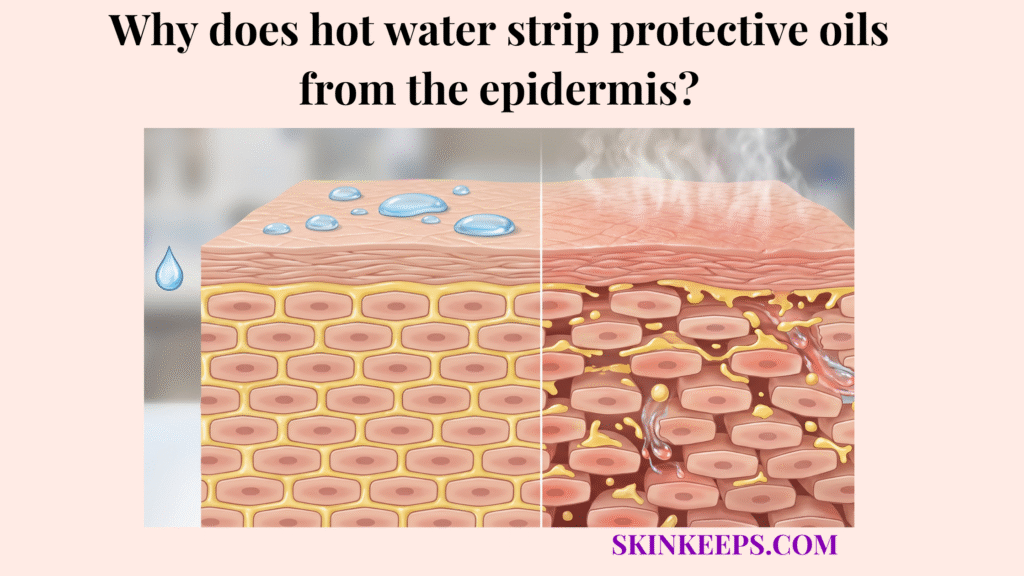
Hot water strips protective oils from the epidermis because heat loosens and removes the lipid material that helps seal the skin surface. As temperature rises, surface oils become easier to disperse and wash away, leaving the epidermis less protected against water loss, irritation, and environmental stress. Reviews of skin barrier physiology and water-exposure studies support the idea that hotter water worsens barrier damage compared with lower-temperature exposure.
This is why skin often feels tight, dry, itchy, or unusually sensitive after long hot showers or repeated hot-water cleansing. The problem is not just water touching the skin; the problem is that heat disrupts the oily surface support the epidermis relies on to stay comfortable and resilient. Hot-water exposure has been associated with increased TEWL, higher pH, and higher erythema in healthy skin.
Understanding why hot water strips protective oils from the epidermis makes it easier to explain why heat-based cleansing can backfire, how repeated exposure weakens the barrier over time, and what actually helps protect the skin without overstripping it.
Why are protective oils so important to the epidermis?
Protective oils—the surface lipid mixture that helps lubricate and shield the skin—are important because they help the epidermis stay sealed, comfortable, and less vulnerable to dryness and reactivity.
These oils help coat the surface, reduce water loss, improve flexibility, and buffer the skin against friction and environmental stress. Without this oily lubricant, the stratum corneum becomes brittle and prone to microscopic fracturing.
The surface lipid film is not just cosmetic shine. It is part of the skin’s first-line protective environment. Reviews describe the skin surface lipid film as a mixture of sebum and keratinocyte-derived lipids that contributes to barrier homeostasis.
What protective oils are being stripped from the epidermis?
The protective oils stripped by hot water are part of the surface lipid environment that helps the epidermis stay hydrated, flexible, and defended.
The epidermal surface is supported by sebum-derived lipids (oily material produced by sebaceous glands), barrier lipids (lipids like ceramides that support sealing), and the acid mantle—the slightly acidic surface environment that supports barrier function and microbiome balance.
Together these create a protective surface environment rather than a bare exposed surface. Reviews of epidermal surface lipids describe this film as a mixture of sebum and epidermal lipids, while acid-mantle reviews emphasize that acidic surface conditions help maintain structural stability.
How does heat make epidermal protective oils easier to remove?
Heat makes epidermal protective oils easier to remove by loosening the surface lipid film and increasing the barrier stress produced during washing. This physical loosening is the “melt” phase of the stripping sequence.
Once surface oils are loosened and dispersed by heat, cleansing removes them more easily and leaves less surface protection behind. This makes even gentle soaps more aggressive than they would be in cooler water.
Direct hot-water studies show hotter exposure worsens barrier measures. In healthy adults, Mavon et al. (1998) reported that forehead sebum levels dropped from baseline levels (e.g., 139 AU) to extremely low levels (9 AU) immediately after washing, supporting the idea that water-based cleansing can dramatically reduce surface oil levels (ScienceDirect, 1998).
How does hot water weaken the epidermal lipid seal after oils are stripped away?
Hot water weakens the lipid seal—the oil-supported surface barrier—because stripped oils leave the outer surface less sealed, less flexible, and less resistant to stress.
Once protective oils are reduced, the surface becomes less efficient at slowing water escape and less capable of buffering irritants. The “mortar” between the skin cells becomes porous and brittle.
This post-wash weakness is why skin often feels tight or rough after hot water rather than just “clean.” Water-exposure studies show that hot water is associated with greater TEWL increase than colder exposure, which fits the logic of a weaker post-cleansing seal.
How does hot water increase evaporation after it strips protective oils?
Hot water increases evaporation after oil stripping because the skin loses the oily layer that normally helps slow water escape, leading to an immediate rise in TEWL (transepidermal water loss).
Protective oils help slow evaporation from the skin surface, so once those oils are reduced the surface dries out more quickly. This evaporation is often invisible but can be felt as a “tight” sensation as the skin loses its internal moisture to the air.
TEWL is the measurable expression of that problem. In the Herrero-Fernandez et al. (2022) hand-exposure study, hot-water exposure increased TEWL from 25.75 to 58.58 g·h−1·m−2, showing that hotter water created a stronger evaporation-related barrier penalty (PubMed, 2022). This mechanism explains why barrier disruption increases TEWL so drastically.
How does repeated hot-water exposure turn temporary oil stripping into chronic barrier stress?
Repeated hot-water exposure turns temporary hot-water stripping into chronic barrier stress by removing protective oils faster than the epidermis can fully restore them.
One hot shower can cause temporary oil loss, but repeated hot-water exposure gives the skin less time to restore what was removed. The chronic problem develops when stripping becomes repetitive and recovery becomes incomplete.
Mavon et al. (1998) noted that skin surface lipid levels can be restored within about 2 hours after washing in many areas, but repeated exposure can keep the skin cycling through fresh removal before that restoration window becomes useful. This constant depletion leads to a persistent state of epidermal barrier disruption.
How does hot water compare with lukewarm water in its effect on epidermal protective oils?
Hot water removes more protective oil and stresses the barrier more than lukewarm water—the lower-stress temperature range recommended in dermatology—which is why skin usually tolerates lukewarm cleansing better.
| Water Temperature | Effect on Protective Oils | Barrier Impact | Skin Feel |
|---|---|---|---|
| Lukewarm Water | Lower oil disruption | More stable | Comfortable, less tight |
| Hot Water | Higher oil stripping | Less stable | Tighter, drier, reactive |
How can you tell when hot water is stripping too much oil from the epidermis?
Hot water is stripping too much oil when the skin feels less comfortable, less flexible, and more reactive after routine cleansing or bathing. Tightness right after washing is the most common early indicator.
Warning Signs Checklist
How does healthy oil balance compare with hot-water-stripped skin?
Healthy oil balance keeps the epidermis calm and protected, while hot-water-stripped skin loses comfort, resilience, and water-retaining ability.
| Surface State | Oil Balance | Water Retention | Visible Result |
|---|---|---|---|
| Healthy Surface | Balanced | Better preserved | Smooth, calm, comfortable |
| Stripped Surface | Reduced/Unstable | Weaker | Tight, rough, dry |
What steps stop hot water from stripping protective oils from the epidermis?
Stopping hot-water oil stripping requires changing the heat exposure itself, not just adding more moisturizer after the damage has already repeated.
How do you reduce the heat trigger?
You reduce the heat trigger by switching from hot water to lukewarm water and shortening shower time. Kim et al. (2015), in consensus guidelines for atopic dermatitis, recommend warm or lukewarm water in the range of 27°C to 30°C and advise avoiding temperature extremes because hotter water can disrupt barrier integrity (PMC, 2015).
How do you cleanse without stripping more protective oils?
You cleanse without stripping oils by using gentle cleansers and avoiding over-washing. Walters et al. (2012) reviewed cleanser–barrier interactions and concluded that surfactants extract skin components, supporting the rule that gentle cleansing is necessary when heat has already weakened the lipid film (PMC, 2012).
How do you prevent repeat oil loss after bathing?
You prevent repeat oil loss by moisturizing soon after washing and keeping the routine simple. Chiang and Eichenfield (2009) found that bathing combined with immediate post-bathing moisturizer increased skin hydration, supporting fast post-wash barrier support after heat-related oil stripping (PMC, 2009).
Problem: hot water is stripping surface oils
Implication: the epidermis is losing seal strength and water retention
Solution: lower the temperature, reduce exposure time, and support barrier recovery
What ingredients help restore protective oils after hot-water stripping?
The best recovery ingredients after hot-water stripping are the ones that help replace lost lipid support and reduce dehydration stress. This means using formulas that mimic the epidermal barrier lipids directly.
Prioritize **Ceramides**, **Cholesterol**, and **Glycerin** to rebuild the lipid seal and bind water into the stratum corneum. Using a diagnostic tool like the Routine Stability Index (RSI) can help you ensure that your post-wash products are providing adequate support without adding irritancy.
What are the key takeaways about why hot water strips protective oils from the epidermis?
- ● Hot water loosens and removes the surface lipid film more easily than lukewarm water.
- ● Once these oils are stripped, water evaporates faster and skin becomes more reactive.
- ● Repeated exposure prevents the skin from fully restoring its protective oily seal.
- ● The best strategy is lower temperature, shorter showers, and immediate moisturization.
What daily steps can you take to prevent hot water from stripping epidermal protective oils?
Daily Cleansing Preservation Protocol
build your routine around lower-heat cleansing and faster barrier recovery if your goal is softer, calmer, less reactive skin.
Quantitative Context Matrix (Key Metrics)
| Metric Measured | Figure / Change | Biological Significance |
|---|---|---|
| Hot-water TEWL rise | 25.75 to 58.58 g·h−1·m−2 | Measurable worsening of barrier leakiness |
| Skin pH Shift | 6.33 to 6.65 | Heat moves the acid mantle toward alkaline |
| Forehead Sebum Loss | 139 AU to 9 AU | Washing can sharply deplete surface oil stores |
| Guideline Temp | 27°C to 30°C | Lukewarm range for lower-stress cleansing |