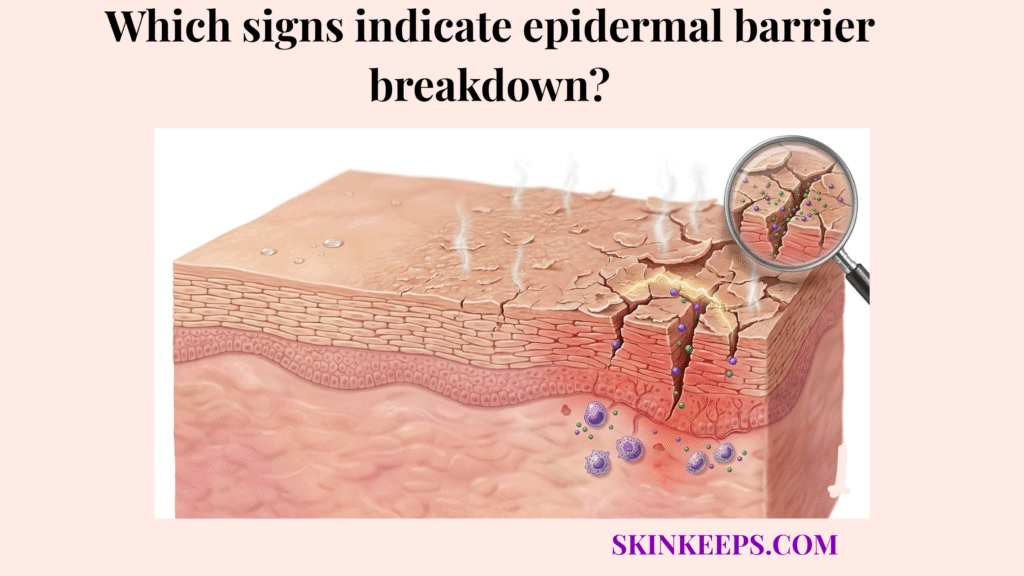
Signs that indicate epidermal barrier breakdown include tightness, stinging, dryness, redness, roughness, flaking, and rising sensitivity to products or environmental exposure. These signs appear when the outer skin layer loses its ability to keep water in, keep irritants out, and maintain surface stability. Burning, stinging, itching, and tightness are characteristic sensory expressions of barrier-related hyperreactivity, even when obvious visible signs are limited.
Barrier breakdown does not always begin with dramatic peeling or obvious inflammation. It often starts with smaller changes in comfort, tolerance, and texture, such as skin that suddenly feels tight after cleansing, burns with familiar products, or stays dry even after moisturizing. Common signs of clinically dry, barrier-stressed skin include flakes, rough texture, itch, painful or burning skin, and cracking.
Understanding which signs indicate epidermal barrier breakdown makes it easier to catch the problem early, distinguish temporary stress from true barrier failure, and respond before the skin becomes chronically reactive.
Why does epidermal barrier breakdown show up through multiple signs instead of one symptom?
Epidermal barrier breakdown shows up through multiple signs because the barrier supports hydration, comfort, and protection at the same time.
When the epidermal barrier—the outer defensive layer that helps keep water in and irritants out—weakens, more than one skin function is affected at once: water retention drops, irritant resistance falls, and surface stability becomes less reliable. This multi-layered failure creates a diverse set of symptoms across sensory and visual categories.
This is why barrier breakdown (the loss of normal surface stability and water retention) usefully appears as a cluster of symptoms rather than one isolated sign. Permeability failure is a process that can drive inflammation, sensitization, and reduced tolerance simultaneously rather than one symptom at a time.
What early sensory signs indicate epidermal barrier breakdown?
The earliest signs of epidermal barrier breakdown are often sensory, especially tightness, burning, stinging, itching, and reduced comfort after routine skin contact.
People often feel barrier stress before they clearly see it, especially after cleansing, water exposure, heat, or mild actives. These sensitive skin symptoms—sensory symptoms such as burning, stinging, or tightness that may or may not have strong visible signs—act as the body’s first warning system that the surface armor is compromised.
Common early sensory signs include tightness after washing, stinging with products that used to feel normal, itching without a clear rash, burning after heat or water, and skin that feels unusually raw or overprocessed. Core sensory symptoms consistently center on this specific cluster of discomfort.
What visible signs indicate epidermal barrier breakdown?
Visible signs indicate epidermal barrier breakdown when the skin looks drier, rougher, redder, or less even than usual and fails to return to baseline quickly.
You should look for dry or dull-looking skin, flaking or rough patches, lingering redness, a shiny but dehydrated-looking surface, and small irritated areas that do not settle quickly. If you are noticing these changes, using a Barrier Health Checker can help you objectively measure the degree of structural impairment.
Visible signs matter because they show that barrier failure is no longer only a comfort issue; it is now affecting surface organization and inflammatory appearance. Signs of dry, barrier-stressed skin include flakes, rough texture, cracks, itching, pain, and visible roughness.
How does rising product intolerance indicate epidermal barrier breakdown?
Rising product intolerance indicates epidermal barrier breakdown because the skin is becoming less able to buffer normal exposure without discomfort.
Product intolerance—stinging, burning, or irritation from products that were previously tolerated—is a decisive marker that the barrier can no longer buffer normal exposure. A strong barrier helps the skin tolerate routine ingredients, but once the seal weakens, even gentle products may penetrate too deeply and sting.
This often happens because irritants penetrate more easily and the skin becomes more reactive. Burning and stinging from otherwise routine exposure acts as a classic marker of reduced tolerance and impaired chemical defense.
How does dehydration that does not improve easily indicate epidermal barrier breakdown?
Dehydration that does not improve easily can indicate epidermal barrier breakdown because the skin is leaking water faster than it can hold onto it, a state marked by increased TEWL (transepidermal water loss).
TEWL—the standard measure of barrier leakiness—tends to rise when the outer protective seal is fractured. Barrier-broken skin often loses water so quickly that moisturizer provides only short-lived relief. This persistent dehydration suggests that the underlying “seal” is no longer functional.
This pattern looks like brief comfort followed by returning tightness, dullness, or reduced softness. Increased TEWL is repeatedly linked with dry, flaky, or sensitive skin states in clinical literature. Understanding how barrier disruption increases TEWL clarifies why simple hydration is not enough to stop this pattern.
How can you tell when epidermal barrier breakdown is getting worse?
Epidermal barrier breakdown is getting worse when the skin becomes less tolerant, more reactive, and slower to calm down after ordinary exposure.
Worsening breakdown usually appears as longer-lasting redness, broader product stinging, more frequent flaking, and stronger reactions to weather or touch. When the signs spread across comfort, appearance, and tolerance at the same time, the barrier is moving from mild stress toward active failure.
Quantitative Matrix: Experimental Breakdown Data
| Experimental Context | Verified Figure | Significance for Sign Recognition |
|---|---|---|
| Tape stripping (35 strips) | TEWL delta 31.8 g/m²/h | Explains rapid post-wash tightness and stinging |
| Epidermal removal (Tape) | ~33% of total epidermis | Explains why skin feels raw or overprocessed |
| Intense stripping (30+ strips) | Shiny & Red appearance | Distinguishes acute damage from simple dryness |
How does acute barrier breakdown differ from chronic barrier instability?
Acute barrier damage—sudden barrier failure after a strong trigger—happens quickly, while chronic barrier instability—a repeated pattern of incomplete recovery and ongoing fragility—develops when the skin is repeatedly stressed without enough repair time.
Acute damage tends to feel dramatic and obvious—burning or immediate redness—whereas chronic instability may feel more subtle but persists because the skin never fully returns to its baseline resilient state.
| Pattern | Typical Trigger | Main Signs | Skin Behavior |
|---|---|---|---|
| Acute Breakdown | Strong peel, over-exfoliation | Burning, redness, rapid sting | Sudden collapse |
| Chronic Instability | Repeated irritation, inflammation | Dullness, sensitivity, flaking | Ongoing fragility |
How does healthy skin compare with skin showing signs of epidermal barrier breakdown?
Healthy skin stays more comfortable and resilient, while skin showing signs of epidermal barrier breakdown becomes less tolerant, less hydrated, and less visually stable.
Healthy skin typically feels comfortable and returns to baseline quickly after mild stress. Conversely, barrier-broken skin feels tight and reactive because its water retention and irritant buffering are both significantly reduced.
| Skin state | Comfort | Water Retention | Product Tolerance |
|---|---|---|---|
| Healthy Barrier | Stable | Better preserved | Higher |
| Barrier Breakdown | Tight, reactive | Reduced | Lower |
When do signs of epidermal barrier breakdown need immediate action?
Signs of epidermal barrier breakdown need immediate action when discomfort, reactivity, and water loss stop being occasional and start becoming a repeated pattern.
When do early signs deserve quick correction?
Early signs deserve quick correction when mild tightness, slight sensitivity, or occasional stinging begin appearing often enough to suggest that recovery is no longer keeping pace with stress. Duarte et al. (2017) note that burning, stinging, itching, and tightness may appear even when visible signs are minimal (PMC, 2017).
When do moderate signs suggest active barrier breakdown?
Moderate signs suggest active barrier breakdown when flaking becomes persistent, products sting repeatedly, and the skin stays uncomfortable for much of the day. Del Rosso (2025) describes an overstressed stratum corneum barrier as impairment that exceeds the skin’s normal self-repair capacity (JCAD, 2025).
When do severe signs suggest urgent barrier recovery is needed?
Severe signs suggest urgent barrier recovery is needed when basic products burn, the skin feels raw or cracked, and simple moisturizing no longer restores comfort. Standard guidance for damaged skin specifically includes painful skin, burning, and cracking as signs requiring a stop-and-recover approach.
What commonly causes the signs of epidermal barrier breakdown to appear?
The signs of epidermal barrier breakdown usually appear when routine stress, environmental exposure, or inflammation pushes the skin past what it can comfortably repair. Identifying what causes disruption of the epidermal barrier is the first step in stopping the progression.
Common triggers include over-exfoliation, harsh cleansing, and environmental stress. A frequent but hidden factor is why hot water strips protective oils from the epidermis, creating a cycle of stripping that outpaces the speed of the epidermal renewal engine.
What steps stop the signs of epidermal barrier breakdown from worsening?
Stopping epidermal barrier breakdown means acting on the signs early instead of waiting for the skin to become severely reactive.
How do you remove the trigger?
You remove the trigger by stopping the harsh product or routine pattern causing the stress, pausing exfoliants, and reducing excess heat. Guidance from the National Eczema Association (2025) emphasizes stopping harsh exposure patterns and using warm rather than hot water as the first step (NEA, 2025).
How do you calm the skin after barrier breakdown signs appear?
You calm the skin by using simple, non-stinging care and focusing on lipid-supportive moisturization. Chiang & Eichenfield (2009) found that moisturizer application after bathing improves hydration outcomes, which supports immediate simple barrier support once signs of breakdown appear (PMC, 2009).
How do you prevent the signs from returning too quickly?
You prevent returning signs by reintroducing strong actives slowly and watching for early discomfort. Using a tool like the Routine Stability Index (RSI) can help you quantify whether your product layering is exceeding your skin’s stability threshold.
What are the key takeaways about signs of epidermal barrier breakdown?
The key takeaways about signs of epidermal barrier breakdown center on the fact that barrier failure usually appears as a cluster of sensory, visual, and tolerance-related changes rather than one isolated symptom.
| Category | Summary Points |
|---|---|
| Pattern Recognition | Epidermal barrier breakdown usually shows up as a cluster of signs, not one isolated symptom |
| Core Signs | The most useful signs include tightness, stinging, dryness, redness, flaking, and lower product tolerance |
| Progression | Early signs are often sensory, while worsening signs become more visible and persistent |
| Response | The best response is to catch the pattern early, remove the trigger, and restore barrier stability before the damage deepens |
What daily steps can you take to reduce the risk of epidermal barrier breakdown?
You can reduce the risk of epidermal barrier breakdown by keeping routine stress below the skin’s recovery capacity and responding early when comfort or tolerance starts to change.
Prevention is easier than reversal, especially when the pattern is caught at the stage of tightness, stinging, or subtle texture change. Acting during these early sensory phases prevents the escalation into inflammatory visible damage.
Final Execution Checklist
Barrier breakdown rarely starts as a dramatic event. It usually begins as small changes in comfort, tolerance, and texture.
Build your routine around barrier stability if your goal is calmer, less reactive, more resilient skin over time.