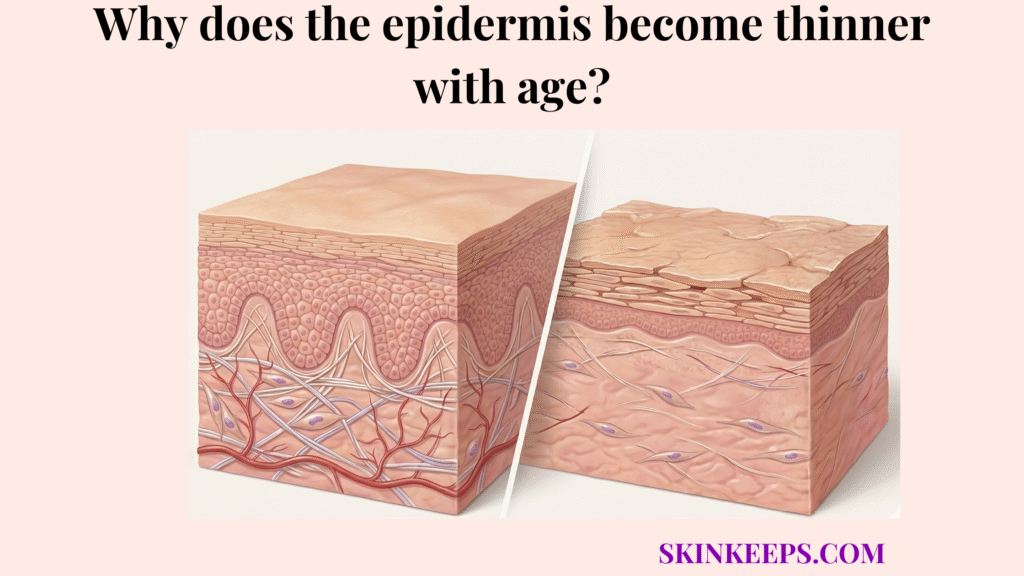
The epidermis becomes thinner with age because the skin gradually produces and replaces epidermal cells less efficiently over time. As basal-cell renewal slows, the dermal-epidermal junction becomes flatter, and the epidermis loses some of the cellular fullness and structural support that once kept it thicker and more resilient.
This thinning does not affect appearance alone; a thinner epidermis is often less protective, slower to recover, more fragile, and more reactive to stress. That is why age-related epidermal thinning—gradual loss of epidermal thickness linked to slower renewal and weaker support—is linked not only to dullness and texture change, but also to weaker barrier performance and slower healing.
Understanding age-related epidermal thinning makes it easier to explain what changes first, how the thinning process develops, how to recognize it, and what actually helps support aging skin.
What begins first in age-related epidermal thinning?
Age-related epidermal thinning often begins when the basal renewal system starts producing new cells more slowly.
One of the earliest shifts is less efficient generation of fresh keratinocytes in the basal layer, the deepest epidermal layer where new skin cells are generated. This biological slowdown means the “supply line” for fresh surface tissue is fundamentally compromised at its source.
This matters because the epidermis—the outer skin layer that provides barrier protection—depends on constant upward replacement to maintain fullness, continuity, and resilience over time. When production at the base drops, the entire stratified structure begins to lose its youthful density.
How does slower epidermal renewal drive age-related epidermal thinning?
Slower epidermal renewal drives age-related epidermal thinning because the tissue is no longer replenished with the same strength and consistency as before.
The epidermis depends on keratinocyte renewal—the ongoing production and upward replacement of epidermal cells. Histologic measurements show that mean epidermal thickness can drop significantly from 39.84 ± 3.85 μm in younger skin to 21.81 ± 5.4 μm in older unexposed skin (Abd El-Aal et al., 2012).
Over time this reduces both visible freshness and structural thickness. Wang et al., 2020 describe age-associated decline in epidermal function as tied to reduced growth-factor signaling and lower keratinocyte proliferative activity, reinforcing that thinning is a problem of regenerative speed.
How does flattening of the dermal-epidermal junction worsen age-related epidermal thinning?
Flattening of the dermal-epidermal junction worsens age-related epidermal thinning by weakening the structural interface that helps support and nourish the epidermis.
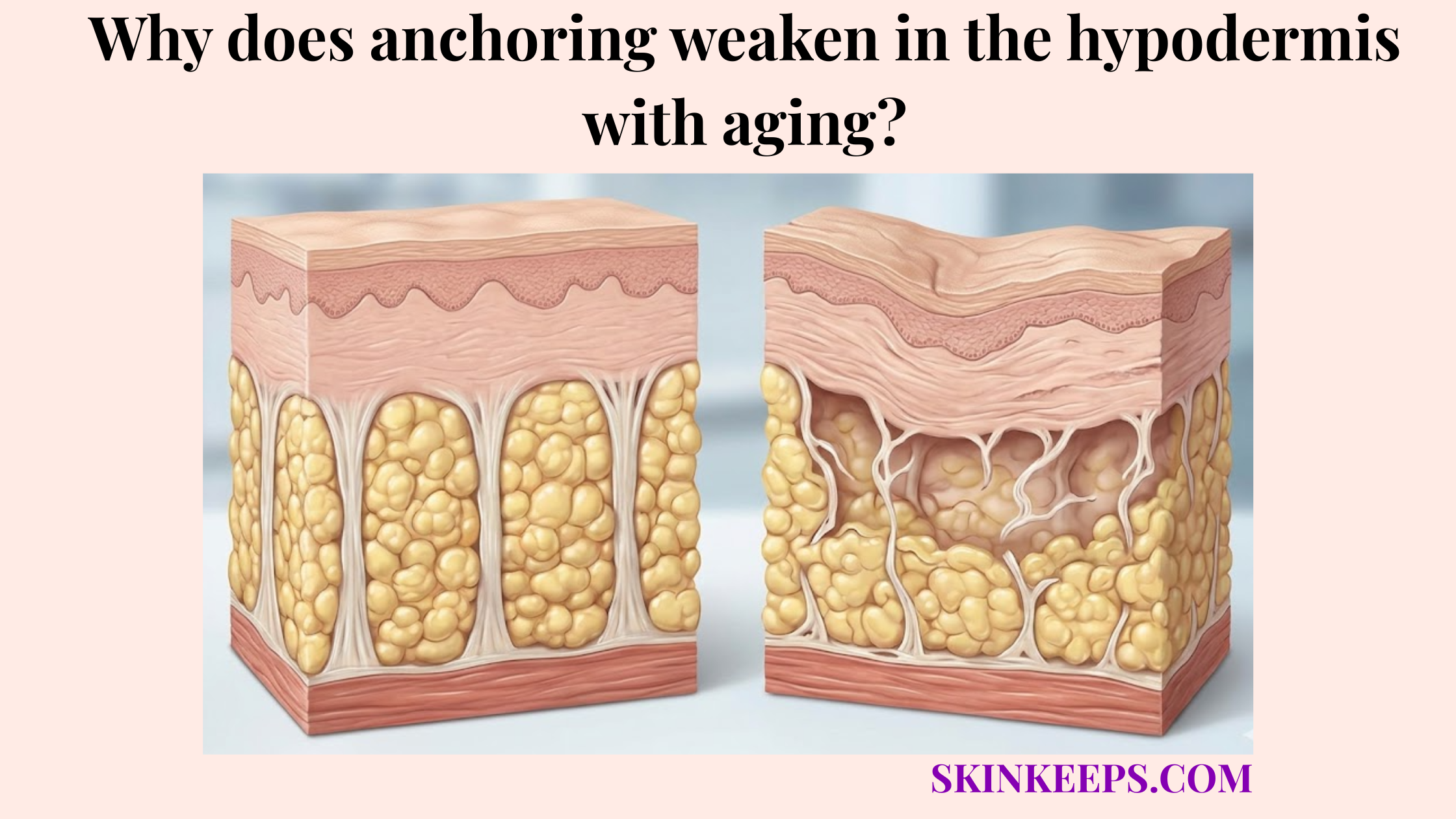
In younger skin the dermal-epidermal junction (DEJ)—the structural interface that anchors the epidermis—has more contour and interlocking support. Research indicates that the height of dermal papillae can drop from 98.67 μm in younger individuals to as low as 47.33 μm in older groups, leading to a flatter, less reinforced interface (Baqar et al., 2018).
With age this junction becomes flatter, which reduces structural support and makes the epidermis less robust over time. Russell-Goldman and Murphy, 2020 describe DEJ flattening as a classical histologic feature of skin aging that precedes visible sagging and fragility.
How do UV exposure and environmental stress accelerate age-related epidermal thinning?
UV exposure and environmental stress accelerate age-related epidermal thinning by increasing the repair burden on a skin system that is already becoming slower and weaker with age.
UV radiation adds cumulative damage to joogta-slowing renewal systems, forcing cells to focus on DNA repair rather than proliferation. Aging and external stress reinforce one another in a cycle of decline. Photoaging literature consistently describes chronic UV exposure as a major driver of structural skin decline.
How does UV exposure accelerate age-related epidermal thinning?
UV exposure accelerates age-related epidermal thinning by weakening repair systems and adding chronic damage to skin that is already renewing more slowly. Russell-Goldman and Murphy, 2020 describe environmental factors as co-drivers of age-related skin degeneration, helping explain why UV-exposed skin usefully shows more pronounced structural decline.
Chronic UV exposure effectively “steals” the metabolic energy needed for renewal, directing it toward emergency repair protocols. This constant shifting of cellular resources leaves the stratified layers in a persistent state of thickness deficit.
How does chronic environmental stress worsen age-related epidermal thinning?
Chronic environmental stress worsens age-related epidermal thinning by increasing barrier stress and making it harder for aging skin to maintain healthy renewal. Wang et al., 2020 explain that aging epidermis shows functional decline that can be further stressed by external insults, accelerating visible thinning and fragility.
Wind, pollution, and low humidity add cumulative barrier strain that aging skin cannot readily offset. This environmental load acts as an extrinsic accelerator, pushing a naturally slow system into a state of visible depletion and reduced resilience.
How does age-related epidermal thinning weaken barrier function and healing?
Age-related epidermal thinning weakens barrier function and healing by making the skin less buffered against damage and less efficient at recovery.
A thinner epidermis has less protective reserve against irritation, water loss, and minor injury. This loss of barrier resilience—the skin’s ability to tolerate stress—means the skin is more easily compromised by everyday environmental factors.
Skin-aging reviews consistently link thinning and DEJ flattening with increased fragility and defective structural repair. This means the epidermis lacks the biological depth required to mount a robust defense after a localized injury or prolonged chemical irritation.
Which signs suggest age-related epidermal thinning is becoming more visible?
Age-related epidermal thinning may be becoming more visible when the skin appears more fragile, less full, less resilient, and slower to recover from everyday stress.
Early signs often include skin that looks more delicate or papery, greater surface transparency, and reduced visual fullness. Recognizing these shifts allows for early intervention using a Barrier Health Checker to monitor ongoing resilience.
These signs matter because they reflect both structural decline and weaker function, not just changes in surface appearance. Understanding this can help you better identify how the epidermis manages pigmentation and turnover concurrently with thickness loss.
How does youthful epidermis compare with age-related epidermal thinning?
Youthful epidermis is thicker and more resilient because renewal and structural support are stronger, while age-related epidermal thinning shows reduced cellular replacement and weaker support.
Youthful skin typically has more efficient renewal and stronger junction support, resulting in a robust and smooth surface. In contrast, age-thinned epidermis is slower, flatter, and less robust, leading to the hallmark delicacy of aging skin.
The defining difference is functional: youthful skin retains water effortlessly and rebounds from minor injury, whereas thinned aging skin is more prone to transepidermal water loss and takes significantly longer to repair its surface architecture.
| Epidermal state | Renewal strength | Junction support | Barrier resilience |
|---|---|---|---|
| Youthful epidermis | Faster and more efficient | More structured (Wavy) | Higher |
| Age-related thinning | Slower and less efficient | Flatter and weaker | Lower |
What factors make age-related epidermal thinning worse?
Age-related epidermal thinning worsens when cumulative damage and chronic barrier stress outpace the skin’s already slowing renewal capacity.
Common worsening factors include chronic UV exposure, overuse of harsh actives, and repeated over-exfoliation. One major but hidden driver is why hot water strips protective oils from the epidermis, adding unnecessary thermal stress to a thinning surface.
These factors do not create the baseline aging process alone, but they can significantly accelerate its visible and functional consequences. Using a diagnostic tool like the Routine Stability Index (RSI) can help you quantify if your current routine is adding to this cumulative stress.
What habits and ingredients help support skin affected by age-related epidermal thinning?
The best support for skin affected by age-related epidermal thinning combines renewal support, barrier protection, and consistent UV defense.
How do retinoids help support skin affected by age-related epidermal thinning?
Retinoids help support skin affected by age-related epidermal thinning by encouraging epidermal renewal over time and helping counter age-related stagnation. Mukherjee et al., 2006 reported that histologic studies of topical tretinoin showed increased epidermal thickness within the first 3 to 6 months, with some compaction changes visible as early as 15 days.
By binding to nuclear receptors, retinoids normalize the maturation cycle and stimulate the production of fresh cells from the base. This biological intervention addresses the core renewal slowdown that drives thinning in the first place.
How does barrier support help protect skin affected by age-related epidermal thinning?
Barrier support helps protect skin affected by age-related epidermal thinning because aging skin often needs help maintaining water balance. Lueangarun et al., 2019 showed that a ceramide-containing moisturizer improved hydration and TEWL for up to 24 hours after application, supporting barrier care as a practical support strategy.
Replenishing the lipid matrix helps prevent the chronic surface stress that further depletes cellular energy. When the barrier is secure, the skin can redirect its limited metabolic resources toward maintenance and renewal.
How does sun protection help slow further age-related epidermal thinning?
Sun protection helps slow further age-related epidermal thinning by reducing cumulative UV damage. Quan et al., 2023 emphasize that topical retinoids and photoprotection remain core preventive strategies because cumulative UV exposure is one of the most important external accelerators of structural decline.
Daily SPF shields the basal renewal factory from radiation that triggers DNA mutations and structural breakdowns. Consistent protection is the single most effective way to preserve existing epidermal thickness over the long term.
Problem: age-related epidermal thinning is increasing
Implication: barrier strength, renewal, and resilience are declining
Solution: support renewal carefully, protect the barrier, and reduce cumulative damage
What are the key takeaways about age-related epidermal thinning?
The key takeaways about age-related epidermal thinning center on the fact that renewal slows, structural support weakens, cumulative stress accelerates the process, and the consequences are functional as well as cosmetic.
It is essential to focus on the biological sequence where reduced cellular energy and environmental damage converge to thin the skin layers. Addressing the root cause requires a shift from superficial treatments to structural support.
Summary Points
- Age-related epidermal thinning happens because renewal slows and structural support weakens over time
- Basal-cell slowdown and flattening of the dermal-epidermal junction are major drivers
- UV exposure and chronic environmental stress can accelerate the thinning process
- A thinner epidermis is not only a cosmetic change; it also means weaker barrier performance and slower healing
- The best support strategy focuses on renewal, barrier stability, and daily protection
What daily steps help reduce the impact of age-related epidermal thinning?
Daily steps help reduce the impact of age-related epidermal thinning by lowering cumulative stress and supporting the skin’s reduced renewal capacity.
Long-term support and preservation work significantly better than aggressive short-term smoothing, which can often backfire on thinner, more fragile aging skin.
Final Execution Checklist
Age-related epidermal thinning is partly natural, but the rate and impact of thinning are strongly influenced by how much cumulative stress the skin experiences and how well its renewal system is supported.
Build your routine around protection, stability, and careful renewal support if your goal is stronger, more resilient aging skin.
Age-Thinning Quantitative Context Matrix
| Metric Measured | Verified Figure | Source Attrib. | Source Link |
|---|---|---|---|
| Mean epidermal thickness | 21.81 ± 5.4 μm (older) vs 39.84 ± 3.85 μm (younger) | Abd El-Aal et al., 2012 | PMC3371519 |
| Dermal papillae height | Drops from 98.67 μm to 47.33 μm across age groups | Baqar et al., 2018 | Download PDF |
| Topical Tretinoin Timeline | Epidermal thickening reported within 3–6 months; 15-day changes noted | Mukherjee et al., 2006 | PMC2699641 |
| Ceramide Barrier Benefit | Improvements in TEWL noted for up to 24 hours | Lueangarun et al., 2019 | PubMed |