
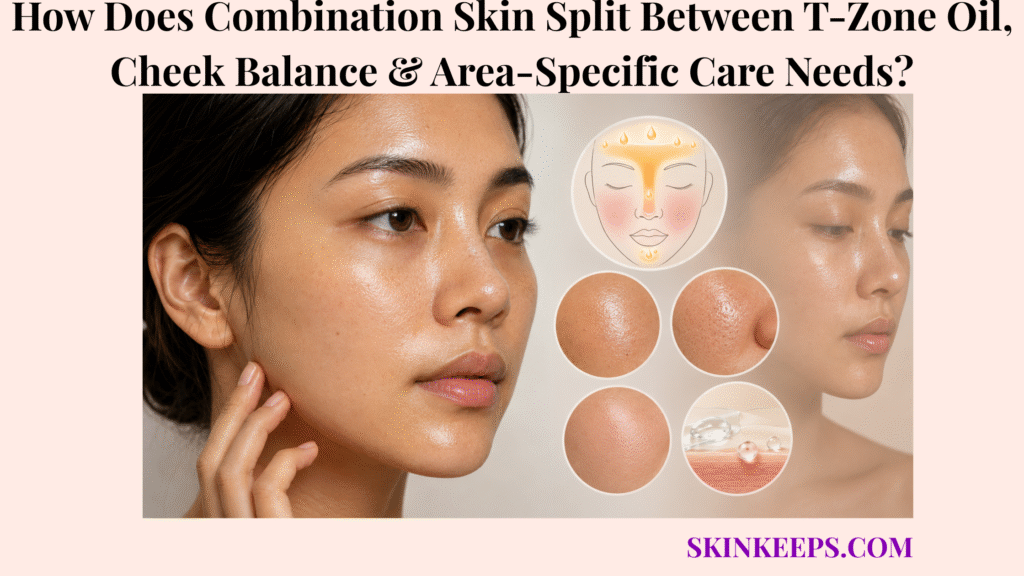
Combination skin splits between T-zone oil and cheek balance because sebaceous activity is stronger in the forehead, nose, and chin than it is across the cheeks and jawline. This combination skin type creates a dual-zone profile where the center of the face requires oil control while the outer perimeter remains normal or dry.
Combination skin is a skin type where the T-zone often appears oily while the cheeks remain normal, balanced, or dry. This split happens because sebum distribution is uneven across the face, so the center needs oil control while the outer areas often need barrier support.
How does asymmetrical sebaceous gland distribution biologically define the combination skin profile?
Asymmetrical sebaceous gland distribution biologically defines the combination skin profile by creating stronger oil production in the central T-zone and lower oil support across the cheeks. Combination skin begins with this uneven sebaceous activity across facial zones. This uneven activity makes the forehead, nose, and chin behave differently from the cheeks. The result is a dual-zone profile where one area needs oil control while another area may need barrier support.
Facial sebaceous gland density can range from about 400 to 900 glands/cm², with higher density commonly described on the forehead. This higher facial density supports stronger oil production in central areas. Stronger central oil production explains why combination skin often looks shiny in the T-zone while the cheeks stay calmer. [ScienceDirect]
Combination skin belongs within the broader system of different skin types, but it needs a more spatial routine because one face can show two different oil patterns. Readers who need help recognizing the facial-zone pattern can compare their signs with the guide on combination skin patterns.
The Topography of Facial Glands
The topography of facial glands explains combination skin by mapping where sebum production is more active and where barrier support is lower. This facial topography maps out anatomical facial zones based on gland concentration. The concentrated glands make the central face significantly more prone to visible oil.
The Split-Barrier Reality
The split-barrier reality means combination skin can show oily congestion in the T-zone while the cheeks remain balanced, tight, or mildly dry. This split-barrier reality can fluctuate depending on season, age, hormones, and climate. Such fluctuations remind users that combination skin requires adaptable, zone-specific skincare.
Why does the central T-Zone consistently trigger extreme lipid production and localized congestion?
The central T-zone consistently shows stronger lipid production and localized congestion because the forehead, nose, and chin contain sebum-prone follicular areas that respond strongly to internal and environmental triggers. The separate guide on oily T-zone in combination skin explains why the forehead, nose, and chin often become the first areas to look shiny.
Androgen Sensitivity in the Mid-Face
Androgen sensitivity in the mid-face can intensify T-zone oiliness because sebaceous glands respond to androgen-related signals that influence sebum production. These androgen receptors trigger the glands to expand and release more oil during hormonal shifts. The resulting surge in oil production makes the mid-face appear noticeably greasier.
The Oil Trap and Oxidation
The oil trap and oxidation pattern occurs when T-zone sebum mixes with dead cells inside follicles and forms open comedones that darken at the surface. These open comedones are commonly known as blackheads. Blackheads represent oxidized follicular material rather than trapped dirt. When oily areas and drier areas appear together, the post on combination skin breakouts and dry patches helps explain why acne and flaking can happen on the same face.
How does the peripheral U-Zone maintain barrier balance or succumb to localized lipid dryness?
The peripheral U-zone maintains barrier function or becomes locally dry because the cheeks and jawline usually receive less surface oil than the T-zone. The peripheral U-zone can stay balanced when cheek barrier lipids remain stable. This cheek balance means the outer face may feel comfortable even while the T-zone looks oily. The difference explains why combination skin cannot be treated as one uniform surface.
The peripheral U-zone can become dry when environmental stress removes too much surface lipid. This local dryness makes the cheeks feel tight, rough, or more reactive. The cheek dryness can appear even while the nose and forehead remain shiny.
The Lack of Natural Occlusives
The lack of natural occlusives on the cheeks means the U-zone may need more barrier support than the oilier center of the face. These natural occlusives normally help reduce transepidermal water loss (TEWL). When these surface lipids are low, the outer face becomes vulnerable to harsh weather and dry air. The guide on combination skin external factors explains why humidity, climate, harsh products, and cleansing habits can shift the cheeks toward dryness.
Inflammatory Vulnerability
Inflammatory vulnerability in the cheeks can appear when low lipid support makes the U-zone more prone to tightness, redness, or product discomfort. This vulnerability depends entirely on the current barrier condition. When the barrier weakens, the cheek area reacts more strongly to environmental triggers.
| Metric | T-Zone | U-Zone |
|---|---|---|
| Main pattern | More oil-prone | Normal, balanced, or dry |
| Common signs | Shine, visible pores, blackheads | Tightness, dullness, mild flaking, or balance |
| Main risk | Follicular congestion | Barrier dryness or irritation |
| Routine need | Sebum regulation and pore clearing | Hydration, lipid support, and comfort |
| Product risk | Heavy creams may feel congesting | Strong astringents may feel stripping |
What are the most common full-face treatment mistakes that destroy a dual-state barrier?
The most common full-face treatment mistakes that harm a dual-state barrier involve using the same harsh oil-control or heavy moisturizing product across every facial zone. A uniform full-face routine mismatches the varying needs of the different facial zones. The article on combination skin internal factors gives context for why genetics, hormones, stress, and health patterns can make the same full-face routine behave differently by zone.
The Acne Wash Astringent Trap
The acne wash astringent trap harms combination skin because a cleanser strong enough for the oily T-zone may be too stripping for the cheeks. Do not use harsh acne cleansers across the entire face by default. The cheeks may lack enough oil to tolerate aggressive cleansing without becoming dry and irritated.
The Rich Cream Congestion Error
The rich cream congestion error occurs when a moisturizer that comforts dry cheeks feels too heavy on the oil-prone T-zone. Rich creams may belong on the cheeks but not the nose or forehead. Applying thick emollients to the oily center can trap sebum and worsen follicular congestion.
Which micro-zoning cosmetic techniques effectively balance a split-behavior complexion?
Micro-zoning cosmetic techniques balance a split-behavior complexion by applying oil-control products to the T-zone and barrier-support products to the cheeks. This micro-zoning strategy relies on treating each facial area according to its specific biological behavior. For practical product placement, the post on combination skin zone-based products shows how to separate T-zone oil control from cheek barrier support.
Targeted Chemical Exfoliation: T-Zone Only
Targeted chemical exfoliation means applying BHA only to congested T-zone areas instead of drying the entire face. Salicylic acid acts as an oil-soluble beta hydroxy acid (BHA) that breaks down sebum within congested follicles. By applying this acid exclusively to the oily center, users avoid irritating their already dry cheeks.
Zonal Hydration and Multi-Moisturizing
Zonal hydration and multi-moisturizing means giving the whole face lightweight water support while adding richer lipid support only where the cheeks need it. A universally applied hyaluronic acid serum can provide this initial water support without adding heavy lipids. Afterward, a richer ceramides cream can be layered specifically onto the drier U-zone, while the T-zone receives a lightweight gel moisturizer.
| Skincare Step | Product Type | Where to Apply | Why It Works |
|---|---|---|---|
| Cleansing | Gentle gel or cream cleanser | Entire face | Cleans without strongly stripping the cheeks |
| Exfoliation | BHA / salicylic acid | T-zone only when congested | Targets oily follicles without drying the cheeks |
| Hydration | Hyaluronic acid or glycerin serum | Entire face | Adds water support without heavy oil |
| Moisturizing | Richer ceramide cream | Cheeks or dry patches | Supports the lower-lipid areas |
| Masking | Clay mask and hydrating mask | Clay on T-zone, hydration on cheeks | Treats oil and dryness separately |
What is the ultimate daily checklist to manage the spatial needs of a hybrid skin matrix?
The ultimate daily checklist for a hybrid skin matrix uses gentle full-face cleansing, lightweight hydration, and zone-specific treatment placement. This practical approach ensures that both zones receive appropriate care without conflicting. The complete guide on combination skin care tips can support readers who need a full routine for cleansing, moisturizing, sunscreen, exfoliation, and targeted treatment placement.
Smart Cleansing and Balancing
Smart cleansing and balancing uses a gentle cleanser that removes T-zone oil without stripping the cheeks.
Morning Checklist
Spatial Application Rules
Spatial application rules require active ingredients to be placed only where the matching zone problem exists.
Evening Checklist
Key Takeaways
The key takeaways about combination skin are that uneven sebum distribution creates oily and balanced zones, so the routine must follow the face map.
Key Takeaways
- Combination skin is defined by an oily T-zone and normal, balanced, or dry cheeks.
- The T-zone often shows shine, visible pores, blackheads, and congestion.
- The cheeks may stay balanced or become tight, dry, dull, or mildly flaky.
- A full-face acne wash can be too harsh for the cheeks.
- A full-face rich cream can feel too heavy on the T-zone.
- Micro-zoning places BHA on oily areas and barrier support on dry areas.
- Multi-masking can treat oil and dryness at the same time without forcing one product across the whole face.
- Combination skin becomes easier to manage when products are applied by zone instead of by habit.
FAQs
What defines combination skin?
Combination skin is defined by uneven facial oil distribution. The T-zone usually appears oily, shiny, or congested, while the cheeks may remain normal, balanced, tight, or dry.
Why is the T-zone oily in combination skin?
The T-zone is oilier because the forehead, nose, and chin contain sebaceous areas that produce more visible sebum. This oilier center can show shine, larger-looking pores, and blackheads more easily.
Can combination skin have dry cheeks and breakouts together?
Yes, combination skin can have dry cheeks and breakouts together because different facial zones behave differently. The T-zone may clog from excess sebum while the cheeks feel dry from lower lipid support.
Should combination skin use different products by area?
Yes, combination skin often benefits from using different products by area. Oil-control products can be placed on the T-zone, while richer moisturizers can be placed on dry cheeks.
Is BHA good for combination skin?
BHA can be useful for combination skin when it is applied only to oily or congested zones. Applying BHA across dry cheeks can increase tightness, dryness, or irritation.
Is a gel moisturizer good for combination skin?
A gel moisturizer can suit the T-zone because it hydrates without heavy residue. The cheeks may still need a richer moisturizer if they feel tight, dull, or dry.
Is multi-masking useful for combination skin?
Multi-masking can be useful for combination skin because it treats different zones separately. A clay mask may suit the oily T-zone, while a hydrating mask may suit dry cheeks.
When should combination skin need a dermatologist?
Combination skin needs a dermatologist when breakouts become painful, persistent, cystic, scarring, or inflamed. A dermatologist is also useful when cheek dryness becomes severe, itchy, cracked, or resistant to routine changes.
Conclusion
Combination skin needs zone-specific care because the T-zone and cheeks do not behave the same way. Combination skin splits between T-zone oil and cheek balance because sebum distribution is uneven across the face. A stable routine cleanses gently, controls oil only where it appears, and supports dry or balanced areas without overloading the T-zone.
When skincare follows the face map, combination skin becomes easier to balance. At SkinKeeps, we explain skin-layer function through evidence-based anatomy so you can make informed choices.