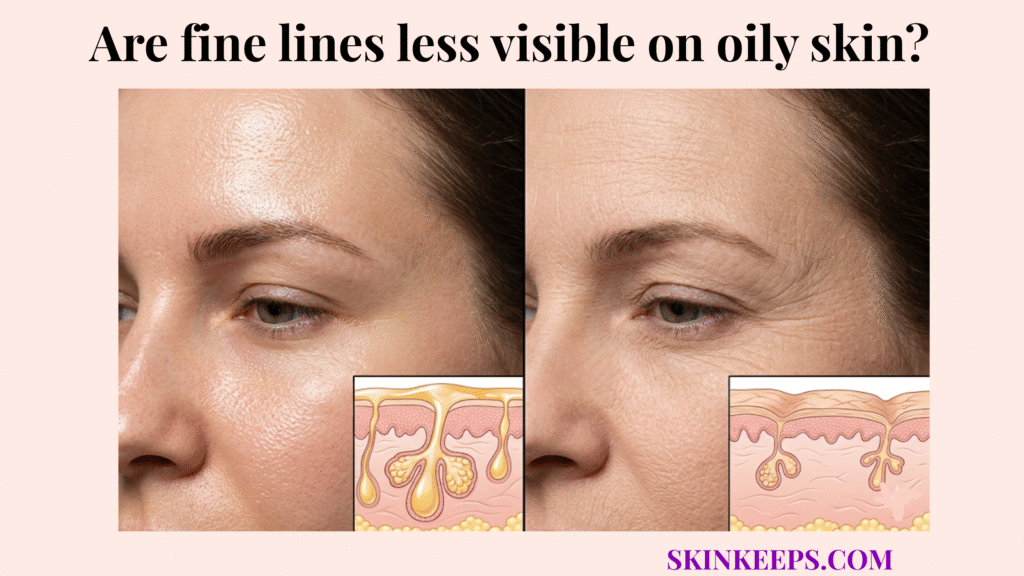
Yes, fine lines can appear less visible on oily skin because surface sebum can reduce visible dryness, soften texture, and change how light reflects from shallow creases. This visual effect is strongest for superficial fine lines, not deep wrinkles caused by collagen and elastin changes.
This guideline explains why surface oil can make fine lines look softer, how superficial dehydration lines differ from structural wrinkles, and why sunscreen still matters for oily skin. It also explains how lightweight anti-aging ingredients can support smoother-looking skin without increasing congestion.
Why can fine lines look less visible on oily skin?
Fine lines can look less visible on oily skin because continuous surface sebum provides lubrication that reduces the dry, papery texture that makes superficial creases stand out. Fine-line visibility is easier to understand when oily skin is viewed as a sebum-driven skin type with both visual advantages and congestion risks. This surface sebum coats the stratum corneum and makes the outer layer look less papery. The less papery surface can make early fine lines appear softer to the eye.
This visual advantage belongs to superficial fine lines rather than deep structural wrinkles. Superficial lines respond more to surface texture, hydration, and oiliness. When surface conditions improve, this lubrication explains how oily skin softness and plumpness contributes to a smoother appearance. Structural wrinkles depend more on collagen, elastin, and dermal support, so surface oil cannot erase them.
How surface oil can reduce the look of fine dryness lines
Surface oil can reduce the look of fine dehydration lines by coating the stratum corneum with a flexible lipid film that softens rough surface edges. This lipid coating softens the rough surface edges that make shallow creases visible. The softened surface makes dryness-related lines look less sharp.
Why oily skin may appear smoother than drier skin at the surface
Oily skin may appear smoother than drier skin at the surface because sebum reduces roughness and visible flaking across the outer layer. This reduced roughness creates a more uniform epidermal barrier. The more uniform barrier feels slicker and often hides superficial texture irregularities.
How does oily skin reduce the visible depth of superficial fine lines?
Oily skin reduces the visible depth of superficial fine lines by coating the epidermis with a lubricating film that makes shallow surface texture look more uniform. This uniform surface reduces the contrast between the crease and the surrounding skin. The lower contrast can make shallow lines look less etched.
This effect is strongest when fine lines are dryness-related. Dryness-related lines depend on surface roughness and low water balance. When sebum softens the surface, those lines may look less obvious even though deeper aging changes remain.
How surface lubrication can make fine lines look softer
Surface lubrication can make fine lines look softer by reducing friction, roughness, and sharp visual edges on the outer skin surface. This reduced roughness smooths the transition between healthy skin and shallow creases. The smoothed transition keeps minor texture irregularities from catching the eye.
How reduced visible dryness changes wrinkle appearance
Reduced visible dryness changes wrinkle appearance by making the skin surface look less tight, flaky, or ashy around shallow creases. This tightness removal allows the stratum corneum to lay flat. The flattened surface disguises small topographical imperfections efficiently.
Why superficial fine lines are easier to disguise than deeper wrinkles
Superficial fine lines are easier to disguise than deeper wrinkles because they are more influenced by surface hydration, oiliness, and texture. These surface factors can be temporarily altered by topical moisture and sebum. The deeper wrinkles reside in the dermal matrix, escaping the softening reach of surface oils.
| Mechanism | What Happens Biologically | Visible Effect |
|---|---|---|
| Surface oil film | Sebum coats the outer skin surface | Lines may look softer |
| Less visible dryness | Skin looks less papery or tight | Fine lines stand out less |
| More surface reflectivity | Light reflects more evenly from oily areas | Small lines may look less sharp |
| Better superficial smoothness | Texture looks less dry | Fine creases appear less obvious |
How does surface reflectivity make fine lines look less obvious on oily skin?
Optical reflectivity can make fine lines look less obvious on oily skin because a lipid film changes how light hits shallow texture and reduces visible shadow contrast. This changed light interaction can reduce the small shadows that make early creases stand out. The result is optical softening, not biological wrinkle removal.
Optical softening has limits because light reflection affects appearance more than structure. This appearance effect can make superficial lines look smoother in some lighting. The same effect cannot stop collagen decline or deeper wrinkle formation.
How a more reflective surface reduces shadowing in fine lines
A more reflective surface reduces shadowing in fine lines by spreading light across shallow creases instead of emphasizing every small valley. This spread of light fills the darker indentations with reflection. The reflected light tricks the eye into perceiving a flatter, more even plane.
Why matte dry skin can make small lines stand out more
Matte dry skin can make small lines stand out more because rough, low-lipid texture increases visible contrast around shallow creases. This increased contrast creates tiny shadows inside every epidermal fold. The shadows draw attention to the lack of surface flexibility.
How visual softening differs from true wrinkle prevention
Visual softening differs from true wrinkle prevention because sebum changes the surface appearance of lines without stopping deeper dermal aging. This surface appearance shift offers a cosmetic benefit for oily-skin individuals. However, the underlying collagen network still requires proactive preservation to avoid long-term structural failure.
How do superficial lines on oily skin differ from deeper structural wrinkles?
Superficial lines on oily skin differ from deeper structural wrinkles because surface lines are more affected by oil, hydration, and texture, while deeper wrinkles reflect dermal collagen degradation and elastin changes. Superficial lines are more responsive to surface conditions. These surface conditions include hydration, sebum, roughness, and temporary dehydration. When surface conditions improve, superficial lines may look softer.
Deeper structural wrinkles are linked to changes in dermal collagen, elastin, and extracellular matrix support. Type I collagen decline is repeatedly identified as a central contributor to dermal thinning, elasticity loss, wrinkles, and sagging. This deeper aging pathway explains why oily skin aging still requires active prevention.
How dehydration lines differ from deeper wrinkles in oily skin
Dehydration lines differ from deeper wrinkles in oily skin because dehydration lines are shallow and surface-dependent, while deeper wrinkles are structural and dermal. Dehydration lines respond quickly to improved water balance in the stratum corneum. Structural wrinkles remain etched regardless of how much topical moisture is applied.
Why oily skin may resist surface crepiness better than dry skin
Oily skin may resist surface crepiness better than dry skin because sebum can reduce visible dryness and rough surface texture. This reduced visible dryness keeps the epidermis looking more supple. The supple appearance staves off the crinkled, papery look characteristic of severe surface crepiness.
Why oily skin still develops collagen-related aging changes
Oily skin still develops collagen-related aging changes because sebaceous activity does not stop dermal collagen decline, elastin change, or UV-driven photoaging. This sebaceous activity is isolated to the upper skin layers. The lower layers gradually lose their youthful resilience despite the oily surface.
| Feature | Superficial Fine Lines | Deeper Structural Wrinkles |
|---|---|---|
| Main driver | Surface dryness, texture, temporary dehydration | Collagen loss, elastin decline, long-term aging |
| Visibility on oily skin | Often less noticeable | Still develops over time |
| Typical appearance | Fine, shallow surface creasing | Deeper folds or etched lines |
| Response to surface oil | May look softer | Much less affected |
| Prevention focus | Hydration and barrier comfort | UV protection, retinoids if tolerated, lifestyle factors |
What mistakes make fine lines look worse even on oily skin?
Fine lines look worse even on oily skin when sunscreen is skipped, harsh cleansers strip the barrier, or drying treatments create artificial surface dehydration. Skipping sunscreen makes fine lines worse because UV exposure contributes to photoaging. Sunscreen is consistently discussed as a key protection strategy against UV-related photoaging, meaning oily skin sunscreen choices are vital for preserving collagen.
Harsh cleansing can make oily skin look more lined by creating surface dehydration. This dehydration makes the stratum corneum feel tight and visually rough. The tighter surface can make fine lines look sharper even when the skin still produces oil, indicating that oily skin harsh products cause more harm than good.
Why skipping sunscreen removes oily skin’s visual advantage
Skipping sunscreen removes oily skin’s visual advantage because UV exposure can drive photoaging that surface oil cannot visually disguise forever. This photoaging accelerates the breakdown of essential structural proteins in the dermis. The structural breakdown eventually creates deep folds that overwhelm any superficial softening effect.
Why harsh acne cleansing can make fine lines look more obvious
Harsh acne cleansing can make fine lines look more obvious by stripping surface lipids and increasing tight, dehydrated texture. This tight texture emphasizes every microscopic fold across the epidermis. The emphasized folds completely negate the natural optical benefits of sebum.
Why over-stripping oily skin can increase surface aging signs
Over-stripping oily skin can increase surface aging signs because repeated barrier stress makes the skin look tighter, duller, and less comfortable. This barrier stress compromises the skin’s ability to hold onto necessary hydration. The lack of hydration inevitably leads to a more lined, tired complexion.
| Mistake | What It Causes | Visible Result |
|---|---|---|
| Skipping sunscreen | More UV-driven photoaging risk | Fine lines and deeper wrinkles become more visible |
| Harsh cleansing | Barrier stress and dehydration | Surface lines look sharper |
| Overusing drying treatments | Rougher, less comfortable skin | Fine lines stand out more |
| Avoiding moisturizer completely | Poor water balance | Skin looks flatter and more lined |
Which anti-aging ingredients suit oily skin without worsening congestion?
Anti-aging ingredients that suit oily skin without worsening congestion include lightweight humectants, non-heavy antioxidants, and retinoids used gradually in tolerated formulas. Oily skin needs anti-aging ingredients that support fine-line appearance without adding heavy residue. This lightweight requirement matters because oily skin can become congested when products are too rich. A non-comedogenic texture keeps the routine aligned with both aging support and oil control.
Retinoids are commonly used for early photoaging signs such as fine lines, wrinkles, roughness, and texture changes. This use makes retinoids relevant for oily skin when the formula is tolerated and introduced gradually. The same caution matters because retinoids can irritate if overused, showing why properly selected oily skin active ingredients balance both efficacy and tolerance.
How retinoids support oily skin aging care
Retinoids support oily skin aging care by improving surface turnover and helping address early signs of photoaging when the skin tolerates them. This improved turnover helps prevent the accumulation of dead cells inside pores. The dual action of smoothing fine lines and reducing congestion makes retinoids a valuable, though optional, tool.
How antioxidants help protect oily skin from aging stress
Antioxidants help protect oily skin from aging stress by reducing oxidative pressure from UV exposure, pollution, and daily environmental contact. This oxidative pressure contributes heavily to the degradation of youthful dermal proteins. Providing antioxidant support acts as an additional defensive measure alongside daily sunscreen.
Which lightweight hydrators help fine lines look less visible without heavy residue
Lightweight hydration helps fine lines look less visible without heavy residue by improving stratum corneum water balance while keeping the surface less greasy. This water balance softens superficial creases efficiently. Incorporating humectants like glycerin or hyaluronic acid provides this plumping effect without increasing congestion.
| Ingredient Type | Main Role | Best Fit for Oily Skin |
|---|---|---|
| Retinoids | Support turnover and photoaging care | Night use in tolerated formulas |
| Antioxidants | Help reduce oxidative stress | Lightweight daytime support |
| Peptides | Support skin-aging care | Light serums or gels |
| Humectants | Improve water balance and superficial smoothness | Lightweight hydration without heavy greasiness |
| Sunscreen | Reduces UV-driven photoaging risk | Daily broad-spectrum protection |
How should a daily routine help keep fine lines less visible on oily skin?
A daily routine helps keep fine lines less visible on oily skin by preserving surface smoothness, preventing UV damage, and avoiding harsh oil removal. A daily routine keeps fine lines less visible by protecting the surface and the deeper structure at the same time. Surface protection comes from gentle cleansing and lightweight hydration. Deeper prevention comes from daily sunscreen and tolerated anti-aging actives, principles explored thoroughly in oily skin care tips.
Aggressive oil removal works against fine-line control because it creates tightness and surface dehydration. This surface dehydration sharpens shallow creases and makes oily skin look less smooth. A balanced routine should reduce excess shine without removing all surface comfort.
What a morning routine should include for oily skin with fine-line concerns
A morning routine for oily skin with fine-line concerns should include gentle cleansing, lightweight hydration, antioxidant support if tolerated, and broad-spectrum sunscreen.
Morning Checklist
What an evening routine should include for oily skin aging support
An evening routine for oily skin aging support should remove sunscreen and daily buildup before applying tolerated renewal or hydration support.
Evening Checklist
Why balance matters more than aggressive oil removal
Balance matters more than aggressive oil removal because oily skin can still show sharper fine lines when the barrier becomes stripped and dehydrated. Controlling shine should never compromise the skin’s essential moisture reserves. A gentle approach ensures the complexion remains both clear and comfortably smooth.
Daily Routine Checklist for Fine-Line Care on Oily Skin
FAQs
Are fine lines less visible on oily skin?
Fine lines can be less visible on oily skin because sebum reduces visible dryness and softens surface texture. This effect mainly applies to superficial fine lines, not deeper wrinkles caused by collagen loss or photoaging.
Does oily skin prevent wrinkles?
No, oily skin does not prevent wrinkles. Surface oil may soften the appearance of shallow lines, but oily skin still experiences photoaging, collagen change, elastin decline, and deeper structural aging over time.
Why does oily skin sometimes look smoother than dry skin?
Oily skin can look smoother because sebum reduces roughness and visible dryness on the outer surface. This surface lubrication can make shallow creases look less sharp than they might on dry, matte skin.
What is the difference between dehydration lines and wrinkles?
Dehydration lines are shallow, surface-dependent lines linked with low water balance and tight texture. Structural wrinkles are deeper lines linked with collagen, elastin, repeated movement, UV exposure, and long-term skin aging.
Should oily skin still use sunscreen for fine lines?
Yes, oily skin still needs sunscreen because surface oil cannot block UV-driven photoaging. Sunscreen helps reduce the UV damage that contributes to deeper wrinkles, texture changes, and collagen loss.
Can harsh cleansers make fine lines look worse on oily skin?
Yes, harsh cleansers can make fine lines look worse by stripping surface lipids and creating tight, dehydrated texture. This tight texture makes shallow lines look sharper even when the skin still produces oil.
Are retinoids good for oily skin with fine lines?
Retinoids can be useful for oily skin with fine-line concerns when introduced gradually and tolerated well. They can irritate or dry the skin if overused, so routine balance matters.
Which hydrators suit oily skin with fine lines?
Lightweight hydrators such as glycerin, hyaluronic acid, and gel moisturizers can support smoother-looking fine lines without heavy residue. The best options are non-comedogenic and comfortable on oil-prone skin.
Conclusion
Fine lines may look less visible on oily skin because sebum softens surface dryness and changes light reflection. Oily skin can make superficial fine lines look softer, but it does not stop structural aging. Sunscreen, gentle cleansing, lightweight hydration, and tolerated actives protect the visual advantage without clogging the skin.
Oily skin can soften the look of fine lines, but it still needs aging prevention. At SkinKeeps, we explain the optics and physiology of skin types so you can balance hydration and anti-aging care confidently.