
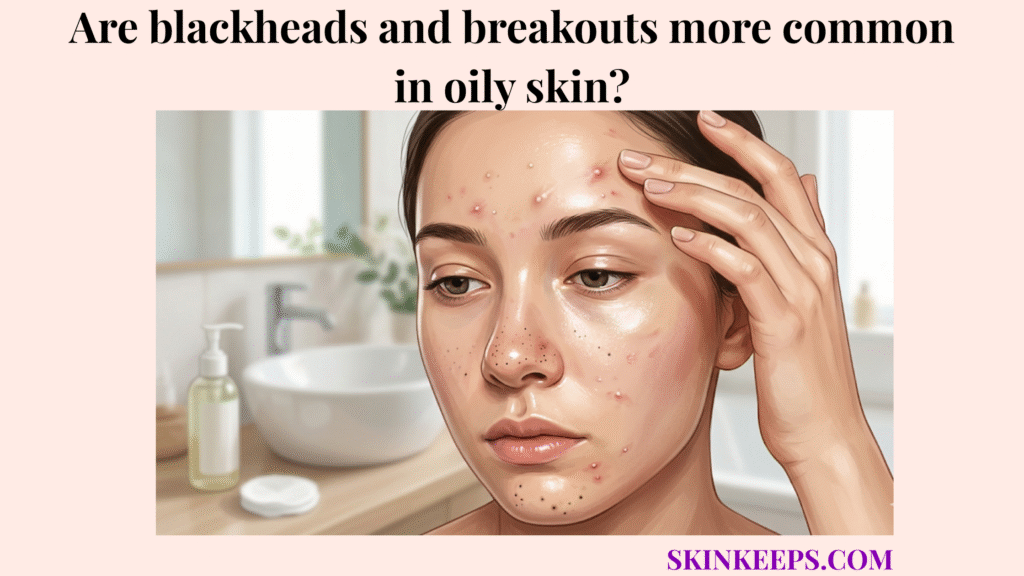
Yes, blackheads and breakouts are more common in oily skin because excess sebum makes follicles more likely to trap dead skin cells and form comedones. This congestion pattern does not mean the face is dirty; it means oil and keratin are getting retained inside the follicular canal.
This guideline explains how oily skin creates clogged pores, why blackheads darken through oxidation, how a blocked pore can shift into an inflamed breakout, and why squeezing or harsh scrubbing can worsen tissue damage. It also explains which ingredient categories can reduce oil-driven congestion without turning the routine into aggressive barrier stripping.
Why are blackheads and breakouts more common in oily skin?
Blackheads and breakouts are more common in oily skin because excess sebum increases follicular retention, allowing dead cells and oil to collect inside the pore. This follicular retention makes dead cells more likely to stay inside the pore instead of shedding cleanly. The retained oil-and-cell mixture can form a comedone that later becomes a blackhead or inflamed breakout. Blackheads and breakouts are more common in oily skin because excess sebum increases follicular retention, illustrating why this skin profile requires consistent congestion management.
Oily or seborrheic skin is associated with sebum production above 1.5 mg/10 cm² every 3 hours. This higher output increases the amount of lipid material entering the follicular canal. The extra lipid material helps explain why oily skin more often shows recurring congestion rather than isolated clogged pores. [PMC]
How excess sebum increases the chance of clogged pores
Excess sebum increases the chance of clogged pores by mixing with shed keratinocytes inside the follicular canal. This mixture can become thicker than normal surface debris. The thicker mixture is more likely to remain inside the pore and begin a comedone.
Why oily skin creates a stronger comedone-forming environment
Oily skin creates a stronger comedone-forming environment because sebum retention gives dead cells more opportunity to collect inside follicles. This environment turns normal cellular shedding into a repeatable risk for blockage. The repeated blockage explains why congestion management is a daily priority for this skin type.
How does oily skin form comedones in the first place?
Oily skin forms comedones when excess sebum and retained keratinocytes collect inside the follicular canal and create a physical blockage. This collection creates a small blockage before the skin shows a visible bump. The early blockage is called a microcomedone because it starts beneath the visible surface.
Acne pathophysiology involves excess sebum production, follicular hyperkeratinization, C. acnes, and inflammation. This four-part process explains why oil-driven clogging can progress beyond simple surface congestion. The comedone stage is especially important because oily skin sebum production supplies the lipid environment that supports follicular blockage. [PMC]
How excess sebum mixes with dead skin cells inside the follicle
Excess sebum mixes with dead skin cells inside the follicle because sebaceous glands release oil into the same canal where follicular cells shed. This anatomical overlap means oil and shedding cells inevitably meet before exiting the pore. When they combine too thickly, they form the initial plug of a comedone.
Why microcomedones form before blackheads and visible pimples
Microcomedones form before blackheads and visible pimples because the first stage of congestion begins as a small invisible plug. This invisible plug can remain hidden or eventually grow into a larger structure. Not every microcomedone becomes a visible lesion, but every visible breakout begins with this early stage.
| Step | What Happens | Why It Matters |
|---|---|---|
| Higher sebum output | More oil enters the follicle | Clogging potential rises |
| Dead-cell retention | Shed cells do not exit cleanly | Blockage begins inside the pore |
| Microcomedone formation | Early invisible clog develops | First stage of comedone formation |
| Ongoing congestion | Plug enlarges or persists | It can become a blackhead, whitehead, or breakout |
How does oily skin form visible blackheads?
Oily skin forms visible blackheads when a comedone remains open at the surface and trapped material darkens through oxidation. This open comedone exposes trapped sebum, keratin, and pigment-containing material to air. The exposed material darkens through oxidation and appears as a black or brown pore plug.
A blackhead is not surface dirt. This distinction matters because washing the top of the skin cannot remove a plug lodged inside the follicular canal. The same follicular depth explains why oily skin enlarged pores often appear together with blackheads in sebum-prone zones.
How an open comedone develops in oily skin
An open comedone develops in oily skin when a follicular plug reaches the surface while the pore opening remains exposed to air. This exposed surface allows the contents of the plug to interact directly with oxygen. The interaction fundamentally changes the appearance of the comedone without requiring it to become inflamed.
Why blackheads turn dark without being dirt
Blackheads turn dark without being dirt because exposed follicular material oxidizes after contact with air. This chemical darkening affects the melanin and lipids trapped within the plug. Recognizing this oxidation prevents the harmful assumption that blackheads are caused by poor hygiene.
Why surface scrubbing does not remove a true blackhead
Surface scrubbing does not remove a true blackhead because the plug sits inside the follicular canal, not only on top of the skin. This deep placement means abrasive scrubs only irritate the surface without clearing the blockage. The resulting irritation often creates redness without solving the underlying congestion.
| Feature | Blackhead | Surface Dirt |
|---|---|---|
| Origin | Inside the follicle | On top of the skin |
| Color source | Oxidized follicular material | External debris |
| Removal logic | Needs congestion-clearing strategy | Washes off more easily |
| Meaning | Sign of follicular congestion | Not a comedone |
How does oily skin turn clogged pores into inflammatory breakouts?
Oily skin can turn clogged pores into inflammatory breakouts when a blocked follicle creates conditions that support C. acnes activity and localized inflammation. This blocked follicle holds sebum, keratinized cells, and microbial activity in a confined space. The confined space can support localized inflammation and create redness, swelling, or tenderness.
C. acnes contributes to breakout formation inside clogged follicles. This bacterium naturally lives on the skin, but a blocked, lipid-rich follicle can increase its inflammatory relevance. The result is a lesion that moves beyond a simple comedone into a red bump, pustule, or tender breakout.
How blocked oily pores create a stronger inflammatory environment
Blocked oily pores create a stronger inflammatory environment because trapped sebum and keratin increase pressure and irritation inside the follicle. This internal irritation signals the surrounding immune cells. The immune cells respond to the stress, leading to the swelling typical of a pimple.
How C. acnes contributes to breakout formation in clogged follicles
C. acnes contributes to breakout formation in clogged follicles by interacting with sebum-rich, low-oxygen conditions inside the blocked pore. This interaction produces byproducts that further aggravate the follicular wall. The added aggravation transitions the clogged pore into an active inflammatory breakout.
Why inflamed lesions look red, swollen, or tender
Inflamed lesions look red, swollen, or tender because local immune activity increases blood flow and inflammatory signaling around the congested follicle. This increased blood flow causes visible redness, while the tissue swelling causes tenderness. These physical changes indicate that the skin is actively managing localized inflammation.
| Feature | Blackhead | Inflammatory Breakout |
|---|---|---|
| Follicle state | Open comedone | Inflamed clogged follicle |
| Main visible sign | Dark pore plug | Red bump, pustule, or tender lesion |
| Oxygen exposure | More open to air | More blocked or inflamed environment |
| Main issue | Congestion | Inflammation plus congestion |
What mistakes make blackheads and breakouts worse in oily skin?
Mistakes make blackheads and breakouts worse in oily skin when squeezing, scrubbing, or aggressive cleansing increases irritation and tissue damage. This follicle damage can increase redness, swelling, and post-breakout marks. The damage risk explains why squeezing an inflamed lesion is more dangerous than managing congestion gradually.
Aggressive cleansing also fails because it treats surface oil while ignoring deeper follicular plugs. This surface-focused mistake can leave the skin tight and irritated while clogged pores remain. The same mistake is explained more fully in over-washing oily skin when repeated cleansing creates discomfort without solving congestion.
Why squeezing can worsen inflammation and lesion damage
Squeezing can worsen inflammation and lesion damage by applying pressure that may rupture the follicular wall and injure surrounding tissue. This rupture spills inflammatory contents into the nearby dermis. The resulting tissue trauma prolongs redness and raises the risk of post-inflammatory marks.
Why harsh scrubs can irritate breakout-prone oily skin
Harsh scrubs can irritate breakout-prone oily skin by increasing surface friction without removing deep follicular plugs. This friction aggressively stresses the stratum corneum. The added barrier stress can leave the skin red and inflamed while the blackheads remain untouched.
Why aggressive cleansing does not solve oily congestion
Aggressive cleansing does not solve oily congestion because surface oil removal does not dissolve plugs already lodged inside follicles. This approach merely strips the external lipid film. Stripping the surface fails to address the retained keratinocytes that form the actual comedone.
| Mistake | What It Causes | Likely Result |
|---|---|---|
| Squeezing inflamed lesions | Follicle trauma and more inflammation | Worse swelling, longer healing, higher mark risk |
| Harsh physical scrubs | Surface irritation | More redness and barrier stress |
| Over-cleansing | Barrier disruption | Oily yet irritated skin |
| Picking blackheads repeatedly | Local trauma | Persistent marks and more visible congestion |
Which ingredients help reduce blackheads and breakouts in oily skin?
Ingredients help reduce blackheads and breakouts in oily skin when they target follicular congestion, abnormal shedding, and inflammatory lesion activity without damaging the barrier. Ingredients reduce blackheads and breakouts best when they match the lesion type. This matching matters because blackheads are mainly congestion, while red lesions involve congestion plus inflammation. The ingredient choice should therefore target the visible problem rather than treating every bump the same way.
AAD acne guidance includes benzoyl peroxide, topical retinoids, salicylic acid, azelaic acid, and other therapies among acne-management options. This guidance supports using targeted actives instead of squeezing or scrubbing lesions. For oily-skin readers, oily skin active ingredients can explain how BHA, retinoids, and oil-control categories fit different congestion patterns. [American Academy of Dermatology]
How salicylic acid helps reduce blackheads in oily skin
Salicylic acid helps reduce blackheads in oily skin because it is a lipophilic beta-hydroxy acid that can work inside sebum-rich follicular openings. Salicylic acid is used in different strengths and forms for acne, and AAD describes it as an ingredient that opens clogged pores and exfoliates skin. It is commonly found as a 2% leave-on treatment, but overuse can irritate the barrier, so it should be introduced based on tolerance. [American Academy of Dermatology]
How retinoids help prevent recurring clogged pores
Retinoids help prevent recurring clogged pores by supporting more regular follicular cell turnover. Retinoids normalize abnormal desquamation in acne by increasing follicular epithelial turnover and shedding corneocytes, but irritation can limit tolerance. Careful, gradual introduction helps prevent this irritation while still supporting recurrent comedone prevention. [PMC]
How benzoyl peroxide helps reduce inflammatory breakouts
Benzoyl peroxide helps reduce inflammatory breakouts by reducing acne-related bacterial burden and supporting inflamed-lesion control. One comparative trial found 2.5% benzoyl peroxide equivalent to 5% and 10% for reducing inflammatory lesions, which supports starting lower when irritation risk matters. This selective use helps dry out active pustules without unnecessarily inflaming the entire face. [PubMed]
Why non-comedogenic support products matter in oily skin
Non-comedogenic support products matter in oily skin because hydration and sunscreen are still needed without adding unnecessary pore-clogging load. This support ensures the stratum corneum remains comfortable during active ingredient use. Exploring oily skin product formulations helps readers select textures that protect the barrier without worsening congestion.
| Ingredient | Main Target | Main Role |
|---|---|---|
| Salicylic acid / BHA | Oil and clogged pores | Helps clear comedonal buildup |
| Retinoids | Dead-cell retention and recurrent clogging | Help normalize follicular turnover |
| Benzoyl peroxide | Inflammatory acne lesions | Helps reduce acne-related bacterial burden |
| Non-comedogenic moisturizers | Barrier support | Hydrate without heavy congestion risk |
| Non-comedogenic sunscreens | Daily protection | Protect skin without unnecessary pore-clogging load |
How should a daily routine reduce blackheads and breakouts in oily skin?
A daily routine should reduce blackheads and breakouts in oily skin by combining gentle cleansing, targeted congestion control, and avoidance of manual extraction. A daily routine reduces blackheads and breakouts by preventing new follicular buildup. This prevention depends on gentle cleansing, selective active use, and non-comedogenic support products. The routine should reduce new clogs without making the skin tight, flaky, or irritated.
Consistency matters more than aggressive clearing because oily skin continues producing sebum every day. This ongoing sebum flow needs regular maintenance rather than repeated squeezing or harsh scrubbing. A fuller step-by-step routine can follow the same principle inside oily skin care tips when the reader needs cleansing, moisturizer, sunscreen, and active-use guidance in one place.
What a morning routine should include for oily, congestion-prone skin
A morning routine for oily, congestion-prone skin should include gentle cleansing, lightweight hydration, and non-comedogenic sunscreen.
Morning Checklist
What an evening routine should include to reduce blackheads and breakouts
An evening routine should reduce blackheads and breakouts by removing daily buildup and applying one targeted active when appropriate.
Evening Checklist
Why consistency matters more than aggressive clearing
Consistency matters more than aggressive clearing because oil-driven congestion forms repeatedly and needs steady, barrier-safe management. This steady approach prevents the barrier damage caused by impatience. Gentle, continuous maintenance ultimately reduces recurrence risk without inducing redness and scaling.
Daily Prevention Checklist
FAQs
Are blackheads and breakouts more common in oily skin?
Yes, blackheads and breakouts are more common in oily skin because excess sebum increases the chance that dead skin cells will stay trapped inside follicles. This trapped mixture can become a comedone, blackhead, whitehead, or inflamed breakout.
Are blackheads just dirt in the pores?
No, blackheads are not dirt. Blackheads are open comedones that turn dark when trapped sebum, keratin, and pigment-containing material oxidize after exposure to air.
Why does oily skin clog pores more easily?
Oily skin clogs pores more easily because more sebum enters the follicular canal. This extra oil can mix with retained keratinocytes and create a plug that blocks the pore.
Can blackheads turn into pimples?
A blackhead does not always turn into a pimple, but clogged follicles can become inflamed under the right conditions. When inflammation increases, the lesion may become red, swollen, tender, or pus-filled.
Should I squeeze blackheads on oily skin?
Squeezing blackheads is risky because pressure can injure the follicle and surrounding skin. Repeated squeezing can prolong redness, increase irritation, and raise the risk of marks.
Does salicylic acid help blackheads?
Salicylic acid can help blackheads because it is a lipophilic beta-hydroxy acid that works well for oily, clogged pores. It should be introduced gradually because overuse can irritate the barrier.
Does benzoyl peroxide help oily-skin breakouts?
Benzoyl peroxide can help inflammatory oily-skin breakouts by reducing acne-related bacterial burden. It can also dry or irritate the skin, so lower concentrations and careful use are often better starting points.
Can oily skin still use moisturizer and sunscreen?
Yes, oily skin still needs moisturizer and sunscreen. The best support products are lightweight and non-comedogenic so they protect barrier comfort without adding unnecessary congestion risk.
Conclusion
Blackheads and breakouts are more common in oily skin because excess sebum increases follicular congestion. Oily skin is more prone to blackheads and breakouts when sebum, dead cells, and follicular blockage repeat over time. The goal is to reduce new congestion without squeezing, scrubbing, or stripping the barrier.
Clearer oily skin comes from steady congestion control, not forceful extraction. At SkinKeeps, we explain the clinical mechanics behind these common issues so readers can select reliable, barrier-safe routines.