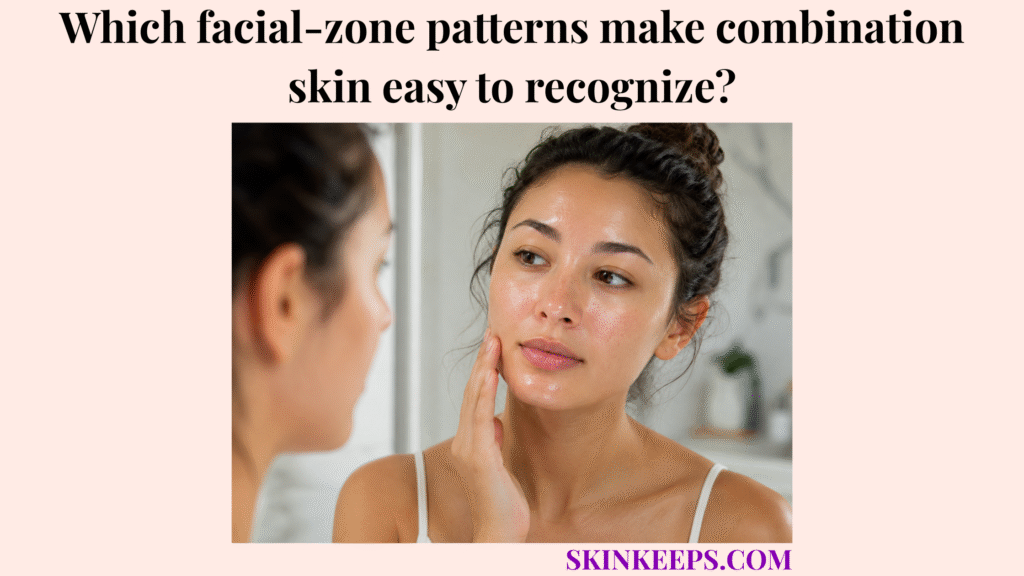
Combination skin is easy to recognize when the T-zone looks oily, shiny, congested, or more pore-visible while the cheeks, jawline, or outer face feel normal, dry, tight, flaky, or less oily. The clearest sign is not oiliness alone; it is the repeated contrast between oil-prone areas and normal, dry, or balanced areas on the same face.
This article moves from facial-zone meaning to T-zone oiliness, cheek dryness, chin and jawline variation, pore and shine clues, product behavior, confusion with other skin types, tracking, and professional evaluation.
What Does a Facial-Zone Pattern Mean in Combination Skin?
A facial-zone pattern in combination skin means that one area of the face behaves differently from another area at the same time. Because combination skin is defined by mixed zone behavior, facial-zone observation is more useful than judging the whole face from one shiny or dry area.
This contrast matters because the same person can have a center face that becomes shiny while the cheeks or outer face feel normal or tight. Since one unusual day can distort the pattern, repeated observation gives a clearer clue than a single mirror check.
Why Is Combination Skin Recognized by Uneven Zone Behavior?
Combination skin is recognized by uneven zone behavior because oiliness, dryness, shine, tightness, and product feel do not appear evenly across the whole face.
Why Do the T-Zone and Cheeks Often Behave Differently?
The T-zone and cheeks often behave differently because the forehead, nose, and chin may show more visible oil while the cheeks may stay normal, dry, or tight.
| Facial zone | Common combination-skin clue |
|---|---|
| Forehead | Shine, oiliness, or occasional congestion. |
| Nose | Most visible oil, pores, blackheads, or shine. |
| Chin | Oiliness, clogged pores, or breakout tendency. |
| Cheeks | Normal, dry, tight, flaky, or less oily. |
| Jawline | Can be normal, dry, or breakout-prone. |
| Outer face | Often less oily than the center of the face. |
| Around mouth | May feel dry, tight, or easily irritated. |
| Between brows | May become oily or flaky depending on routine and season. |
Facial-Zone Contrast Map
This visual shows how combination skin recognition starts by comparing center-face oil with cheek and outer-face comfort.
Figure 1. Combination skin is recognized by comparing facial zones instead of judging the whole face from one oily or dry area.
Why Is the T-Zone Important for Recognizing Combination Skin?
The T-zone is important for recognizing combination skin because the forehead, nose, and chin often show oil, shine, pore visibility, or congestion before the cheeks do. This T-zone clue is most useful when it is compared with the jawline, cheeks, and outer face rather than treated as proof by itself.
T-Zone Clues to Compare With Cheeks
- Forehead becomes shiny before the cheeks.
- Nose looks oily or pore-visible.
- Chin feels oilier than the jawline.
- Makeup separates first on the nose or forehead.
- Sunscreen feels heavier in the center of the face.
- Blotting paper shows more oil in the T-zone.
- The cheeks may still feel tight or dry.
T-Zone Versus Cheek Pattern
This visual compares the most common combination-skin pattern: a shinier T-zone with cheeks that stay normal, dry, tight, or flaky.
Figure 2. The T-zone clue becomes stronger when the cheeks or outer face do not show the same oil pattern.
How Do Cheeks Behave in Combination Skin?
Cheeks in combination skin may feel normal, dry, tight, flaky, or less oily than the T-zone. This cheek contrast helps separate combination skin from fully oily skin because the cheeks do not usually match the center-face shine.
| Feature | T-zone pattern | Cheek pattern |
|---|---|---|
| Shine | Often more visible. | Often lower or absent. |
| Oil feel | More noticeable. | Less oily or dry. |
| Pores | More visible around nose and center. | Often less visible. |
| Flaking | Less common unless over-cleansed. | More common in dry zones. |
| Tightness | May happen after harsh cleansing. | More likely if cheeks are dry. |
| Makeup wear | Separates or slips faster. | May cling to dry patches. |
| Moisturizer feel | May feel heavy quickly. | May feel necessary for comfort. |
Can the Chin and Jawline Show Mixed Combination-Skin Patterns?
Yes, the chin and jawline can show mixed combination-skin patterns because the lower face may be oily, dry, normal, or breakout-prone depending on the person. This lower-face variation can complicate recognition, so the chin and jawline should be observed separately rather than merged into one oily or dry label.
| Area | Possible combination-skin pattern |
|---|---|
| Chin | Oily, congested, or breakout-prone. |
| Around mouth | Dry, tight, or sensitive-feeling. |
| Jawline | Normal, dry, or acne-prone. |
| Lower cheeks | May be drier than the center face. |
| Nose-to-chin line | May show oil while nearby skin feels dry. |
| Chin after moisturizer | May feel greasy faster than cheeks. |
What Pore Patterns Make Combination Skin Easier to Recognize?
Pore patterns make combination skin easier to recognize when pores look more visible in the T-zone than on the cheeks or outer face. Visible pores alone do not prove combination skin, but they support the pattern when they match the same zones that become shinier or oilier.
Pore Clues That Support the Zone Pattern
- Nose pores are more visible than cheek pores.
- Blackheads appear mainly on the nose or chin.
- Forehead looks shinier than the outer face.
- Cheeks feel dry but nose looks oily.
- Pore-minimizing products dry the cheeks but help the T-zone.
- Heavy moisturizer feels fine on cheeks but greasy on the nose.
How Does Shine Distribution Reveal Combination Skin?
Shine distribution reveals combination skin when the center of the face becomes shiny while the cheeks or outer face stay matte, dry, or comfortable. Because shine and pores often appear together in oil-prone zones, the pattern becomes more meaningful when both repeat in the same areas.
| Shine location | What it may suggest |
|---|---|
| Nose only | Mild combination or localized oiliness. |
| Nose and forehead | Classic T-zone oil pattern. |
| Nose, forehead, and chin | Stronger T-zone pattern. |
| T-zone shiny but cheeks tight | Combination skin with dry cheeks. |
| Full face shiny | More likely oily skin than combination skin. |
| No shine but tight/flaky areas | More likely dry skin or dehydrated skin. |
| Shine plus flaking | Combination skin, dehydration, or over-cleansing may overlap. |
How Do Dry Patches Fit Into Combination Skin?
Dry patches fit into combination skin when they appear on the cheeks, around the mouth, jawline, or outer face while the T-zone still becomes oily or shiny. Dry patches alone may point toward dry skin, but dry patches plus repeated T-zone oil create a mixed-zone clue.
Dry-Patch Clues in Combination Skin
- Cheeks feel tight after cleansing.
- Flakes appear around the mouth or lower cheeks.
- Foundation clings to cheek texture.
- Moisturizer absorbs quickly on cheeks but feels heavy on the nose.
- Exfoliation irritates dry zones before helping oily zones.
- The face feels oily and dry at the same time.
Can Combination Skin Feel Oily and Tight at the Same Time?
Yes, combination skin can feel oily and tight at the same time when the T-zone produces shine while the cheeks or outer face feel dry or stripped. This mixed feeling is useful only when it repeats, because harsh cleansing or dehydration can also make skin feel oily and tight temporarily.
| Pattern | What it may suggest |
|---|---|
| Oily nose, tight cheeks | Classic combination pattern. |
| Oily forehead, flaky cheeks | Combination with dry zones. |
| Shiny T-zone after harsh cleanser | Oil may return while barrier feels stripped. |
| Greasy moisturizer on nose, not enough on cheeks | Product mismatch by zone. |
| Tight full face plus shine | Dehydration or over-cleansing may be involved. |
| Burning or rash with tightness | Irritation or another condition may need evaluation. |
How Does Product Behavior Reveal Combination Skin?
Product behavior reveals combination skin when the same cleanser, moisturizer, sunscreen, or makeup works differently across the T-zone and cheeks. Products expose mixed needs because one zone may feel greasy while another feels under-supported.
| Product behavior | Combination-skin clue |
|---|---|
| Cleanser leaves cheeks tight but T-zone oily later | Different zone needs. |
| Moisturizer feels greasy on nose but needed on cheeks | Mixed oil and dryness. |
| Sunscreen shines mostly on forehead or nose | T-zone oil pattern. |
| Makeup separates on nose | Oil-prone center face. |
| Foundation clings to cheeks | Dry or flaky outer zones. |
| Mattifying products dry the cheeks | Oil-control product may be too broad. |
| Rich creams clog or shine in T-zone | Product may suit dry zones only. |
| Lightweight lotion helps T-zone but not cheeks | Dry zones may need more support. |
Recognition Decision Loop
This visual shows the safer recognition logic: observe zones, compare product behavior, repeat across days, and stop skin-type guessing when warning signs appear.
Figure 3. Recognition is more reliable when the same zone pattern repeats and warning signs are separated from skin-type clues.
How Is Combination Skin Different From Oily Skin?
Combination skin is different from oily skin because combination skin usually shows oil in some zones while oily skin shows shine more broadly across the face. That difference matters because combination skin is defined by contrast, while oily skin usually has a more even oil pattern.
| Feature | Combination skin | Oily skin |
|---|---|---|
| Shine | Mainly T-zone. | Often widespread. |
| Cheeks | Normal, dry, or less oily. | Often oily too. |
| Pores | More visible in center face. | More visible across wider areas. |
| Moisturizer needs | May differ by zone. | Usually lighter products all over. |
| Makeup wear | Slips in T-zone, clings in dry zones. | Slips more evenly. |
| Cleansing response | Some zones feel tight, others oily. | Oil returns broadly. |
How Is Combination Skin Different From Dry Skin?
Combination skin is different from dry skin because combination skin still has oil-prone zones even when the cheeks or outer face feel dry. Combination skin can include dry zones, but dry skin usually feels dry across most facial areas rather than only the cheeks or outer face.
| Feature | Combination skin | Dry skin |
|---|---|---|
| Oil pattern | T-zone oil appears. | Oil is low across most areas. |
| Cheeks | May be dry. | Usually dry or tight. |
| Nose | Often shiny or pore-visible. | May be dry or normal. |
| Chin | May be oily or congested. | Often dry or normal. |
| Product feel | Different by zone. | Richer products may feel useful all over. |
| Makeup behavior | Separates in T-zone, clings on cheeks. | Clings or flakes more widely. |
Can Combination Skin Be Confused With Sensitive or Dehydrated Skin?
Yes, combination skin can be confused with sensitive or dehydrated skin because oil, tightness, stinging, flaking, and product discomfort can overlap. Combination skin can overlap with sensitive skin when oily zones appear alongside burning, stinging, tightness, or product discomfort.
| Pattern | Possible explanation |
|---|---|
| Oily T-zone plus burning cheeks | Combination skin with sensitivity. |
| Shine plus tightness after cleansing | Over-cleansing or dehydration may contribute. |
| Flaking near nose and brows | Dryness, irritation, or another condition may be involved. |
| Redness or darker irritation with rash | Not just combination skin. |
| Oil changes after new products | Product reaction may be distorting the pattern. |
| Seasonal dry cheeks only | Combination pattern may shift by weather. |
How Do Seasonal Changes Affect Facial-Zone Patterns?
Seasonal changes affect facial-zone patterns by making combination skin look oilier in heat or humidity and drier in cold, wind, or low humidity. The core clue is not one season, but the repeated difference between zones even as conditions shift.
| Season or condition | Possible combination-skin change |
|---|---|
| Hot weather | T-zone shine increases. |
| Humidity | Oily areas feel heavier. |
| Cold weather | Cheeks become tighter or flaky. |
| Wind | Outer face feels dry or irritated. |
| Indoor heating | Dry zones become more noticeable. |
| Sweat | T-zone congestion may increase. |
| Seasonal product changes | Wrong products may exaggerate mixed patterns. |
How Can Someone Check Their Facial-Zone Pattern at Home?
Someone can check a facial-zone pattern at home by observing which areas become oily, tight, shiny, dry, or flaky after gentle cleansing and across repeated days. This observation is most useful when the skin is calm and not distorted by harsh scrubs, strong actives, or an active flare.
At-Home Facial-Zone Check
- Wash with a gentle cleanser.
- Avoid applying products immediately if the skin can comfortably tolerate a short observation period.
- Notice which areas become shiny first.
- Notice whether cheeks feel tight or comfortable.
- Check whether the nose looks more oily than the cheeks.
- Observe forehead and chin separately.
- Watch how moisturizer behaves in each zone.
- Track whether the pattern repeats across several days.
- Avoid judging skin type during an active flare.
- Avoid judging after harsh scrubs or strong actives.
What Mistakes Make Combination Skin Harder to Recognize?
Combination skin becomes harder to recognize when one temporary symptom is treated as a permanent pattern. Recognizing different skin types becomes harder when one temporary symptom is treated as a permanent skin pattern.
| Mistake | Why it causes confusion |
|---|---|
| Judging skin after one day | Skin can shift temporarily. |
| Using harsh cleanser before checking | Creates artificial tightness. |
| Assuming any shine means oily skin | Combination skin can shine only in zones. |
| Assuming dry cheeks mean dry skin | T-zone oil may still indicate combination skin. |
| Ignoring product behavior | Products reveal zone differences. |
| Treating the whole face the same | May hide mixed needs. |
| Judging during a flare | Irritation can distort normal patterns. |
| Confusing dehydration with skin type | Oil and tightness can happen together. |
How Should Facial-Zone Patterns Be Tracked?
Facial-zone patterns should be tracked by recording oil, shine, dryness, tightness, flaking, pore visibility, and product behavior in each major face zone. Repeated notes are more useful than one mirror check because they show whether the same pattern appears after similar conditions.
Facial-Zone Tracking Worksheet
- Date and weather conditions.
- Forehead oil level.
- Nose oil level.
- Chin oil level.
- Cheek dryness or tightness.
- Jawline condition.
- Flaking areas.
- Pore visibility by zone.
- Makeup or sunscreen behavior.
- Cleanser after-feel by zone.
- Moisturizer comfort by zone.
- Breakout locations.
- Products used recently.
- Whether the pattern repeats.
- Photos of visible shine or dry patches if helpful.
When Should Facial-Zone Changes Be Professionally Evaluated?
Facial-zone changes should be professionally evaluated when they include severe, persistent, painful, swollen, oozing, bleeding, rash-like, eye-area, or suddenly inflamed symptoms. Facial-zone patterns can guide skin-type recognition, but severe, spreading, painful, swollen, oozing, bleeding, or rash-like changes need professional evaluation.
Professional Evaluation Warning Signs
- Rash, swelling, oozing, crusting, or bleeding appears.
- Burning, pain, or itching is severe or persistent.
- Flaking is thick, spreading, or recurring.
- Redness or darker irritation does not settle.
- Breakouts are painful, cyst-like, or scarring.
- Skin reacts to many basic products.
- Eye or eyelid irritation occurs.
- One facial zone becomes suddenly inflamed.
- Symptoms continue despite gentle care.
- Eczema, dermatitis, rosacea, infection, psoriasis, or another condition may be involved.
Urgent Safety Note
Rapid swelling, severe pain, pus, fever with skin symptoms, rapidly spreading warmth, breathing difficulty, throat tightness, faintness, or rapid facial, lip, tongue, or throat swelling requires urgent medical care.
What Should You Remember About Facial-Zone Patterns and Combination Skin?
Remember that combination skin is recognized by repeated differences between facial zones, not by one temporary oily or dry area.
What Should You Remember?
- Combination skin is recognized by different facial zones behaving differently.
- The T-zone is often oilier, shinier, more pore-visible, or more congestion-prone.
- Cheeks and outer facial areas may feel normal, dry, tight, or flaky.
- The chin and jawline can be oily, dry, normal, or breakout-prone.
- Product behavior often reveals combination skin.
- Makeup may separate in oily zones and cling to dry zones.
- Combination skin is different from fully oily skin because the cheeks are often less oily.
- Combination skin is different from dry skin because the T-zone still shows oil or shine.
- Sensitivity, dehydration, harsh cleansing, and seasonal shifts can confuse the pattern.
- A repeated zone pattern matters more than one temporary day of shine or dryness.
- Severe, persistent, painful, swollen, oozing, bleeding, or rash-like changes need professional evaluation.
Frequently Asked Questions
What Is the Clearest Facial-Zone Pattern for Combination Skin?
The clearest pattern is an oily or shiny T-zone with cheeks, jawline, or outer facial areas that feel normal, dry, tight, flaky, or less oily.
Does an Oily Nose Mean Combination Skin?
An oily nose alone does not prove combination skin. It becomes more meaningful when the nose is repeatedly oily while the cheeks or outer face stay dry, normal, or less oily.
Can Combination Skin Have Dry Cheeks?
Yes. Dry cheeks are common in combination skin when they appear alongside a shinier or oilier forehead, nose, or chin.
Can Combination Skin Feel Tight and Oily?
Yes. Combination skin can feel oily in the T-zone and tight on the cheeks. It can also feel oily and tight after harsh cleansing or dehydration.
How Is Combination Skin Different From Oily Skin?
Combination skin usually has oil mainly in the T-zone, while oily skin tends to show shine across more of the face, including the cheeks.
When Should Facial-Zone Changes Be Checked Professionally?
Facial-zone changes should be checked if they include severe burning, pain, swelling, rash, oozing, bleeding, eye-area irritation, painful breakouts, or symptoms that persist despite gentle care.
Conclusion
Combination skin is easiest to recognize when different facial zones show a repeated contrast between oiliness and dryness or balance. The T-zone is often the most visible clue because the forehead, nose, and chin may become shiny, oily, pore-visible, or congested before the cheeks do.
That clue becomes stronger when the cheeks, jawline, or outer face stay normal, dry, tight, flaky, or less oily. Because temporary weather, harsh cleansing, dehydration, sensitivity, and product changes can distort the pattern, combination skin should be judged by repeated zone behavior rather than one day of shine or dryness.
If the pattern includes rash, pain, swelling, oozing, bleeding, eye irritation, or persistent symptoms, professional evaluation is safer than skin-type guessing. The best recognition rule is simple: combination skin is not just oily or dry; it is a repeated pattern of different zones behaving differently on the same face.
Sources & Evidence
Cleveland Clinic — Understanding Skin Types
Supports combination skin as mixed facial-zone behavior, often involving a different T-zone and cheek pattern.
[Cleveland Clinic]DermNet — Sebum
Supports sebum and sebaceous-gland distribution context, including larger and more numerous sebaceous glands in areas such as the forehead and chin.
[DermNet]American Academy of Dermatology — Dry Skin Signs and Symptoms
Supports dry skin signs such as dryness, rough texture, flakes, and itch.
[AAD]American Academy of Dermatology — Oily Skin Care
Supports oily skin shine and oil-control context without turning this recognition guide into an oily-skin routine.
[AAD]DermNet — Acne
Supports acne as a follicle and sebaceous-gland related condition, helping avoid overdiagnosing breakouts from facial zones alone.
[DermNet]Cleveland Clinic — Contact Dermatitis
Supports professional evaluation when rash, swelling, oozing, persistent irritation, or contact-reaction patterns appear.
[Cleveland Clinic]Disclaimer: This article provides general educational information about recognizing facial-zone patterns and does not diagnose combination skin, acne, dermatitis, eczema, rosacea, psoriasis, infection, allergy, or another skin condition. Facial-zone observation can help with skin-type recognition, but severe, persistent, spreading, painful, swollen, oozing, crusting, bleeding, eye-area, or rash-like symptoms should be professionally evaluated. Breathing difficulty, throat tightness, faintness, fever with rapidly worsening skin symptoms, pus, severe pain, or rapid facial, lip, tongue, or throat swelling requires urgent medical care.