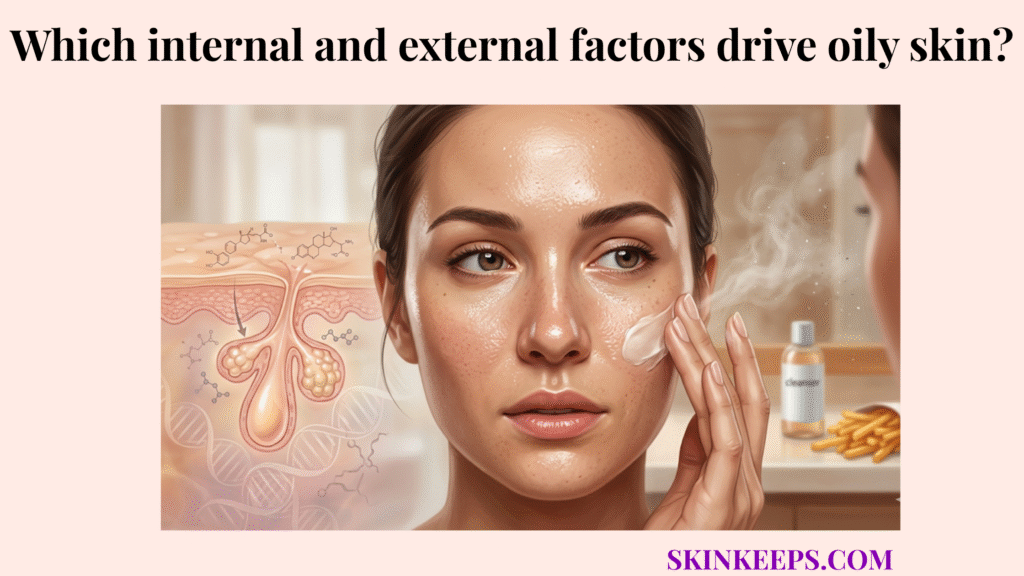
Oily skin is driven by internal factors such as genetics and hormones, while external factors such as heat, humidity, stress, diet patterns, and harsh skincare can amplify how oily the skin looks or feels. This distinction matters because some factors set the sebaceous baseline, while others only make existing oiliness more visible.
This guideline explains how genetic predisposition, androgen sensitivity, DHT, IGF-1 signaling, stress, climate, and skincare habits influence oily skin. It also shows how to manage daily amplifiers without confusing trigger control with permanent changes to sebaceous biology. The parent guide on oily skin gives the broader definition, while this page focuses specifically on the causes and amplifiers behind oiliness.
Which internal factors set the baseline for oily skin?
The internal factors that set the baseline for oily skin include genetic predisposition, sebaceous gland density, and localized sensitivity to normal circulating hormones. This baseline determines how easily the skin produces visible oil before climate, stress, or skincare habits modify the appearance. The internal baseline explains why two people can follow the same routine but show different oil levels.
Sebaceous baseline is important because oily skin begins with gland behavior, not surface dirt. This gland behavior controls how much sebum reaches the stratum corneum throughout the day. The result is a skin type that may look shiny even when hygiene is consistent. Understanding oily skin sebum production clarifies the exact mechanism behind this baseline oil output.
How genetics influence sebaceous gland activity
Genetics influence sebaceous gland activity by shaping the inherited tendency for sebaceous glands to produce more or less visible oil. This inherited tendency affects how strongly sebaceous glands contribute to baseline shine. The baseline shine then becomes more noticeable when external amplifiers such as heat or humidity appear. Recognizing this innate biological framework connects directly to oily skin genetics, helping readers separate genetic oiliness from temporary shine triggers.
How androgen sensitivity helps determine baseline oil production
Androgen sensitivity helps determine baseline oil production because sebaceous glands can respond strongly to normal hormone signals even when systemic hormone levels are not abnormal. This localized receptor sensitivity dictates how much lipid material the sebocytes manufacture. The manufacturing process naturally translates into higher surface oil volumes.
How do hormones increase oily skin?
Hormones increase oily skin primarily through androgens, which interact with sebaceous glands and support the lipid-synthesis pathways that produce sebum. This androgen pathway matters because sebaceous glands are hormone-responsive structures. The response can increase visible oiliness during puberty, cycle shifts, or other androgen-sensitive periods, making oily skin hormones a critical topic for understanding these biological fluctuations.
Type 1 5-alpha reductase activity shows regional differences in isolated sebaceous glands and whole skin. One cited study reported higher activity in facial and scalp sebaceous glands than in non-acne-prone areas, supporting the idea that some regions are more hormonally active. This regional activity helps explain why facial oiliness often concentrates in sebaceous areas. [PubMed]
How androgens stimulate sebum production
Androgens stimulate sebum production by interacting with sebaceous glands and increasing sebocyte activity in oil-prone regions. Type 1 5-alpha reductase activity was reported as 32 ± 6 pmol/min/mg protein in facial sebaceous glands, 35 ± 7 in scalp sebaceous glands, and 6.0 ± 3.0 in comparable material from non-acne-prone areas in the cited study. This regional enzyme activity supports the idea that sebaceous facial zones can be more responsive to androgen-related pathways. The number should be used only in a technical section, not as a self-diagnosis metric. [ScienceDirect]
Why puberty and some menstrual-cycle phases can increase oiliness
Puberty and some menstrual-cycle phases can increase oiliness because hormone fluctuations can temporarily change sebaceous gland activity. Puberty represents a common period of higher androgen activity that stimulates gland enlargement. Cycle changes are possible triggers for pre-period shine, though not guaranteed for every individual.
When hormone-related oily skin may need medical evaluation
Hormone-related oily skin may need medical evaluation when persistent oiliness appears with severe acne, irregular cycles, or excess hair growth. Hormone-related oily skin deserves medical evaluation when it appears with symptoms such as irregular periods, acne, or excess hair growth. These symptoms can appear in PCOS, although they do not prove PCOS by themselves. The correct action is medical assessment, not self-diagnosis. NHS lists irregular periods, excess androgen signs such as excess facial/body hair, and acne/oily skin-type symptoms among PCOS-related presentations. [NHS]
| Hormonal Factor | What It Does | Common Visible Result |
|---|---|---|
| Androgens | Increase sebaceous activity | More oil, shine, and clogged pores |
| Puberty-related hormone shifts | Raise sebum output in many people | New or worsening oiliness |
| Cycle-related hormone shifts | Can change oiliness or breakouts in some people | Pre-period shine or congestion |
| Hyperandrogen-related disorders | Can amplify sebaceous activity | Persistent oiliness, acne, or other hormonal signs |
How do stress and diet influence oily skin?
Stress and diet influence oily skin by acting as lifestyle modifiers that can amplify inflammatory signaling, metabolic signaling, and follicular congestion in some people. These modifiers can make an existing sebaceous baseline more noticeable. The result may appear as more shine, congestion, or breakouts in susceptible people.
IGF-1 is relevant because it has been shown to increase expression of inflammatory biomarkers and sebum-production-related proteins in sebocytes. This pathway connects metabolic signaling with acne-prone sebaceous behavior. The claim supports discussing high-glycemic patterns cautiously as possible modifiers rather than direct universal causes. [PMC]
How stress can worsen oily skin
Stress can worsen oily skin by shifting neuroendocrine and inflammatory signaling in ways that may make oiliness or breakouts more noticeable. This stress signaling utilizes cortisol and neuropeptides that can interact with sebaceous structures. Treating oily skin stress as a modifier rather than a root cause allows for a more realistic management strategy.
How high-glycemic dietary patterns may contribute to oilier, acne-prone skin
High-glycemic dietary patterns may contribute to oilier, acne-prone skin by influencing insulin signaling and IGF-1 signaling in susceptible people. This signaling matters because IGF-1 is implicated in sebocyte activity and acne biology. The relationship should be framed as a modifier, and exploring oily skin diet and breakouts helps clarify why one food does not directly create oily skin.
High-glycemic dietary patterns may contribute to acne-prone oiliness by influencing insulin and IGF-1 signaling in susceptible people. This signaling matters because IGF-1 is implicated in sebocyte activity and acne biology. The relationship should be framed as a modifier, not as proof that one food directly creates oily skin. [PMC]
Why diet and stress are modifiers, not the only cause
Diet and stress are modifiers, not the only cause, because they can amplify an existing genetic or hormonal baseline rather than create oily skin from nothing. This amplification worsens the visible symptoms temporarily. Identifying the baseline versus the amplifier ensures the routine remains balanced and non-punishing.
| Factor | Main Pathway | Likely Effect |
|---|---|---|
| Stress | Neuroendocrine and inflammatory signaling | More visible oiliness or breakouts in some people |
| High-glycemic diet | Insulin/IGF-1-related signaling | Increased acne-prone oiliness in susceptible people |
| Poor sleep or chronic stress load | Stress-system dysregulation | Harder-to-control skin behavior |
| Existing hormonal sensitivity | Amplifies lifestyle effects | Stronger oil response to triggers |
Which external conditions make oily skin look worse?
External conditions such as heat, humidity, and sweat make oily skin look worse by spreading existing surface oil and increasing visible shine without necessarily changing the internal hormonal baseline. This surface spread increases shine across the stratum corneum. The increased shine can make the skin look oilier even when the internal baseline has not changed, underscoring why oily skin climate and humidity factors significantly alter daily appearance.
Controlled forehead-temperature research reported that sebum excretion rate changed on the order of 10% for each 1°C local temperature change. This number should be treated as physiology-measurement data, not as a guaranteed daily rule for every climate. The practical meaning is that heat can make oil output and shine more noticeable. [OUP Academic]
How heat makes oily skin look shinier
Heat makes oily skin look shinier by increasing surface spread and reflectivity of existing sebum. This heat response lowers the viscosity of the oil, allowing it to coat the epidermis more readily. The broader reflective film amplifies the visual intensity of the shine.
How humidity and sweat can spread surface oil
Humidity and sweat can spread surface oil by mixing with sebum and widening the reflective film across the skin surface. This sweat mixing creates a combined fluid layer that covers the face thoroughly. The resulting sheen makes the baseline oiliness look far more severe.
Why climate changes how oily skin appears during the day
Climate changes how oily skin appears during the day because temperature, humidity, and sweat alter how visible surface oil becomes. These midday shine spikes are temporary appearance shifts rather than permanent changes to the skin type. Adapting to the environment requires managing the surface film without over-drying the barrier.
| Factor Type | Example | Main Role |
|---|---|---|
| Internal driver | Genetics | Sets baseline tendency |
| Internal driver | Hormones | Directly influences sebum output |
| Lifestyle modifier | Stress or diet | Can worsen oiliness in some people |
| External amplifier | Heat or humidity | Makes oiliness more visible |
| Routine mistake | Harsh cleansing | Can irritate the barrier and worsen visible oiliness |
What skincare mistakes can make oily skin worse?
Skincare mistakes can make oily skin worse when harsh cleansers, alcohol-heavy toners, or over-washing irritate the barrier and disrupt surface comfort. This barrier irritation can leave the skin tight, red, or uncomfortable while oil still returns later. The result is skin that feels stripped but still looks shiny.
The American Academy of Dermatology advises oily-skin users to avoid harsh or alcohol-based cleansers because irritation can trigger increased oil production. This guidance supports gentle cleansing rather than repeated stripping. The goal is to reduce excess surface oil without destabilizing the barrier. [AAD]
Why over-washing can worsen oily skin
Over-washing can worsen oily skin by causing barrier stress and making the skin feel tight while visible oiliness still returns later. This repeated washing irritates the delicate stratum corneum unnecessarily. The irritation prompts a continuous cycle of discomfort and subsequent oil accumulation.
Why alcohol-heavy or harsh cleansers can backfire
Alcohol-heavy or harsh cleansers can backfire because they remove surface oil aggressively while increasing dryness, tightness, or irritation. This sudden lipid removal shocks the barrier and leaves the acid mantle temporarily vulnerable. The temporary dryness is swiftly followed by the natural recurrence of surface oil.
Why oily skin still needs lightweight hydration
Oily skin still needs lightweight hydration because oiliness and water balance are different barrier needs. Sebum provides a lipid-rich layer, but hydration relies on holding water within the cells. Utilizing a lightweight, non-comedogenic moisturizer ensures the skin remains comfortable without feeling heavy.
| Mistake | What Happens | Likely Result |
|---|---|---|
| Washing too often | Barrier irritation increases | Oiliness may still return |
| Using harsh cleansers | More stripping and irritation | Shinier, less comfortable skin |
| Using alcohol-heavy toners | Surface dryness and stress | Temporary dryness, then visible oil returns |
| Skipping moisturizer entirely | Poor water balance | Oily yet dehydrated skin feel |
How should daily habits reduce oily-skin triggers?
Daily habits should reduce oily-skin triggers by focusing on gentle cleansing, lightweight hydration, non-comedogenic products, and consistent management of heat, stress, and diet patterns. This stability depends on gentle cleansing, lightweight hydration, and product textures that do not clog oil-prone areas. The same stable routine makes it easier to identify whether heat, stress, or diet patterns worsen oiliness.
Consistency works better than aggressive oil removal because oily skin needs regulation, not punishment. This regulation reduces daily extremes without trying to eliminate sebum completely. The result should be steadier oil levels, fewer trigger spikes, and a more comfortable barrier.
What a basic daily routine should include for oily skin
A basic daily routine should include a gentle cleanser, lightweight hydration, and broad-spectrum sunscreen to support the barrier without adding heavy residue. This straightforward approach provides essential care without overwhelming the follicles. Choosing non-comedogenic textures keeps the skin protected and breathable.
Which habits help reduce trigger amplification
Habits that help reduce trigger amplification include tracking heat exposure, stress patterns, and diet patterns that correlate with increased shine or congestion. This pattern tracking empowers the user to anticipate flare-ups calmly. The calm anticipation prevents frantic, overly harsh reactions when the skin misbehaves.
Why consistency works better than aggressive oil removal
Consistency works better than aggressive oil removal because the barrier responds better to stable regulation than repeated stripping. This stable regulation fosters long-term comfort and resilience. Embracing a steady regimen gently normalizes the skin’s daily appearance.
Daily Trigger Management Checklist
FAQs
What are the main internal factors that drive oily skin?
The main internal factors that drive oily skin are genetics, sebaceous gland activity, androgen sensitivity, and hormone shifts. These factors set the baseline for how much sebum the skin tends to produce.
Do hormones cause oily skin?
Hormones can increase oily skin because androgens influence sebaceous gland activity. Puberty, some cycle phases, and hyperandrogen-related conditions can increase visible oiliness in susceptible people.
Can stress make oily skin worse?
Stress can make oily skin worse in some people by shifting neuroendocrine and inflammatory signaling. Stress should be treated as a modifier, not the only cause of oily skin.
Does diet cause oily skin?
Diet does not directly cause oily skin in everyone. High-glycemic dietary patterns may worsen acne-prone oiliness in susceptible people through insulin and IGF-1-related pathways.
Why does heat make oily skin look worse?
Heat can make oily skin look worse by increasing surface oil spread and visible shine. Controlled physiology work also reports sebum excretion changes with local temperature variation, but daily response varies.
Can humidity make oily skin oilier?
Humidity can make oily skin look oilier by mixing sweat and surface sebum into a wider reflective film. Humidity is better described as a visibility amplifier than a true internal cause.
Can over-washing make oily skin worse?
Over-washing can make oily skin worse when harsh cleansing irritates the barrier. The skin may feel tight while oil still returns, which makes oiliness harder to manage.
When should oily skin need medical evaluation?
Oily skin may need medical evaluation when it appears with severe acne, irregular periods, sudden worsening, excess hair growth, or other hormone-related symptoms. These signs may require assessment for underlying conditions.
Conclusion
Oily skin is easier to manage when internal drivers and external amplifiers are separated clearly. Genetics and hormones set the oily-skin baseline, while heat, humidity, stress, diet patterns, and harsh skincare can amplify visible oiliness.
The best routine controls triggers gently instead of fighting sebum aggressively. Stable oil control comes from understanding the driver, not attacking the skin. A basic daily routine should include a gentle cleanser, lightweight hydration, and targeted care, which is why exploring general oily skin management helps users maintain a strong, comfortable barrier over time.