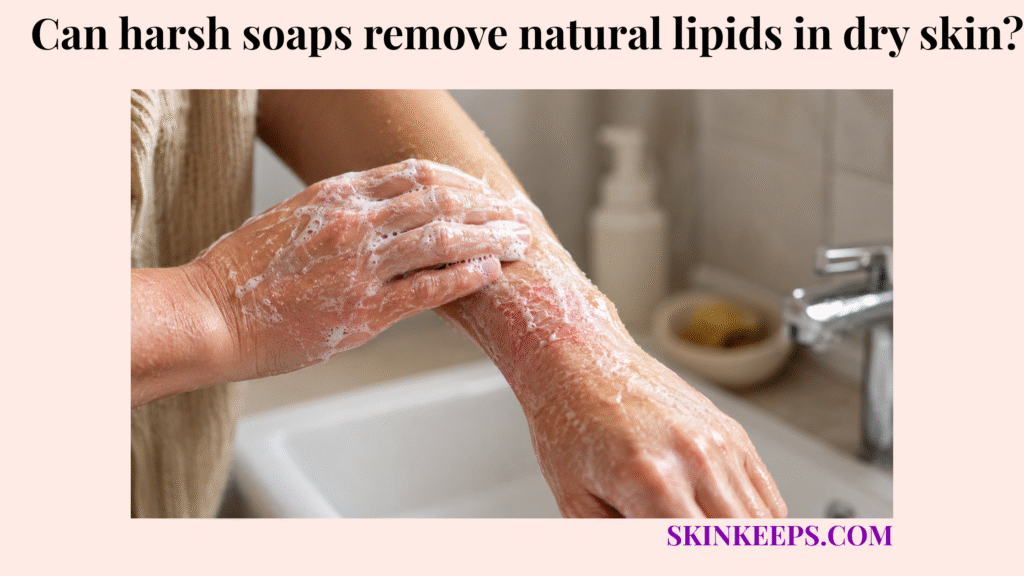
Yes, Harsh soaps can remove natural lipids in dry skin by dissolving and washing away the surface oils that help protect barrier comfort. This lipid loss matters because dry skin depends on surface oils and barrier lipids to feel smooth, flexible, and less irritated after washing.
This guideline explains how harsh soaps remove natural lipids, why lipid loss weakens dry-skin comfort, which soap types are most likely to feel stripping, what soap-stripped skin looks or feels like, and how to choose gentler cleansing options without ignoring hygiene.
How do harsh soaps remove natural lipids from dry skin?
Harsh soaps remove natural lipids from dry skin by dissolving protective surface oils and rinsing them away during cleansing. This cleansing action is useful for removing dirt, sweat, and residue, but it becomes a problem when it removes too much of the lipid film dry skin needs for comfort. The result is skin that may feel clean at first but tight or rough soon afterward.
Mayo Clinic lists harsh soaps as one cause of dry skin, and cleanser-focused dermatology literature notes that soaps and harsh cleansers can contribute to dryness and irritation when they disturb the skin barrier. This does not mean all cleansing is harmful; it means dry skin needs a cleanser that removes buildup without excessive lipid stripping. Mayo Clinic PMC
How soap dissolves protective surface oils
Soap dissolves protective surface oils by binding to oily material on the skin so that it can be lifted and rinsed away with water. This action is useful when the goal is removing dirt, sweat, and residue. It becomes too drying when the cleanser removes more lipid support than dry skin can comfortably tolerate.
Why dry skin loses comfort faster when lipids are stripped
Dry skin loses comfort faster when lipids are stripped because it already has less surface support to buffer washing, friction, and environmental stress. Once that support is reduced, the outer layer can feel tighter and less flexible. This is why a “clean” feeling can turn into roughness or irritation after the skin dries.
| Soap Effect | What Happens | Dry-Skin Result |
|---|---|---|
| Oil dissolution | Soap breaks down surface lipids | Skin feels tight |
| Barrier stripping | Protective oils are washed away | Moisture escapes more easily |
| Squeaky after-feel | Surface friction increases | Skin feels over-cleansed |
| Repeated use | Lipid loss happens again and again | Roughness, flaking, or itching worsens |
| Added fragrance or irritation | Reactive skin is stressed further | Stinging or redness may appear |
Why are natural lipids important for dry skin?
Natural lipids are important for dry skin because they help lubricate the surface, support barrier comfort, and reduce the tight, rough feeling that appears after washing. These lipids do not replace hydration, but they help the outer layer feel less exposed. When they are removed too aggressively, dryness symptoms become easier to trigger.
The dry-skin barrier depends on more than visible moisture. Surface oils, barrier lipids, and the outer skin layer work together to reduce friction and maintain comfort. When that lipid support is reduced by harsh cleansing, the skin may become less tolerant of washing, towels, clothing, and weather exposure.
How natural lipids help seal the outer skin layer
Natural lipids help seal the outer skin layer by forming part of the surface support system that reduces friction and moisture escape. This support is especially important when dry skin already feels tight or rough. Removing too much lipid support can make ordinary washing feel harsher than expected.
Why lipid loss makes dry skin more vulnerable to water loss
Lipid loss makes dry skin more vulnerable to water loss because the outer layer has less protective support after cleansing. With less support, the skin can feel less flexible as it dries. This helps explain why soap-related dryness may become noticeable after washing rather than during washing.
| Barrier Component | Main Role | What Happens When Reduced |
|---|---|---|
| Sebum | Surface lubrication | Skin feels less soft |
| Barrier lipids | Moisture barrier support | More tightness and dryness |
| Ceramide-rich lipid structure | Helps hold barrier layers together | More roughness and sensitivity |
| Surface oil film | Reduces friction | More irritation from washing or rubbing |
| Moisturizer support | Replaces comfort after washing | Less post-wash tightness |
Which harsh soap types are worst for dry skin?
The harsh soap types worst for dry skin are strong alkaline bar soaps, deodorant soaps, unnecessary antibacterial soaps, strong detergent-based cleansers, fragrance-heavy soaps, scrub soaps, and formulas that leave the skin squeaky or tight. These products often remove more surface comfort than dry skin can tolerate. The problem is not cleansing itself; the problem is excessive oil removal and irritation.
Mayo Clinic Health System recommends avoiding harsh, drying soaps and choosing cleansing creams, gentle skin cleansers, shower gels with added moisturizers, hypoallergenic soap, or fragrance-free soap without alcohol. This supports the practical rule that dry skin usually does better with gentler cleansing, not stronger degreasing. Mayo Clinic Health System
Why strong bar soaps can feel too stripping for dry skin
Strong bar soaps can feel too stripping for dry skin because they often remove surface oils aggressively and leave a tight after-feel. That tight after-feel is not proof of better cleansing. It can signal that the surface has lost comfort and needs a gentler approach.
Why fragrance-heavy or scrub soaps can increase irritation
Fragrance-heavy or scrub soaps can increase irritation because they add chemical or mechanical stress to skin that already lacks enough surface comfort. Fragrance can be unnecessary exposure for reactive skin, while scrub particles add friction. Together, they can worsen rough patches or post-wash stinging.
| Soap Type or Pattern | Why It Can Backfire |
|---|---|
| Strong alkaline bar soap | Can leave dry skin tight or squeaky |
| Deodorant soap | May be too harsh for dry-prone areas |
| Unnecessary antibacterial soap | Can increase dryness without being needed for routine cleansing |
| Strong detergent-based cleanser | Can remove too much surface oil |
| Fragrance-heavy soap | Adds irritation risk |
| Scrub soap | Adds friction to dry patches |
| Squeaky-clean formula | Often signals over-stripping |
What does soap-stripped dry skin feel or look like?
Soap-stripped dry skin can feel or look tight, rough, itchy, flaky, scaly, stinging, burning, red, darker irritated, ashy, chalky, or cracked when dryness becomes stronger. These signs appear because the skin surface has lost part of the lipid support that normally reduces friction and discomfort. Mild stripping may only create tightness, while stronger stripping may create visible texture changes.
Symptom timing helps identify soap-related dryness. If soap leaves the skin pulled or uncomfortable, the article on dry skin feels tight after washing can explain the post-cleansing sensation. If washing causes sharp discomfort, the page on dry skin stinging or burning can help separate ordinary dryness from stronger irritation.
Why tightness after soap can signal lipid stripping
Tightness after soap can signal lipid stripping because the skin surface has less oil-based support after cleansing. This tightness often appears as the skin dries rather than while the cleanser is still on the skin. If the same cleanser repeatedly causes tightness, it may be too stripping for dry skin.
Why flaking, scaling, or stinging can appear when soap stripping continues
Flaking, scaling, or stinging can appear when soap stripping continues because repeated lipid loss makes dry skin less comfortable and more reactive. Visible flakes suggest surface cells are shedding unevenly. Stinging suggests the barrier may be more sensitive after repeated cleanser exposure.
| Sign | What It May Suggest |
|---|---|
| Tightness after washing | Surface lipids were removed too aggressively |
| Rough texture | Dry skin has less surface comfort |
| Itching | Dryness is irritating the barrier |
| Flaking | Dry cells are shedding visibly |
| Scaling | Dryness is more advanced |
| Stinging or burning | Skin may be reactive or irritated |
| Redness or darker irritation | Inflammation may be present |
| Ashy or chalky tone | Dryness is visible on the surface |
| Cracks | Dryness may be severe |
How are harsh soaps different from gentle cleansers?
Harsh soaps differ from gentle cleansers because harsh soaps prioritize stronger oil removal, while gentle cleansers aim to remove residue with less barrier discomfort. This difference matters most after washing, when dry skin reveals whether the cleanser was tolerated. A cleanser that leaves tightness or stinging is not a good match simply because it feels “clean.”
AAD advises lukewarm water, gentle fingertip cleansing, avoiding scrubbing, patting dry, and applying moisturizer when the skin is dry or itchy. These steps support a lower-friction cleansing routine that protects dry skin better than rough washing or aggressive soap use. American Academy of Dermatology
Why gentle cleansers are better matched to dry skin
Gentle cleansers are better matched to dry skin because they clean without creating the tight, squeaky, rough after-feel linked with excessive lipid removal. This makes them a better daily choice for skin that becomes uncomfortable after washing. The goal is clean skin, not aggressively degreased skin.
Why the after-feel matters when judging a cleanser
The after-feel matters when judging a cleanser because dry skin often reveals over-stripping through tightness, roughness, itching, or stinging after washing. A product can foam well and still be too harsh. The best cleanser for dry skin should leave the skin comfortable enough that moisturizer can support, not rescue, the barrier.
| Feature | Harsh Soap | Gentle Cleanser |
|---|---|---|
| Cleansing style | Strong oil removal | Mild dirt and residue removal |
| After-feel | Tight, squeaky, dry | Comfortable, soft, clean |
| Dry-skin effect | Can worsen lipid loss | Better barrier comfort |
| Irritation risk | Higher | Lower |
| Best use for dry skin | Usually avoid or limit | Better daily choice |
| Formula direction | Strong or fragrance-heavy | Gentle, fragrance-free, moisturizing |
How should dry skin be cleansed without removing too many lipids?
Dry skin should be cleansed without removing too many lipids by using a gentle fragrance-free cleanser, lukewarm water, minimal friction, pat drying, and moisturizer while the skin is still slightly damp. This method removes sweat, dirt, and residue without treating the skin like it needs aggressive degreasing. It is especially important for dry-prone areas that feel tight after washing.
Mayo Clinic recommends warm water, fragrance-free moisturizing soap for handwashing, and moisturizing cream while the hands are still damp. Cleveland Clinic also supports warm water, mild fragrance-free cleanser, pat drying, and damp-skin moisturizer for dry skin. Mayo Clinic Cleveland Clinic
Why fragrance-free gentle cleanser is safer for dry skin
Fragrance-free gentle cleanser is safer for dry skin because it reduces the chance of unnecessary irritation while still removing everyday buildup. Dry skin often reacts more strongly when fragrance, scrubbing, and strong degreasing are combined. A simpler formula can be easier to tolerate.
Why lukewarm water and pat drying reduce soap-related dryness
Lukewarm water and pat drying reduce soap-related dryness because they limit heat and friction after the skin has already been cleansed. Hot water can worsen oil removal, and towel rubbing can stress dry patches. Pat drying keeps the routine cleaner and less abrasive.
Why moisturizer should follow cleansing
Moisturizer should follow cleansing because dry skin needs support after surface oils and water are reduced during washing. Moisturizer helps restore comfort after the cleanser has done its job. When soap leaves the skin rough or flaky, the guide on dry skin flaking and scaling can explain the later surface changes.
Dry-Skin Cleansing Checklist
When does soap-related dryness need professional care?
Soap-related dryness needs professional care when it cracks, bleeds, becomes painful, burns, stings persistently, swells, oozes, crusts, or does not improve after switching to gentle cleansing and moisturizing. These signs suggest that the issue may involve stronger barrier disruption or an underlying skin condition. The safest next step is professional evaluation, not self-diagnosis.
Persistent symptoms can overlap with eczema, dermatitis, psoriasis, allergy, infection, or other skin conditions. A clinician can check whether harsh soap is the main trigger or whether another condition is also present. When symptoms continue despite switching cleansers, the article on persistent dry skin needs a dermatologist can guide escalation.
Why cracking, bleeding, or oozing should be checked
Cracking, bleeding, or oozing should be checked because those signs suggest stronger skin disruption than ordinary soap-related tightness. These signs may need care beyond switching products. Evaluation helps separate severe dryness from infection, allergy, or inflammatory skin conditions.
Why persistent soap-related irritation should not be ignored
Persistent soap-related irritation should not be ignored because ongoing burning, stinging, itching, or inflammation may reflect more than simple cleanser mismatch. The irritation may come from a product, repeated friction, or an underlying condition. A clinician can help identify the pattern safely.
Warning-Sign Checklist
What should you remember about harsh soaps and dry skin lipids?
The main point to remember is that harsh soaps can remove natural lipids from dry skin and make the outer layer feel tighter, rougher, itchier, or more irritated after washing. Dry skin usually tolerates gentle cleansing better than aggressive oil removal. Squeaky-clean skin is often a warning sign of over-stripping, not a healthy cleansing goal.
Final Takeaways
- Harsh soaps can remove natural lipids from dry skin.
- Natural lipids help dry skin feel smoother, softer, and less tight after washing.
- Dry skin is more vulnerable to harsh soap because it already has less surface comfort than balanced skin.
- Squeaky-clean skin is often a warning sign of over-stripping, not a healthy cleansing goal.
- Fragrance-heavy soaps, strong bar soaps, scrub soaps, and harsh detergents can worsen dry-skin discomfort.
- Gentle, fragrance-free cleansing plus moisturizer after washing protects dry skin better than aggressive oil removal.
- Persistent cracking, bleeding, burning, oozing, crusting, or inflamed patches should be checked professionally.
FAQs
Can harsh soaps remove natural lipids in dry skin?
Yes, harsh soaps can remove natural lipids in dry skin by dissolving and washing away surface oils that help protect comfort.
Why does dry skin feel tight after using harsh soap?
Dry skin feels tight after using harsh soap because too much surface lipid support has been removed during cleansing.
What types of soap are harsh for dry skin?
Strong bar soaps, deodorant soaps, unnecessary antibacterial soaps, fragrance-heavy soaps, scrub soaps, and squeaky-clean formulas can be harsh for dry skin.
Is squeaky-clean skin good for dry skin?
No, squeaky-clean skin is often a warning sign that dry skin has been over-stripped and left with too little surface comfort.
What cleanser is better for dry skin?
A gentle, fragrance-free cleanser is usually better for dry skin because it removes everyday buildup without excessive tightness or irritation.
Should dry skin moisturize after washing?
Yes, dry skin should moisturize after washing because cleansing can reduce surface oils and water, leaving the skin needing support.
When does soap-related dryness need professional care?
Soap-related dryness needs professional care when it cracks, bleeds, burns, stings persistently, oozes, crusts, or does not improve after gentler cleansing.
Conclusion
Harsh soaps can remove natural lipids from dry skin by dissolving and washing away the surface oils that help maintain barrier comfort. When those lipids are reduced too aggressively, dry skin may feel tight, rough, itchy, flaky, stinging, or more irritated after washing.
The better approach is gentle, fragrance-free cleansing, lukewarm water, minimal friction, pat drying, and moisturizer while the skin is still slightly damp. If symptoms persist despite switching cleansers, or if cracking, bleeding, oozing, crusting, or pain appears, professional review is the safer next step.