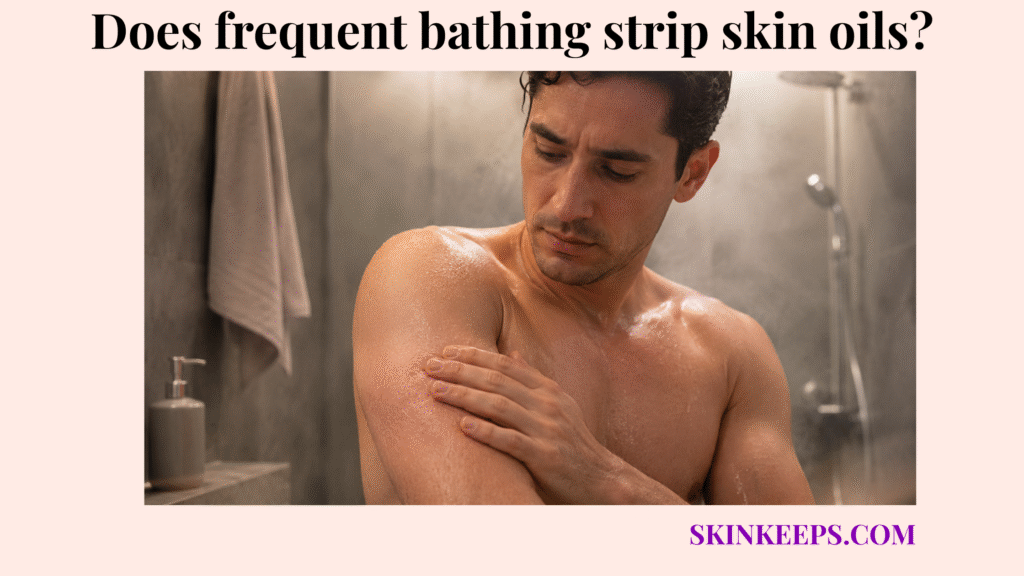
Yes, Frequent bathing strip skin oils by repeatedly exposing the skin to water, cleansers, heat, and towel friction that reduce the protective surface lipid film. This surface lipid film helps the outer skin layer feel comfortable, so repeated oil removal can leave dry skin tight, rough, itchy, flaky, or irritated after bathing.
This guideline explains how frequent bathing strips skin oils, why bathing duration can matter as much as frequency, how hot water and harsh soaps intensify the effect, what oil-stripped skin feels or looks like, and how to bathe cleanly without weakening dry-skin comfort.
How does frequent bathing strip skin oils?
Frequent bathing strips skin oils by repeatedly dissolving and washing away surface lipids before the outer skin layer has enough time to regain comfort. These surface lipids help dry skin feel smoother and less tight. When bathing happens too often for the skin’s tolerance, dryness symptoms can become more noticeable.
Frequent bathing is one hygiene-related trigger within the wider group of environmental factors that worsen dry skin, but this page focuses only on repeated bathing exposure. That distinction matters because a person can bathe often for valid hygiene reasons and still need to reduce oil stripping. Mayo Clinic lists harsh soaps and overbathing among dry-skin contributors. [Mayo Clinic]
How repeated water exposure removes surface lipids
Repeated water exposure removes surface lipids by repeatedly softening and rinsing away part of the oil film that helps dry skin stay comfortable. This does not mean bathing is harmful by itself. It means frequency, duration, cleanser strength, water temperature, and towel friction change how much comfort the skin keeps after washing.
Why cleansing products make oil removal stronger
Cleansing products make oil removal stronger because they are designed to lift oils, sweat, dirt, and residue from the skin surface. That cleansing action is useful for hygiene, but it can also remove supportive surface lipids when the cleanser is strong or used repeatedly. The result can be tighter, rougher, or more reactive skin after bathing.
| Bathing Factor | What Happens | Dry-Skin Result |
|---|---|---|
| Frequent water exposure | Surface lipids are repeatedly reduced. | Tightness and dryness. |
| Soap or cleanser use | Oils are dissolved and washed away. | Roughness or irritation. |
| Hot water | Oil stripping becomes stronger. | More post-bath dryness. |
| Long bathing time | Water and cleanser exposure lasts longer. | More barrier discomfort. |
| Towel rubbing | Friction is added after lipid loss. | More irritation. |
Is bathing frequency or shower length more important for dry skin?
Bathing frequency and shower length both matter for dry skin because repeated washing and prolonged exposure can each reduce surface oils and increase post-bathing tightness. A short warm shower may be tolerated better than a long hot bath, even if both happen once a day. The skin’s response depends on frequency, heat, cleanser strength, and friction.
Mayo Clinic recommends limiting bathing to no more than once a day and no longer than 5–10 minutes when managing dry skin, while AAD recommends limiting baths or showers to 5–10 minutes to avoid drying the skin. These numbers should be used as dry-skin relief guidance, not as a rigid rule for every hygiene situation. [Mayo Clinic]
Why long bathing can strip oils even if bathing is not very frequent
Long bathing can strip oils even if bathing is not very frequent because the skin stays exposed to water, heat, and cleanser for longer than necessary. This longer exposure gives surface lipids more time to loosen and rinse away. A long hot bath can therefore leave dry skin more strained than a shorter warm shower.
Why frequent short bathing may still be necessary after sweat or dirt exposure
Frequent short bathing may still be necessary after sweat or dirt exposure because hygiene needs sometimes require cleansing even when dry skin needs gentler methods. The better question is not whether to bathe or avoid bathing. The better question is how to remove sweat, dirt, odor, or irritants while limiting heat, soap, and friction stress.
| Bathing Pattern | Dry-Skin Risk |
|---|---|
| Short warm shower once daily | Lower risk for many people. |
| Long shower once daily | Higher risk. |
| Short shower after sweating | Often reasonable. |
| Multiple hot showers daily | High risk. |
| Long bath with harsh soap | High risk. |
| Frequent gentle rinsing after sweat | Lower risk than harsh repeated washing. |
Why do hot water and harsh soaps make frequent bathing worse?
Hot water and harsh soaps make frequent bathing worse by removing more surface oils than water alone and leaving dry skin less comfortable after each wash. Heat loosens the surface lipid film, while stronger cleansers dissolve oils more aggressively. Together, they can make post-bathing dryness appear faster.
Mayo Clinic Health System states that long showers or baths and hot water remove oils from the skin, and Mayo Clinic notes that harsh soaps and detergents can strip moisture because they are formulated to remove oil. When the main problem is water temperature rather than bathing frequency, the guide on hot showers worsen dryness explains that narrower mechanism. [Mayo Clinic Health System]
Why hot water removes more protective oil
Hot water removes more protective oil because heat makes the surface lipid film easier to loosen and wash away during bathing. This does not mean every warm wash is harmful. It means hot water can make repeated bathing more drying, especially when dry skin already has low surface comfort.
Why harsh soaps are designed to dissolve oils
Harsh soaps are designed to dissolve oils, which means they can remove useful surface lipids along with sweat, dirt, and residue. This oil-removing function is part of why cleansers work. The problem appears when strong cleansing is repeated on dry-prone areas that need more comfort support.
| Trigger | Why It Can Worsen Oil Stripping |
|---|---|
| Hot water | Loosens and removes surface oils more easily. |
| Long shower | Extends water and cleanser exposure. |
| Harsh bar soap | Can remove too much surface comfort. |
| Strong foaming cleanser | May leave skin tight or rough. |
| Fragrance-heavy product | Adds irritation risk. |
| Rough towel drying | Adds friction after oil loss. |
What does oil-stripped skin feel or look like after bathing?
Oil-stripped skin after bathing can feel or look tight, itchy, rough, flaky, scaly, dull, stinging, or cracked when dryness becomes stronger. These signs appear because the outer skin layer has less lipid support after repeated washing. Mild oil stripping may only feel tight, while stronger dryness may become visible.
The timing of symptoms helps identify bathing-related dryness. If bathing mainly leaves a pulled feeling, the article on dry skin feels tight after washing can explain the post-wash tightness pattern. When repeated bathing progresses into visible shedding, the guide on dry skin flaking and scaling can explain the later surface changes.
Why tightness and itching can appear after frequent bathing
Tightness and itching can appear after frequent bathing because surface oil reduction leaves the outer skin layer less comfortable as it dries. The skin may feel clean immediately after washing but strained once the water evaporates. This timing makes post-bathing dryness different from dirt or poor hygiene.
Why flaking, scaling, or stinging can appear when oil stripping progresses
Flaking, scaling, or stinging can appear when oil stripping progresses because dry surface cells become less stable and more reactive after repeated washing. Visible shedding suggests the dryness has moved beyond a simple tight feeling. Stinging suggests the barrier may be reacting more strongly to water, cleanser, or friction.
| Sign | What It May Suggest |
|---|---|
| Tightness | Surface oils were reduced after washing. |
| Itching | Dry skin is becoming irritated. |
| Rough texture | Outer layer feels less smooth. |
| Flaking | Dry cells are shedding visibly. |
| Scaling | Dryness is more visible or advanced. |
| Stinging | Barrier may be more reactive. |
| Dullness | Surface texture is uneven. |
| Cracking | Dryness may be severe. |
How can dry skin bathe without stripping too much oil?
Dry skin can bathe without stripping too much oil by using warm water, shortening baths or showers, choosing gentle fragrance-free cleansers, patting dry, and moisturizing while the skin is still damp. This method removes sweat, dirt, and odor without treating the whole body like it needs aggressive degreasing. It protects dry zones while still supporting hygiene.
AAD recommends limiting baths or showers to 5–10 minutes, using warm water, patting the skin dry, and applying moisturizer while the skin is still damp. Mayo Clinic Health System also recommends five to 10 minutes with warm, not hot, water. [American Academy of Dermatology]
Why warm water is better than hot water for frequent bathing
Warm water is better than hot water for frequent bathing because it cleanses while reducing the amount of surface oil removed from dry skin. Warm water still supports hygiene, but it is less likely to leave the skin feeling stripped. This matters most when bathing happens often.
Why moisturizer should be applied while skin is still damp
Moisturizer should be applied while skin is still damp because it helps support the outer layer before post-bathing moisture evaporates. This timing helps reduce the tight feeling that can appear after the skin fully dries. It also gives dry-prone areas more comfort support after water and cleanser exposure.
Why cleansing can focus more on sweaty or odor-prone areas
Cleansing can focus more on sweaty or odor-prone areas because dry-prone skin does not always need the same level of soap exposure everywhere. This focused method helps preserve comfort on arms, legs, or dry patches while still cleansing areas where sweat, odor, or residue collect more easily.
Safer Bathing Checklist
When can more frequent bathing still be necessary?
More frequent bathing can still be necessary after heavy sweating, exercise, outdoor dirt, occupational exposure, strong odor, pool water, saltwater, or medical hygiene needs. The solution is not to ignore hygiene. The solution is to make necessary bathing shorter, warmer, gentler, and followed by moisturizer.
This distinction prevents a dangerous oversimplification. Dry skin needs reduced stripping, but the skin also needs sweat, irritants, and contaminants removed when necessary. Extra bathing should be judged by exposure level, not by the false idea that all frequent washing is automatically wrong.
Why sweat, dirt, and occupational exposure may require extra cleansing
Sweat, dirt, and occupational exposure may require extra cleansing because residues left on the skin can irritate the surface or create hygiene problems. This is especially important after exercise, outdoor work, pool exposure, or contact with workplace residue. Hygiene needs should be respected while the method is adjusted to reduce stripping.
Why necessary extra bathing should be gentler rather than harsher
Necessary extra bathing should be gentler rather than harsher because dry skin already faces more oil stripping when bathing happens often. A gentle rinse or mild cleanser can remove residue without adding unnecessary irritation. Moisturizer afterward helps restore comfort after the necessary wash.
| Situation | Better Bathing Direction |
|---|---|
| Heavy sweating | Short warm rinse or gentle cleanse. |
| Exercise | Remove sweat without harsh scrubbing. |
| Outdoor dirt | Clean exposed areas gently. |
| Occupational residue | Follow safety and hygiene needs. |
| Strong body odor | Clean odor-prone areas thoroughly but gently. |
| Pool or saltwater exposure | Rinse and moisturize afterward. |
| Medical hygiene needs | Follow clinician instructions. |
When does bathing-related dryness need professional evaluation?
Bathing-related dryness needs professional evaluation when it cracks, bleeds, becomes painful, burns, stings persistently, swells, oozes, crusts, or does not improve after gentler bathing and moisturizing. These signs suggest the skin may need more than a change in bathing frequency. The safe next step is evaluation, not self-diagnosis.
Persistent symptoms can overlap with dermatitis, eczema, psoriasis, infection, allergy, or another condition. A clinician can check whether the dryness is simple oil stripping or part of a more specific skin issue. When dryness continues despite gentler bathing, the article on persistent dry skin needs a dermatologist can guide escalation.
Why cracking, bleeding, or oozing should be checked
Cracking, bleeding, or oozing should be checked because those signs suggest stronger barrier disruption than ordinary post-bathing tightness. These changes can make the skin more vulnerable and more uncomfortable. Evaluation is safer than continuing to adjust bathing alone.
Why persistent bathing-related irritation should not be ignored
Persistent bathing-related irritation should not be ignored because ongoing burning, stinging, itching, or inflammation may reflect more than simple dryness. The problem may be related to a product, a skin condition, or repeated exposure that basic changes are not correcting. Persistent symptoms deserve a clinician’s review.
Warning-Sign Checklist
What should you remember about frequent bathing and skin oils?
The main point to remember is that frequent bathing can strip skin oils when repeated water, cleanser, heat, and towel exposure reduce the protective surface lipid film. This is most likely when bathing is long, hot, soap-heavy, or followed by rough towel drying. A gentler method keeps hygiene intact while reducing unnecessary dryness.
Final Takeaways
- Frequent bathing can strip skin oils when water, cleanser, heat, and friction are repeated too often for the skin’s tolerance.
- Long, hot, soap-heavy bathing is more drying than short, warm, gentle bathing.
- Surface oils help dry skin feel smoother, softer, and less tight after washing.
- Bathing frequency and bathing duration both affect dryness risk.
- More frequent bathing may still be necessary after sweating, dirt, occupational exposure, odor, pool water, or medical hygiene needs.
- Moisturizer should be applied while the skin is still damp after bathing.
- Persistent cracking, bleeding, severe itching, pain, burning, oozing, crusting, or inflamed patches should be evaluated professionally.
FAQs
Does frequent bathing strip skin oils?
Yes, frequent bathing can strip skin oils when repeated water, cleanser, heat, and towel exposure reduce the protective surface lipid film.
Why does skin feel tight after frequent bathing?
Skin can feel tight after frequent bathing because repeated washing reduces surface oils that help the outer layer stay comfortable.
Are long showers worse than frequent short showers?
Long showers can be worse when they extend water, heat, and cleanser exposure, while short warm showers are usually gentler for dry skin.
Does hot water remove more skin oil?
Yes, hot water can remove more skin oil because heat makes the surface lipid film easier to loosen and wash away.
Can harsh soap make frequent bathing more drying?
Yes, harsh soap can make frequent bathing more drying because it dissolves useful surface lipids along with sweat, dirt, and residue.
Should dry skin stop bathing often?
Dry skin should not ignore hygiene needs, but bathing should be gentler, shorter, warmer, and followed by moisturizer when dryness is a problem.
When does bathing-related dryness need professional care?
Bathing-related dryness needs professional care when it cracks, bleeds, becomes painful, burns, stings persistently, oozes, crusts, or does not improve with gentler care.
Conclusion
Frequent bathing can strip skin oils when repeated water, cleanser, heat, and towel exposure reduce the protective surface lipid film. The risk increases when bathing is long, hot, soap-heavy, or followed by rough towel drying.
The safer approach is to keep bathing warm, short, gentle, and followed by moisturizer while the skin is still damp, while still cleansing when sweat, dirt, odor, or hygiene needs require it.