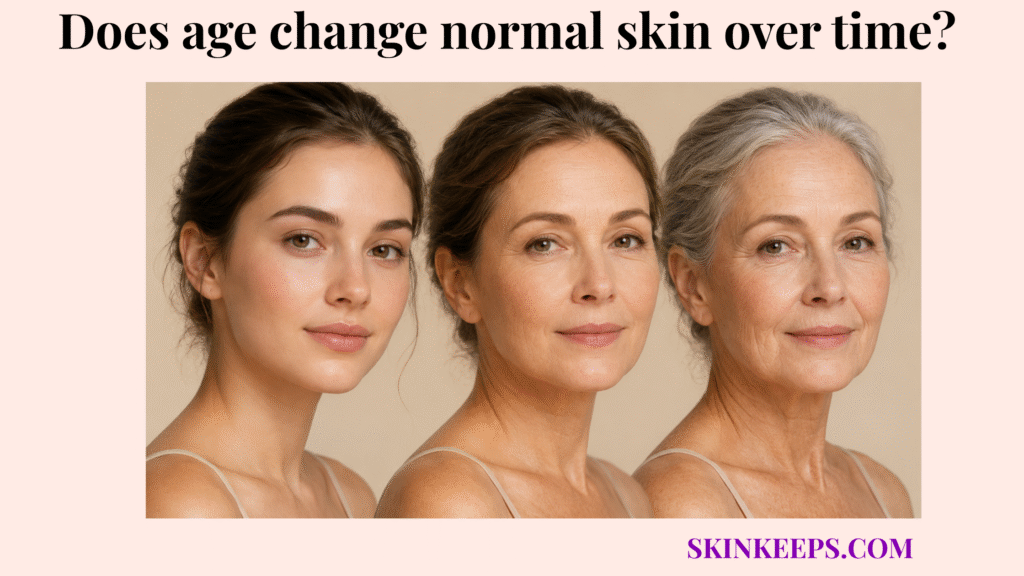
Yes, age can change normal skin over time. Normal skin may gradually become drier, thinner-looking, less elastic, more textured, more sensitive, or slower to recover. These changes usually build slowly rather than appearing as a sudden loss of balance.
Stress, sun exposure, harsh products, cold weather, and environmental pressure can make age-related changes more visible. Age is one influence, but it does not work alone.
Age does not automatically remove normal skin balance. A person can still have normal skin as they get older if oiliness, dryness, sensitivity, and breakouts remain relatively moderate.
The main shift is that normal skin may need more protection, more moisture support, and gentler care than it did earlier.
Why should normal skin aging be understood as gradual change, not sudden loss of balance?
Normal skin aging should be understood as gradual change, not sudden loss of balance, because oil, hydration, elasticity, barrier comfort, and recovery can shift slowly over years.
Normal skin may still feel balanced while becoming less forgiving. A cleanser, exfoliant, weather pattern, or active ingredient that once felt easy may start to create tightness, stinging, dullness, or longer recovery.
Reduced tolerance often shows up after harsh cleansing, sun exposure, cold weather, stress, or strong actives. The skin may still belong within the normal range, but its margin for pressure becomes narrower over time.
Skin type labels should stay realistic rather than rigid. A wider view of different skin types helps separate gradual normal-skin aging from a stronger dry, oily, sensitive, or combination pattern.
| Age-related shift in normal skin | How it may appear | What it does not mean |
|---|---|---|
| Less oil support | Skin may feel drier than before | Skin type has changed overnight |
| Slower recovery | Irritation lasts longer | Skin is permanently damaged |
| Less elasticity | Fine lines or looser texture may appear | Normal skin is unhealthy |
| More dryness | Moisturizer may matter more | Every older person has dry skin |
| More visible texture | Pores, lines, and roughness may show more | Skin must be aggressively exfoliated |
| More sensitivity | Products may sting more easily | All skincare must stop |
| More tone changes | Spots or unevenness may appear | Every mark is harmless |
Age can make normal skin less effortless, but not automatically unbalanced.
Which age-related changes can appear in normal skin?
Age-related changes that can appear in normal skin include more dryness, less elasticity, more visible texture, slower recovery, more sensitivity, uneven tone, lower oiliness, or new breakouts.
This overview helps set expectations before each change is explained more closely. Normal skin does not have to show every age-related change, and the timing can differ from person to person.
These shifts can appear gradually while the skin still stays within a balanced pattern. The key is whether oiliness, dryness, sensitivity, and breakouts remain relatively moderate instead of becoming dominant every day.
| Change over time | How normal skin may show it | Main care meaning |
|---|---|---|
| More dryness | Tightness, dullness, rough patches | Moisture support may need to increase |
| Less elasticity | Fine lines, less bounce | Gentle protection matters |
| More visible texture | Pores, lines, uneven surface | Avoid over-exfoliating |
| Slower healing | Marks or irritation last longer | Reduce triggers |
| More sensitivity | Products sting more easily | Simplify and patch test |
| Uneven tone | Sun spots, redness, dullness | Sunscreen becomes even more important |
| Less oiliness | T-zone may become calmer | Avoid stripping |
| New breakouts | Hormones or products may contribute | Track pattern, not panic |
Normal skin can age while still being normal; the visible balance just becomes more influenced by moisture, protection, and recovery.
How does age affect oil balance in normal skin?
Age can affect oil balance in normal skin by reducing some natural oil support or changing how greasy, dry, or comfortable the skin feels during the day.
Some people notice less greasiness and more dryness with age. This can make the T-zone calmer while the cheeks or around-mouth area feel tighter than they used to.
Other people keep a moderate oil pattern and still fit normal skin. Aging does not require normal skin to become dry skin, and a soft glow can still appear without heavy shine.
Changing oil levels should be judged by comfort, not by panic. SkinKeeps explains the balance between radiance and oiliness in its page on whether normal skin can have a healthy glow without shine.
| Oil change in normal skin | Possible sign | Better interpretation |
|---|---|---|
| Less midday shine | Skin may feel less oily than before | Can still be normal |
| More cheek tightness | Oil and moisture support may be lower | Add comfort before using actives |
| T-zone stays balanced | Oil pattern remains moderate | Normal skin may persist |
| Nose pores look more visible | Texture and elasticity may affect appearance | Not always more oil |
| Skin feels dry after cleansing | Cleanser may now be too strong | Adjust gentleness |
| Acne decreases | Lower oil may reduce some breakouts | Not guaranteed |
| New adult breakouts | Hormones, stress, products, or medication may contribute | Track and evaluate if persistent |
Aging normal skin often needs less stripping and more comfort support.
How does age affect dryness and hydration in normal skin?
Age can affect dryness and hydration in normal skin by making the skin feel tighter, duller, rougher, or more dependent on moisture support.
Normal skin may feel drier after cleansing, cold weather, indoor heat, or sun exposure. That does not mean the skin has failed; it means the comfort threshold has changed.
Normal skin may feel drier with age
Normal skin may feel drier with age because oil support, barrier comfort, and recovery can become less effortless over time.
Tightness, dullness, or roughness may appear more often as the skin becomes less forgiving. Cleansing, cold weather, indoor heat, and sun exposure can make this drier feel easier to notice.
Normal skin may need more moisturizer with age
Normal skin may need more moisturizer with age because a product that once felt optional may become more useful for comfort.
More moisturizer need does not mean the skin is permanently bad. It means the skin may benefit from comfort support rather than being forced into aggressive correction.
Comfort is the better measurement than age alone. SkinKeeps separates that baseline in its page on whether normal skin feels comfortable and balanced.
| Dryness sign in aging normal skin | What it may suggest | Better response |
|---|---|---|
| Tightness after washing | Cleanser may be too strong | Use gentler cleansing |
| Cheeks feel rough | Moisture support may be lower | Add barrier-support moisturizer |
| Makeup clings | Surface dryness may be present | Moisturize before makeup |
| Skin looks dull | Dryness or slow turnover may contribute | Support hydration and protection |
| Around-mouth dryness | Barrier comfort may be lower | Avoid harsh actives nearby |
| Moisturizer absorbs quickly | Skin may need more support | Adjust amount or texture |
| Cracking or bleeding | Not routine normal aging | Seek professional care |
Normal skin can become drier with age without becoming permanently “bad skin.”
How does age affect texture and elasticity in normal skin?
Age can affect texture and elasticity in normal skin by making fine lines, pores, roughness, makeup settling, and slower recovery more noticeable.
Visible texture can increase as hydration, elasticity, and support change. The surface may show fine lines more clearly, pores may look more noticeable, and makeup may settle differently than it did earlier.
Texture does not mean normal skin must be aggressively exfoliated or corrected. Over-scrubbing, daily strong acids, or product stacking can make the skin look more irritated rather than smoother.
Age-related texture should be read with tone and surface balance together. SkinKeeps explains the baseline pattern in its page on whether normal skin has even tone and texture.
| Age-related texture sign in normal skin | Possible meaning | What to avoid |
|---|---|---|
| Fine lines | Natural elasticity and hydration changes | Over-scrubbing |
| More visible pores | Texture and support changes | Pore-erasing claims |
| Less bounce | Elasticity changes | Harsh actives too quickly |
| Rougher surface | Dryness, buildup, or barrier stress | Daily aggressive exfoliation |
| Makeup settles more | Texture and dryness may be involved | Powder overload |
| Slower recovery from irritation | Skin may need gentler care | Product stacking |
| More fragile feel | Barrier may need support | Strong cleansers |
Normal skin texture can become more visible with age, but visible texture does not mean the skin must be aggressively corrected.
How does age affect tone and brightness in normal skin?
Age can affect tone and brightness in normal skin by making dullness, uneven color, redness, sun-related spots, or post-breakout marks more noticeable.
Normal skin tone can change because time and exposure both influence the skin surface. UV exposure, inflammation, sleep loss, stress, and irritation can all make uneven tone or dullness more visible.
Tone changes should not be turned into a fear-based correction project. Mild dullness or unevenness can be part of aging normal skin, while sudden color change, spreading discoloration, or a changing spot needs closer attention.
| Tone change in normal skin | Possible trigger | Safe interpretation |
|---|---|---|
| Mild dullness | Dryness, sleep, stress, aging | Often supportive care helps appearance |
| Uneven tone | Sun exposure, inflammation, aging | Track pattern and protect skin |
| Brown spots | UV history or aging-related change | Monitor changes |
| Redness | Irritation, sensitivity, heat, conditions | Watch persistence |
| Post-breakout marks | Slower fading with age | Avoid picking and use protection |
| Sudden color change | Medical or irritation concern | Seek evaluation |
| Changing mole or lesion | Needs attention | Do not self-diagnose |
Normal skin can lose some even-looking brightness over time, but changing or unexplained spots need careful attention.
How does age affect sensitivity in normal skin?
Age can affect sensitivity in normal skin by making previously comfortable skin more reactive to products, cleansing, weather, acids, or dryness.
Aging normal skin may become less tolerant when it is dry, over-treated, or exposed to harsh conditions. Products that once felt comfortable may start to sting if the barrier needs more support.
Mild increased reactivity is different from swelling, rash-like redness, or persistent burning. Those signs should not be written off as ordinary age-related change.
Sensitivity can appear even in a usually balanced pattern. SkinKeeps explains the baseline in its page on whether normal skin is usually less sensitive.
| Sensitivity change in normal skin | Possible cause | Better response |
|---|---|---|
| Stinging after products | Barrier is less tolerant or formula too strong | Simplify and reassess |
| Redness after cleansing | Cleanser or water temperature may be harsh | Use gentler habits |
| Burning after acids | Active strength or frequency too high | Reduce or stop |
| More dryness in winter | Environmental stress | Add moisture support |
| Itching | Dryness or irritation may be involved | Avoid triggers |
| Reacting to old products | Skin needs may have changed | Patch test alternatives |
| Swelling or rash-like redness | Not normal routine aging | Seek care |
Normal skin can become more sensitive with age, especially when it is dry, over-treated, or exposed to harsh conditions.
How does age affect breakouts in normal skin?
Age can affect breakouts in normal skin by reducing some oil-driven pimples for some people while still allowing hormone-, product-, stress-, or medication-related breakouts.
Aging does not automatically mean no breakouts. Some oil-driven pimples may decrease, but adult breakouts can still appear when hormones, stress, rich products, sunscreen residue, makeup, friction, or medication changes affect the skin.
The safest response is to track pattern rather than panic. Sudden adult acne, deep painful acne, or scarring acne should not be dismissed as ordinary aging.
Breakouts should be judged by frequency, depth, and recovery. SkinKeeps covers that distinction in its page on whether normal skin is less prone to frequent breakouts.
| Breakout change in normal skin | Possible meaning | When to worry |
|---|---|---|
| Fewer oily breakouts | Oil pattern may be calmer | Usually compatible with aging normal skin |
| Occasional chin pimples | Hormonal shifts may contribute | Track repetition |
| Breakouts after rich creams | Product too heavy | Adjust texture |
| Breakouts after sunscreen/makeup | Residue or formula issue | Cleanse gently and track |
| Sudden adult acne | Hormones, medication, or condition possible | Seek evaluation if persistent |
| Deep painful acne | Not routine normal aging | Get professional guidance |
| Scarring acne | Needs attention | Do not delay care |
Aging normal skin may be less oily, but it is not automatically breakout-proof.
How do life stages change normal skin over time?
Life stages change normal skin over time because hormones, oil levels, recovery, barrier comfort, and sensitivity can shift from the teen years into older adulthood.
Each life stage can affect normal skin differently. Teens may notice more oil, adults may notice stress-linked dullness or breakouts, and later stages may bring more dryness, texture, or sensitivity.
This pattern should stay educational rather than diagnostic. A life-stage shift can be normal, but sudden, severe, painful, bleeding, or spreading changes need professional review.
| Life stage | How normal skin may change | Main interpretation |
|---|---|---|
| Teens | More oil or breakouts may appear | Hormones can temporarily shift skin |
| 20s | Skin may feel balanced and resilient | Still needs sunscreen |
| 30s | Fine lines, stress breakouts, dullness may appear | Recovery may need support |
| 40s | Dryness, texture, and tone changes may increase | Moisture and protection matter more |
| 50s and beyond | Skin may feel drier, thinner, or more sensitive | Barrier support becomes more important |
| Menopause transition | Dryness, sensitivity, acne, or texture shifts may occur | Track severity and persistence |
| Older adulthood | Fragility, dryness, itching, or slower healing may increase | Avoid harsh routines and seek help for wounds |
Normal skin changes by life stage, but the pace and pattern are individual.
How do sun exposure and lifestyle affect aging normal skin?
Sun exposure and lifestyle affect aging normal skin by influencing how visible dryness, uneven tone, wrinkles, texture, dullness, irritation, and recovery changes become.
Chronological age is only one part of skin aging. UV exposure, smoking, sleep loss, stress, harsh products, pollution, and nutrition or hydration imbalance can all change how aging appears on normal skin.
This should not be framed as fear. The practical point is that normal skin often ages better when avoidable pressure is reduced and daily protection is consistent.
| Influence | How it may affect normal skin over time |
|---|---|
| Chronological age | Gradual dryness, fine lines, elasticity changes |
| UV exposure | Uneven tone, spots, wrinkles, texture changes |
| Smoking | Premature visible aging and dullness risk |
| Sleep loss | Dullness and slower recovery |
| Stress | Breakouts, picking, inflammation-related changes |
| Poor routine consistency | Irritation, clogged pores, dryness |
| Harsh products | Barrier disruption and sensitivity |
| Pollution | Oxidative stress and dullness risk |
| Nutrition and hydration imbalance | General appearance and comfort may suffer |
Age changes normal skin, but external exposure often decides how visible those changes become.
How should normal skin adjust expectations as it ages?
Normal skin should adjust expectations as it ages by accepting that balance can continue even when dryness, texture, sensitivity, and recovery needs change.
Aging normal skin should be supported, not forced back into its younger behavior. The goal is not to chase the same oil level, texture, or recovery speed from earlier years.
Expectation changes may include more moisture support, consistent sunscreen, gentler cleansing, slower active introduction, and product reassessment. Sudden symptoms still deserve professional review instead of being blamed on age alone.
- “Balanced” does not mean unchanged.
- More moisture may be needed over time.
- Sunscreen becomes increasingly important.
- Texture may become more visible.
- Strong actives may need slower introduction.
- Products that worked before may stop feeling ideal.
- Breakouts can still happen.
- Skin may recover more slowly.
- Gentle care becomes more valuable.
- Professional review matters for sudden or changing symptoms.
Aging normal skin should be supported, not forced back into its younger behavior.
What mistakes should normal skin avoid as it ages?
Normal skin should avoid aging-related mistakes such as skipping sunscreen, using harsh cleansers, over-exfoliating, stacking actives, ignoring dryness, or dismissing changing spots.
Aging normal skin often needs more respect for comfort and recovery. Overcorrection can create irritation, while neglect can allow avoidable tone, texture, and comfort problems to build.
The strongest mistake is treating aging as damage. That mindset pushes people toward aggressive routines when the skin may need calmer support.
| Mistake | Why it hurts normal skin over time | Better move |
|---|---|---|
| Skipping sunscreen | UV can worsen tone and texture changes | Use daily protection |
| Using harsh cleansers | Dryness and sensitivity may increase | Cleanse gently |
| Over-exfoliating for texture | Barrier stress may worsen | Exfoliate only if needed |
| Adding many actives at once | Irritation becomes harder to trace | Introduce slowly |
| Ignoring dryness | Texture and discomfort may worsen | Add moisture support |
| Using heavy products everywhere | Pores or breakouts may worsen | Apply by need |
| Treating aging as damage | Creates fear-based care | Support skin respectfully |
| Ignoring changing spots | Delays evaluation | Seek professional review |
| Assuming old products still fit | Skin needs change | Reassess formula comfort |
Aging normal skin often does worse from overcorrection than from aging itself.
When should age-related changes in normal skin need professional attention?
Age-related changes in normal skin need professional attention when they are sudden, painful, bleeding, spreading, rash-like, scarring, slow-healing, swollen, or linked with changing spots or lesions.
Many gradual changes can be normal, but certain signs need evaluation. A changing mole, bleeding patch, slow-healing wound, painful acne, swelling, or persistent rash should not be dismissed as age.
Referral signs do not diagnose the cause. They mark the point where a dermatologist or qualified clinician can check whether acne, dermatitis, infection, allergy, medication effects, pigmentation change, or a changing lesion is involved.
- A mole, spot, or lesion changes color, shape, size, or behavior.
- A patch of discoloration grows, darkens, bleeds, or changes.
- Dry patches crack, bleed, burn, or spread.
- Skin becomes suddenly very oily, dry, reactive, or itchy.
- Breakouts become painful, deep, cystic, frequent, or scarring.
- Redness, warmth, swelling, or rash-like patches appear.
- Wounds heal slowly or repeatedly reopen.
- Products that used to work suddenly burn or sting.
- Skin reacts to many gentle products.
- Skin changes appear with broader health symptoms or medication changes.
Aging changes can be normal, but changing lesions, bleeding, pain, swelling, severe acne, persistent rash, or sudden unexplained shifts need professional review.
What should you remember about age and normal skin?
The key point is that age can change normal skin over time, but normal skin can still remain balanced as its moisture, texture, sensitivity, and recovery needs shift.
Normal skin may become drier, more textured, less elastic, more sensitive, or slower to recover. These changes can be real without making the skin unhealthy or no longer normal.
Age does not automatically make normal skin unhealthy. The safer approach is to protect the skin, support comfort, reduce harsh triggers, and take sudden or changing symptoms seriously.
Frequently Asked Questions About Age and Normal Skin
Does normal skin become dry with age?
Normal skin can become drier with age, especially as oil and moisture support change. This does not mean every person with normal skin becomes permanently dry.
Can normal skin become sensitive with age?
Yes. Normal skin may become more sensitive over time, especially if it becomes drier, over-exfoliated, sun-damaged, or exposed to harsh products.
Does normal skin still get acne with age?
Yes. Normal skin can still get occasional breakouts from hormones, stress, heavy products, sunscreen residue, makeup, medication changes, or friction.
Does aging normal skin need different products?
Sometimes. Aging normal skin may need gentler cleansing, more moisture support, consistent sunscreen, and slower introduction of strong actives.
When are normal skin changes with age concerning?
Changes are more concerning when they are sudden, painful, spreading, bleeding, rash-like, scarring, or involve a mole, spot, or lesion that changes.
Sources & Evidence About Age and Normal Skin
Cleveland Clinic skin-type guidance was used to ground the article’s normal, oily, dry, combination, and sensitive skin distinctions.
American Academy of Dermatology sun-protection guidance was used for UV exposure, premature aging, age spots, sagging, wrinkles, and daily protection boundaries.
American Academy of Dermatology menopause skin-care guidance was used for hormone-related dryness, thinness, slackness, and life-stage skin changes.
American Academy of Dermatology dry-skin signs guidance was used for dryness, itching, cracking, bleeding, and moisturizer-support boundaries.
American Academy of Dermatology adult acne guidance was used for adult breakouts, sudden acne changes, and professional-care boundaries.
American Academy of Dermatology acne treatment guidance was used for painful, persistent, frequent, or scarring acne referral boundaries.
American Academy of Dermatology melanoma signs guidance was used for changing mole, spot, and lesion referral boundaries.
Peer-reviewed skin aging review from NIH/PMC was used to support cautious claims about intrinsic aging, extrinsic aging, structural change, and physiological skin shifts.
Peer-reviewed skin-aging mechanisms review from NIH/PMC was used for collagen, elastin, elasticity, rough texture, and intrinsic/extrinsic aging context.
Educational Disclaimer: This article is for general skin education only and does not diagnose, treat, or replace professional medical advice. If age-related skin changes include changing moles or lesions, bleeding patches, slow-healing wounds, painful acne, scarring, persistent burning, swelling, spreading redness, rash-like irritation, sudden unexplained changes, or severe itching, consult a qualified dermatologist or healthcare professional.