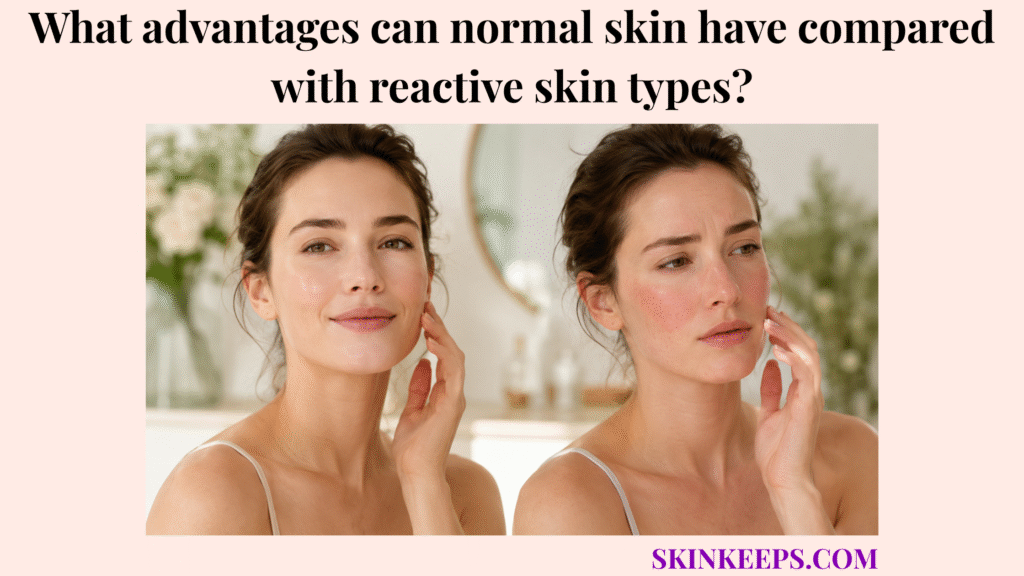
Normal skin can have advantages compared with reactive skin types because it is usually more comfortable, more predictable, and less likely to react strongly to basic skincare products and everyday environmental changes.
Normal skin is often less likely to sting, burn, itch, flush, or react strongly to simple skincare products and ordinary environmental changes.
This does not mean normal skin is perfect or immune. Harsh cleansers, fragrance, over-exfoliation, sun exposure, weather changes, medications, illness, or stress can still irritate normal skin.
Why can normal skin have advantages compared with reactive skin types?
Normal skin can have advantages compared with reactive skin types because its baseline is usually calmer, steadier, and less trigger-prone.
This is a pattern comparison, not a value judgment. Normal skin and sensitive skin can both be valid skin-response patterns, but they often need different levels of trigger caution.
Normal skin is usually easier to interpret because fewer repeated triggers may disturb its baseline comfort.
Normal skin usually has steadier baseline comfort
Normal skin usually has steadier baseline comfort because it often feels calm and balanced on ordinary days.
Reactive skin may change more easily after products, weather, heat, friction, or stress. This comparison describes behavior, not personal worth.
Normal skin usually needs fewer trigger restrictions
Normal skin usually needs fewer trigger restrictions because basic products and ordinary environmental changes are often easier to tolerate.
Reactive skin may need stricter avoidance of known irritants. Normal skin’s advantage is practical predictability, not superiority.
| Comparison point | Normal skin advantage | Reactive skin pattern |
|---|---|---|
| Daily comfort | Usually calm and steady | May sting, burn, itch, or flush |
| Product tolerance | Basic products often feel comfortable | More formulas may trigger reactions |
| Routine complexity | Often simpler | Usually more cautious |
| Environmental response | Often milder and temporary | May flare more easily |
| Redness tendency | Usually less frequent | Redness may appear faster |
| Barrier stress | Less easily disrupted | Barrier may feel more fragile |
| Recovery | Often returns to baseline faster | Reactions may linger |
| Trigger tracking | Fewer repeated triggers | More trigger mapping may be needed |
Normal skin’s advantage is predictability, not perfection.
How can normal skin have better product tolerance than reactive skin types?
Normal skin may have better product tolerance than reactive skin types because gentle cleansers, moisturizers, sunscreens, and basic skincare products often feel comfortable.
Reactive skin may need more careful patch testing, fragrance avoidance, simpler formulas, and slower product introduction. This does not mean every product is safe for normal skin.
Fragrance can be a bigger trigger concern in reactive patterns, especially when fragrance and dyes affect sensitive skin.
| Product situation | Normal skin | Reactive skin types |
|---|---|---|
| Gentle cleanser | Usually comfortable | May still sting if barrier is stressed |
| Moisturizer | Often easy to tolerate | May need fragrance-free, simpler formulas |
| Sunscreen | Usually tolerates many options | Some formulas may sting or flush |
| Exfoliants | May tolerate careful use | Higher irritation risk |
| Retinoids or acids | Still needs slow introduction | Often needs extra caution |
| Fragrance | May tolerate some products | More likely to trigger irritation |
| New products | Lower reaction risk | Patch testing more important |
| Multiple products | May tolerate better | Product stacking can trigger flares |
Normal skin may have more product flexibility, but strong actives still require caution.
How can normal skin have steadier comfort than reactive skin types?
Normal skin can have steadier comfort than reactive skin types because tightness, burning, stinging, itching, flushing, and product discomfort are usually less frequent.
This comfort advantage should not be turned into a promise that normal skin never reacts. Normal skin still needs gentle care when its barrier is stressed.
Steadier daily comfort is part of why normal skin feels comfortable and balanced on ordinary days.
| Felt sign | Normal skin advantage | Reactive skin concern |
|---|---|---|
| Tightness | Less frequent | May appear after washing or weather |
| Burning | Uncommon | May appear after products or heat |
| Stinging | Usually trigger-specific | May occur with many products |
| Itching | Rare or occasional | More frequent |
| Flushing | Less dominant | Heat, stress, or products may trigger it |
| Roughness | Usually temporary | May repeat with barrier stress |
| Product discomfort | Less common | More common |
| Recovery time | Often shorter | May take longer |
Normal skin usually gives the reader fewer daily comfort surprises.
How can normal skin have fewer redness and stinging episodes than reactive skin types?
Normal skin can have fewer redness and stinging episodes than reactive skin types because simple products and ordinary triggers are less likely to cause repeated sensory reactions.
Visible redness and sensory stinging are useful comparison cues. Normal skin may still sting with harsh products, strong actives, sunburn, wind exposure, or barrier stress.
Repeated stinging, burning, swelling, or rash-like redness should be treated as a care signal, not ignored because the baseline skin type is normal.
Normal skin may show less frequent product stinging
Normal skin may show less frequent product stinging because simple cleansers, moisturizers, and sunscreens often feel comfortable when the barrier is not stressed.
Stinging can still happen with harsh products, strong actives, or barrier stress. Normal skin tolerance is real, but it is not flawless.
Normal skin may show less frequent redness after triggers
Normal skin may show less frequent redness after triggers because heat, wind, fragrance, actives, friction, or environmental changes may cause milder or shorter responses.
Reactive skin may flush or redden more easily. Repeated redness, swelling, or burning deserves professional review.
Less redness and stinging can be an advantage of normal skin, but repeated burning or swelling is never something to ignore.
How can normal skin make skincare routines easier than reactive skin types?
Normal skin can make skincare routines easier than reactive skin types because it often needs consistency more than strict trigger avoidance.
This is a routine simplicity advantage, not a full routine plan. Reactive skin may need more careful formula selection, slower testing, and stricter trigger control.
| Routine factor | Normal skin advantage | Reactive skin need |
|---|---|---|
| Cleanser choice | More flexibility | Very gentle formulas may be needed |
| Moisturizer choice | Texture can be chosen by comfort | Ingredient caution may matter more |
| Sunscreen choice | More options may work | Stinging or flushing may limit options |
| Exfoliation | Careful use may be tolerated | Lower frequency may be needed |
| New product testing | Still useful, but less restrictive | Patch testing more important |
| Routine length | Simple routine often works | Minimal routine may be safer |
| Seasonal adjustment | Usually moderate | May need stricter trigger control |
| Recovery from mistakes | Often easier | Flares may last longer |
Normal skin often needs consistency more than restriction.
How can normal skin respond more predictably to environment than reactive skin types?
Normal skin can respond more predictably to environment than reactive skin types because weather, humidity, heat, wind, sun exposure, pollution, and travel often cause milder or more temporary shifts.
Normal skin is not environment-proof. It can still become dry, shiny, dull, irritated, or burned, but the response is often temporary and less intense.
Environmental predictability should still include sun safety because normal skin still needs protection from sun damage.
| Environmental change | Normal skin response | Reactive skin response |
|---|---|---|
| Cold air | Mild dryness or tightness | Stronger dryness, redness, stinging |
| Heat | Temporary shine or redness | Flushing or burning may increase |
| Humidity | More shine or sweat | Clogged feel or irritation may worsen |
| Wind | Mild tightness | Stinging or redness may flare |
| Pollution | Dullness or irritation | Itching, redness, or discomfort may repeat |
| Sun exposure | Burn or redness possible | May feel more sensitive after exposure |
| Travel | Temporary unpredictability | Stronger routine disruption |
| Friction | Mild irritation | Rash-like redness or burning may occur |
Normal skin may adapt faster, but it still needs protection from sun, weather, and friction.
What practical advantages can normal skin have in daily life?
Normal skin can have practical daily advantages because fewer repeated reactions often make comfort, product use, sunscreen selection, and routine consistency easier.
These benefits are useful, but they should not be exaggerated. The main daily advantage is lower maintenance pressure when the skin is calm.
- Fewer repeated product reactions.
- Less frequent burning or stinging.
- Less need for strict ingredient avoidance.
- More predictable comfort after cleansing.
- Easier sunscreen selection.
- Fewer weather-related flares.
- Less frequent redness after ordinary triggers.
- Easier routine consistency.
- Faster return to baseline after mild disruption.
- More flexibility with texture choices.
- Lower need for constant trigger tracking.
- Simpler maintenance when skin is calm.
The main daily advantage of normal skin is lower maintenance pressure.
What limitations should normal skin remember compared with reactive skin types?
Normal skin should remember that more tolerance does not mean total protection from irritation, sun damage, over-exfoliation, product reactions, or medical changes.
Normal skin can still become reactive when the barrier is stressed. Over-cleansing, strong actives, fragrance, sunburn, cold weather, illness, medication changes, stress, and over-exfoliation can make normal skin behave more reactively for a time.
- Sting after harsh products.
- Burn after strong acids or retinoids.
- Turn red after sun or heat.
- Itch after fragrance or irritation.
- Become dry in cold weather.
- Break out after heavy products.
- React to medications or illness.
- Become sensitive after over-exfoliation.
- Need patch testing for stronger products.
- Need dermatology care for persistent reactions.
Normal skin has more tolerance, but tolerance has limits.
What mistakes happen when comparing normal skin with reactive skin types?
Mistakes happen when comparing normal skin with reactive skin types by calling normal skin perfect, judging reactive skin, skipping caution, or ignoring repeated reactions.
Unsafe comparison creates wrong assumptions. Normal skin should not become careless, and reactive skin should not be judged.
| Mistake | Why it is wrong | Better interpretation |
|---|---|---|
| Calling normal skin “perfect skin” | Normal skin can still have pores, texture, and pimples | Balanced, not flawless |
| Thinking reactive skin is “bad skin” | Reactive skin is a valid pattern needing care | Use respectful comparison |
| Skipping patch tests for strong products | Normal skin can still react | Test strong actives slowly |
| Using harsh products because skin is “normal” | Barrier can still be damaged | Keep care gentle |
| Ignoring sunscreen | Normal skin is not UV-proof | Protect daily |
| Dismissing repeated stinging | May signal irritation or sensitivity | Track and adjust |
| Treating redness as harmless | Persistent redness can need care | Seek review if repeated |
| Copying reactive-skin restrictions unnecessarily | May overcomplicate normal skin care | Use only needed caution |
Normal skin should not become careless, and reactive skin should not be judged.
When should normal skin reactions be evaluated like reactive skin concerns?
Normal skin reactions should be evaluated like reactive skin concerns when stinging, burning, swelling, itching, redness, rash-like patches, painful acne, or product reactions become repeated, severe, spreading, or persistent.
If normal skin starts behaving reactive repeatedly, the pattern deserves attention rather than dismissal.
- Products repeatedly sting, burn, or cause rash-like redness.
- Skin reacts to many gentle products.
- Redness becomes persistent, warm, swollen, or spreading.
- Itching is persistent or intense.
- Dry patches crack, bleed, burn, or spread.
- Breakouts become painful, deep, frequent, cystic, or scarring.
- Eye-area swelling or facial swelling appears.
- Sun exposure causes unusual rash, blistering, or severe burning.
- A mole, spot, or lesion changes color, shape, size, or behavior.
- Skin changes appear after medication, illness, or broader symptoms.
If normal skin starts behaving reactive repeatedly, the pattern deserves attention.
What should you remember about normal skin advantages compared with reactive skin types?
The key point is that normal skin can have practical advantages compared with reactive skin types, but those advantages mean lower reactivity, not perfection.
Normal skin is usually more predictable, more comfortable, and easier to maintain. Reactive skin is not bad skin; it simply needs more trigger awareness.
Frequently Asked Questions About Normal Skin Advantages Compared With Reactive Skin Types
Is normal skin better than reactive skin?
Normal skin is not morally or medically “better,” but it may be easier to manage because it is usually less reactive, more comfortable, and more predictable.
Can normal skin still react to products?
Yes. Normal skin can still react to harsh cleansers, fragrance, strong acids, retinoids, over-exfoliation, sunscreen, or damaged barrier conditions.
Does normal skin need less skincare than reactive skin?
Often, yes. Normal skin may do well with a simpler routine, while reactive skin may need stricter trigger control and gentler formulas.
Can normal skin become reactive temporarily?
Yes. Normal skin can become temporarily reactive after sunburn, over-exfoliation, illness, medication changes, harsh products, stress, or extreme weather.
When is normal skin reactivity concerning?
Normal skin reactivity is concerning when stinging, burning, swelling, itching, redness, rash-like patches, painful acne, or product reactions become repeated, severe, spreading, or persistent.
Sources & Evidence About Normal Skin and Reactive Skin Comparison
Cleveland Clinic skin-type guidance was used to ground normal, dry, oily, combination, and sensitive skin distinctions.
American Academy of Dermatology contact-dermatitis overview was used for irritation, allergic skin reactions, itching, rash, blisters, and dermatology-care boundaries.
American Academy of Dermatology dry and sensitive skin guidance was used for fragrance-free product boundaries, harsh products, and dry-sensitive skin irritation cautions.
American Academy of Dermatology face-washing guidance was used for gentle cleansing, avoiding scrubbing, and irritation-prevention boundaries.
American Academy of Dermatology exfoliation guidance was used for redness, irritation, acne breakouts, and over-exfoliation risk boundaries.
American Academy of Dermatology sunscreen guidance was used for sun protection needs across exposed skin, SPF 30 or higher, broad-spectrum protection, and irritation-sensitive sunscreen choices.
American Academy of Dermatology acne treatment guidance was used for painful, persistent, cystic, frequent, or scarring acne referral boundaries.
Peer-reviewed sensitive-skin review from NIH/PMC was used for sensitive skin symptoms such as stinging, burning, itching, and reactive sensations.
Peer-reviewed irritant contact dermatitis review from NIH/PMC was used for burning, stinging, soreness, erythema, irritant exposure, and barrier-stress context.
American Academy of Dermatology melanoma signs guidance was used for changing mole, changing spot, lesion behavior, and referral boundaries.
Educational Disclaimer: This article is for general skin education only and does not diagnose, treat, or replace professional medical advice. If skin reactions include persistent burning, swelling, cracked or bleeding patches, painful acne, spreading redness, rash-like irritation, severe itching, repeated product reactions, eye-area swelling, broader health symptoms, or changing moles or lesions, consult a qualified dermatologist or healthcare professional.