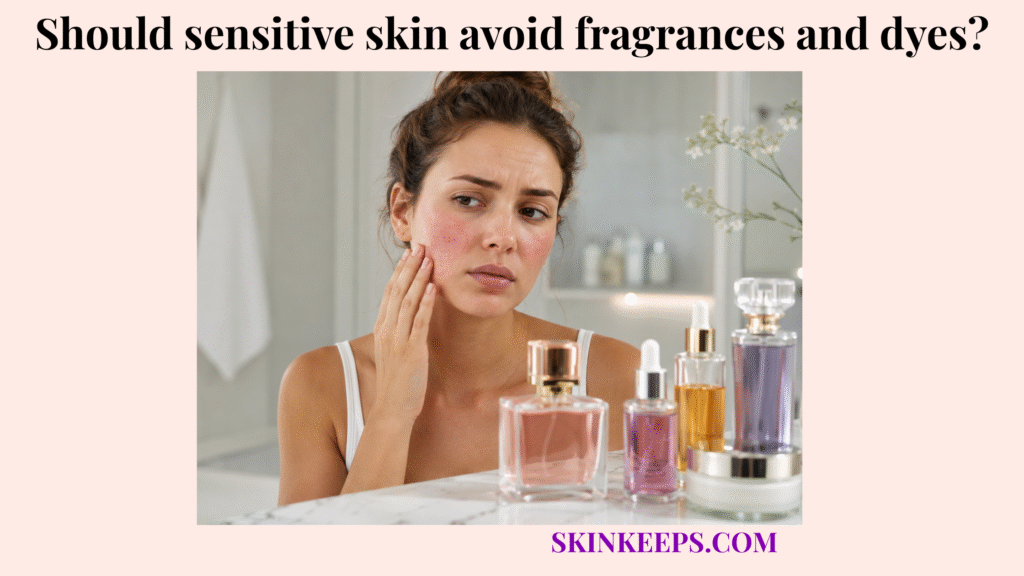
Sensitive skin does not always need to avoid every fragrance or dye, but fragrance-free and minimally colored formulas are sensible starting points when scented or colored products repeatedly cause irritation. Added fragrance is generally the greater concern, while cosmetic dyes should be judged through reaction history, product type, application area, and recurrence. Stinging, burning, itching, rash-like changes, eyelid discomfort, swelling, or repeated localized reactions deserve closer assessment.
This article explains why fragrance causes concern, why dyes should be evaluated separately, how fragrance-free differs from unscented, why leave-on exposure matters, how natural aromatic ingredients can still irritate, how irritation differs from allergy, and how to test, track, and escalate a suspected reaction without creating a universal avoidance rule.
Why May Fragrance Be a Problem for Sensitive Skin?
Fragrance may be a problem for sensitive skin because fragrance mixtures contain multiple aromatic compounds capable of causing irritation or allergic contact reactions in susceptible users. Added fragrance belongs to the broader group of irritating skincare ingredients, although fragrance deserves separate attention because it is optional and may contain multiple aromatic compounds.
How Can Fragrance Compounds Trigger Irritation?
Fragrance compounds can trigger irritation by activating sensory discomfort or directly stressing skin that already has reduced tolerance. Complete formulation, concentration, skin condition, and repeated exposure determine whether stinging, burning, itching, or dryness appears.
Why Does Leave-On Fragrance Create Longer Skin Exposure?
Leave-on fragrance creates longer exposure because moisturizers, serums, sunscreen, and makeup remain in contact with the skin after application. Fragrance near the eye or eyelid area deserves particular caution because transferred products, rubbing, and prolonged contact can complicate the reaction.
| Fragrance pattern | Possible sensitive-skin concern |
|---|---|
| Added perfume in leave-on skincare | Prolonged contact creates more reaction opportunity. |
| Strongly scented cleansers | May cause itching, stinging, or dryness. |
| Fragrant essential oils | Add concentrated aromatic exposure. |
| Several scented layers | Increase cumulative fragrance contact. |
| Fragrance near the eyes | May create discomfort in a delicate area. |
| Repeated reactions to scented products | Support trying fragrance-free alternatives. |
How Fragrance Exposure Changes With Product Format
This visual compares short rinse-off contact with prolonged leave-on contact. Contact duration, application area, repeated layers, heat, sweat, and individual sensitization shape the final response.
Figure 1. Leave-on products create longer fragrance contact than rinse-off products, but actual tolerance still depends on the complete formula and individual history.
Are Dyes as Likely as Fragrance to Irritate Sensitive Skin?
No, cosmetic dyes are not automatically as likely as added fragrance to irritate sensitive skin, although a specific colorant can still trigger a reaction in a susceptible user. Visible color does not prove irritation, and mineral or naturally derived pigments should not be treated as universally safe or unsafe.
| Formula component | Typical sensitive-skin concern |
|---|---|
| Added fragrance | A common source of irritation or allergic contact reactions. |
| Fragrant essential oils | Add scent and active botanical exposure. |
| Cosmetic dyes | Can trigger reactions, although risk varies by colorant and formula. |
| Mineral pigments | Commonly provide color, but tolerance varies. |
| Naturally colored extracts | Are not automatically less irritating. |
| A tolerated colored product | Is not automatically high risk. |
When Should Sensitive Skin Consider Avoiding Fragrance?
Sensitive skin should consider avoiding added fragrance when scented products repeatedly produce itching, burning, rash-like changes, eyelid reactions, or other reproducible symptoms. Fragrance avoidance becomes more relevant when scented products repeatedly produce itching, burning, redness and flushing, or rash-like changes.
Fragrance-Avoidance Clues
- Fragranced products repeatedly cause itching or stinging.
- Rash-like irritation follows scented skincare.
- Eyelids or the neck react after fragrance exposure.
- Different fragranced products produce similar symptoms.
- Skin becomes calmer after switching to fragrance-free formulas.
- Dermatitis-prone skin repeatedly worsens with fragrance exposure.
- Fragrance is unnecessary for the product’s primary function.
When Should Sensitive Skin Consider Avoiding Dyes?
Sensitive skin should consider avoiding a dye when the same colorant or colored product repeatedly produces a similar localized reaction. Targeted avoidance is more defensible than removing every tinted or colored formula after one uncertain episode.
Dye-Avoidance Clues
- The same colored product repeatedly causes a reaction.
- Several reacting formulas share one listed colorant.
- Irritation appears only where a tinted product was applied.
- An otherwise similar uncolored formula is better tolerated.
- Eye-area makeup repeatedly causes itching or swelling.
- A clinician identifies a specific colorant sensitivity.
Key Rule
Avoid a dye because of a repeatable reaction pattern, not simply because the product has visible color.
What Is the Difference Between Fragrance-Free and Unscented?
Fragrance-free generally means fragrance was not added for scent, while unscented means the product has little noticeable odor and may still contain masking fragrance. Naturally scented, hypoallergenic, and dermatologist-tested labels also do not guarantee universal tolerance.
| Label | What it generally means | Sensitive-skin caution |
|---|---|---|
| Fragrance-free | Fragrance was not added primarily for scent. | Often the better starting point when fragrance repeatedly triggers reactions. |
| Unscented | The product has little noticeable odor. | Masking fragrance may still be present. |
| Naturally scented | Aroma comes from botanicals or essential oils. | Natural aromatic compounds can still irritate. |
| Hypoallergenic | Marketed as having reduced allergy potential. | Does not guarantee that no reaction will occur. |
| Dermatologist tested | The product underwent some form of testing. | Does not prove universal suitability. |
Do Rinse-Off and Leave-On Fragrance Carry the Same Risk?
No, rinse-off and leave-on fragrance do not create the same exposure because leave-on products remain on the skin substantially longer. Rinse-off fragrance is not harmless by definition, but shorter contact generally creates less exposure opportunity than prolonged wear.
| Product format | Exposure pattern | Sensitive-skin consideration |
|---|---|---|
| Cleanser | Short contact followed by rinsing | A strong or heavily fragranced cleanser may still irritate. |
| Wash-off mask | Moderate contact | Longer application increases exposure time. |
| Moisturizer | Remains on the skin | Fragrance has longer reaction opportunity. |
| Serum | Concentrated leave-on use | Added fragrance may be difficult to tolerate. |
| Sunscreen | Long daytime contact | Heat, sweat, reapplication, and other ingredients complicate interpretation. |
| Makeup | Prolonged wear | Fragrance, colorants, friction, and removal all affect tolerance. |
Can Natural Fragrance or Plant Colorants Still Irritate Sensitive Skin?
Yes, natural fragrance and plant-derived colorants can irritate sensitive skin because botanical origin does not remove aromatic, active, or sensitizing constituents. Essential oils, floral waters, and naturally colored extracts may be tolerated by some users and poorly tolerated by others.
Natural-Formula Warning Signs
- The product relies heavily on essential oils for scent.
- Several aromatic botanical extracts are combined.
- Skin stings despite a natural or clean label.
- Mint, citrus, cinnamon, clove, or floral oils produce warmth or burning.
- Similar botanical-scented formulas cause recurring reactions.
- Numerous plant extracts make the actual trigger difficult to isolate.
How Is Fragrance Irritation Different From Fragrance Allergy?
Fragrance irritation usually reflects direct exposure strength and current skin tolerance, while fragrance allergy is a delayed immune reaction to a specific fragrance substance. Immediate burning after skincare products often reflects irritation, while delayed itching, rash, swelling, or blistering may require a different assessment.
| Feature | Irritation pattern | Allergy-like pattern |
|---|---|---|
| Main sensation | Stinging, burning, tightness, or dryness | Strong itching, rash, swelling, or blisters |
| Timing | Often begins during or soon after use | May be delayed or appear after repeated exposure |
| Location | Usually strongest where applied | May extend beyond the original application area |
| Dose relationship | Often worsens with greater exposure | Small repeat exposure may trigger recurrence |
| Improvement | Often settles after stopping exposure | May require professional assessment |
| Best confirmation | Repeatable tolerance pattern provides clues | Clinical evaluation and patch testing may be required |
Fragrance Irritation Versus Allergy-Like Reaction
This comparison separates direct irritation from delayed immune sensitization. Irritation often follows stronger or repeated exposure, while an allergy-like pattern may recur after smaller contact in a sensitized person.
Figure 2. Symptom timing and recurrence guide suspicion, but only professional evaluation can confirm fragrance allergy or allergic contact dermatitis.
How Can Someone Tell Whether Fragrance or Dye Caused the Reaction?
Fragrance or dye becomes more suspicious when the same exposure repeatedly produces a similar reaction in the same area and better-tolerated alternatives remove that pattern. Trigger identification becomes less reliable when using too many products introduces several fragrances, colorants, and active ingredients simultaneously.
Trigger-Identification Checklist
- The reaction followed a scented or colored product.
- Symptoms appeared in the application area.
- The same product produced a similar reaction more than once.
- Other fragranced or similarly colored products caused comparable symptoms.
- An unfragranced or uncolored alternative was better tolerated.
- Ingredient lists show a repeated fragrance or colorant.
- Symptoms improved after the suspected product was stopped.
How Should Sensitive Skin Read Labels for Fragrance and Dyes?
Sensitive skin should read fragrance and dye labels by checking the full ingredient list, product format, and repeated reaction history rather than relying on front-label claims alone. Color additives often appear near the end of a list, but ingredient order does not confirm whether that colorant caused the reaction.
Label-Reading Checklist
- Look for fragrance, parfum, or aroma.
- Check for fragrant essential oils.
- Do not assume unscented means fragrance-free.
- Review listed color additives.
- Compare ingredient lists across products that caused similar reactions.
- Note whether the product is rinse-off or leave-on.
- Avoid judging tolerance from marketing claims alone.
- Do not create a broad blacklist from one uncertain episode.
Should Every Sensitive-Skin Product Be Fragrance-Free and Dye-Free?
No, every sensitive-skin product does not need to be fragrance-free and dye-free, but simpler formulas are sensible when reactions are frequent, unexplained, or difficult to assess. Avoidance intensity should match the quality of the evidence rather than the visibility of color or strength of a marketing claim.
| Skin pattern | Better starting direction |
|---|---|
| No fragrance or dye reaction history | Evaluate products through overall tolerance rather than automatic avoidance. |
| Frequent unexplained irritation | Simplify toward fragrance-free formulas and fewer color variables. |
| Eczema- or dermatitis-prone pattern | Reduce unnecessary fragrance exposure. |
| Eye-area sensitivity | Prefer simpler fragrance-free formulas near the eyelids. |
| Repeated reaction to one colorant | Avoid the identified colorant rather than every colored product. |
| Active irritation or poor tolerance | Use fewer and simpler formula variables during assessment. |
How Should Fragrance-Free or Dye-Free Alternatives Be Tested?
Fragrance-free or dye-free alternatives should be tested one at a time while the rest of the routine remains stable. Readers may patch test new products where appropriate, but home testing cannot exclude every delayed or facial reaction.
Controlled Testing Guide
- Wait until the current reaction has settled enough to assess a new exposure.
- Introduce one alternative at a time.
- Keep the rest of the routine unchanged.
- Begin with a small application area when appropriate.
- Observe immediate and delayed symptoms.
- Do not test several sensitive-skin products together.
- Stop if itching, burning, swelling, or rash returns.
- Do not deliberately retest a product that caused a severe reaction.
What Mistakes Make Fragrance and Dye Avoidance Ineffective?
Fragrance and dye avoidance becomes ineffective when labels are misread, several replacements are introduced together, or the more likely trigger remains in the routine. Effective avoidance removes one credible exposure while preserving enough stability to interpret the response.
| Mistake | Why it fails |
|---|---|
| Choosing unscented without reading the ingredient list | Masking fragrance may remain in the formula. |
| Avoiding dyes while retaining several fragranced products | The more likely trigger may remain unchanged. |
| Replacing one product with several alternatives | Creates uncontrolled variables. |
| Assuming botanical scent is safer | Ignores aromatic plant compounds. |
| Blaming all colorants after one uncertain reaction | Creates an unsupported blacklist. |
| Ignoring rinse-off and leave-on differences | Overlooks contact duration. |
| Continuing a repeatedly irritating product | Prevents the pattern from clearing. |
| Treating strong swelling as ordinary sensitivity | May delay medical assessment. |
How Can Someone Track Fragrance- or Dye-Related Reactions?
Fragrance- or dye-related reactions should be tracked by recording the product label, full ingredient list, format, application area, symptom timing, and shared components across reacting formulas. Tracking strengthens pattern recognition but does not diagnose allergy.
Fragrance and Dye Reaction Tracker
- Product name and category.
- Fragrance-free, unscented, scented, tinted, or uncolored label.
- Full ingredient list.
- Leave-on or rinse-off format.
- Application area.
- Time between application and symptoms.
- Itching, stinging, burning, tightness, rash, swelling, bumps, or peeling.
- Previous tolerance history.
- Shared fragrance or colorants across reacting products.
- Tolerance of an unfragranced or uncolored alternative.
- Other routine, weather, medication, or health changes.
- Photographs when appropriate.
When Should Fragrance- or Dye-Related Reactions Be Professionally Evaluated?
Fragrance- or dye-related reactions should be professionally evaluated when they are severe, recurrent, spreading, blistering, swollen, painful, or difficult to connect to one product. Persistent, spreading, swollen, blistering, or diagnostically unclear reactions are reasons to see a dermatologist.
Professional Evaluation Checklist
- The rash is severe, persistent, or spreading.
- Skin swells, blisters, oozes, crusts, or bleeds.
- Eyelids, lips, tongue, or face swell.
- Burning, pain, or itching is intense.
- Reactions occur with many unrelated products.
- Symptoms continue after the suspected product is stopped.
- Skin becomes infected-looking.
- Reactions interfere with sleep or daily activity.
- A specific fragrance or dye allergy is suspected.
Urgent Safety Note
Breathing difficulty, throat tightness, faintness, or rapidly progressing lip, tongue, or facial swelling requires emergency medical attention.
What Should You Remember About Fragrances, Dyes, and Sensitive Skin?
Sensitive skin should avoid fragrances or dyes when repeatable reactions justify avoidance, not because every scented or colored formula is automatically unsafe.
What Should You Remember?
- Sensitive skin does not automatically need to avoid every fragrance and dye.
- Added fragrance is generally a more common sensitivity concern than cosmetic colorants.
- Fragrance-free and unscented are not interchangeable labels.
- Unscented products may contain masking fragrance.
- Natural fragrance and essential oils can still irritate susceptible skin.
- Natural or mineral color does not guarantee universal tolerance.
- Leave-on fragranced products create longer contact than rinse-off products.
- Fragrance irritation and fragrance allergy are different reaction pathways.
- One isolated reaction does not prove a fragrance or dye trigger.
- Repeated timing, location, and exposure strengthen the trigger hypothesis.
- Alternatives should be introduced one at a time.
- Severe reactions should not be deliberately reproduced.
- Persistent, spreading, swollen, blistering, oozing, painful, or recurrent reactions require professional evaluation.
Frequently Asked Questions
Is Fragrance-Free Better for Sensitive Skin?
Fragrance-free is often a better starting point when scented products repeatedly trigger itching, burning, rash, or eyelid irritation. It does not guarantee complete tolerance because other active and inactive ingredients can still cause reactions.
Is Unscented the Same as Fragrance-Free?
No. Unscented means the product has little noticeable smell, but masking fragrance may still be present. Fragrance-free generally indicates that fragrance was not added for scent.
Should Sensitive Skin Avoid All Colored Makeup?
Not automatically. A specific cosmetic dye or pigment should be avoided when it produces a repeatable reaction. Color alone does not prove that a makeup product will irritate sensitive skin.
Are Essential Oils Safer Than Synthetic Fragrance?
Not necessarily. Essential oils contain concentrated aromatic compounds and can irritate or sensitize susceptible skin. Natural origin does not guarantee better tolerance.
Can a Fragranced Cleanser Be Safer Than a Fragranced Moisturizer?
A fragranced cleanser usually creates shorter contact because it is rinsed away, while a moisturizer remains on the skin. The cleanser may still irritate if its fragrance or cleansing system is poorly tolerated.
Does Eyelid Itching Mean Fragrance Allergy?
Not necessarily. Eyelid itching can have several causes, including irritation, allergic contact dermatitis, transferred products, and underlying skin conditions. Recurrent eyelid reactions warrant careful product review and professional assessment.
Conclusion
Sensitive skin does not need universal fragrance and dye avoidance, but fragrance-free and simpler formulas are rational choices when repeated reactions make the trigger difficult to ignore. Fragrance is generally the greater concern, dye reactions are better handled through targeted avoidance, leave-on exposure creates longer contact, and natural fragrance does not guarantee tolerance.
Avoidance should follow repeatable evidence, alternatives should be introduced individually, and severe or unclear reactions need professional evaluation. The safest choice is not the product with the strongest sensitive-skin claim, but the formula whose fragrance, color, and complete ingredient profile remain consistently well tolerated.
Sources & Evidence
American Academy of Dermatology — Eczema-Friendly Product Guidance
Supports choosing fragrance-free rather than unscented products when fragrance exposure is a concern.
[AAD]American Academy of Dermatology — Contact Dermatitis Causes
Supports fragrance as a recognized contact-dermatitis exposure.
[AAD]FDA — Fragrances in Cosmetics
Supports the fact that some unscented products may contain masking fragrance ingredients.
[FDA]FDA — Hypoallergenic Cosmetics
Supports the limitation that hypoallergenic is not governed by a single federal standard or definition.
[FDA]DermNet — Fragrance Allergy
Supports fragrance allergy as delayed allergic contact dermatitis after sensitization.
[DermNet]DermNet — Allergic Contact Dermatitis to Essential Oils
Supports delayed contact allergy to essential-oil constituents.
[DermNet]DermNet — Fragrance Mix Allergy
Supports eyelid, face, hand, and arm involvement and delayed fragrance-reaction patterns.
[DermNet]Alani et al., 2013 — Allergy to Cosmetics
Supports fragrances as major cosmetic allergens and patch testing for delayed contact allergy.
[PubMed]Disclaimer: This article provides general educational information and does not diagnose or treat fragrance allergy, dye allergy, irritant contact dermatitis, allergic contact dermatitis, eczema, rosacea, infection, or another skin condition. Stop using a suspected product and seek professional advice for severe, persistent, recurrent, spreading, blistering, swollen, oozing, bleeding, painful, or eye-area reactions. Breathing difficulty, throat tightness, faintness, or rapid facial, lip, or tongue swelling requires urgent medical care.