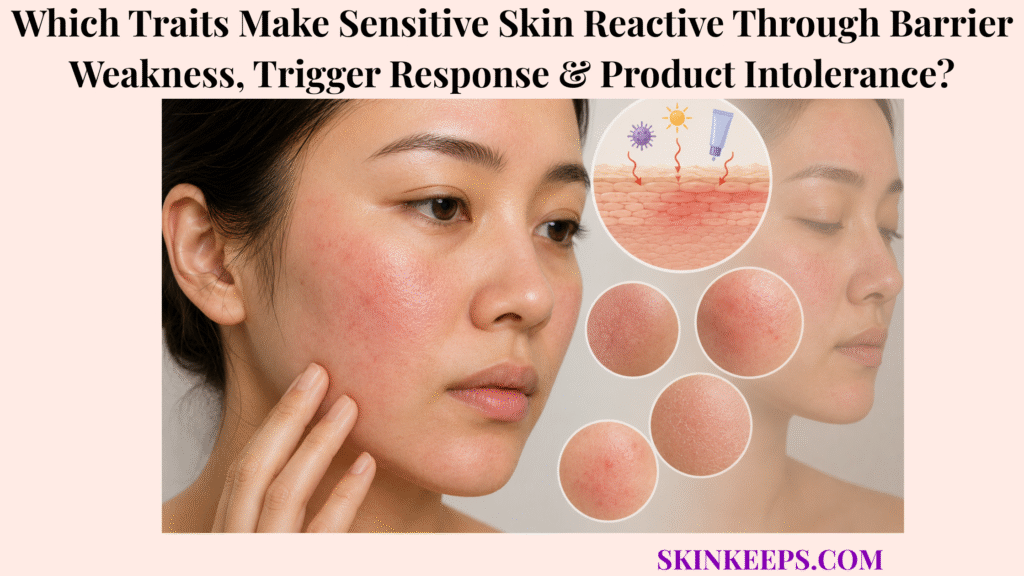
Sensitive skin becomes reactive when a weakened barrier allows everyday triggers to provoke stinging, burning, redness, tightness, itching, or product intolerance more easily than normal skin. This reactive skin pattern may look normal between reactions, but the underlying lower tolerance threshold remains. A lower tolerance threshold means ordinary cosmetics and personal-care products can irritate the skin quickly.
This guide defines sensitive skin reactivity, explores why products sting or burn, and outlines how to reduce irritation. Identifying these traits helps separate true product intolerance from ordinary skin behavior, leading to calmer daily care.
How do invisible microscopic fissures physically define the sensitive skin barrier weakness?
Invisible microscopic fissures can define sensitive skin barrier weakness by reducing the stratum corneum’s ability to block irritants, hold water, and protect sensory nerve endings from external triggers. Sensitive skin barrier weakness begins when the stratum corneum loses some of its protective sealing capacity. This weakened stratum corneum allows irritants, water loss, and sensory discomfort to appear more easily. The lower protective capacity makes ordinary products feel stronger than they would on less reactive skin.
The lipid matrix supports sensitive skin tolerance by sealing spaces between corneocytes. This lipid matrix depends on barrier lipids such as ceramides, cholesterol, and fatty acids. When the matrix becomes weak or disorganized, the barrier allows more irritation signals to reach the surface nerves. Surveys report approximately 50% of women and 40% of men may report sensitive skin, highlighting how common this barrier-seal problem is globally. [DermNet]
Readers who want a broader learning path can continue through the sensitive skin hub for related guides on symptoms, triggers, and routine choices.
The Stratum Corneum Fissure Model
The stratum corneum fissure model explains sensitive skin as a barrier-seal problem where small disruptions in the outer layer reduce tolerance to routine products and environmental stress. This barrier-seal problem lowers the skin’s ability to buffer ingredients, friction, heat, and pollution. When buffering capacity drops, normal skincare steps can create stinging, tightness, or redness. This reactive pattern can overlap with oily, dry, normal, or combination skin types.
The Exposed Wire Phenomenon
The exposed wire phenomenon describes how a weakened barrier can make sensory nerve fibers respond faster to ingredients, temperature changes, and friction. This faster sensory response begins when a weak barrier gives external triggers easier access to nerve-signaling pathways. The easier access explains why a bland product may sting on reactive skin even when the same product feels comfortable on normal skin.
Why does a hyper-reactive skin type instantly trigger neurogenic inflammation and heat?
A hyper-reactive skin type can trigger neurogenic inflammation and heat when sensory nerves respond to irritants by releasing signals that expand local blood vessels and intensify discomfort. Neurogenic inflammation explains why sensitive skin can burn and flush quickly. This inflammation begins when sensory nerves react strongly to a trigger. The nerve response can encourage blood-vessel expansion, which appears as heat, redness, or flushing. Neurogenic inflammation in sensitive skin is linked with sensory nerve overactivity and C-fiber signaling, demonstrating a measurable physiological response. [PMC]
The burning sensation does not always mean the skin is infected or allergic. This burning sensation can reflect a sensory alarm from irritated nerve pathways. The sensory alarm helps explain why sensitive skin may react before a visible rash develops.
The guide on sensitive skin discomfort explains more about how these nerve signals translate into physical burning and itching.
Neurogenic Erythema: The Brain-Skin Loop
Neurogenic erythema describes redness that appears when sensory nerve signaling causes local blood vessels to widen during a sensitive-skin flare. This redness appears when sensory nerves encourage nearby blood vessels to widen through neuropeptides like Substance P. The widened vessels bring more visible blood flow to the area, which the user sees as flushing. This visible erythema confirms that the irritation has triggered a vascular response.
The False-Alarm Immune Response
The false-alarm immune response occurs when sensitive skin treats a mild external trigger as a threat and produces redness, itching, stinging, or swelling. This response shows that sensitive skin can react strongly to non-dangerous triggers. The irritation is distinct from a true allergy, though both cause discomfort. Persistent swelling, severe rash, or repeated reactions to products may require patch testing to rule out contact dermatitis.
| Action Phase | Biological Event | Visible or Sensory Result |
|---|---|---|
| Barrier weakness | The trigger contacts a less protected surface | Stinging or prickling may begin |
| Sensory signal | Nerve fibers respond to the trigger | Burning or heat may appear |
| Blood-vessel response | Local vessels widen during irritation | Redness or flushing becomes visible |
| Inflammatory response | Immune mediators increase in the area | Itching, swelling, or prolonged discomfort may occur |
What chemical thresholds cause sudden product intolerance in a compromised epidermal matrix?
Chemical thresholds cause sudden product intolerance in a compromised epidermal matrix when small, volatile, acidic, fragranced, or highly active ingredients cross the weakened barrier too quickly. Product intolerance occurs when sensitive skin reacts to ingredients that normal skin may tolerate. This intolerance develops because a weakened barrier lowers the skin’s trigger threshold. The lower threshold makes fragrance, alcohol, acids, sunscreen filters, or actives feel stronger on contact.
The 500 Dalton Rule explains why molecular size matters in product tolerance. This rule states that molecules under 500 Daltons are more likely to penetrate the stratum corneum. Faster penetration can increase irritation risk when the barrier is already compromised. [PubMed]
The Molecular Weight Trap
The molecular weight trap explains why some small or highly active ingredients can irritate sensitive skin faster than larger barrier-sealing ingredients. This reaction becomes more likely when small ingredients meet a weakened barrier. The weakened barrier allows faster contact with sensory pathways, which can create stinging or burning. However, formula pH, concentration, solvent system, and overall barrier condition also influence whether a product causes stinging. Patch testing new leave-on products helps identify these risks before applying them to the entire face.
The Volatile Aromatic Compound Danger
The volatile aromatic compound danger comes from fragrance ingredients that can irritate sensitive skin or contribute to contact allergy after oxidation. Oxidized limonene and oxidized linalool are recognized fragrance allergens that can provoke strong reactions. These volatile aromatic compounds are common in essential oils, which can trigger redness or dermatitis in highly reactive skin. Fragrance-free products are generally safer for users trying to minimize unexpected sensory irritation. [PMC]
Why is the genetic hypersensitivity of this skin profile actually a long-term protective signal?
The hypersensitivity of this skin profile can act as a protective signal because sensitive skin warns the user quickly when friction, heat, fragrance, or strong actives exceed the barrier’s tolerance. This protective behavior pushes users toward simpler, safer routines. A simpler routine reduces unnecessary product layering and prevents over-exfoliation. This reduced overuse of actives preserves the skin barrier over the long term.
The guide on sensitive skin reactions explains which visible signs show that the skin has crossed its tolerance threshold.
The Ultimate Chemical Defense System
The chemical defense value of sensitive skin is that it encourages earlier avoidance of irritating products before the barrier becomes more inflamed. This early warning appears as stinging, burning, itching, or redness after a trigger. The warning can push the user to stop the product before irritation becomes prolonged. Listening to this irritation signal minimizes severe contact dermatitis.
Forced Routine Preservation
Forced routine preservation is a practical benefit of sensitive skin because reactive skin often cannot tolerate excessive exfoliation, fragrance layering, or frequent active-ingredient changes. This forced routine preservation naturally limits the number of products applied daily. Limiting product choice reduces the chance of ingredient clashes and chemical burns. Consistency with minimal, well-tolerated formulas ultimately supports a calmer lipid barrier.
Which biocompatible lipids and neuro-calming agents successfully patch an intolerant cutaneous barrier?
Biocompatible lipids and calming agents can support an intolerant cutaneous barrier by sealing weak areas, reducing water loss, and lowering exposure to irritating ingredients. Biocompatible ingredients support sensitive skin by reducing barrier stress. These ingredients are useful because sensitive skin reacts more easily to fragrance, strong actives, and unnecessary formula complexity. Lower formula complexity gives the barrier fewer potential triggers to process.
Occlusive ingredients support sensitive skin by forming a protective surface film. This protective film reduces direct exposure to friction, transepidermal water loss (TEWL), and external irritants. Reduced exposure can make a reactive barrier feel calmer during a flare. Petrolatum is an occlusive ingredient used to reduce water loss and support barrier recovery, offering bland protection for compromised tissue. [ScienceDirect]
The supporting guide on sensitive skin care tips explains how to choose gentle cleansers, moisturizers, sunscreen, and patch-testing steps.
Neuro-Calming Agents
Neuro-calming agents support sensitive skin comfort by reducing irritation signals and helping the barrier feel less reactive during routine care. This comfort support matters because the barrier becomes more reactive when triggers remain in the routine. Removing triggers first allows calming ingredients like allantoin, beta-glucan, Centella asiatica, and panthenol to work in a lower-stress environment. These soothing additions assist in managing daily sensory discomfort.
Biocompatible Patching
Biocompatible patching supports sensitive skin by using bland occlusives and lipid-supportive ingredients to protect the weakened barrier surface. Petrolatum is a classic occlusive that locks in hydration without adding potential allergens. Dimethicone offers a silicone-based barrier-protective alternative, while ceramides and squalane provide essential lipid-supportive options. These inert compounds shield the skin surface from friction and environmental stress.
| Ingredient Category | Mechanism for Reactive Skin | Examples |
|---|---|---|
| Calming-support agents | Reduce discomfort and support a calmer routine | Allantoin, beta-glucan, centella asiatica, panthenol |
| Bland occlusives | Form a protective surface layer that reduces water loss and exposure | Petrolatum, dimethicone |
| Barrier lipids | Support the lipid matrix between corneocytes | Ceramides, cholesterol, fatty acids |
| Lightweight emollients | Smooth roughness without fragrance-heavy formulas | Squalane, simple fragrance-free creams |
| Mineral UV filters | Protect from UV with lower stinging risk for some sensitive users | Zinc oxide, titanium dioxide |
What is the Zero-Stimulation daily protocol to stabilize an actively reacting sensitive skin profile?
The Zero-Stimulation daily protocol stabilizes an actively reacting sensitive skin profile by removing unnecessary chemical, mechanical, and thermal triggers for a short reset period. This temporary simplification phase gives the inflamed barrier time to recover. The Zero-Stimulation protocol reduces sensitive skin reactivity by removing avoidable triggers. These triggers include fragrance, strong actives, hot water, friction, and frequent product changes. Removing the triggers gives the barrier a calmer environment for recovery.
Track Your Unique Reaction Patterns
The Skin Sensitivity Analyzer can support this reset by helping users identify patterns in stinging, burning, redness, and product intolerance. This tool is useful because sensitive skin reactions often repeat after similar triggers. Recognizing the repeated trigger pattern helps the user simplify the routine more accurately.
The Skin Fasting Phase
The skin fasting phase reduces sensitive skin stress by pausing strong actives and limiting the routine to a few bland, fragrance-free essentials. This skin fasting temporarily removes retinoids, vitamin C acids, exfoliating acids, scrubs, and fragranced products. Pausing these ingredients prevents further chemical irritation during an active flare-up. The routine relies only on a gentle cleanser, a bland moisturizer, and mineral sunscreen if tolerated, until the skin feels calm.
Skin Fasting Checklist
Mechanical and Thermal Defenses
Mechanical and thermal defenses reduce sensitive skin flares by limiting rubbing, scrubbing, hot water, steam, and sudden temperature changes. These defenses limit mechanical stress from washcloths, cotton pads, and harsh massage. Thermal stress is managed by avoiding steam rooms, direct heater blasts, and extreme hot-to-cold transitions. For instance, TRPV1 receptors (heat sensors) are activated near 42–43°C, so using lukewarm water instead of hot showers reduces the chance of intense thermal flushing. [NCBI Bookshelf]
The guide on sensitive skin triggers helps identify more specific environmental factors that provoke these sudden flares.
| Day Range | Action | Purpose |
|---|---|---|
| Days 1–2 | Stop fragrance, actives, scrubs, and new products | Reduce chemical triggers |
| Days 1–7 | Cleanse only with lukewarm water or a gentle non-foaming cleanser | Reduce barrier stripping |
| Days 1–7 | Apply a bland fragrance-free moisturizer | Support barrier comfort |
| Days 1–7 | Avoid washcloths, cotton pads, and rubbing | Reduce mechanical irritation |
| Days 1–7 | Avoid steam rooms, hot showers, and direct heater heat | Reduce thermal flushing |
| After calm period | Reintroduce one product at a time | Identify intolerance patterns |
| If symptoms persist | Seek dermatology advice | Rule out eczema, rosacea, allergy, or dermatitis |
Key Takeaways
The key takeaways about sensitive skin are that barrier weakness lowers tolerance, sensory nerves amplify discomfort, and simplified routines reduce repeated triggering.
Key Takeaways
- Sensitive skin is best defined by low tolerance to products, heat, friction, fragrance, and environmental stress.
- Barrier weakness can make ordinary skincare ingredients feel stronger than they should.
- Stinging and burning can appear before visible rash because sensory pathways respond quickly.
- Redness and flushing can reflect vasodilation during irritation.
- Product intolerance can involve irritation, allergy, formula strength, fragrance, pH, and barrier condition.
- Fragrance-free and low-complexity formulas are often safer during active reactivity.
- A short zero-stimulation routine can reduce repeated triggering while the barrier calms.
- Persistent swelling, rash, oozing, severe burning, or repeated product reactions should be assessed by a dermatologist.
FAQs
What traits define sensitive skin?
Sensitive skin is defined by reduced tolerance to products, friction, heat, fragrance, and environmental triggers. The main traits include stinging, burning, itching, redness, flushing, tightness, dryness, and product intolerance.
Why does sensitive skin burn after moisturizer?
Sensitive skin can burn after moisturizer when the barrier is weakened or the formula contains irritating ingredients. This weakened barrier allows preservatives, fragrance, acids, or active compounds to trigger sensory discomfort more easily.
Is sensitive skin always dry?
Sensitive skin is not always dry. Sensitive skin can appear oily, dry, normal, or combination because sensitivity describes reactivity, not oil level. The shared feature is a lower tolerance threshold.
Why does sensitive skin turn red so quickly?
Sensitive skin turns red quickly when irritation triggers local blood-vessel widening. This vasodilation increases visible blood flow near the surface and appears as flushing, warmth, or erythema.
Are fragrances bad for sensitive skin?
Fragrance can be a common trigger for sensitive skin, especially when the barrier is already irritated. Fragrance-free products are usually safer during active flares, but individual tolerance can vary.
Should sensitive skin patch test new products?
Sensitive skin should patch test new leave-on products because product intolerance can appear after repeated exposure. Patch testing helps identify irritation before the product is applied across the whole face.
Is mineral sunscreen better for sensitive skin?
Mineral sunscreen may be better tolerated by some sensitive-skin users because zinc oxide and titanium dioxide sit mainly on the surface. Formula quality still matters because fragrance, alcohol, or irritating additives can trigger reactions.
When should sensitive skin need a dermatologist?
Sensitive skin needs a dermatologist when reactions include swelling, blistering, oozing, severe burning, persistent rash, eye-area involvement, or repeated reactions to many products. These signs may indicate allergy, dermatitis, rosacea, eczema, or another medical condition.
Conclusion
Sensitive skin is best understood as a low-tolerance skin profile that reacts when barrier weakness, sensory signaling, and product triggers overlap. Sensitive skin becomes reactive when the barrier cannot buffer external triggers as effectively as less reactive skin. This lower tolerance explains why fragrance, heat, friction, acids, sunscreen, or moisturizer can produce stinging, burning, redness, or tightness.
The best sensitive-skin routine reduces trigger load before adding more products. A short reset phase, fragrance-free moisturizer, gentle cleansing, mineral sunscreen if tolerated, and careful patch testing can help the skin become calmer and more predictable. At SkinKeeps, we explain skin types through evidence-based dermatology to help users build safe routines. When sensitive skin is treated as a low-tolerance barrier profile rather than a flaw, its reactions become easier to understand, track, and manage.